
Social Psychology Attitude Attraction Aggression Group Behavior Studying

Social Psychology Attitude Attraction Aggression Group Behavior Studying the way people relate to others. http: //www. youtube. com/watch? v=RS 3 i. B 47 n. Q 6 E 1: 38 Carlsberg http: //www. youtube. com/watch? v=mv. UPLN_ea. Vw 3: 00 Per. Space http: //www. youtube. com/watch? v=Dc. UIFNaq. Gv. M 3: 15 Social identity
Major Ideas within Social Psychology • • Attitudes Prejudice Attraction Group Behavior • Conformity & Obedience • Aggression & Altruism
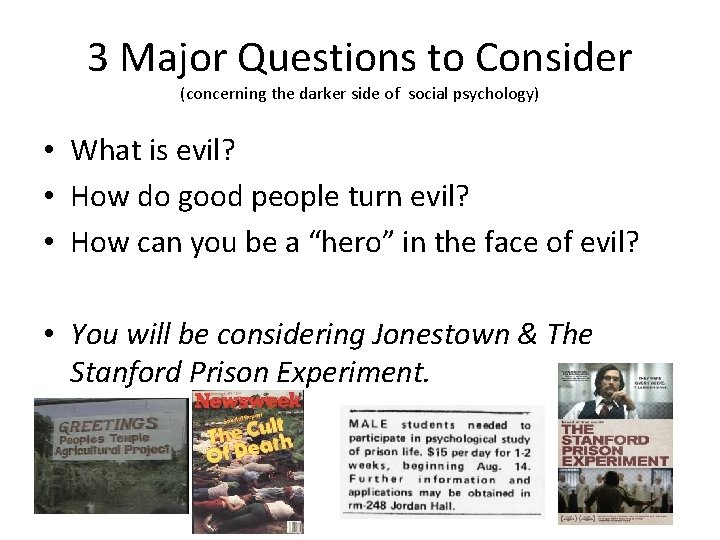
3 Major Questions to Consider (concerning the darker side of social psychology) • What is evil? • How do good people turn evil? • How can you be a “hero” in the face of evil? • You will be considering Jonestown & The Stanford Prison Experiment.
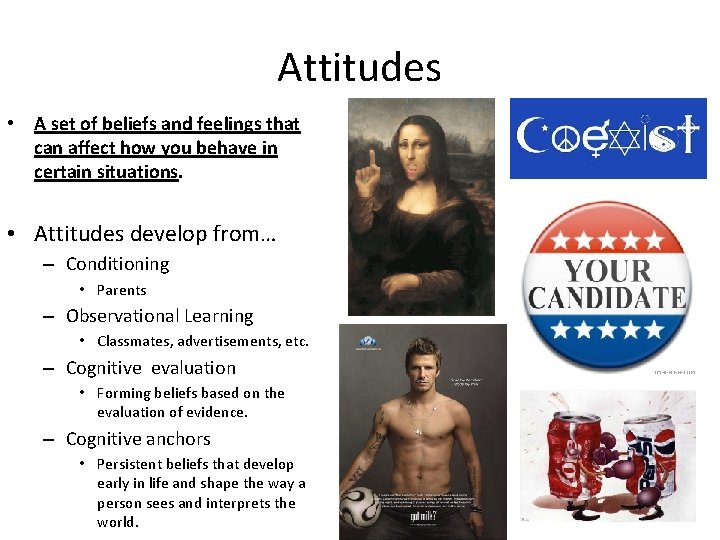
Attitudes • A set of beliefs and feelings that can affect how you behave in certain situations. • Attitudes develop from… – Conditioning • Parents – Observational Learning • Classmates, advertisements, etc. – Cognitive evaluation • Forming beliefs based on the evaluation of evidence. – Cognitive anchors • Persistent beliefs that develop early in life and shape the way a person sees and interprets the world.
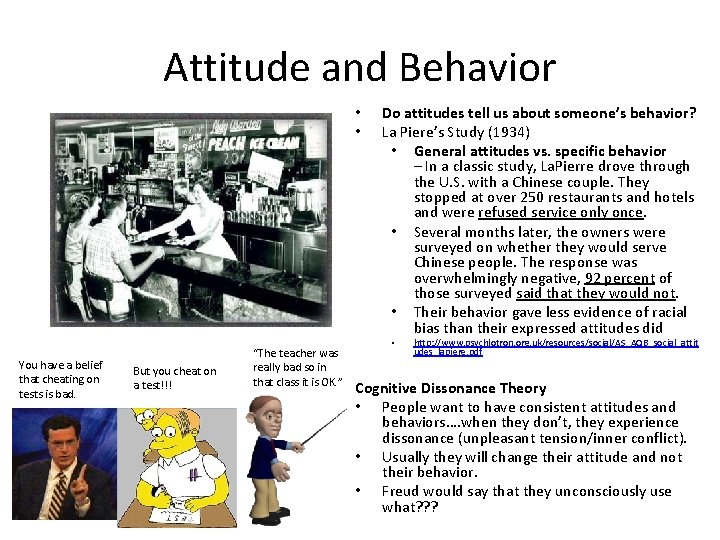
Attitude and Behavior • • You have a belief that cheating on tests is bad. But you cheat on a test!!! “The teacher was really bad so in that class it is OK. ” Do attitudes tell us about someone’s behavior? La Piere’s Study (1934) • General attitudes vs. specific behavior – In a classic study, La. Pierre drove through the U. S. with a Chinese couple. They stopped at over 250 restaurants and hotels and were refused service only once. • Several months later, the owners were surveyed on whether they would serve Chinese people. The response was overwhelmingly negative, 92 percent of those surveyed said that they would not. • Their behavior gave less evidence of racial bias than their expressed attitudes did • http: //www. psychlotron. org. uk/resources/social/AS_AQB_social_attit udes_lapiere. pdf Cognitive Dissonance Theory • People want to have consistent attitudes and behaviors…. when they don’t, they experience dissonance (unpleasant tension/inner conflict). • Usually they will change their attitude and not their behavior. • Freud would say that they unconsciously use what? ? ?
Persuasion • The attempt to influence or change people’s attitudes or views. • Elements of Persuasion – Central Route • Direct-use of evidence and logic. – Lung cancer statistics from smoking – Peripheral Route • Indirect-use of making (+ or –) associations using objects, people, or events. – Using an athlete in a Nike advertisement
More Elements of Persuasion – The Message • Stands alone or is used to discredit opposing view. – Repetition, emotional appeals, and glittering generalalities are important – The Messenger • Persuasive if delivered by trustworthy, attractive, or familiar people.
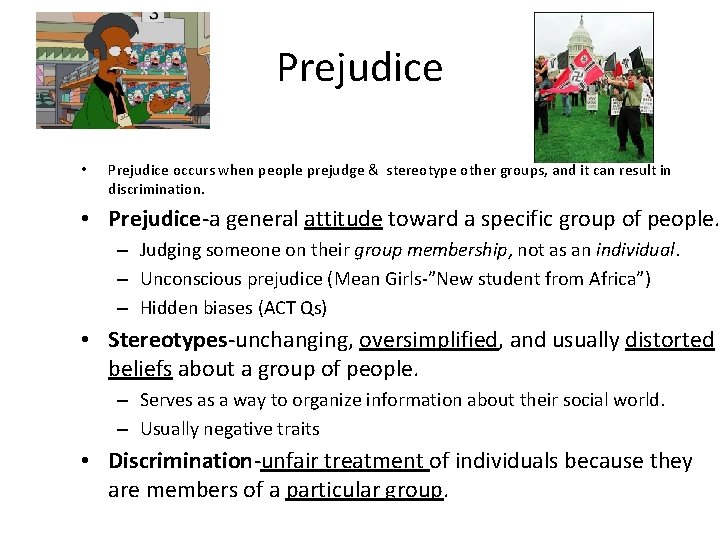
Prejudice • Prejudice occurs when people prejudge & stereotype other groups, and it can result in discrimination. • Prejudice-a general attitude toward a specific group of people. – Judging someone on their group membership, not as an individual. – Unconscious prejudice (Mean Girls-”New student from Africa”) – Hidden biases (ACT Qs) • Stereotypes-unchanging, oversimplified, and usually distorted beliefs about a group of people. – Serves as a way to organize information about their social world. – Usually negative traits • Discrimination-unfair treatment of individuals because they are members of a particular group.
Anyone “Remember” This? • A TWA Boeing 747 had just taken off from Miami International Airport for Los Angeles when a passenger near the rear of the aircraft announced that the plane was being taken over by the People's Revolutionary Army for the Liberation of the Oppressed. The hijacker then held a 357 magnum to the head of Jack Swanson, a flight attendant, and forced him to open the cockpit door. There, the hijacker confronted the pilot, Jane Randall, and ordered her to change the course for Cuba. The pilot radioed the Miami Air Traffic Control Center to report the situation but then suddenly hurled the microphone at the hijacker, who fell backward through the open cockpit door and onto the floor, where angry passengers took over from there. The plane landed in Miami a few minutes later and the hijacker was arrested. • S? – L? – – S? A?
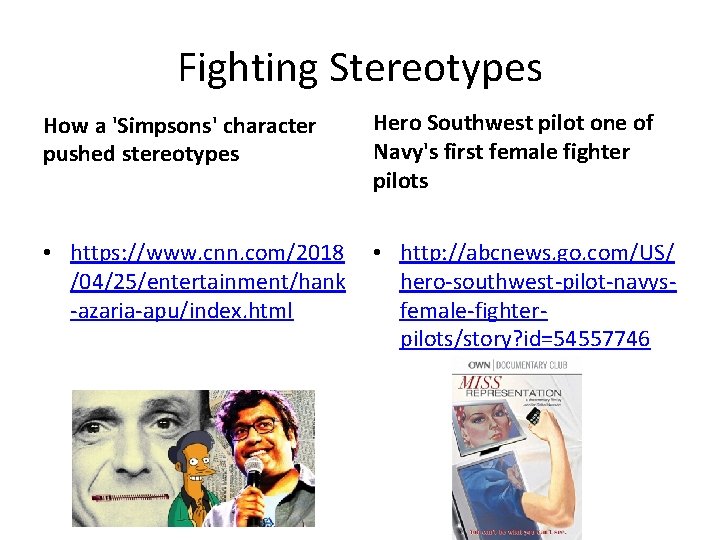
Fighting Stereotypes How a 'Simpsons' character pushed stereotypes Hero Southwest pilot one of Navy's first female fighter pilots • https: //www. cnn. com/2018 /04/25/entertainment/hank -azaria-apu/index. html • http: //abcnews. go. com/US/ hero-southwest-pilot-navysfemale-fighterpilots/story? id=54557746
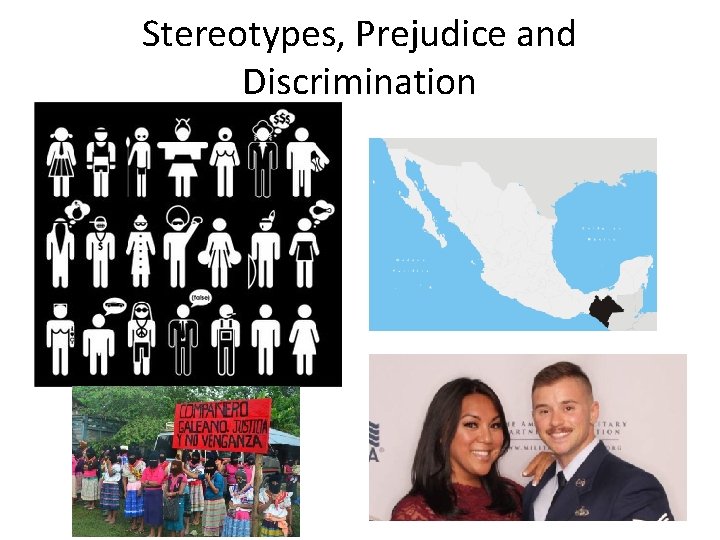
Stereotypes, Prejudice and Discrimination
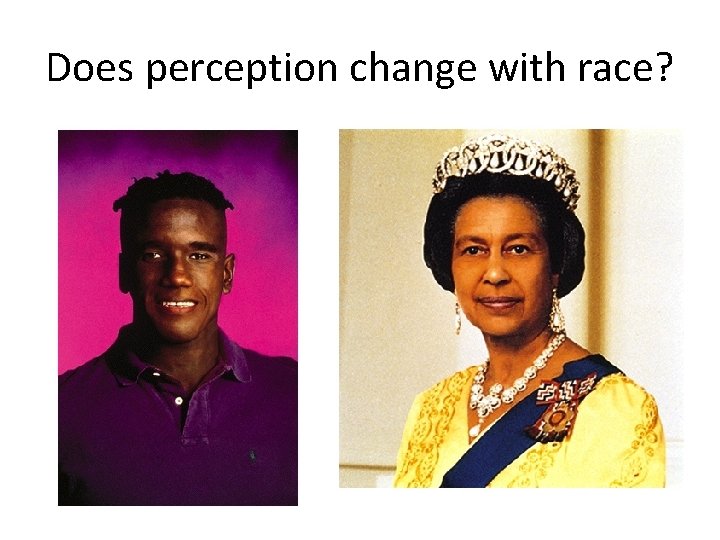
Does perception change with race?
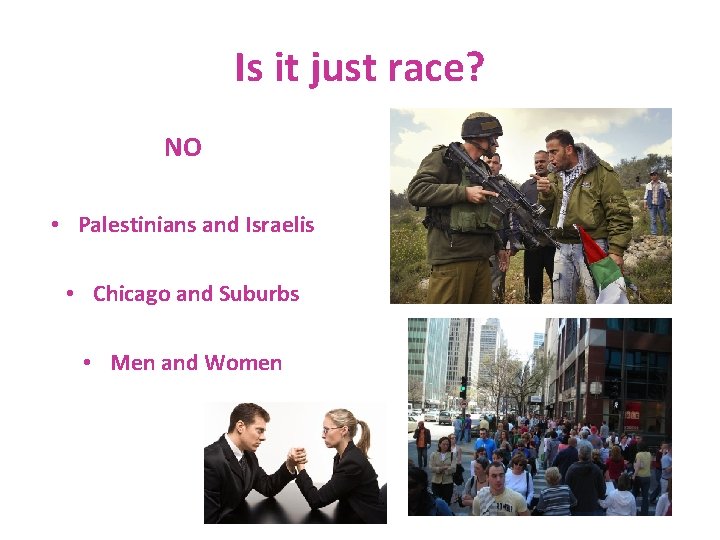
Is it just race? NO • Palestinians and Israelis • Chicago and Suburbs • Men and Women
Microaggressions • The everyday verbal, nonverbal, and environmental slights, snubs, or insults, whether intentional or unintentional, which communicate hostile, derogatory, or negative messages to target persons based solely upon their marginalized group membership. • https: //www. psychologytoday. com/us/blog/microaggressions-in-everyday-life/201011/microaggressions-more-just-race • https: //www. messiah. edu/downloads/id/921/Microaggressions_in_the_Classroom. pdf
Examples of Microaggressions • “You’re very well spoken/articulate. ” Said to an African American. • Your English is really good. ” Said to an Asian American born & raised in Chicago. • “You don’t look gay. ” Said to a LGBTQ person. • “I hate when gays flaunt their sexuality. ” • “Where are you REALLY from? ” Said to a Mexican American born and raised in Chicago. • Calling your male boss “firm” and your female boss “bitchy. ”
The Many • • • Causes of Prejudice Exaggerating Differences – They are different from me. – People tend to prefer those who are similar to themselves/share attitudes, etc. (Facebook/Twitter) Justifying Economic Status – People who have a lower economic status are inferior (lazy, stupid), so this justifies my economic superiority. – “Prosperity gospel” vs institutional racism/classism Social Learning – Children imitate (and are reinforced by) their parents. – This helps explain internalized sexism, racism, heteronormativity, etc. • • Victimization – Victims of prejudice sometimes try to gain a sense of power/pride by asserting their superiority over others worse off than themselves. Victimizing others Scapegoating – Blaming others for problems that are too complex/powerful/remote. – Scapegoats are usually too weak to defend themselves. https: //www. youtube. com/watch? v=-N 8 n. Ce 9 lc. VU 1: 40
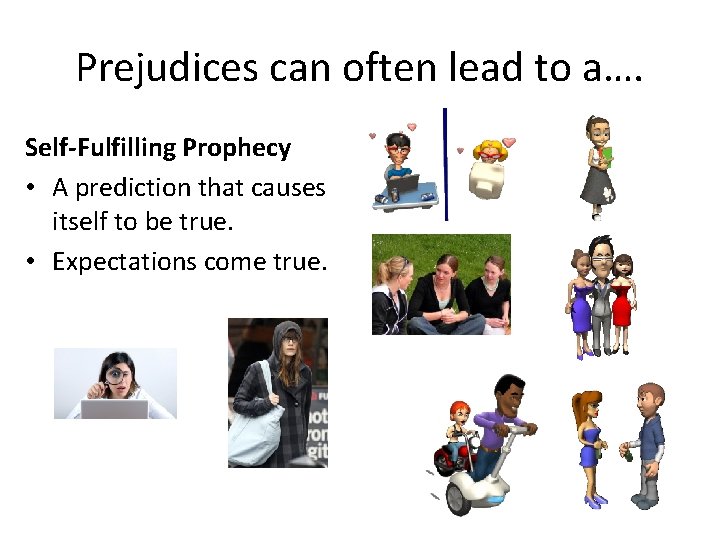
Prejudices can often lead to a…. Self-Fulfilling Prophecy • A prediction that causes itself to be true. • Expectations come true.
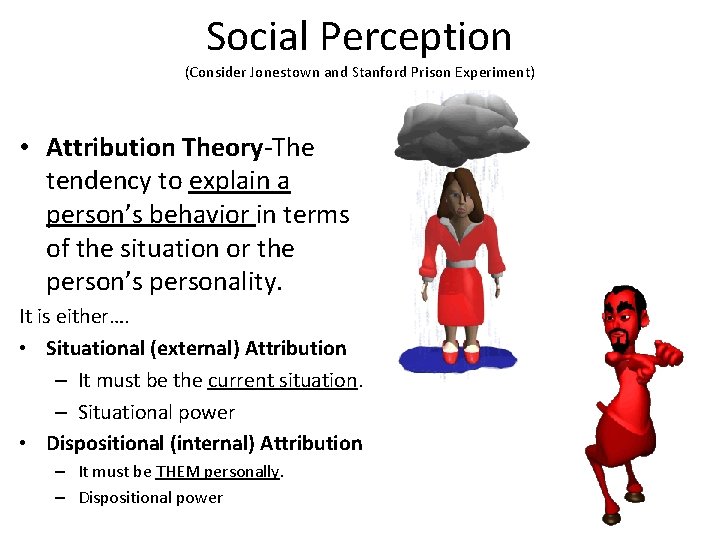
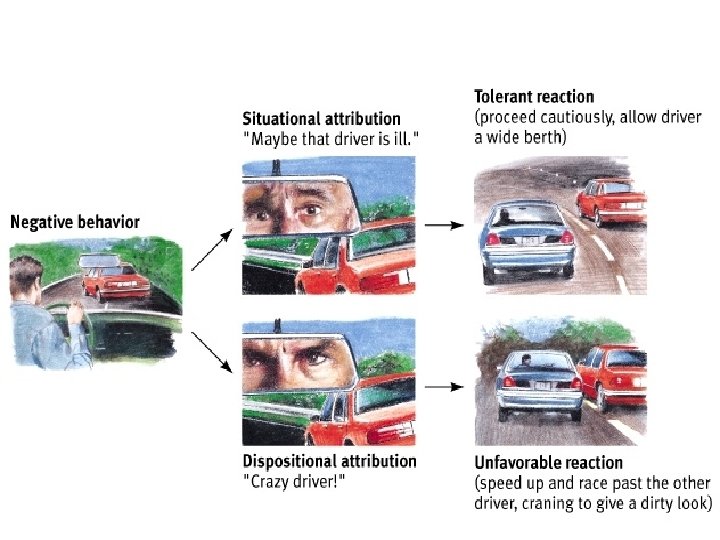
Social Perception (Consider Jonestown and Stanford Prison Experiment) • Attribution Theory-The tendency to explain a person’s behavior in terms of the situation or the person’s personality. It is either…. • Situational (external) Attribution – It must be the current situation. – Situational power • Dispositional (internal) Attribution – It must be THEM personally. – Dispositional power
Attraction (no note taking needed) 5 Factors of Attraction
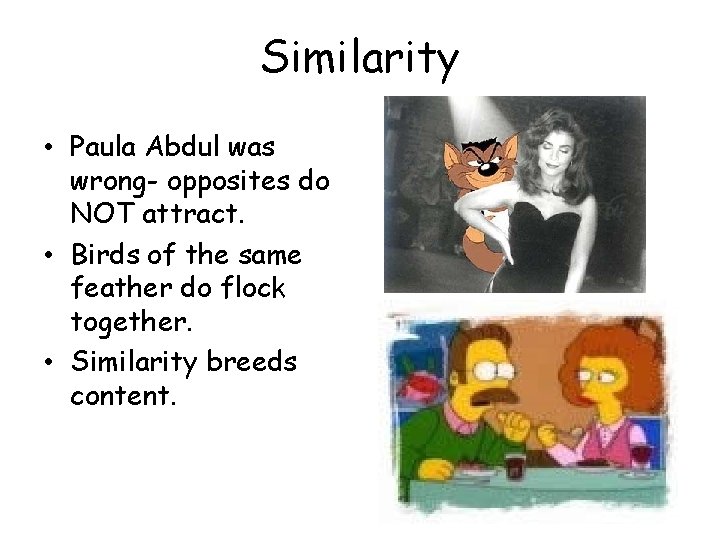
Similarity • Paula Abdul was wrong- opposites do NOT attract. • Birds of the same feather do flock together. • Similarity breeds content.
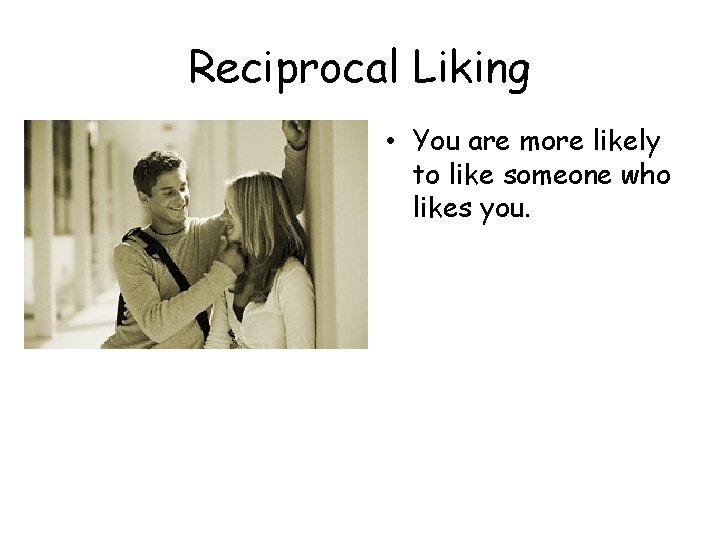
Reciprocal Liking • You are more likely to like someone who likes you.
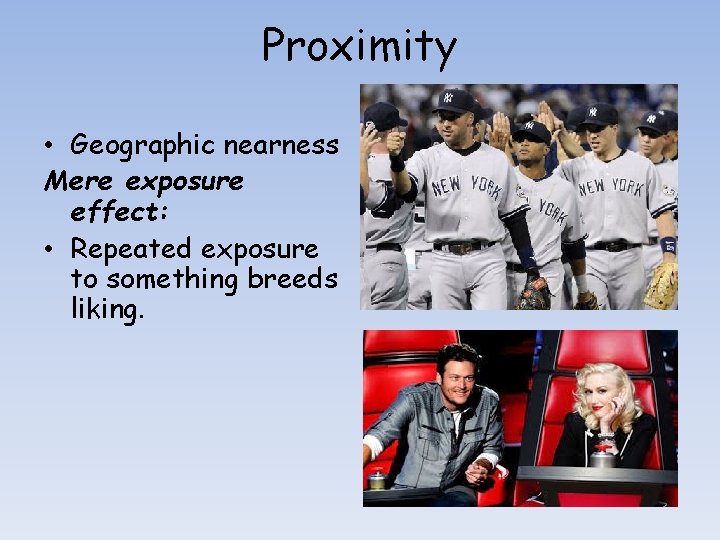
Proximity • Geographic nearness Mere exposure effect: • Repeated exposure to something breeds liking.
Liking through Association • Classical Conditioning can play a part in attraction. • I love Theo’s Wings. If I see the same waitress every time I go there, I may begin to associate that waitress with the good feelings I get from Theo's.
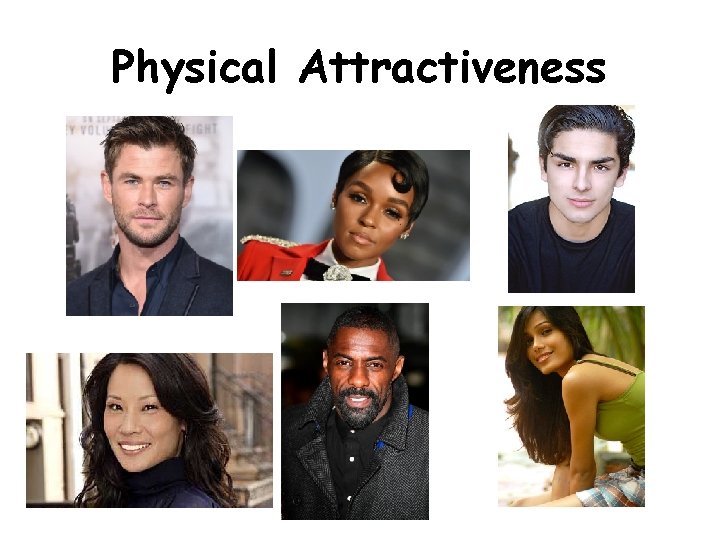
Physical Attractiveness
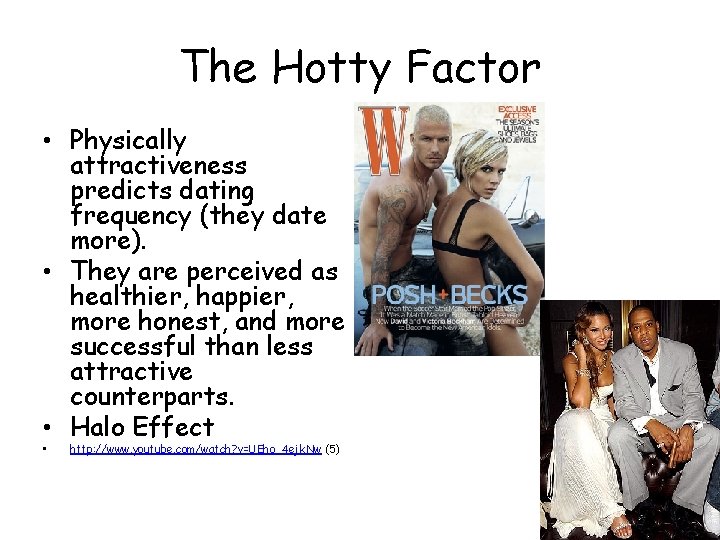
The Hotty Factor • Physically attractiveness predicts dating frequency (they date more). • They are perceived as healthier, happier, more honest, and more successful than less attractive counterparts. • Halo Effect • http: //www. youtube. com/watch? v=UEho_4 ejk. Nw (5)
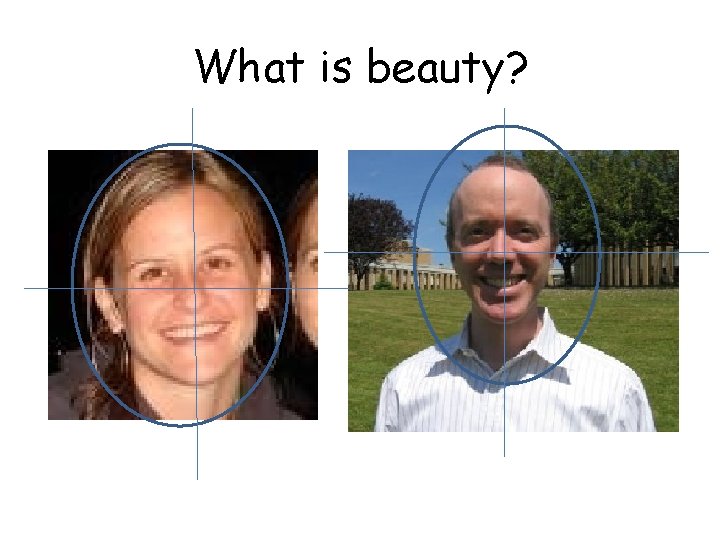
What is beauty?
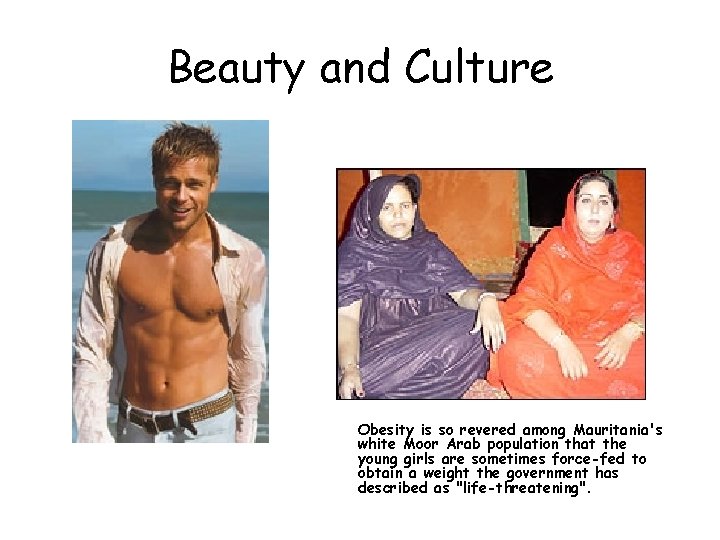
Beauty and Culture Obesity is so revered among Mauritania's white Moor Arab population that the young girls are sometimes force-fed to obtain a weight the government has described as "life-threatening".
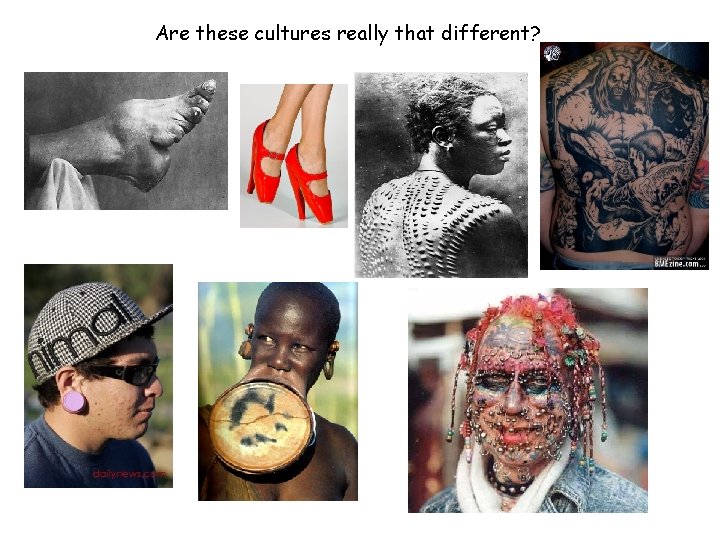
Are these cultures really that different?
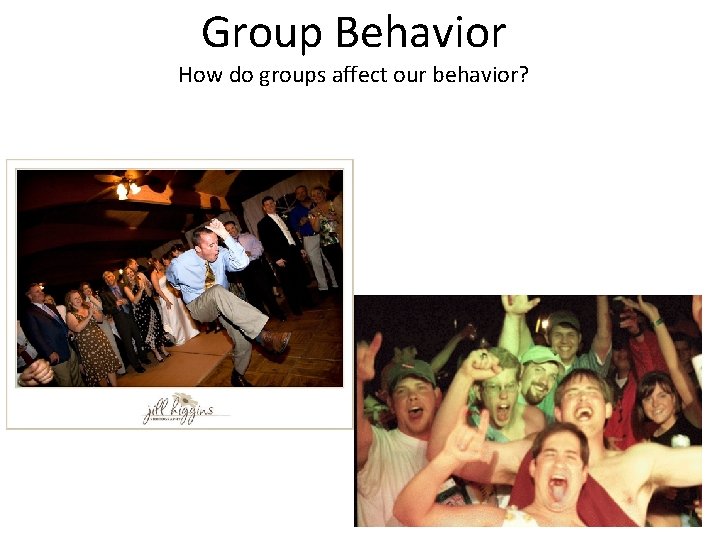
Group Behavior How do groups affect our behavior?
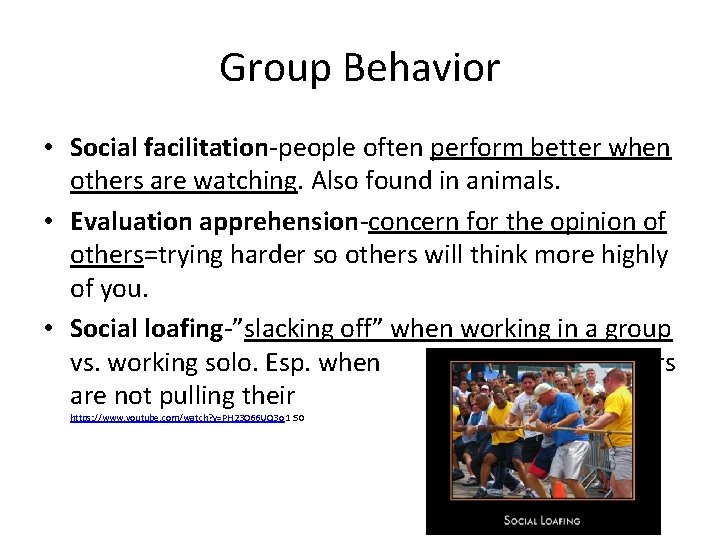
Group Behavior • Social facilitation-people often perform better when others are watching. Also found in animals. • Evaluation apprehension-concern for the opinion of others=trying harder so others will think more highly of you. • Social loafing-”slacking off” when working in a group vs. working solo. Esp. when others are not pulling their weight. https: //www. youtube. com/watch? v=PH 23 O 66 UQ 3 o 1: 50
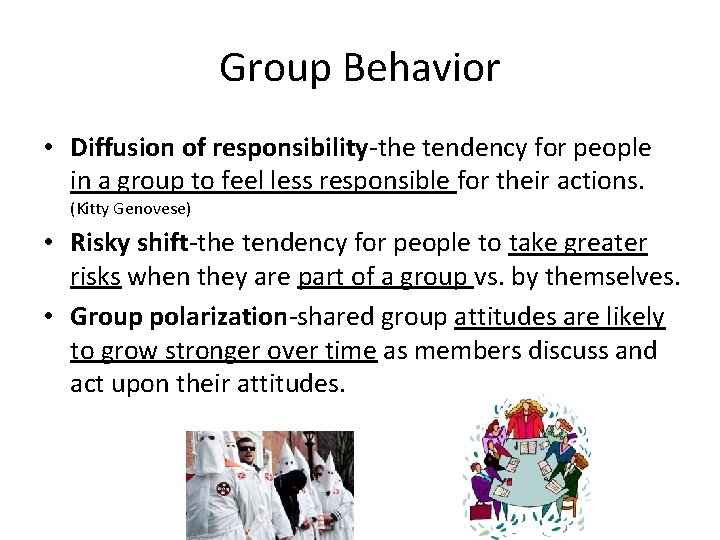
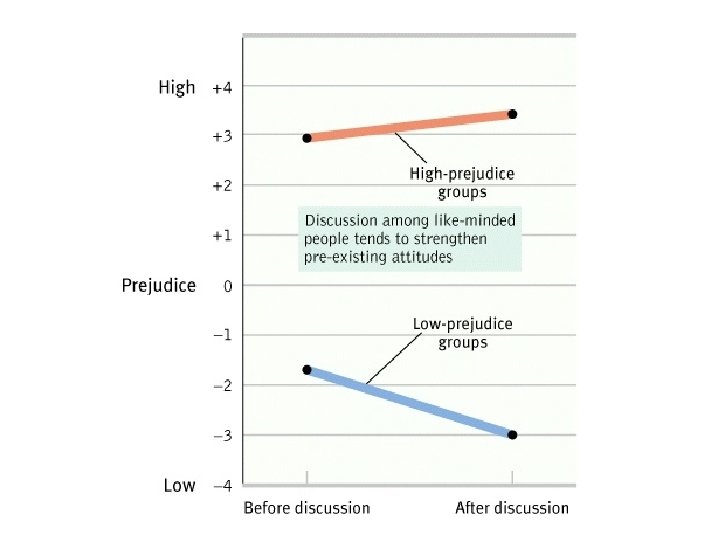
Group Behavior • Diffusion of responsibility-the tendency for people in a group to feel less responsible for their actions. (Kitty Genovese) • Risky shift-the tendency for people to take greater risks when they are part of a group vs. by themselves. • Group polarization-shared group attitudes are likely to grow stronger over time as members discuss and act upon their attitudes.
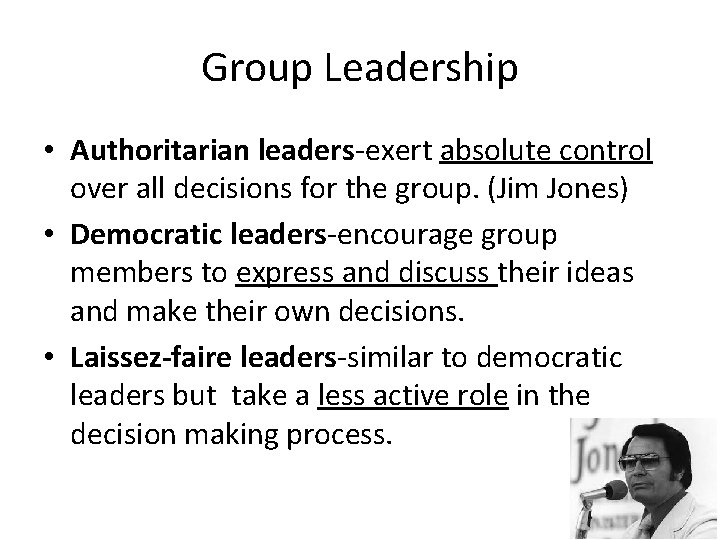
Group Leadership • Authoritarian leaders-exert absolute control over all decisions for the group. (Jim Jones) • Democratic leaders-encourage group members to express and discuss their ideas and make their own decisions. • Laissez-faire leaders-similar to democratic leaders but take a less active role in the decision making process.
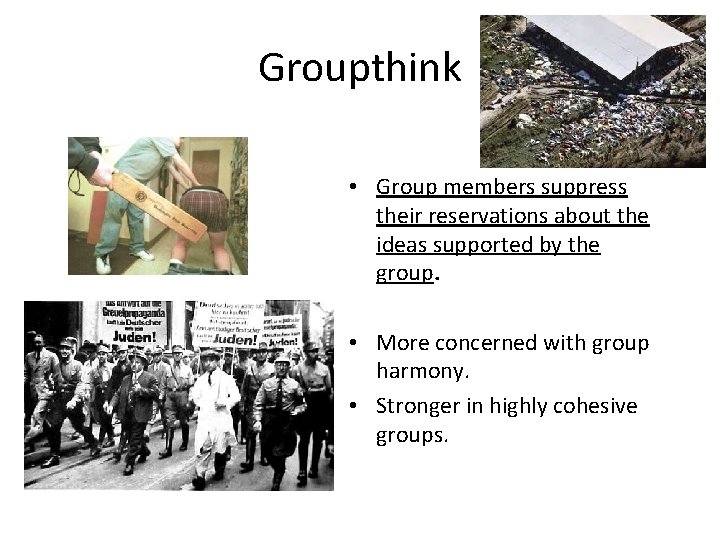
Groupthink • Group members suppress their reservations about the ideas supported by the group. • More concerned with group harmony. • Stronger in highly cohesive groups.
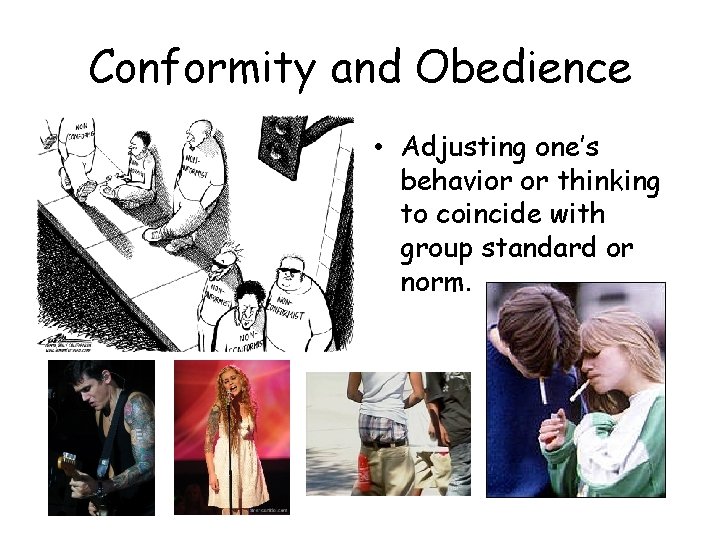
Conformity and Obedience • Adjusting one’s behavior or thinking to coincide with group standard or norm.
Conformity and Obedience • Conform-to change one’s attitude or behavior in accordance with generally accepted standards. • Social norms-rules that reflect social expectations and influence the ways people behave in social situations. • Explicit norms-spoken or written rules of social behavior (traffic rules, graduation requirements). • Implicit norms-unspoken, unwritten standards of behavior for a group (ways of greeting, fashion fads).
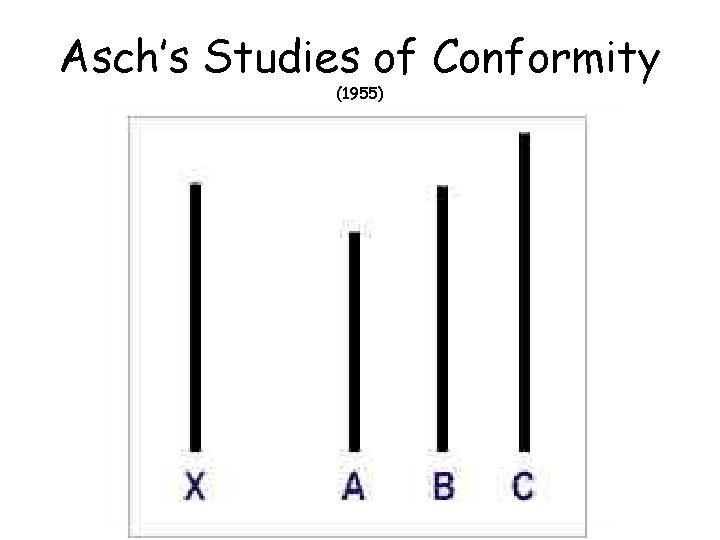
Asch’s Studies of Conformity (1955)
Asch’s Studies of Conformity (1955) • Asch wanted to determine whether people would go along with group opinion even when the group opinion differed from their own, and even when the group opinion was very obviously wrong. • Confederates/shills were used – Sometimes gave correct answers – Sometimes gave incorrect answers
Asch’s Results • Participants went along… – 3/4 at least once – 1/3 at least half the time – 1/4 virtually every time • http: //www. youtube. com/watch? v=Ny. DDy. T 1 l. D h. A (6 m)
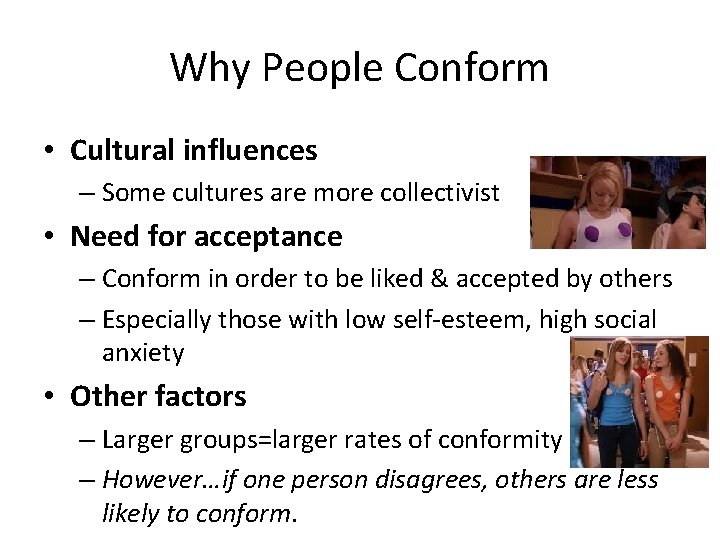
Why People Conform • Cultural influences – Some cultures are more collectivist • Need for acceptance – Conform in order to be liked & accepted by others – Especially those with low self-esteem, high social anxiety • Other factors – Larger groups=larger rates of conformity – However…if one person disagrees, others are less likely to conform.
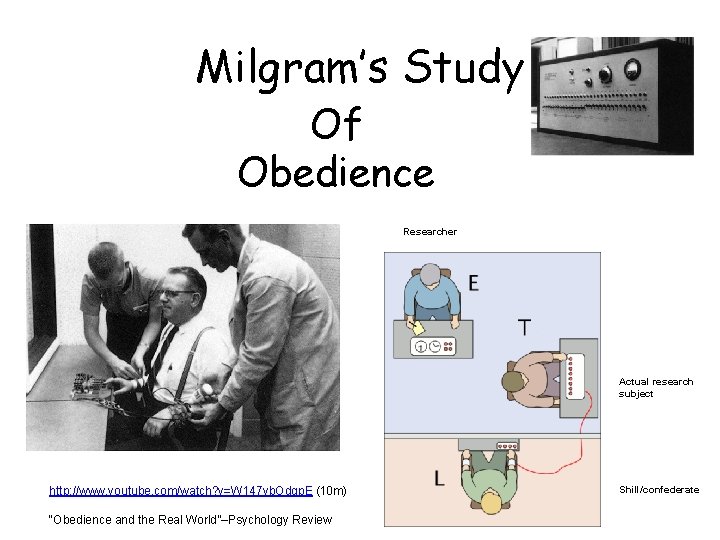
Milgram’s Study Of Obedience Researcher Actual research subject http: //www. youtube. com/watch? v=W 147 yb. Odgp. E (10 m) “Obedience and the Real World”–Psychology Review Shill/confederate
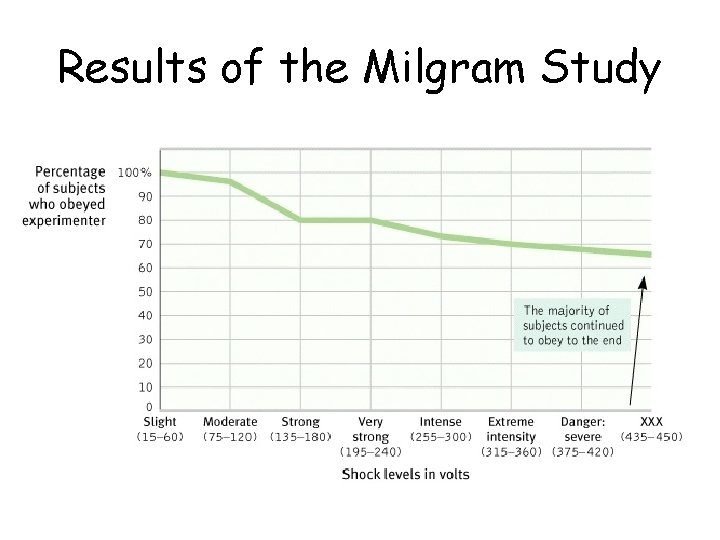
Results of the Milgram Study
Reasons People Obey • Socialization – People have been socialized since childhood to obey authority figures. (Age, sex, race, etc. ) • Foot-in-the-Door Effect – The tendency to give in to major demands once they have given in to minor ones. (Signing over your SS checks) • Confusion about attitudes – People become confused about their beliefs if they are disturbed by what is happening around them. (Hunger, exhaustion, sexual abuse, humiliation) • Buffers – If people are protected from the consequences of their actions they are more likely to follow orders. (Familial & geographic Isolation)
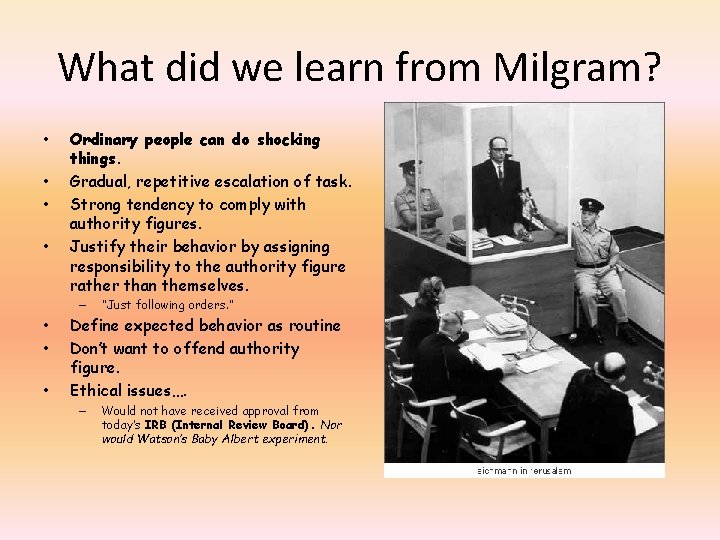
What did we learn from Milgram? • • Ordinary people can do shocking things. Gradual, repetitive escalation of task. Strong tendency to comply with authority figures. Justify their behavior by assigning responsibility to the authority figure rather than themselves. – • • • “Just following orders. ” Define expected behavior as routine Don’t want to offend authority figure. Ethical issues…. – Would not have received approval from today’s IRB (Internal Review Board). Nor would Watson’s Baby Albert experiment.
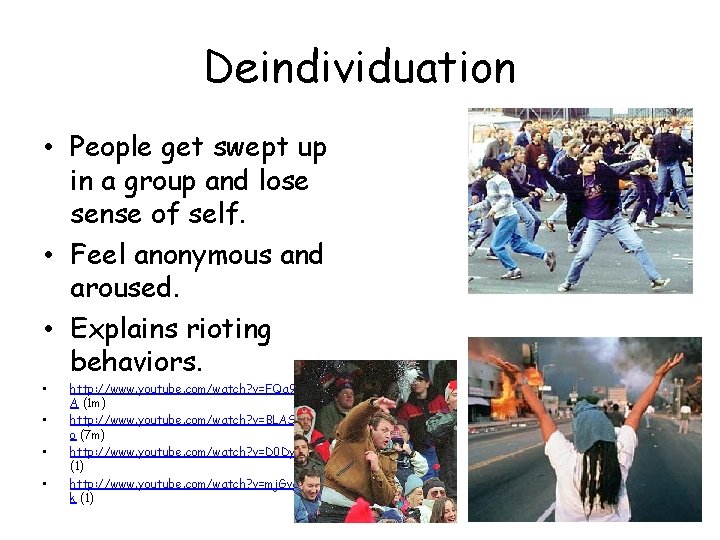
Deindividuation • People get swept up in a group and lose sense of self. • Feel anonymous and aroused. • Explains rioting behaviors. • • http: //www. youtube. com/watch? v=FQa 9 z. WK 5 XJ A (1 m) http: //www. youtube. com/watch? v=BLASu. YMGUV o (7 m) http: //www. youtube. com/watch? v=D 0 Dy 63 -kjz. A (1) http: //www. youtube. com/watch? v=mj. Gvge. GSVW k (1)
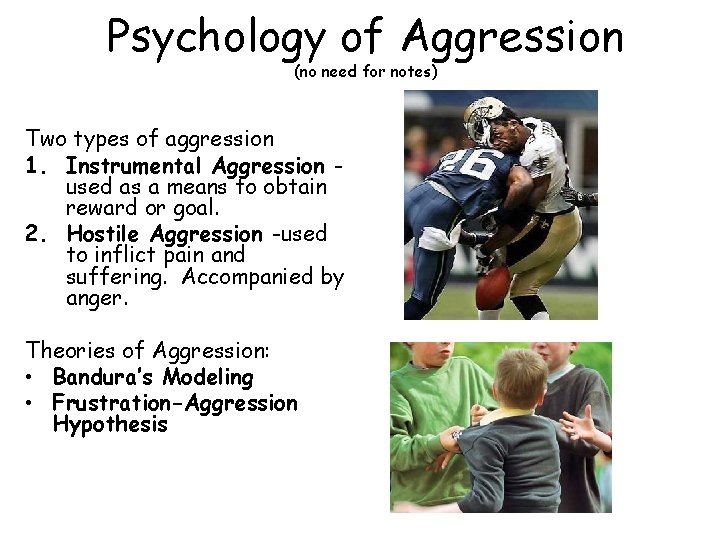
Psychology of Aggression (no need for notes) Two types of aggression 1. Instrumental Aggression used as a means to obtain reward or goal. 2. Hostile Aggression -used to inflict pain and suffering. Accompanied by anger. Theories of Aggression: • Bandura’s Modeling • Frustration-Aggression Hypothesis
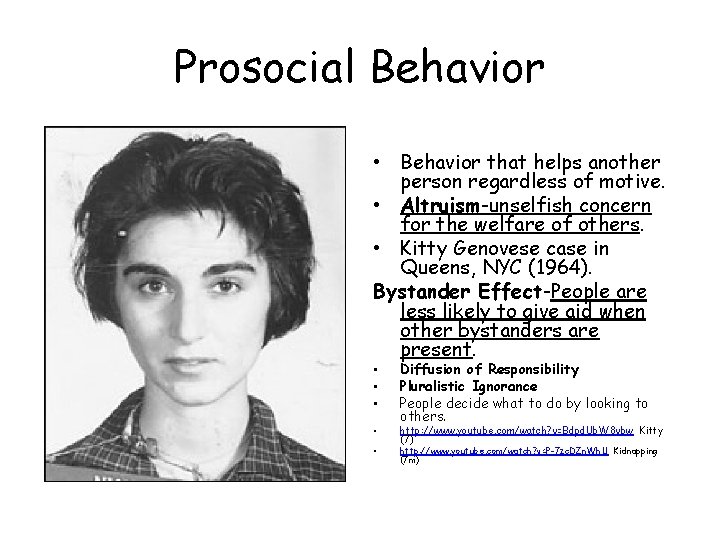
Prosocial Behavior • Behavior that helps another person regardless of motive. • Altruism-unselfish concern for the welfare of others. • Kitty Genovese case in Queens, NYC (1964). Bystander Effect-People are less likely to give aid when other bystanders are present. • • • Diffusion of Responsibility Pluralistic Ignorance People decide what to do by looking to others. http: //www. youtube. com/watch? v=Bdpd. Ub. W 8 vbw Kitty (7) http: //www. youtube. com/watch? v=P-7 zc. DZn. Wh. U Kidnapping (7 m)
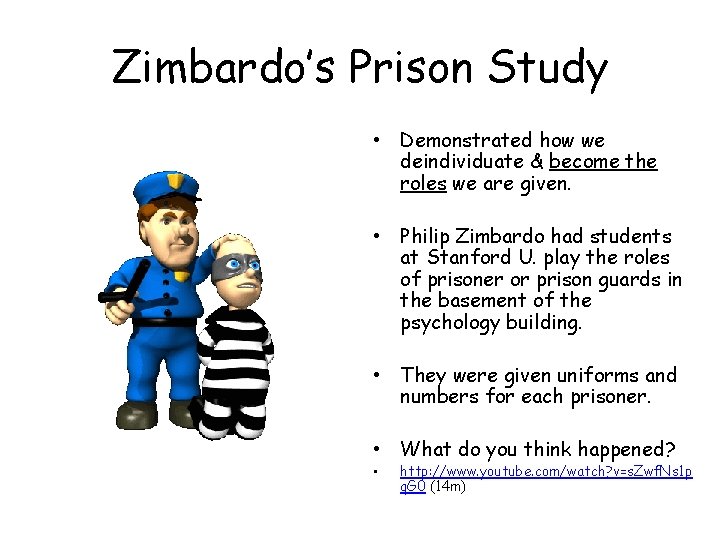
Zimbardo’s Prison Study • Demonstrated how we deindividuate & become the roles we are given. • Philip Zimbardo had students at Stanford U. play the roles of prisoner or prison guards in the basement of the psychology building. • They were given uniforms and numbers for each prisoner. • What do you think happened? • http: //www. youtube. com/watch? v=s. Zwf. Ns 1 p q. G 0 (14 m)
Recall the 3 Major Questions to Consider • What is evil? • How do good people turn evil? • How can you be a “hero” in the face of evil? • According to Zimbardo… – “Evil consists in intentionally behaving in ways that harm, abuse, demean, dehumanize, or destroy innocent others-or using one’s authority and systemic power to encourage or permit others to do so on your behalf. ”
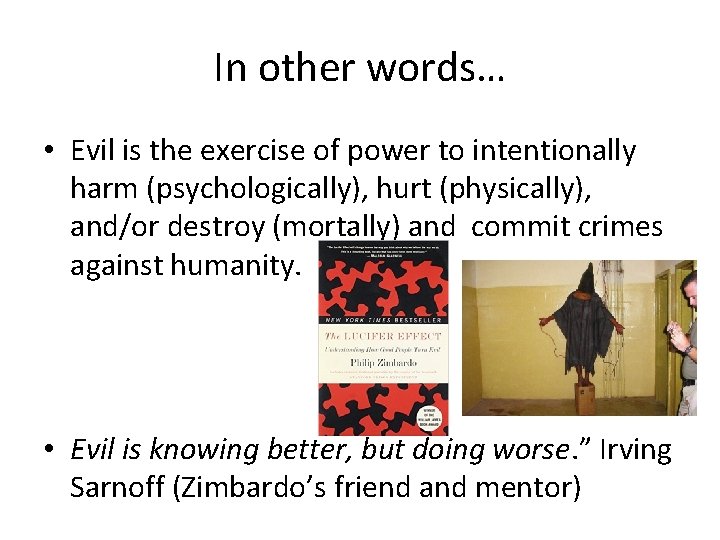
In other words… • Evil is the exercise of power to intentionally harm (psychologically), hurt (physically), and/or destroy (mortally) and commit crimes against humanity. • Evil is knowing better, but doing worse. ” Irving Sarnoff (Zimbardo’s friend and mentor)
- Slides: 52