
Social Protection and the SDGs A 5150031 REGIONAL

- Slides: 32
Social Protection and the SDGs A 5150031 REGIONAL COURSE ON SUSTAINABLE DEVELOPMENT GOALS; TRADE UNION POLICIES AND ACTION PLANS 6 -17 TH MARCH, 2017 PRAIA, CAPE VERDE
Outline 1. Social protection in the SDGs: goals and indicators 2. How does the ILO policy approach contribute to the achievement of the SDGs? 3. Role of workers’ organizations in achieving SDGs on social protection 4. Questions and discussion 3
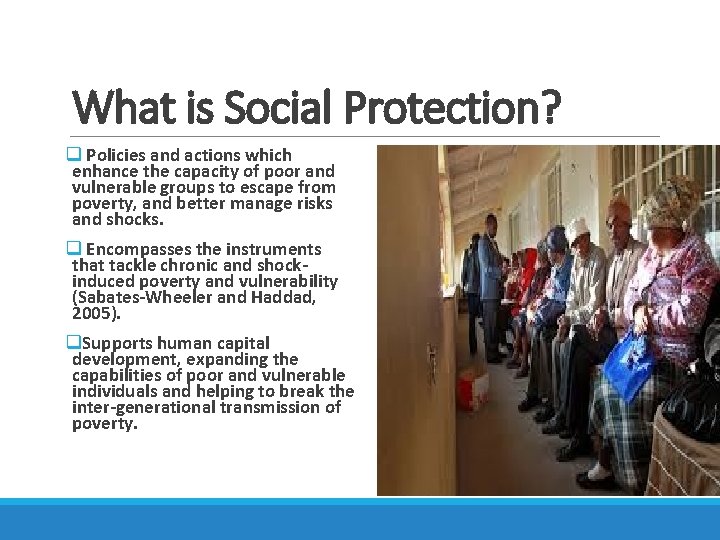
What is Social Protection? q Policies and actions which enhance the capacity of poor and vulnerable groups to escape from poverty, and better manage risks and shocks. q Encompasses the instruments that tackle chronic and shockinduced poverty and vulnerability (Sabates-Wheeler and Haddad, 2005). q. Supports human capital development, expanding the capabilities of poor and vulnerable individuals and helping to break the inter-generational transmission of poverty.
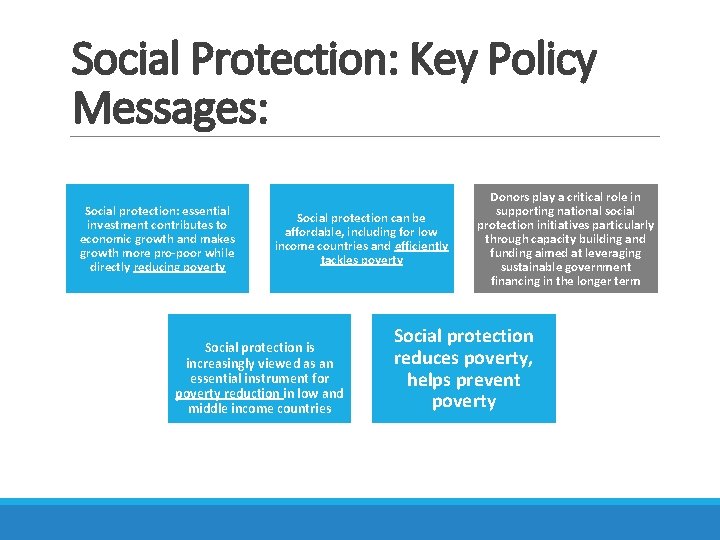
Social Protection: Key Policy Messages: Social protection: essential investment contributes to economic growth and makes growth more pro-poor while directly reducing poverty Social protection can be affordable, including for low income countries and efficiently tackles poverty Social protection is increasingly viewed as an essential instrument for poverty reduction in low and middle income countries Donors play a critical role in supporting national social protection initiatives particularly through capacity building and funding aimed at leveraging sustainable government financing in the longer term Social protection reduces poverty, helps prevent poverty
Some Facts, Figures and Trends The World Social Protection Report 2014/15 includes valuable and comprehensive statistical annexes with the latest social protection data
Social protection and the SDGs MEANS AND END IN THE 2030 AGENDA 7
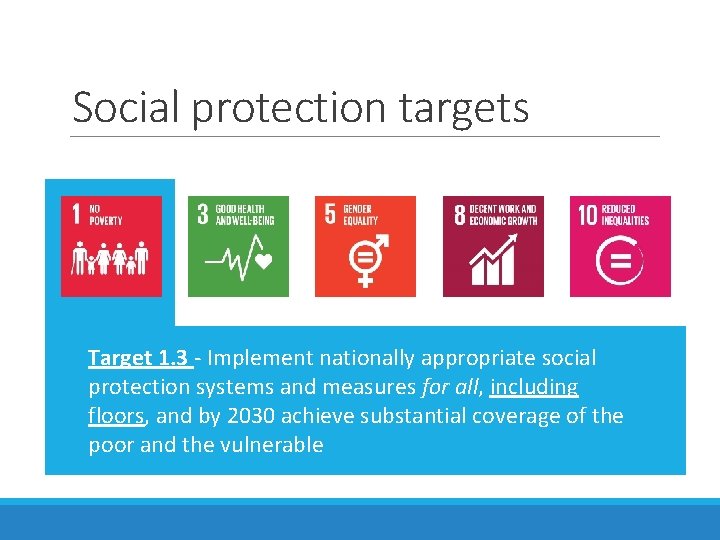
Social protection targets Target 1. 3 - Implement nationally appropriate social protection systems and measures for all, including floors, and by 2030 achieve substantial coverage of the poor and the vulnerable
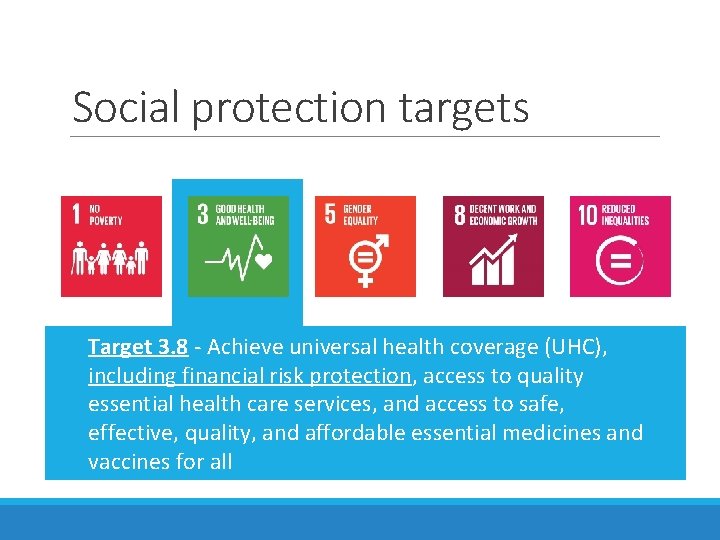
Social protection targets Target 3. 8 - Achieve universal health coverage (UHC), including financial risk protection, access to quality essential health care services, and access to safe, effective, quality, and affordable essential medicines and vaccines for all
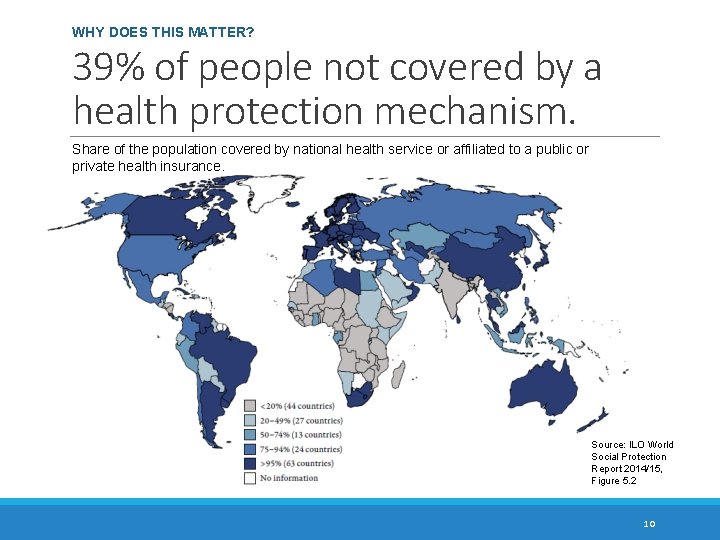
WHY DOES THIS MATTER? 39% of people not covered by a health protection mechanism. Share of the population covered by national health service or affiliated to a public or private health insurance. Source: ILO World Social Protection Report 2014/15, Figure 5. 2 10
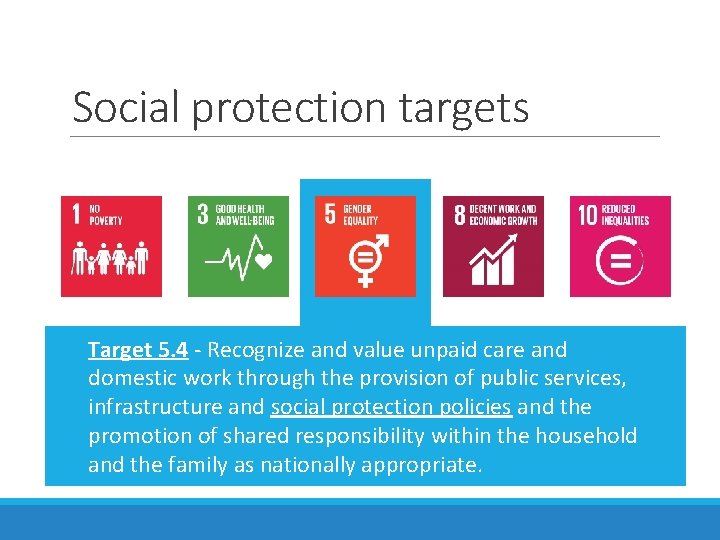
Social protection targets Target 5. 4 - Recognize and value unpaid care and domestic work through the provision of public services, infrastructure and social protection policies and the promotion of shared responsibility within the household and the family as nationally appropriate.
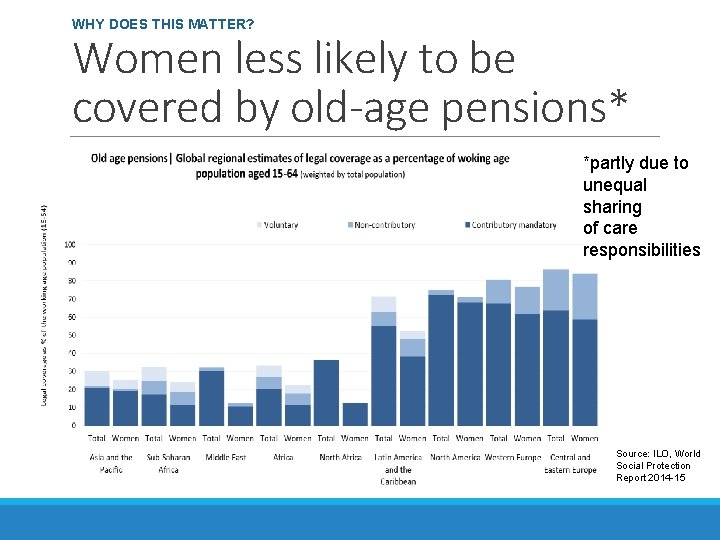
WHY DOES THIS MATTER? Women less likely to be covered by old-age pensions* *partly due to unequal sharing of care responsibilities Source: ILO, World Social Protection Report 2014 -15
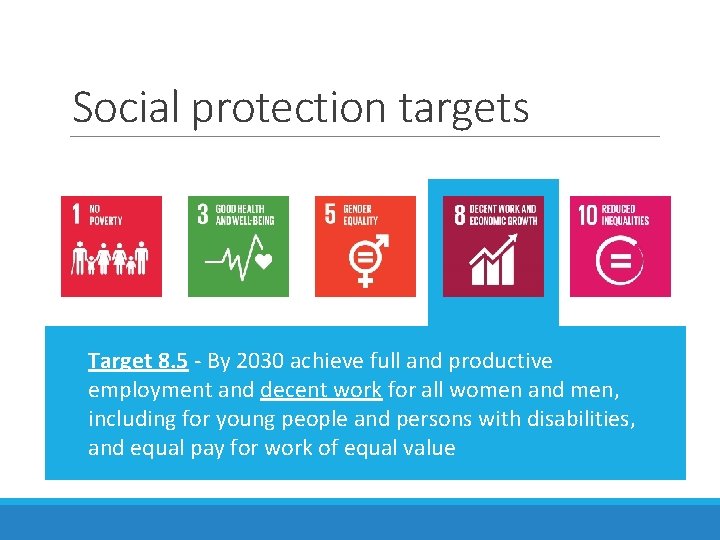
Social protection targets Target 8. 5 - By 2030 achieve full and productive employment and decent work for all women and men, including for young people and persons with disabilities, and equal pay for work of equal value
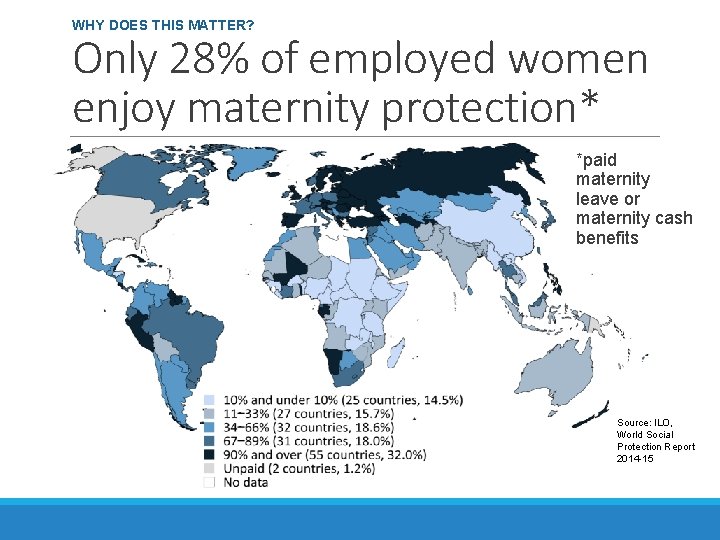
WHY DOES THIS MATTER? Only 28% of employed women enjoy maternity protection* *paid maternity leave or maternity cash benefits Source: ILO, World Social Protection Report 2014 -15
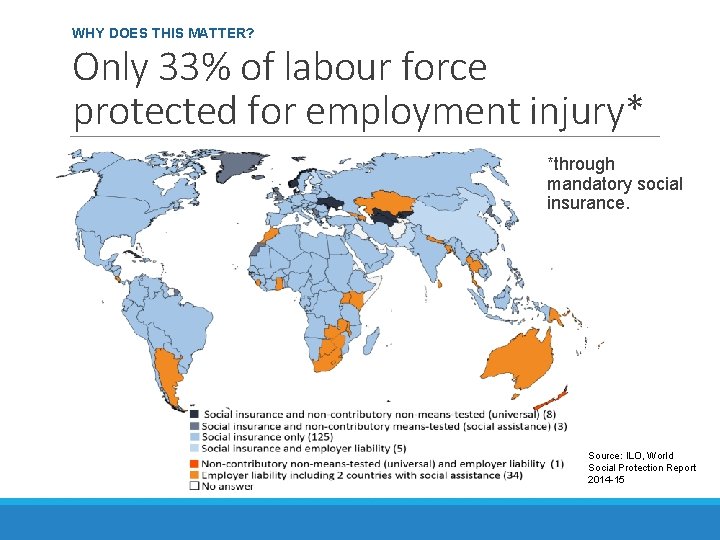
WHY DOES THIS MATTER? Only 33% of labour force protected for employment injury* *through mandatory social insurance. Source: ILO, World Social Protection Report 2014 -15
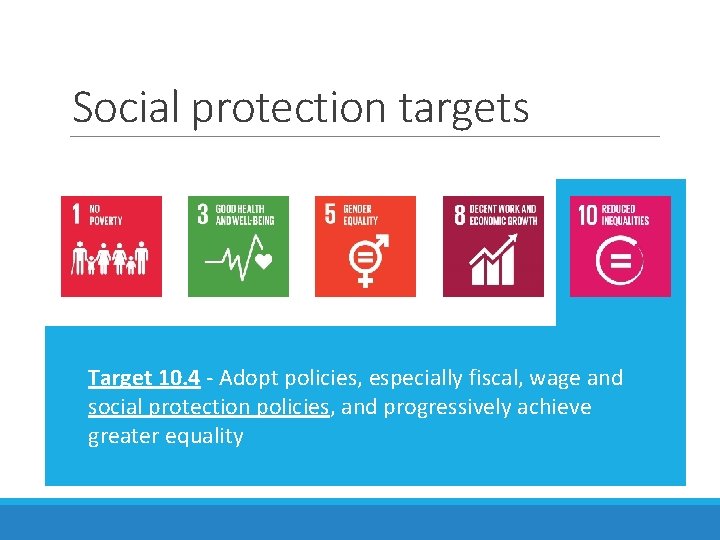
Social protection targets Target 10. 4 - Adopt policies, especially fiscal, wage and social protection policies, and progressively achieve greater equality
ILO’s policy contributions to SDGs achievement? 17
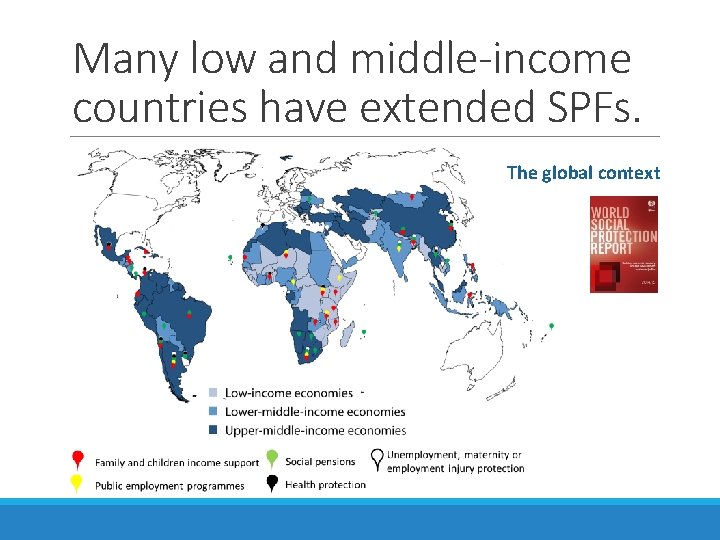
Many low and middle-income countries have extended SPFs. The global context
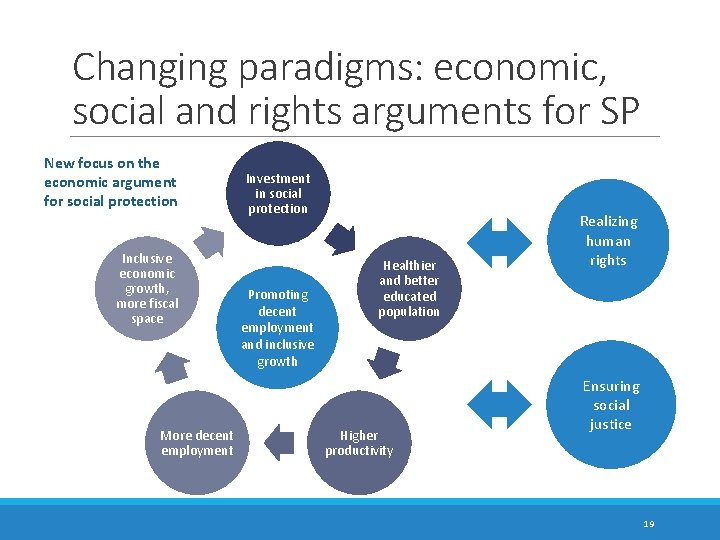
Changing paradigms: economic, social and rights arguments for SP New focus on the economic argument for social protection Inclusive economic growth, more fiscal space More decent employment Investment in social protection Promoting decent employment and inclusive growth Healthier and better educated population Higher productivity Realizing human rights Ensuring social justice 19
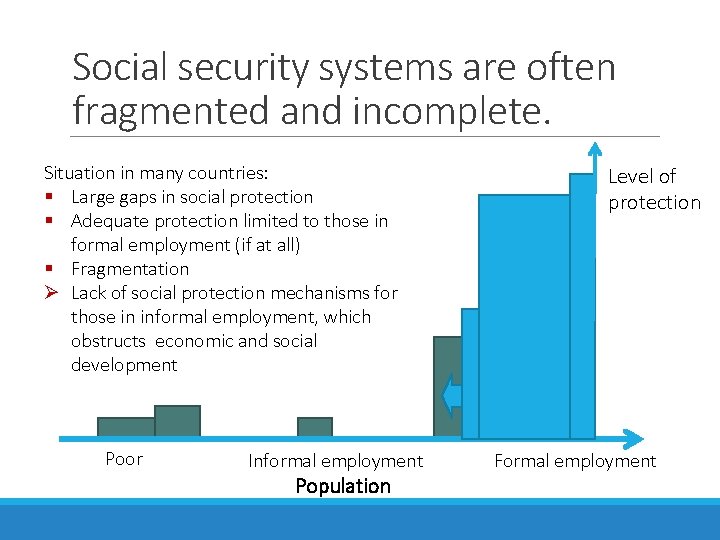
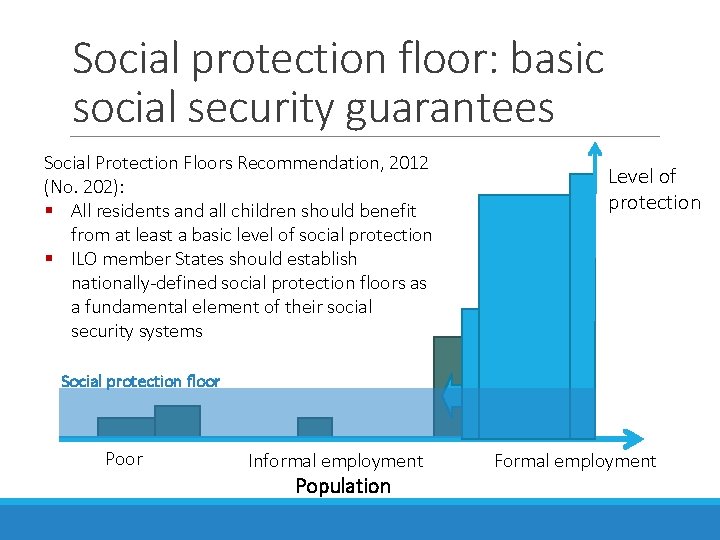
Social security systems are often fragmented and incomplete. Situation in many countries: § Large gaps in social protection § Adequate protection limited to those in formal employment (if at all) § Fragmentation Ø Lack of social protection mechanisms for those in informal employment, which obstructs economic and social development Poor Informal employment Population Level of protection Formal employment
Social protection floor: basic social security guarantees Social Protection Floors Recommendation, 2012 (No. 202): § All residents and all children should benefit from at least a basic level of social protection § ILO member States should establish nationally-defined social protection floors as a fundamental element of their social security systems Level of protection Social protection floor Poor Informal employment Population Formal employment
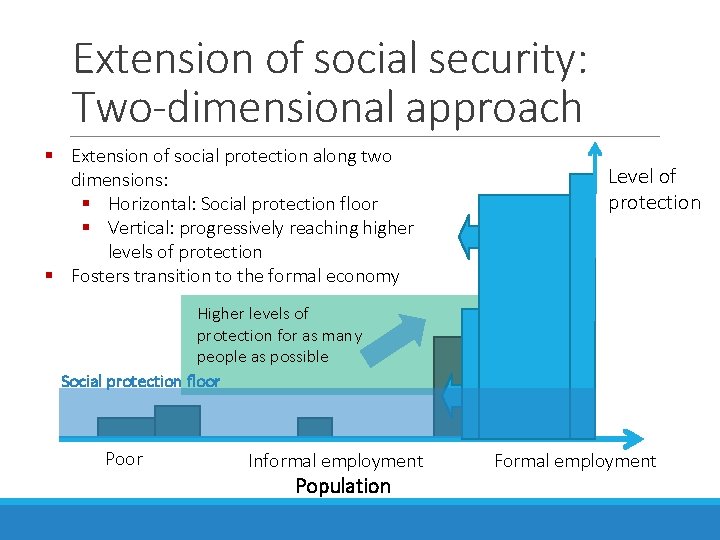
Extension of social security: Two-dimensional approach § Extension of social protection along two dimensions: § Horizontal: Social protection floor § Vertical: progressively reaching higher levels of protection § Fosters transition to the formal economy Level of protection Higher levels of protection for as many people as possible Social protection floor Poor Informal employment Population Formal employment
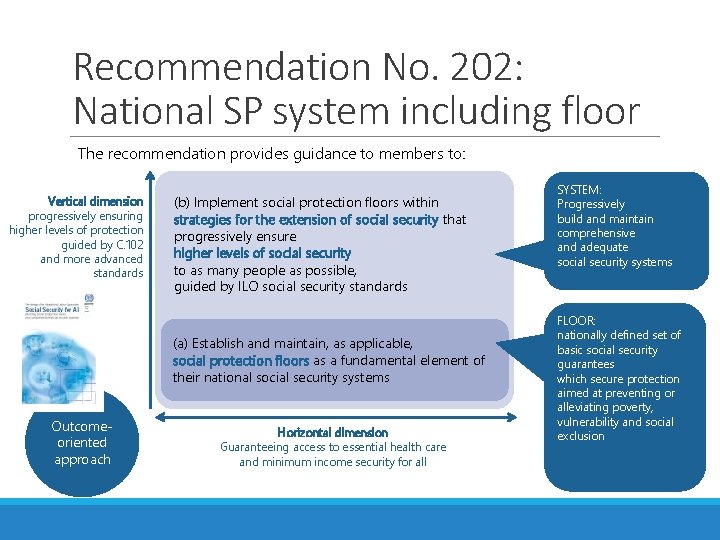
Recommendation No. 202: National SP system including floor The recommendation provides guidance to members to: Vertical dimension progressively ensuring higher levels of protection guided by C. 102 and more advanced standards (b) Implement social protection floors within strategies for the extension of social security that progressively ensure higher levels of social security to as many people as possible, guided by ILO social security standards (a) Establish and maintain, as applicable, social protection floors as a fundamental element of their national social security systems Outcomeoriented approach Horizontal dimension Guaranteeing access to essential health care and minimum income security for all SYSTEM: Progressively build and maintain comprehensive and adequate social security systems FLOOR: nationally defined set of basic social security guarantees which secure protection aimed at preventing or alleviating poverty, vulnerability and social exclusion
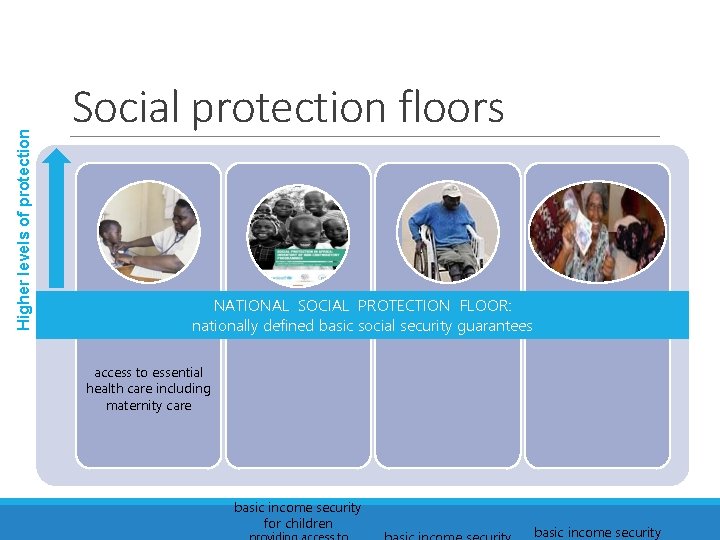
Higher levels of protection Social protection floors NATIONAL SOCIAL PROTECTION FLOOR: nationally defined basic social security guarantees access to essential health care including maternity care basic income security for children basic income security
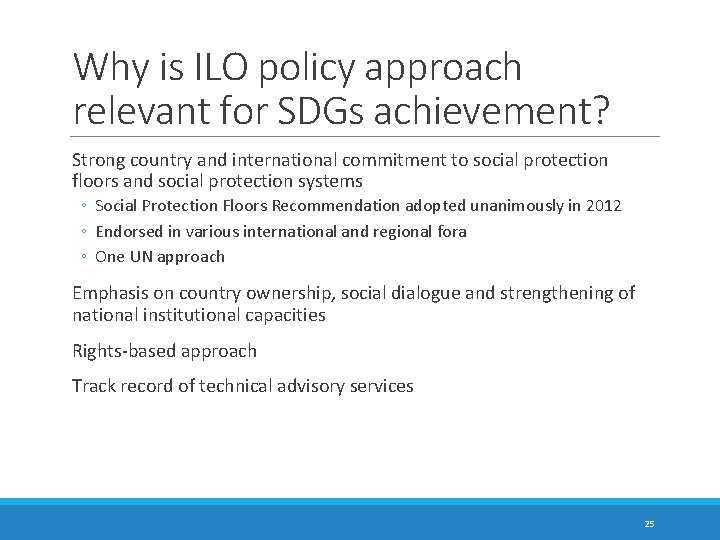
Why is ILO policy approach relevant for SDGs achievement? Strong country and international commitment to social protection floors and social protection systems ◦ Social Protection Floors Recommendation adopted unanimously in 2012 ◦ Endorsed in various international and regional fora ◦ One UN approach Emphasis on country ownership, social dialogue and strengthening of national institutional capacities Rights-based approach Track record of technical advisory services 25
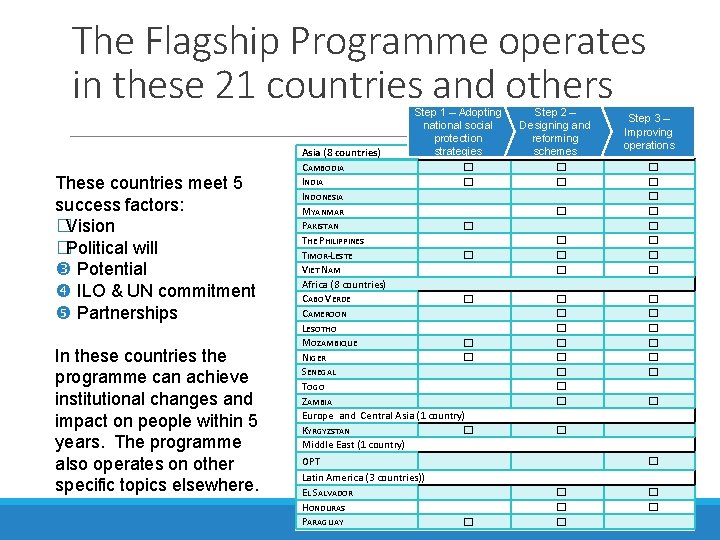
The Flagship Programme operates in these 21 countries and others These countries meet 5 success factors: �Vision �Political will Potential ILO & UN commitment Partnerships In these countries the programme can achieve institutional changes and impact on people within 5 years. The programme also operates on other specific topics elsewhere. Step 1 – Adopting national social protection strategies � � Asia (8 countries) CAMBODIA INDONESIA MYANMAR PAKISTAN � THE PHILIPPINES TIMOR-LESTE � VIET NAM Africa (8 countries) CABO VERDE � CAMEROON LESOTHO MOZAMBIQUE � NIGER � SENEGAL TOGO ZAMBIA Europe and Central Asia (1 country) KYRGYZSTAN � Middle East (1 country) Step 2 – Designing and reforming schemes � � � � � � � � OPT Latin America (3 countries)) EL SALVADOR HONDURAS PARAGUAY Step 3 – Improving operations � � � �
Role of workers’ organizations IN ACHIEVING THE SDGS ON SOCIAL PROTECTION 27
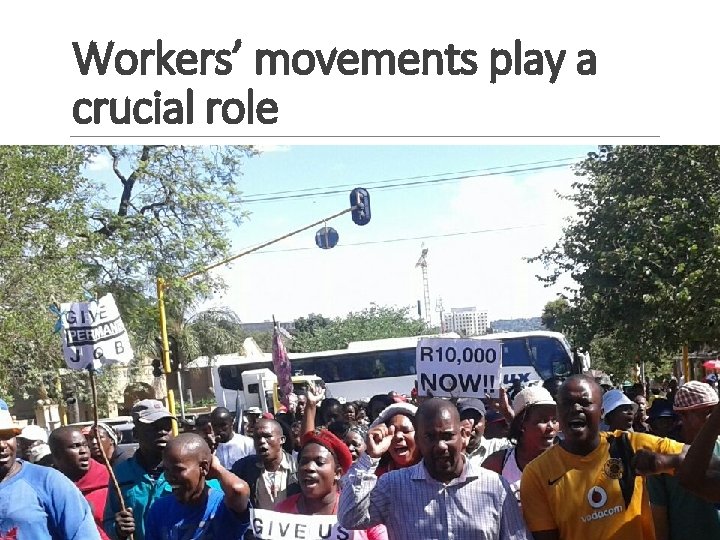
Workers’ movements play a crucial role Unions and unemployed New Yorkers demonstrate with signs in front of Emergency Relief Building in 1935.
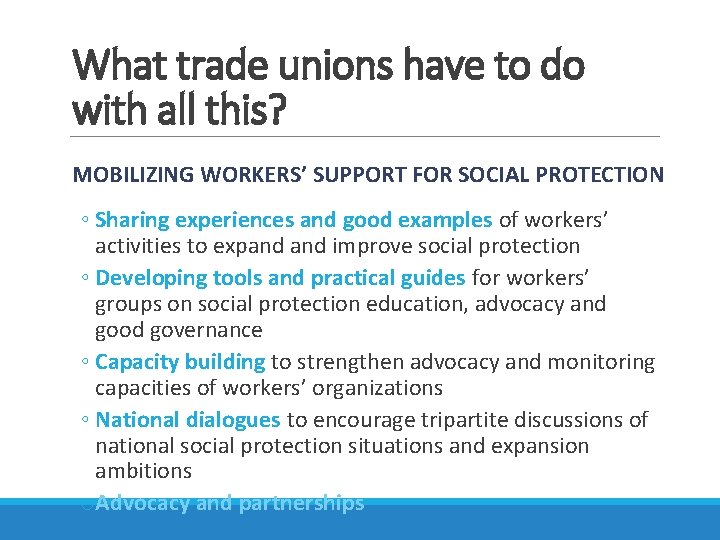
What trade unions have to do with all this? MOBILIZING WORKERS’ SUPPORT FOR SOCIAL PROTECTION ◦ Sharing experiences and good examples of workers’ activities to expand improve social protection ◦ Developing tools and practical guides for workers’ groups on social protection education, advocacy and good governance ◦ Capacity building to strengthen advocacy and monitoring capacities of workers’ organizations ◦ National dialogues to encourage tripartite discussions of national social protection situations and expansion ambitions o. Advocacy and partnerships
Learn more MOBILIZING WORKERS’ SUPPORT FOR SOCIAL PROTECTION http: //workers. social-protection. org
Questions and Discussion 31
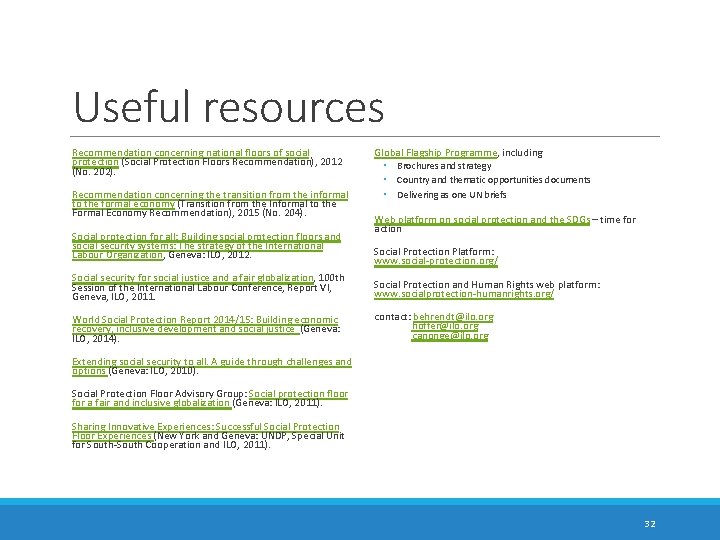
Useful resources Recommendation concerning national floors of social protection (Social Protection Floors Recommendation), 2012 (No. 202). Recommendation concerning the transition from the informal to the formal economy (Transition from the Informal to the Formal Economy Recommendation), 2015 (No. 204). Social protection for all: Building social protection floors and social security systems: The strategy of the International Labour Organization, Geneva: ILO, 2012. Global Flagship Programme, including ◦ Brochures and strategy ◦ Country and thematic opportunities documents ◦ Delivering as one UN briefs Web platform on social protection and the SDGs – time for action Social Protection Platform: www. social-protection. org/ Social security for social justice and a fair globalization, 100 th Session of the International Labour Conference, Report VI, Geneva, ILO, 2011. Social Protection and Human Rights web platform: www. socialprotection-humanrights. org/ World Social Protection Report 2014/15: Building economic recovery, inclusive development and social justice (Geneva: ILO, 2014). contact: behrendt@ilo. org hoffer@ilo. org canonge@ilo. org Extending social security to all. A guide through challenges and options (Geneva: ILO, 2010). Social Protection Floor Advisory Group: Social protection floor for a fair and inclusive globalization (Geneva: ILO, 2011). Sharing Innovative Experiences: Successful Social Protection Floor Experiences (New York and Geneva: UNDP, Special Unit for South-South Cooperation and ILO, 2011). 32