
SOCIAL PROBLEMS DEFINITIONS Fuller and Myers a condition
SOCIAL PROBLEMS- DEFINITIONS Fuller and Myers: “ a condition which is defined by a considerable number of persons as a deviation from some social norms which they cherish”. Merton and Nisbet hold that a social problem is “a way of behaviour that is regarded by a substantial part of a social order as being in violation of one or more generally accepted or approved norms” Raab and Selznick maintain that a social problem is “ a problem in human relationships which seriously threatens society or impedes the important aspiration of many people”.
SOCIAL PROBLEMS- DEFINITIONS According to Carr, “ a social problem exists whenever we become conscious of a difficulty, a gap between our preferences and reality”. Blumer writes that “ social problems involves actions or patterns of behaviour that are viewed by a substantial number of persons in the society as being deleterious to the society or in violation of societal norms, and about which ameliorative action seen as both possible and desirable”. Landis is of the opinion that “ social problems are men’s unfulfilled aspirations for welfare”.
SOCIAL PROBLEMS- DEFINITIONS Case has said that “ a social problem refers to any situation which attracts the attention of a considerable number of competent observers within a society and appeals to them as calling for readjustment or remedy by social action of some kind or other” Horton and Leslie write that a social problem is “ a condition affecting a significant number of people in ways considered undesirable, about which it is felt that something can be done through collective social action”. Public Concern- measured by assessing no. of articles devoted to it in popular magazines.
SOCIAL PROBLEMS- DEFINITIONS According to Weinberg, social problems are “ behaviour patterns or conditions which arise from social processes and are considered so objectionable or undesirable by many members of a society that they recognize that corrective policies, programmes and services are necessary to cope with them”. Weinberg gives six characteristics of social problems as under: 1. Social problems arise by being collectively defined as objectionable by many members of the community. Thus, adverse conditions not defined by the community as reprehensible are not considered as social problems. For example, alcoholism
CHARACTERISTICS OF SOCIAL PROBLEMS 2. Social problems change when the concerned behavioral patterns as interpreted differently. For example attitude towards mental illness 3. Mass media play an important role in creating awareness about the scope and urgency of social problems. 4. Social problems have to be viewed in the context of society’s values and institutions, for example, the problem of racial conflict in the United States is different from the problem of untouchability in India.
CHARACTERISTICS OF SOCIAL PROBLEMS 5. Social problems need to be analyzed in terms of the influences upon them by group processes and social relationships. 6. Social problems vary historically, contemporary social problems are the society’s concern. For example the problem of refugee settlement in India in 1947 -48 was different from the problem of settling refugees from Assam in 1968, or the Tamils from Sri Lanka in 1988 -89, or the Indians from Kuwait and Iraq in September, 1990.
CHARACTERISTICS OF SOCIAL PROBLEMS All social problems are situations which have injurious consequence for society All social problems are deviations from the ‘ideal’ situation. All social problems have some common basis of origin. All social problems are social in origin. All social problems are caused by pathological social conditions. All social problems are interconnected.
CHARACTERISTICS AND TYPES OF SOCIAL PROBLEMS All social problems are social in their results, that is, they affect all sections of society. The responsibility for social problems is social, that is, they require a collective approach for their solution. Social problems occur in all societies. Case has given four types of social problems on the basis of their origin: i) which are rooted in some aspect of the physical environment; pollution, health problems ii) which are inherent in the nature of distribution of the population involved; basic needs like housing
TYPES OF SOCIAL PROBLEMS iii) which result from poor social organization and iv) which evolve from a conflict of cultural values within the society. Fuller and Myers have given three types of problems: i) Physical Problems: though these are problems for the society but their causes are not based on value conflict, for example floods and famines ii) Ameliorative Problems: there is consensus about the effects of these problems but there are differences pertaining to their solutions, for example, crime, poverty, and AIDS.
TYPES OF SOCIAL PROBLEMS iii) Moral Problems: There is no consensus pertaining to the nature of causes of these problems, for example, gambling, alcoholism, drug abuse and divorce. Factors responsible can be categorized i. economic: poverty, unemployment ii. Cultural: divorce, juvenile delinquency iii. Biological : infectious diseases, food poisoning iv. Psychological: A neurological disease, a cult, etc
THEORTICAL APPROACHES TO SOCIAL PROBLEMS Social Disorganization Approach Social disorganization is a condition of a society, community or group in which there is a breakdown of social control, or of a social order, or formal and informal norms that define permissible behaviour.
THEORTICAL APPROACHES TO SOCIAL PROBLEMS Warren has describes it as a condition involving: A. Lack of consensus (disagreement about group purposes) B. Lack of integration of institutions (often working at cross purposes) C. Inadequate means of social control (preventing individuals from playing their individual roles due to confusion) Elliott and Merrill have defined it as a process by which relationships between members of a group are broken or dissolved.
THEORTICAL APPROACHES TO SOCIAL PROBLEMS Social disorganization occurs when there is a change in the equilibrium of forces, a breakdown of the social structure to that the former patterns no longer apply, and the accepted forms of social control no longer function effectively. This disruptive conditions of society, which is evidenced by normlessness, role conflict, social conflicts, and demoralization, increases social problems For example, increasing industrialization, spread of education, and women taking up paid work have affected the relations between husband wife, and between parents and children. Social change has disrupted the organization of the formal system of behaviour.
THEORTICAL APPROACHES TO SOCIAL PROBLEMS All social problems cannot be explained by using this approach. For example, during Hitler’s regime, or Stalin’s regime the societies were not in the state of social disorganizations. Their actions were deviations from the social ideal, that demanded for social action. Mental illness may not be a symptom of a disorganized society but corruption in the society does lead to the malfunctioning of institutions, lack of perfect consensus and the evasion of social control by some citizens
THEORTICAL APPROACHES TO SOCIAL PROBLEMS Factors to be looked upon: Women taking up job? ? ? What were the traditional norms and practices? What were the major changes that made them ineffective? What are the old rules which have broken down partially or completely? What is the nature and direction of social change? Who are the disgruntled groups and that solutions do they propose? How do various proposed solutions fit in with the trend of social change? What may become the accepted rules in the future?
CULTURAL LAG APPROACH Culture lag is a situation in which some parts of a culture change at a faster rate than other related parts resulting in the disruption of integration and equilibrium of the culture. The term cultural lag refers to the notion that culture takes time to catch up with technological innovations, and that social problems and conflicts are caused by this lag. For example, the material culture change more rapidly than the non-material culture in industrial societies through rapid advances in science and technology.
CULTURAL LAG APPROACH Material culture is the physical or technological aspects of a culture in our daily lives. Non-material culture includes the behaviors, ideas, norms, values, and beliefs that contribute to a society's overall culture. This approach holds good that in modern societies there has been a tendency for change in the political, educational, family and religious institutions to fall behind technological changes. For example, in the last quarter of the nineteenth century and in the first quarter of the twentieth century, some people refused to work with members of other castes in industries.
CULTURAL LAG APPROACH Thus social institutions retain the traditional flavor whereas technology would have advanced in the world. Cultural lag theory explains the social problems such as AIDS, population explosion, etc; Therefore cannot be accepted as a universal explanation of all social problems.

An antibody (green) in contact with part of HIV (yellow and red) -
VALUE CONFLICT APPROACH Value: is a generalized principle of behavior to which the members of a group feel a strong, emotionally-toned positive commitment and which provides a standard for judging specific acts and goals. Examples: Equality, justice, communal harmony, patriotism, mobility, collectivism, compromised, sacrifice, adjustment and so forth. Incompatibility between the values of two or more groups to the extent that the role performance of individuals is interfered with is called ‘value conflict’.
VALUE CONFLICT APPROACH Examples: Conflict in values of workers and employers leads to industrial unrest, strikes and lockouts; Conflict in values between landowners and landless labourers leads to agrarian unrest or agricultural labourers’ movements. Liberal businessmen may believe in encouraging hard work, thrift, honesty and ambition and may reward these virtues financially, but on the other hand, conservatives may differ profoundly with this view and may believe in the profit motive and individual initiative.
VALUE CONFLICT APPROACH Waller has referred to the conflict between ‘organizational’ and ‘humanitarian’ values. The former favour private property and individualism; while the latter are votaries of remedying the misfortunes of others. There is an overemphasis on money and material possessions and this attitude encourages_____________. Family disorganization need not be due to value conflict only. This approach may be useful in some areas like economics, in the analysis of social problems, but not an universal explaination.
VALUE CONFLICT APPROACH Questions generally asked are: What are the values that are in conflict? How deep is the value conflict? What groups in the society hold to each of the competing values? How powerful are they? Which values are more consistent with other larger values such as democracy and freedom? What value sacrifice would each solution require? Are some problems insoluble at present because of certain irreconcilable value conflicts?
ANOMIE APPROACH Anomie is a condition characterized by the relative absence or weakening or confusion of norms and values in a society Anomies involves a breakdown in the cultural structure when there is disjunction between cultural norms and goals and the socially structured capacities of members of the group
NON- SOCIOLOGICAL APPROACHES TO SOCIAL PROBLEMS- RELIGION
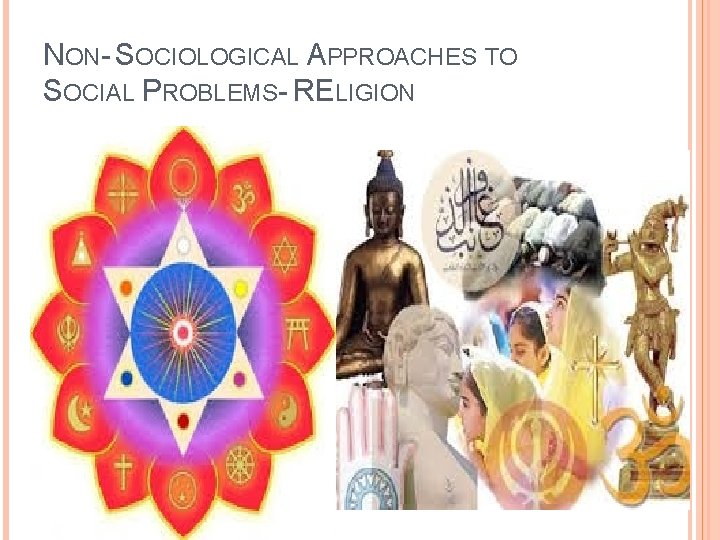
NON- SOCIOLOGICAL APPROACHES TO SOCIAL PROBLEMS- RELIGION: For thousands of years religious and legal codes have been the major perspectives through which social problems have been defined and acted upon. It is a social experience which is believed to be transforming or purifying. It distills and also composes the experience. According to Durkheim the realm of the sacred, was the most powerful realm in the early development of human consciousness. Many of our moral or even metaphysical concepts have arosed due to the differentiation made between sacred and profane.
NON- SOCIOLOGICAL APPROACHES TO SOCIAL PROBLEMS Therefore from this perception social problems are judged as good and evil or right and wrong. From a theological point of vie may of the social problems are treated as violations of divinely sanctioned moral order. They are often considered as to be manifestations of evil, of original sin. The theologian will concede readily that such acts as murder, adultery and theft are susceptible in part to nonreligious explanations and it may be due to influences of environment.
NON- SOCIOLOGICAL APPROACHES TO SOCIAL PROBLEMS Even a pastor may not hesitate to avail the help of legal and social agencies to sort out certain social problems. But, as a theologian, he will probably choose to see the final explanation of these acts in religious terms as violation of God’s commandments, as sin. The ultimate solution would be expiation through prayer and penance.
NON- SOCIOLOGICAL APPROACHES TO SOCIAL PROBLEMS- LAW There is a both logical and historical relationship between the religious and legal approaches to social problem. In acts such as murder and theft are conceived as violations of the duly constituted and sanctioned law of the society concerned. From a judicial point of view, the social problem has its legal reality as a crime, tort, or other breach of the legal order.
NON- SOCIOLOGICAL APPROACHES TO SOCIAL PROBLEMS- LAW A murder is not something for either study or redemptive prayer, it is the signal for mobilization of the whole retributive apparatus of the state, a mobilization that does not end until judicial determination of guilt is concluded. The modern legal process increasingly avails itself of the resources of medicine, psychiatry, and the social sciences. A case that begins as a hard and fast legal matterwith apprehension, prosecution and punishment may end therapeutically rather than retributively.
NON- SOCIOLOGICAL APPROACHES TO SOCIAL PROBLEMS- LAW The borrowed objective is cure rather than punishment. And that social prevention of crime, rather than repression alone, has become more widely accepted in many communities is a mark both of rising recognitions of the practical contributions of the social sciences and of more humane objectives of law-enforcement agencies. The guilty person must pay fines for the sins committed, through imprisonment to execution.
JOURNALISTIC APPROACH Ever since the 18 th century, newspapers and magazines have been notable organs of exposure of and protest against exploitation, corruption, and degradation in society. Accurate exposure difficult because of sensationalism and yellow journalism. In the United States, the so-called Muckrakers- , group of courageous and perceptive journalists that included Lincoln Steffens, Ida Tarbell , and Upton Sinclair. Above any other single force it was first of its kind in shocking the American Public on Social Problems
JOURNALISTIC APPROACH The issues ranged from burgeoning cities and its contribution to the emergence of social problems. The news coverage forced public agencies to take action. Today, the newspaper and the magazine remain valuable instruments for awakening popular response to narcotic, poverty, slums, prostitution, delinquency. They also cover all other issues that may take refuge behind public lethargy or official incompetence
JOURNALISTIC APPROACH The primary intention of journalism is to shock or shame the public into awareness of violations of the legal moral order. Exposure is the overriding aim; all else-whether understanding, prevention, cure, or punishment- is secondary. The method is consequently impressionistic and rarely contextual.
ART A fourth approach to social problems, that of the artist, is to be seen in all spheres of art, painting, dram, poetry, but nowhere so compellingly as in the social novel. Some of the most celebrated literary works of the past century have been conceived by their authors in hatred of poverty, injustice, and inequality. In the nineteenth century the mordant depictions of lower class misery under the impact of the new industrialism contained in the works of Mrs. Gaskell, Charles Kingsley, Charles Dickens and Emile Zola.
ART In a later period, the works of Henrik Ibsen, H. G. Wells, Samuel Butler, George Bernard Shaw and John Galsworthy bring to attention the cankering social and moral problems. In Europe, the social novel and play attained, in the late nineteenth and early twentieth centuries, much of the appeal to popular taste that picaresque or romantic novel had held earlier. It was therefore an effective vehicle of the development of humanitarianism.
ART The novels of David Graham Phillips, Upton Sinclair, Theodore Dreiser, John Stein beck James Farrell, Charles Jackson, Nelson Algreen and others have dealt with haunting social problems in a genius way. Some of the books such as Susan Lenox, The Jungle, An American Tragedy, The grapes of Wrath, The Lost Weekend, The Man with the Golden Arm, and Invisible man have illuminated on issues like prostitution, poverty, crime, job and family dislocation, juvenile delinquency, alcoholism, narcotics, ethnic segregation, and other social problems.
ART Music- Music such as ballads and folk songs have always had a powerful impact in creating awareness of social problems. Beautiful and moving “ The Boxer” by Simon and Garfunkel with its reminder of the impoverished and the rootless. The songs of Beatles and their pioneering efforts to fuse the character of rock with illumination of the political and social setting. Music is today, as it always has been, one of the most important avenues to awareness of, and action on, social problems.
SOCIOLOGICAL PERSPECTIVE The primary intent of the sociologist is to seek their determining context and their relation to other areas of social behaviour. For example a student of social problems might try to determine why in a society with the highest standard of living in the world, millions of people are living in poverty? He / She may examine why, in a society which stresses a high level of education, may highly educated people are unemployed? Through the collection of data on such phenomena, he hopes to contribute to the means of remedying the situation and making it possible for a greater number of citizens to lead personally satisfying lives.
SOCIOLOGICAL PERSPECTIVE For instance, drug addiction- A problem like this is analyzed by sociologists. They discover the causes and effects of it by analysing its manifestations in certain groups of people under various socio-cultural conditions. Two classic works Suicide by Emile Durkheim 1896 The Polish Peasant by W. I. Thomas and F. Znaniecki – delinquency and crime among the polish population of Chicago.
These works lifted social problems from the simple and sterile perspectives “ perspectives of pathology”, “evil” and the like- and related it significantly to some of the main currents and contexts of modern western society: individualism, secularism, urbanism and industrialism According to Nisbet, The sociological approach was popularised by pioneers such as Le-Play, Durkheim, Weber, C. H. Cooley and others by applying different methodologies and theories.
Even today when sociology has built up an imposing body of empirical fact, sociologists continue to find in their studies of crime narcotics, alcohol, delinquency and other social problems insights into the nature of human behaviour with implication that reach for beyond the empirical area from which they are drawn.
- Slides: 42