
Social Problems and Divorce Eportfolio Soc1020 Alex Phillips
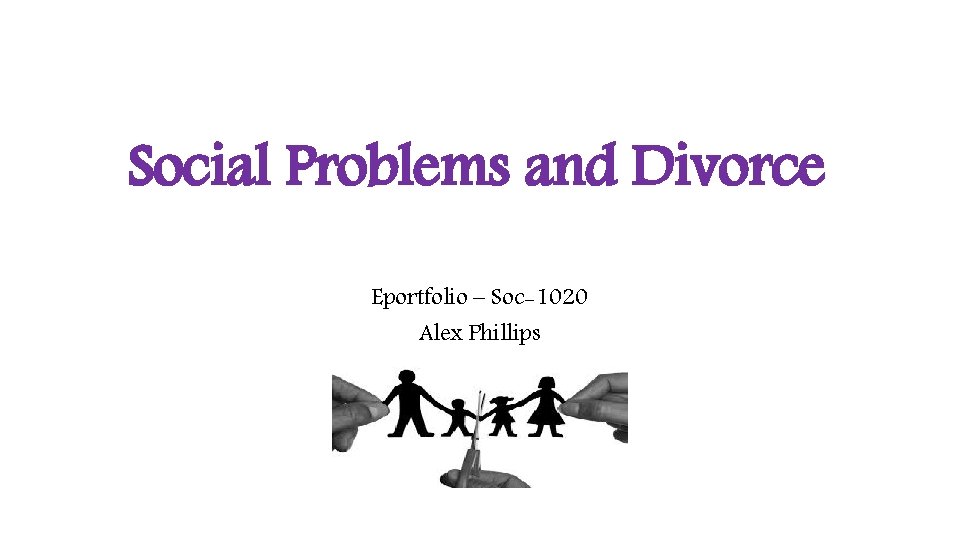
Social Problems and Divorce Eportfolio – Soc-1020 Alex Phillips
Table of content: • Reflection Page 1 • Article Review 2 • Facts, Data and Charts – Divorce Rates • Book Review – The Truth about Children and Divorce • Robert E Emery • Reflection Page 2 • Conclusion – Personal Thoughts
Reflection Page 1 • I personally picked the topic of divorce to explore and do my reflection on because I recently just went through a divorce myself, therefore I feel as if I have a lot of good knowledge I can use to help me with my eportfolio project. Also, I went through my divorce with a lot of unanswered questions and I think choosing this as my topic, it may help me get some of the questions I have about my divorce, answered. • What I know about divorce: Divorces are as common as marriages themselves. Couples marry and when something goes wrong in their relationship they divorce. Divorce is now a popular solution to problems that many couples have. In the past several years, the divorce rate has skyrocketed to a record high of almost fifty percent. It is also believed that the divorce rate is higher in the United States than in any other country in the world. Although divorce is not always the answer, it is sometimes necessary for many situations. This raises the question of why divorce is more common today than it was in the past. Some reasons for seeking a divorce include infidelity, domestic violence, and a lack of communication, among others. It is accepted in most societies that “where there is a marriage, there is a divorce. ” Our society has a confused attitude towards divorce: accepting it as inevitable but at the same time, hankering after the religious ideal of “till death due us part. ” Even still, the divorce rate continues to climb. • When dealing with a divorce, both people may feel betrayed, cheated, a loss of friends they may have had or fear of being alone. On the other hand more serious problems may occur. This included alcohol, drug abuse, money problems, physical abuse, children or perhaps in-laws. May couples say that the relationship didn’t turn out the way they expected that is why the decided to separate for good. Some believe that they just don’t feel the dame about their partner anymore. • So now you are divorced, and you believe the first time you married was for real love. As a result, you might decide the next time you marry will be based not on love but on what someone can provide for you. Someone who will help to take care of your kids; someone that is financially secure, a nice personality, and won’t do the things that drove you crazy about your ex. How fair is that to the person you find that fits the bill? How fair is that to yourself, being with someone just for what they can do for you.
Children Of Divorce: Study Finds Younger Children Feel Lasting Effects Of Divorce. – Huffington Post • According to this Article by the Huffington Post, there have been many studies done on divorce and how it has a long lasting effect on children. As these studies are in process, one of the major conclusions they have come about is that those parents who are divorced and have children, do unfortunately have a difficult time gaining a fair relationship with their parents. • A recent study showed that children between 3 and 5 years old whose parents end up in a divorce end up with more insecurities about themselves and their relationships with their parents, than those who are older and parents are divorced have less insecurities. • The article states: "A person who has a secure relationship with a parent is more likely than someone who is insecure to feel that they can trust the parent, ” said R. Chris Fraley, associate professor at the University of Illinois at Urbana-Champaign and co-author of the study. "Such a person is more comfortable depending on the parent and is confident that the parent will be psychologically available when needed. ” • As research continues, they have come to an understanding that the relationship that a child has with their divorced parents is very crucial and important. It has an effect on how the child may grow up and have an impact on their future with their potential children as well. As always, I feel it’s important to have a very close relationship with your parents, especially when a divorce is in the pictures. Parents should stay close and personal with their child. • Work Cited: • Post, Huffington. "Children Of Divorce: Study Finds Younger Children Feel Lasting Effects Of Divorce. " Huffingonostcom. Huffington Pot, 01 July 2013. Web. 23 July 2015.
Psychological and Emotional Aspects of Divorce – Kathleen O’Connell Corcoran • There are many psychological and emotional issues that effect children when a divorce happens in a family. Accoroding to this article, it stresses the concern that children who come from divorce families a lot of the time have suffered from depression, tend to get in trouble with the law and do poorly in school. They have also determined that those whose parents are divorced and can communicate effectively, tend to succeed more than those whose parents lack communication skills post-divorce. • I found it interesting that through certain studies, they have come to know that boys suffer more than girls through a divorce. Boys tend to struggle more in the social and academic department more than girls. Both genders have a different way of handling the situation, as boys tend to act out their anger and frustration and girls tend to internalize their feelings and stress. • One major fact about the future for children who come from divorced families is that a child’s continued involvement with both of his or her parents allows for realistic and better balanced future relationships. We watch and learn how to have a relationship by watching our parents relationships. If a child has a close and personal relationship with their parents, they are more than likely to have a successful relationship in their adulthood. • The article states: Joan Kelly, Ph. D, former president of the Academy of Family Mediators and prominent divorce researcher from California reports that, depending on the strength of the parent-child bond at the time of divorce, the parent-child relationship diminishes over time for children who see their fathers less than 35% of the time. Court-ordered "standard visitation" patterns typically provide less.
Psychological and Emotional Aspects of Divorce – Kathleen O’Connell Corcoran • Some of the side effect and outrages from children from divorce are: • Denial • Abandonment • Preoccupation with information • Anger and Hostility • Depression • Immaturity/Prematurity • Guilt and Blame • Acting out • Work Cited: • Corcoran, Kathlen O'Conell. "Psychological and Emotional Aspects of Divorce. " Mediate. com. Kathleen Corcoran, 01 June 1997. Web. 23 July 2015.
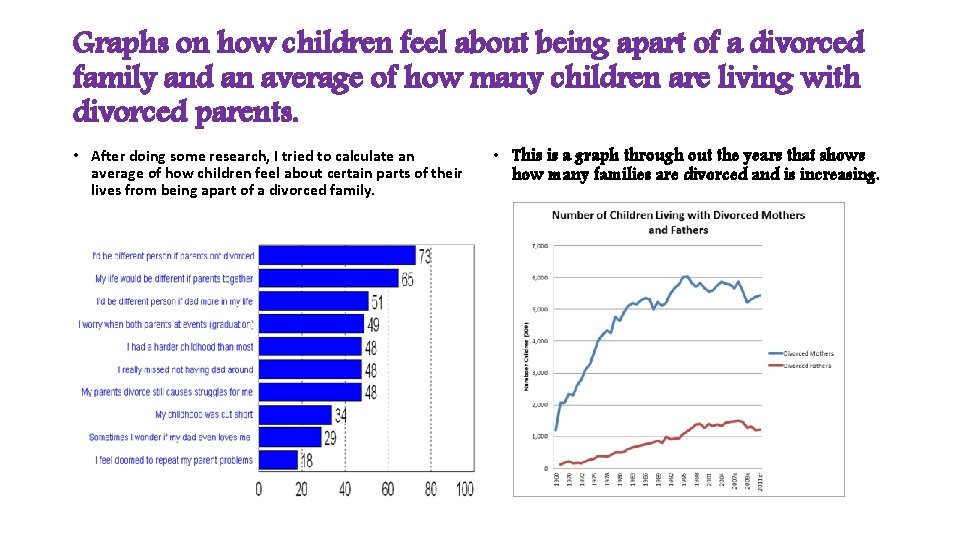
Graphs on how children feel about being apart of a divorced family and an average of how many children are living with divorced parents. • After doing some research, I tried to calculate an average of how children feel about certain parts of their lives from being apart of a divorced family. • This is a graph through out the years that shows how many families are divorced and is increasing.
Reflection Page 2 • There are some well known factors that put people at higher risk for divorce: marrying at a very early age, less education and income, living together before marriage, a premarital pregnancy, no religious affiliation, coming from a divorced family, and feelings of insecurity. The most common reasons people give for their divorce are lack of commitment, too much arguing, infidelity, marrying too young, unrealistic expectations, lack of equality in the relationship, lack of preparation for marriage, and abuse. Some of these problems can be fixed and divorce prevented. Commitment is having a long-term view of the marriage that helps us not get overwhelmed by the problems and challenges day to day. When there is high commitment in a relationship, we feel safer and are willing to give more for the relationship to succeed. Commitment is clearly a factor in why some couples stay together and others divorce. Divorce is necessary at times, and it may even help to preserve the moral boundaries of marriage. But parents have a responsibility to do all that they reasonably can to preserve and repair a marriage, especially when the reasons for divorce are not the most serious ones. Barriers to leaving a marriage, such as financial worries, can keep marriages together in the short run. However, unless there is improvement in the relationship, eventually the barriers are usually not enough to keep a marriage together in the long run. Divorce is both very personal and all too common. But there are many myths about divorce. Individuals at the crossroads of divorce may benefit by knowing the research facts about divorce rates, factors that are associated with a higher risk of divorce, and common reasons that people give for divorcing. To say that nearly half of all first marriages end in divorce sounds a lot like saying marriage is just a game of chance. But a lot of research has identified various factors that are associated with a higher risk for divorce. So some people actually have a low risk of divorce while others have a high risk. Understanding these factors may not directly help you improve your marriage or make a decision about divorce, but it may help you understand why you may be facing some challenges. Of course, these factors do not guarantee that you will divorce; they simply increase your risk.
Book Review: The Truth About Children and Divorce: Dealing with the Emotions So You and Your Children Can Thrive. By: Robert E. Emery • Emery takes his place alongside the judicious and thoughtful work of Joan Kelly as well as Mavis Hetherington. Emery offers an assessment of where the ‘truth’ lies about divorce: in the vast majority of cases, divorce, he notes, does not permanently damage children. But it is a major stressor and causes much pain. As he summarizes: “pain is not pathology. Grief is not a mental disorder. But it is also true that resilience is not invulnerability. The pain is real. ” (p. 81). • Robert has another goal: clarifying the conflicting data on the impact of divorce on children. Ever since Judith Wallerstein’s controversial book The Unexpected Legacy of Divorce suggested that parents might choose not to divorce for the sake of their children, we have seen divorcing parents anxious that they are harming their children. And on the other side, we have the self-help shelves offering the ‘good’ divorce. • Finally, Emery employed his research skills on his own work as a mediator. He studied a group of couples contesting custody. Though working with small numbers, he was able to assign people randomly to two groups: one was offered mediation; the other had no intervention and so continued litigation. Amazingly, he found in a follow-up study that nonresidential parents in the couples who mediated “were three times more likely to see their children at least once a week twelve years after the mediation or legal proceedings ended ” (p. 228). This is just one of a host of similar findings of significant difference between the litigated and mediated group 12 years later! Emery offers one of the most dramatic findings I know about the impact of mediation

Book Review: The Truth About Children and Divorce: Dealing with the Emotions So You and Your Children Can Thrive. By: Robert E. Emery • This is a self-help book, written for parents in the midst of divorce, but one that a professional can recommend in good conscience. The way Emery is able to make familiar points with fresh images and apt metaphors leaves the book a cut above the rest of the field. For example, regarding new relationships: “You get to pick your partner, but whom you get involved with is an arranged marriage for your children. ” • About dating: “You’re ready to date when you’re ready to tell other people–including your ex and your children–that you’re dating…Beginning to date after divorce is kind of like unprotected sex: You shouldn’t start doing it unless you’re prepared to deal with the consequences. ” • About parents abdicating decisions to their children about schedules: “How many children would be truant if parents asked them every morning if they wanted to go to school–and actually let the children decide? ”
Book Review: The Truth About Children and Divorce: Dealing with the Emotions So You and Your Children Can Thrive. By: Robert E. Emery • And I love his vivid description of the difference between the leaver and the left in divorce: “…the leaver…has thought through why he wants a divorce, built up a case in his mind about why his decision is right, and probably even carefully considered where the children might live, how the property might be divided, how his life might be afterward. If there is an affair, the leaver has already made a leap into a future–perhaps even what seems a very promising future–without the current spouse. The leaver possesses something her [his? ] partner may need a very long time to develop–a vision of the future, a future outside this marriage… This might have taken him years or perhaps only months, but he has already started distancing himself from the marriage; he has already begun thinking of it as something that once was–not something that is, will be, could be, should be, might be. ” (p. 38). • Emery is passionate in urging that parents do the hard work of being adults in order to protect their children in divorce. His passion, as well as his wisdom, clearly shines through in this book. I recommend it.
Conclusion and my personal thoughts • For children, divorce can be stressful, sad, and confusing. At any age, kids may feel uncertain or angry at the prospect of mom and dad splitting up. As a parent, you can make the process and its effects less painful for your children. Helping your kids cope with divorce means providing stability in your home and attending to your children's needs with a reassuring, positive attitude. It won't be a seamless process, but these tips can help your children cope. • There are many ways you can help your kids adjust to separation or divorce. Your patience, reassurance, and listening ear can minimize tension as children learn to cope with new circumstances. By providing routines kids can rely on, you remind children they can count on you for stability, structure, and care. And if you can maintain a working relationship with your ex, you can help kids avoid the stress that comes with watching parents in conflict. Such a transitional time can’t be without some measure of hardship, but you can powerfully reduce your children’s pain by making their well-being your top priority.
- Slides: 12