
Social Preconditions for Operational Excellence in engineertoorder dynamic
- Slides: 18
Social Preconditions for Operational Excellence in engineer-to-order dynamic systems The context of the Norwegian offshore shipbuilding Hajnalka Vaagen, SINTEF Applied Economics and Operations Research , Trondheim, Norway Jan Emblemsvåg Managing Director Kongsberg Evotec (former Senior Vice President Innovation and Process Management VARD Group) Eirik Borgen, SINTEF Applied Economics and Operations Research , Trondheim, Norway Technology for a better society 1
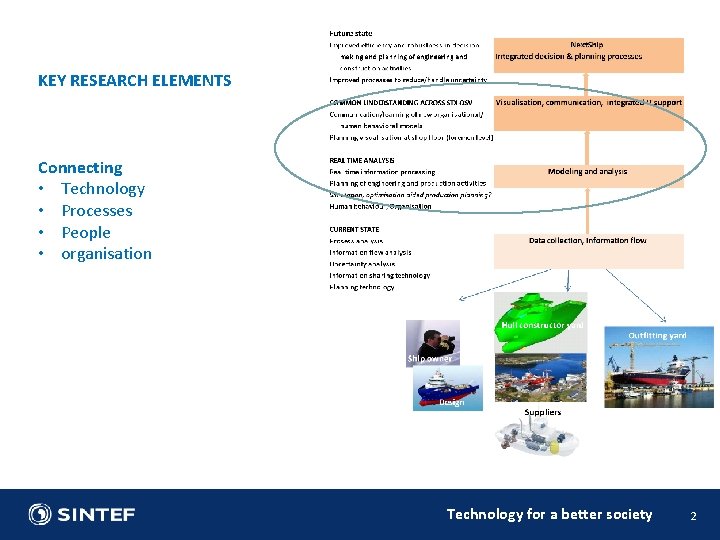
KEY RESEARCH ELEMENTS Connecting • Technology • Processes • People • organisation Technology for a better society 2
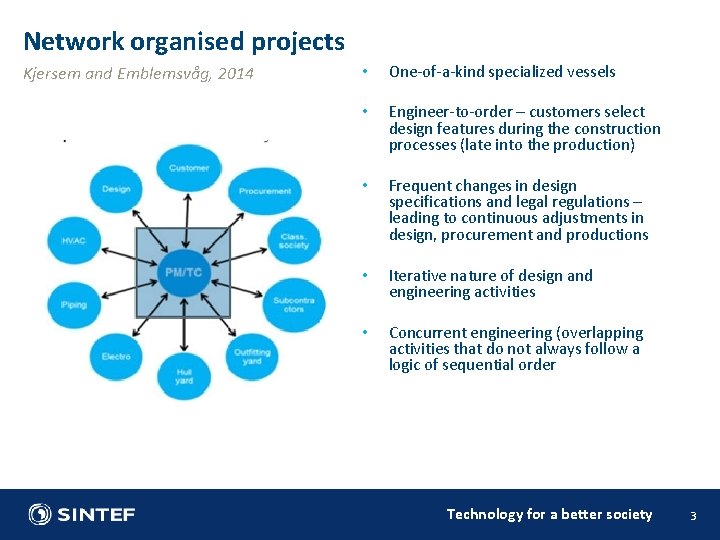
Network organised projects Kjersem and Emblemsvåg, 2014 • One-of-a-kind specialized vessels • Engineer-to-order – customers select design features during the construction processes (late into the production) • Frequent changes in design specifications and legal regulations – leading to continuous adjustments in design, procurement and productions • Iterative nature of design and engineering activities • Concurrent engineering (overlapping activities that do not always follow a logic of sequential order Technology for a better society 3
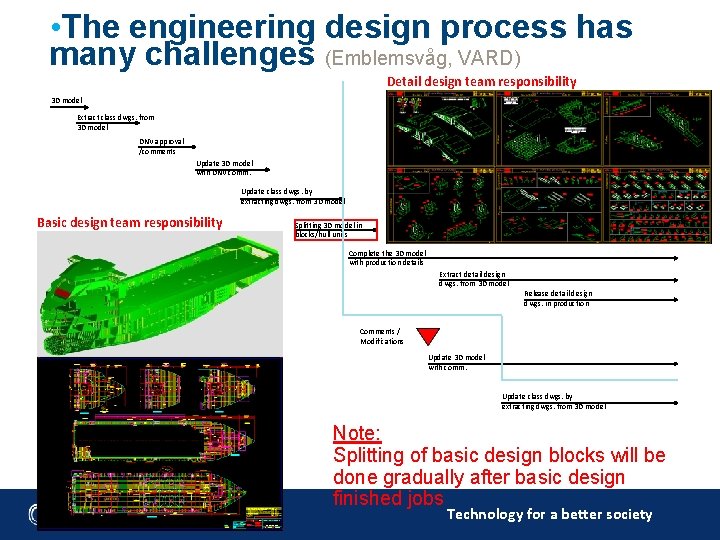
• The engineering design process has many challenges (Emblemsvåg, VARD) Detail design team responsibility 3 D model Extract class dwgs. from 3 D model DNV approval /comments Update 3 D model with DNV comm. Update class dwgs. by extracting dwgs. from 3 D model Basic design team responsibility Splitting 3 D model in blocks/hull units Complete the 3 D model with production details Extract detail design dwgs. from 3 D model Release detail design dwgs. in production Comments / Modifications Update 3 D model with comm. Update class dwgs. by extracting dwgs. from 3 D model Note: Splitting of basic design blocks will be done gradually after basic design finished jobs 3/4/2021 | Page 4 Technology for a better society
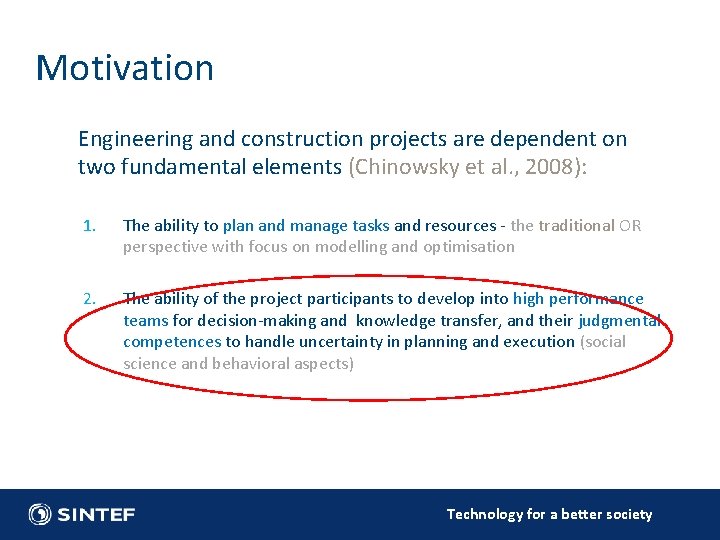
Motivation Engineering and construction projects are dependent on two fundamental elements (Chinowsky et al. , 2008): 1. The ability to plan and manage tasks and resources - the traditional OR perspective with focus on modelling and optimisation 2. The ability of the project participants to develop into high performance teams for decision-making and knowledge transfer, and their judgmental competences to handle uncertainty in planning and execution (social science and behavioral aspects) Technology for a better society
The objective - Improve understanding on the impact of the human and social elements on engineering planning and decision-making RESEARCH QUESTION • How social capital and micro-level behaviour in engineering (like motivation, trust, risk attitudes, cognitive overloading) influences macro level decisionmaking (e. g. design flexibility offered to the market) ? Technology for a better society 6
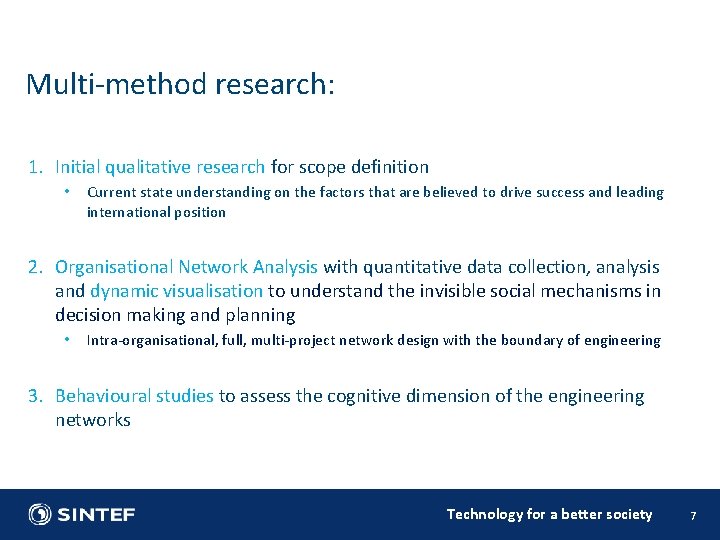
Multi-method research: 1. Initial qualitative research for scope definition • Current state understanding on the factors that are believed to drive success and leading international position 2. Organisational Network Analysis with quantitative data collection, analysis and dynamic visualisation to understand the invisible social mechanisms in decision making and planning • Intra-organisational, full, multi-project network design with the boundary of engineering 3. Behavioural studies to assess the cognitive dimension of the engineering networks Technology for a better society 7
Findings from the qualitative study… • Social capital (tacit knowledge, trust, network connections) is believed to be the major driver of the competitive advantage (e. g. design flexibility throughout the construction processes) • Human behaviour is driven by social motivations - violating the OM/OR assumption of people being hyper-rational decision makers; Urda and Loch, 2013 • Potential difference between established formal reporting systems and 'true' networks – Time consuming to maneuver through the 'tacit' informal network Technology for a better society 8
Findings from the qualitative study… • Engineers use a large share of their time on coordination activities upstream and downstream in the value chain • Model based decision aids and current PM approaches fail to capture important characteristics of real systems, e. g. concurrency between advanced design, engineering and execution, and complex uncertainty and dependency patterns – State-of-the-practice: judgemental adjustments of some 'deterministic' plans provided by standards software • The listed challenges are believed to apply to the Norwegian shipbuilding cluster as a whole Technology for a better society 9
Organisational Network Analysis Understanding built by 4 networks: A. B. C. D. Daily work Challenge handling Personal, trust True project organisation Technology for a better society 10
Findings from SNA wrt. the RQ: How micro level behaviour (trust, risk perception, human-computer interaction) influences macro level decision-making (i. e. flexibility offered to customers)? 1. TRUST - High level of trust in the organisation. The structural dimensions of the A, B, C networks, and the relational dimension (strength and orientation; in-out degree) of A and C networks overlap Trust potentially plays a vital role in daily work and uncertainty handling Large extent of tacit knowledge, trust, and the ability to form high performance networks to develop innovative solutions and handle variations, directly affects the design flexibility offered to the customers micro level behaviour drives strategic decisions and competitive advantage Technology for a better society 11
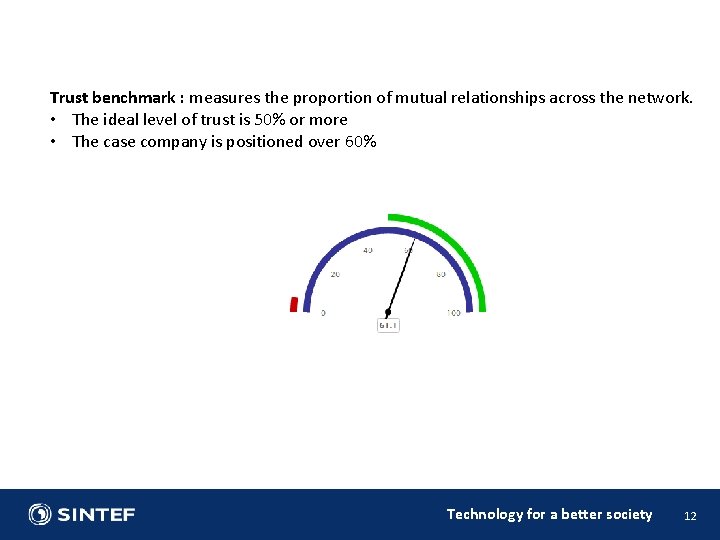
Trust benchmark : measures the proportion of mutual relationships across the network. • The ideal level of trust is 50% or more • The case company is positioned over 60% Technology for a better society 12
2. RISK Perception Daily work and challenge handling networks overlap - indicating that challenge and risk is part of the daily work • • • The perceived risk is 'lower' than in contexts where changes occur occasionally The impact of a 'change' is low compared to the overall wealth of the company, leading to 'risk neutral decision making Judgemental adjustments reflect experience, tacit knowledge and individual aspiration levels Valence theory: optimistic risk perceptions are attributed positive emotions (Lerner and Keltner, 2000) • Customer driven design uncertainty is a profit- driver opportunity - positive emotions, optimistic risk perception and self-esteem facilitate innovative solutions on different levels in the organisation Technology for a better society 13
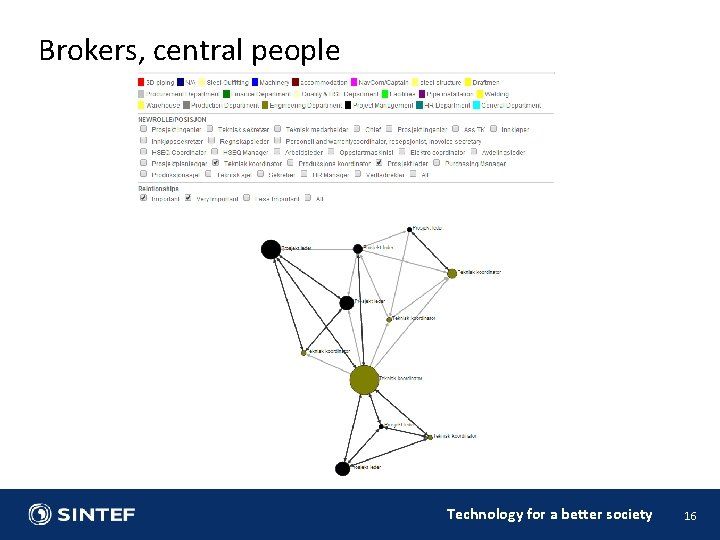
The true communication network - to make invisible patterns of information flow, knowledge transfer and collaboration visible SNA helps to identify: – Central people, functions- in terms of information flow within the group – 'cognitive overload' (in terms of information and knowledge transfer, informal advisor, collaborator) bottlenecks – Peripheral people , that essentially represent untapped expertise and underutilized resource – members in theory but not in practice – Subgroups, within a network, as a product of location, function, hierarchy, tenure, age, gender – The connection between different divisions in the organisation (for example: connection between engineering-production packages, planning-production, etc) – Connect engineering and production work packages – Visualisation of the relationships, and quick dynamic display of a network Technology for a better society
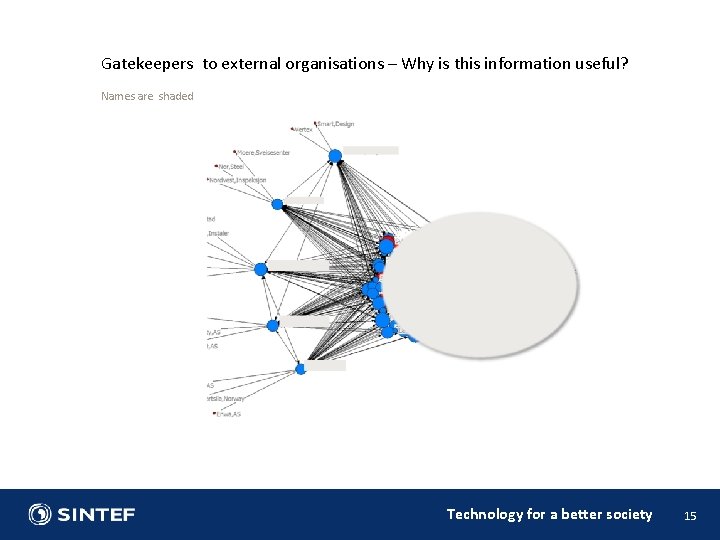
Gatekeepers to external organisations – Why is this information useful? Names are shaded Technology for a better society 15
Brokers, central people Technology for a better society 16
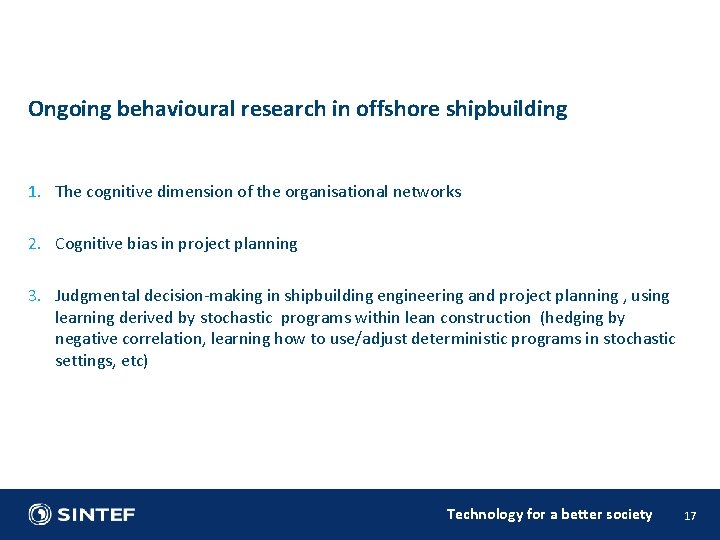
Ongoing behavioural research in offshore shipbuilding 1. The cognitive dimension of the organisational networks 2. Cognitive bias in project planning 3. Judgmental decision-making in shipbuilding engineering and project planning , using learning derived by stochastic programs within lean construction (hedging by negative correlation, learning how to use/adjust deterministic programs in stochastic settings, etc) Technology for a better society 17
Thank you for your attention Hajnalka Vaagen, hajnalka. vaagen@sintef. no SINTEF Applied Economics and Operations Research , Trondheim, Norway Technology for a better society 18