
Social Policy and Education The History of Education
- Slides: 29
Social Policy and Education
The History of Education
1880 -1944 What education was like from 1880 -1918: • Compulsory education for all children introduced; The Elementary Education Act (1880). • Education controlled by local administrators • Basic skills taught with religious instruction • Gender separation • Boys- practical skills • Girls- “domestic competence” • A small percentage of working class pupils won scholarships
“Social Democracy” and Education reforms • War brought about a change of ideas. • 1918; All men over the age of 21 given the right to vote. • 1928; equal voting rights for women. • “The Social Democratic Idea”; all citizens should have a say in society.
“Social Democracy” and Education reforms The results of this change were: • A demand for meritocracy. • Education was seen as a mechanism in which individuals had ‘equal chances’ to develop their talents. • However, education still advantaged the upper and middle classes most.
Social Policy
1944 -1965 - the ‘Tripartite System’ • After WW 2, the Atlee government launched the “a land fit for heroes” objective. • The Butlers Education Act (1944) ratified compulsory • • 1. 2. 3. secondary education for all pupils. ^ This aimed to abolish class inequalities within state- education. A tripartite system was introduced- it provided 3 types of secondary school to suit 3 types of ability: Grammar Schools (able pupils) Technical Schools Secondary Moderns (average pupils)
1944 -1965 - the ‘Tripartite System’ • Underpinning the Tripartite system was the belief that intelligence was innate and could be scientifically measured via examinations. • ^ Therefore, all children took an 11+ which allocated them to the school that suited their best ability. • Each school had a ‘parity of esteem’; (Equal status)
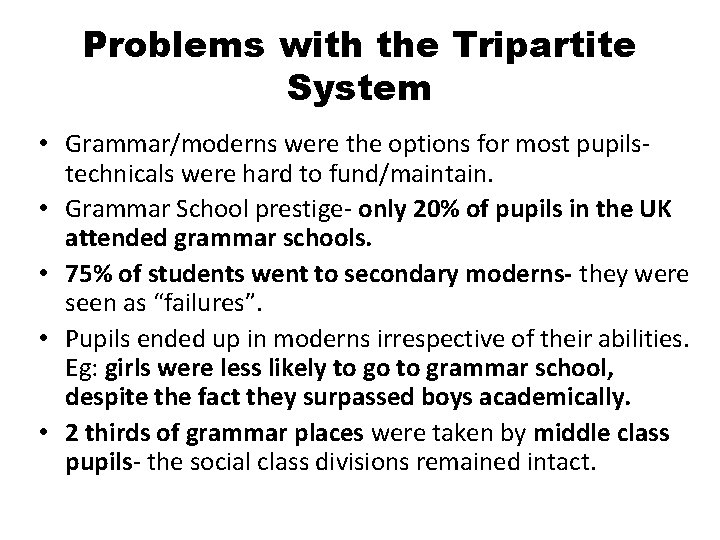
Problems with the Tripartite System • Grammar/moderns were the options for most pupilstechnicals were hard to fund/maintain. • Grammar School prestige- only 20% of pupils in the UK attended grammar schools. • 75% of students went to secondary moderns- they were seen as “failures”. • Pupils ended up in moderns irrespective of their abilities. Eg: girls were less likely to go to grammar school, despite the fact they surpassed boys academically. • 2 thirds of grammar places were taken by middle class pupils- the social class divisions remained intact.
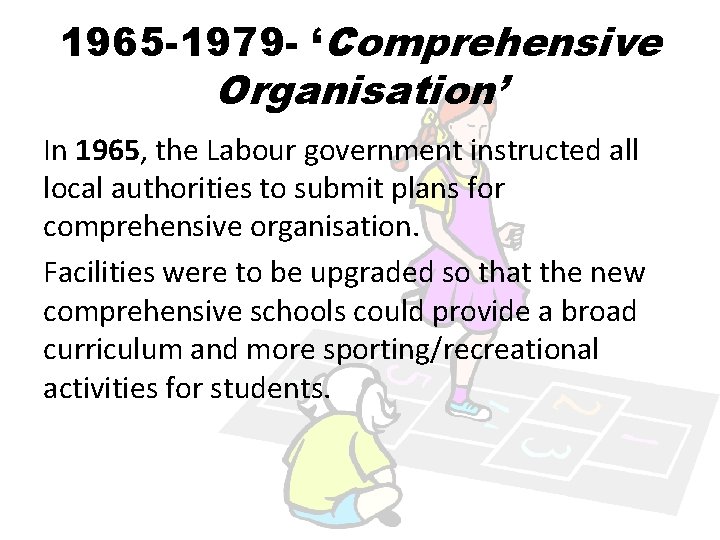
1965 -1979 - ‘Comprehensive Organisation’ In 1965, the Labour government instructed all local authorities to submit plans for comprehensive organisation. Facilities were to be upgraded so that the new comprehensive schools could provide a broad curriculum and more sporting/recreational activities for students.
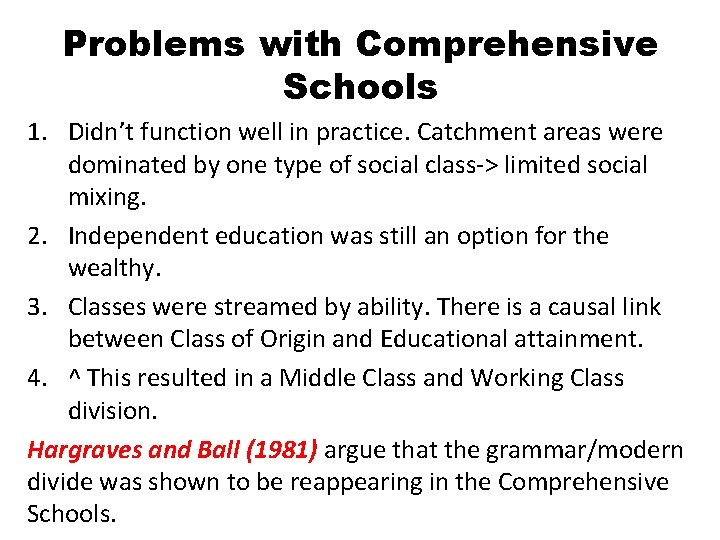
Problems with Comprehensive Schools 1. Didn’t function well in practice. Catchment areas were dominated by one type of social class-> limited social mixing. 2. Independent education was still an option for the wealthy. 3. Classes were streamed by ability. There is a causal link between Class of Origin and Educational attainment. 4. ^ This resulted in a Middle Class and Working Class division. Hargraves and Ball (1981) argue that the grammar/modern divide was shown to be reappearing in the Comprehensive Schools.
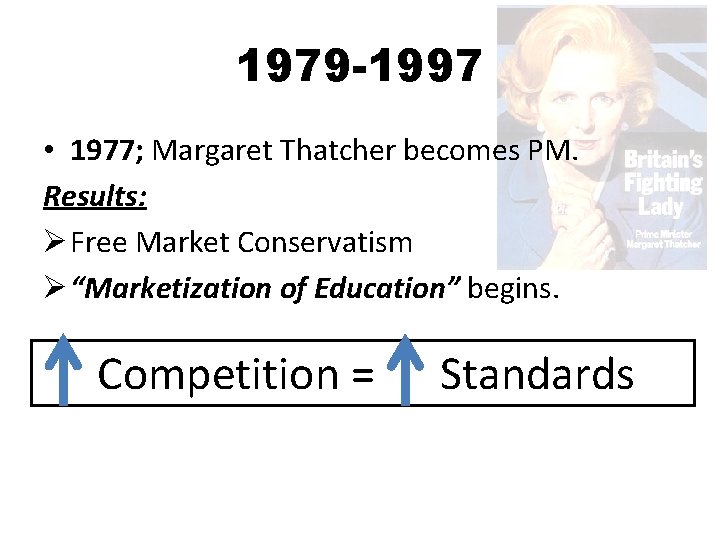
1979 -1997 • 1977; Margaret Thatcher becomes PM. Results: Ø Free Market Conservatism Ø “Marketization of Education” begins. Competition = Standards
‘Vocational education’ and training • The “skills crisis” was blamed for Britain’s economic decline. • “New Vocationalism” began; government schemes to: ü reduce youth unemployment ü increase youth ‘skill levels’ ü make pupils more aware of the world of work.
Criticisms of Vocationalism • Finn (1987) – ‘’hidden political agenda’. • ^ Cheap labour for employers/ low pay rates for young workers. • Undermines the power of Trade Unions because only permanent workers can be members. • Reduces ‘Politically embarrassing’ unemployment statistics. • Intended to reduce street crime by retaining young people from the streets; “two birds with one stone”. • Cohen (1984); ‘real purpose’ of VT = creation of ‘good attitudes’ and work discipline rather than job/work skills. • Young people who don’t wish to be exploited are punished with the withdrawal of unemployment benefits.
Criticisms of Vocationalism • Youth unemployment due to lack of skills, not jobs. • Skills only taught for the secondary/manual labour market = limited prospects. • Working class and ethnic minorities disproportionally represented in Youth Training Scheme Courses. • Bcswell (1987) “gender inequality”. (Df. ES 2006) apprenticeship stats: Ø Hairdressing = 6% male, 94% female. Ø Retail= 38/62 split. Ø Construction crafts= male/female ration at 99: 1
1988 Education Reform Act The most influential movement in Education since 1944. Government emphasis on choice and competition in education… (the New Right)
Elements of the ERA (1988) Marketization = competition between schools was encouraged with the financial incentive for schools to improve. Testing = judging the quality of schools. All students were to sit national tests at 7, 11 and 14. These tests plus GCSE and A-Level results would be used to draw up League Tables. The National Curriculum= Prescribed range of subjects that every school would teach. More power to schools to decide budgets/pupil’s admissions.
Criticisms of the ERA (1988) • Concerns about ‘damaging’ effects of testing children so often. • Fear that schools would “teach to test” • League tables disadvantaged struggling/troubled pupils. • ^ Statistical iceberg; some schools did not enter underachieving students for exams. • Fewer places available in highly ranked schools= limited choice. • Political rivalry= abolition of labour controlled local authorities eg: councils. • Class divide- Middle Class parents used Culture Capital -eg: Ball et al (1994)- and economic capital to cover school costs.
New Labour (1997) and Onwards…
New Labour (1997) • Conservative influenced policies • Specialist Schools- increased choice, competition, raised standards and ‘specialities’ in languages, sports, humanities etc. • David Blunkett- claimed that New Labour would reform ‘bog standard’ local comprehensive schools. • Schools must raise £ 50, 000 from sponsors, which will be matched by government funding. • ^ By 2007, 80% of schools were ‘specialist’. • Work related training- multiple initiatives, raised school leaving age to 18 in order to provide schools/colleges with more Vocational Training schemes.
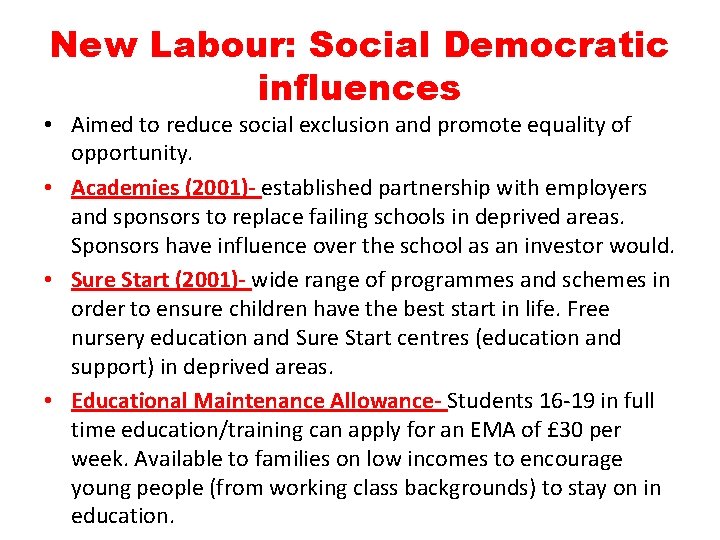
New Labour: Social Democratic influences • Aimed to reduce social exclusion and promote equality of opportunity. • Academies (2001)- established partnership with employers and sponsors to replace failing schools in deprived areas. Sponsors have influence over the school as an investor would. • Sure Start (2001)- wide range of programmes and schemes in order to ensure children have the best start in life. Free nursery education and Sure Start centres (education and support) in deprived areas. • Educational Maintenance Allowance- Students 16 -19 in full time education/training can apply for an EMA of £ 30 per week. Available to families on low incomes to encourage young people (from working class backgrounds) to stay on in education.
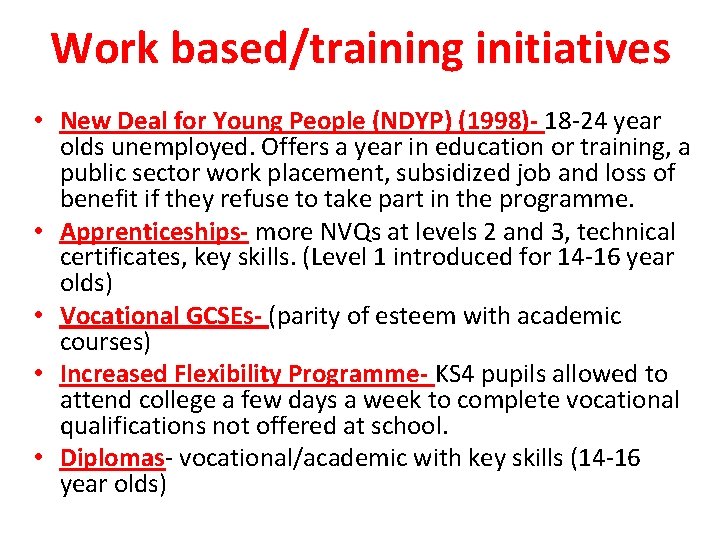
Work based/training initiatives • New Deal for Young People (NDYP) (1998)- 18 -24 year olds unemployed. Offers a year in education or training, a public sector work placement, subsidized job and loss of benefit if they refuse to take part in the programme. • Apprenticeships- more NVQs at levels 2 and 3, technical certificates, key skills. (Level 1 introduced for 14 -16 year olds) • Vocational GCSEs- (parity of esteem with academic courses) • Increased Flexibility Programme- KS 4 pupils allowed to attend college a few days a week to complete vocational qualifications not offered at school. • Diplomas- vocational/academic with key skills (14 -16 year olds)
Evaluating New Labour… (1997 -2010)
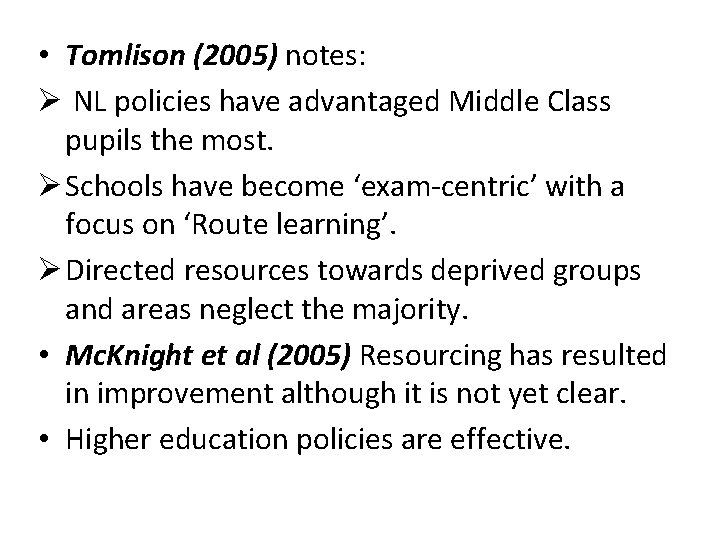
• Tomlison (2005) notes: Ø NL policies have advantaged Middle Class pupils the most. Ø Schools have become ‘exam-centric’ with a focus on ‘Route learning’. Ø Directed resources towards deprived groups and areas neglect the majority. • Mc. Knight et al (2005) Resourcing has resulted in improvement although it is not yet clear. • Higher education policies are effective.
Higher Education • NL target: 50% of youth in higher education by 2010. • Initiatives: ü Expansion of Universities ü Student loans on a flexiable basis ü Financial support for less affluent pupils Did this work? . .
Higher Education Statistics • Students from manual working class backgrounds attending university = INCREASE!; 11% to 19% between 1992 -2002 • However, middle class students have also increased at a greater rate… 35% to 50% 19922002 (evidence of Tomlinson 2005’s theory) • The Higher Education Statistics Agency (HESA) (2004/5) found only 28. 7% of young undergraduates came from manual labour backgrounds. • ^Mc. Knight et al (2004)
Higher Education: Conclusion • Mc. Knight et al (2005) “class inequalities in higher education have increased”. • Class inequalities are stubborn; education reflects these trends.
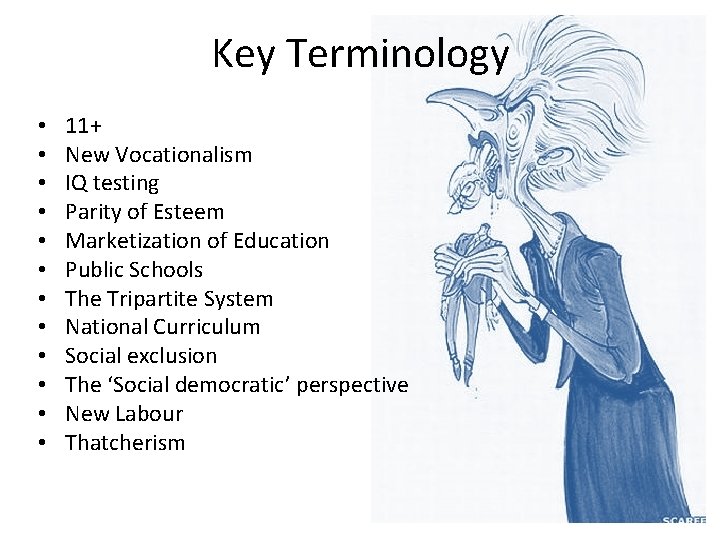
Key Terminology • • • 11+ New Vocationalism IQ testing Parity of Esteem Marketization of Education Public Schools The Tripartite System National Curriculum Social exclusion The ‘Social democratic’ perspective New Labour Thatcherism
“Education cannot compensate for Society” – Basil Bernstein, 1971.