
Social Pedagogy Organisational Change Janet Grauberg SPPA Webinar

Social Pedagogy & Organisational Change Janet Grauberg SPPA Webinar 22 November 2017
Overview: What would a social pedagogy approach to organisational change look like? � Introduction � Why it matters � What this presentation is (& isn’t) � A minute on organisational theory � The social pedagogy “Diamond Model” � Applying the Diamond Model to organisations � Conclusion � Please ask questions as we go along – don’t wait until the end. 2
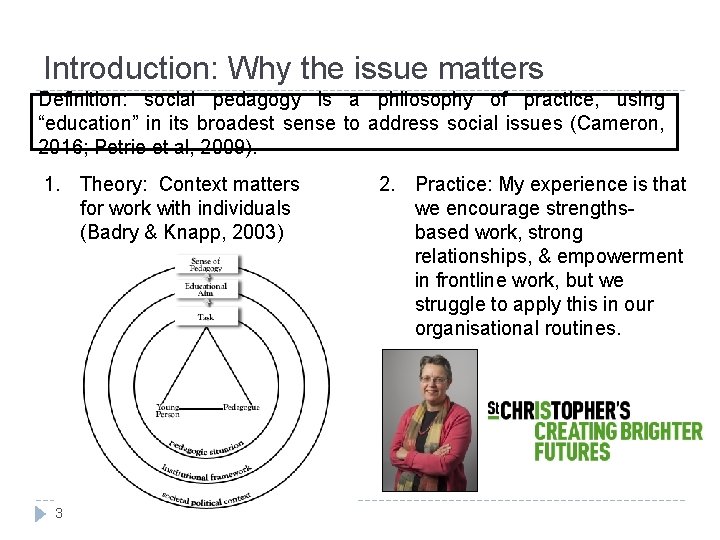
Introduction: Why the issue matters Definition: social pedagogy is a philosophy of practice, using “education” in its broadest sense to address social issues (Cameron, 2016; Petrie et al, 2009). 1. Theory: Context matters for work with individuals (Badry & Knapp, 2003) 3 2. Practice: My experience is that we encourage strengthsbased work, strong relationships, & empowerment in frontline work, but we struggle to apply this in our organisational routines.
Introduction: The Presentation Selective Practical 4 Leaping over Leaping philosophical over chasms philosophical chasms Standing on the shoulder s of giants
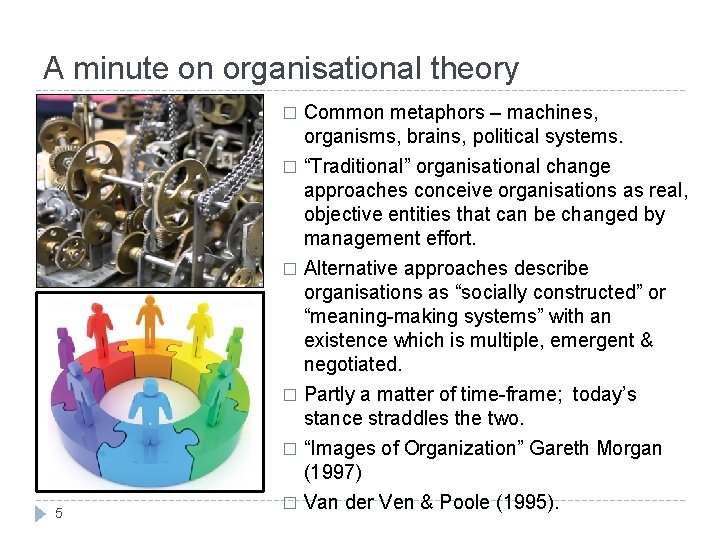
A minute on organisational theory � “Traditional” organisational change approaches conceive organisations as real, objective entities that can be changed by management effort. � Alternative approaches describe organisations as “socially constructed” or “meaning-making systems” with an existence which is multiple, emergent & negotiated. � Partly a matter of time-frame; today’s stance straddles the two. � “Images of Organization” Gareth Morgan (1997) � Van der Ven & Poole (1995). � 5 Common metaphors – machines, organisms, brains, political systems.
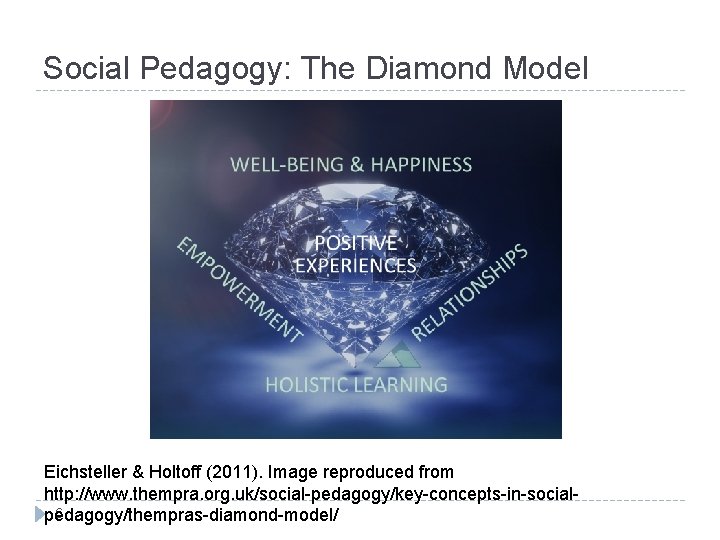
Social Pedagogy: The Diamond Model Eichsteller & Holtoff (2011). Image reproduced from http: //www. thempra. org. uk/social-pedagogy/key-concepts-in-social 6 pedagogy/thempras-diamond-model/
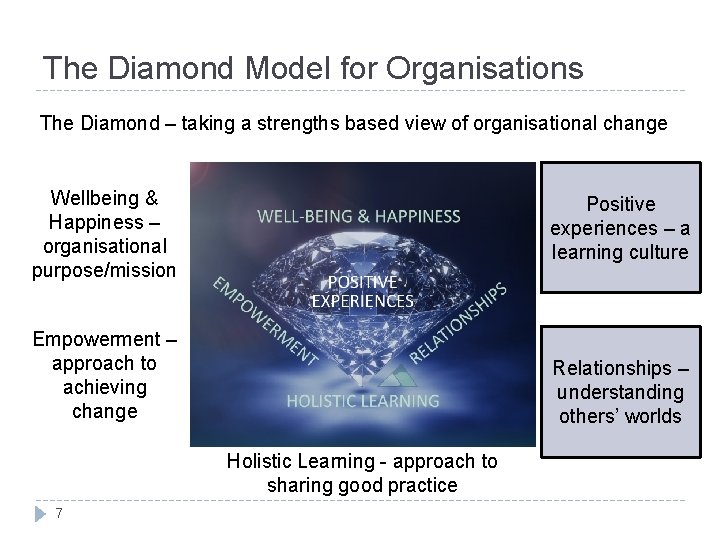
The Diamond Model for Organisations The Diamond – taking a strengths based view of organisational change Wellbeing & Happiness – organisational purpose/mission Positive experiences – a learning culture Empowerment – approach to achieving change Relationships – understanding others’ worlds Holistic Learning - approach to sharing good practice 7
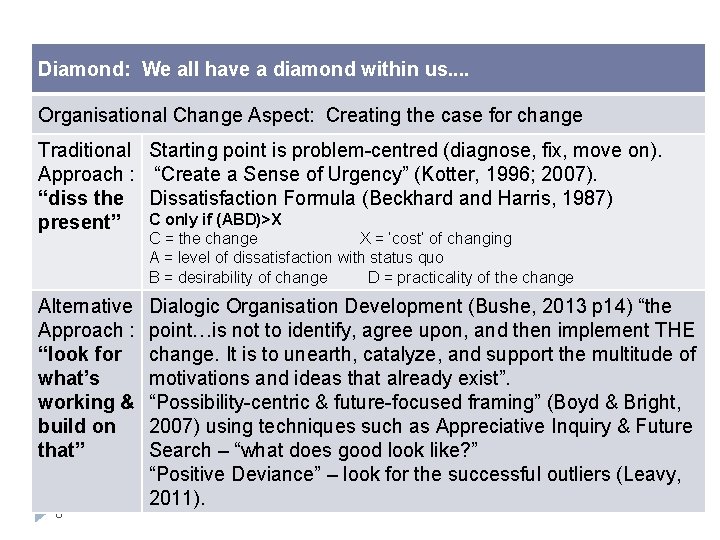
Diamond: We all have a diamond within us. . Organisational Change Aspect: Creating the case for change Traditional Starting point is problem-centred (diagnose, fix, move on). Approach : “Create a Sense of Urgency” (Kotter, 1996; 2007). “diss the Dissatisfaction Formula (Beckhard and Harris, 1987) present” C only if (ABD)>X C = the change X = ‘cost’ of changing A = level of dissatisfaction with status quo B = desirability of change D = practicality of the change Alternative Approach : “look for what’s working & build on that” 8 Dialogic Organisation Development (Bushe, 2013 p 14) “the point…is not to identify, agree upon, and then implement THE change. It is to unearth, catalyze, and support the multitude of motivations and ideas that already exist”. “Possibility-centric & future-focused framing” (Boyd & Bright, 2007) using techniques such as Appreciative Inquiry & Future Search – “what does good look like? ” “Positive Deviance” – look for the successful outliers (Leavy, 2011).
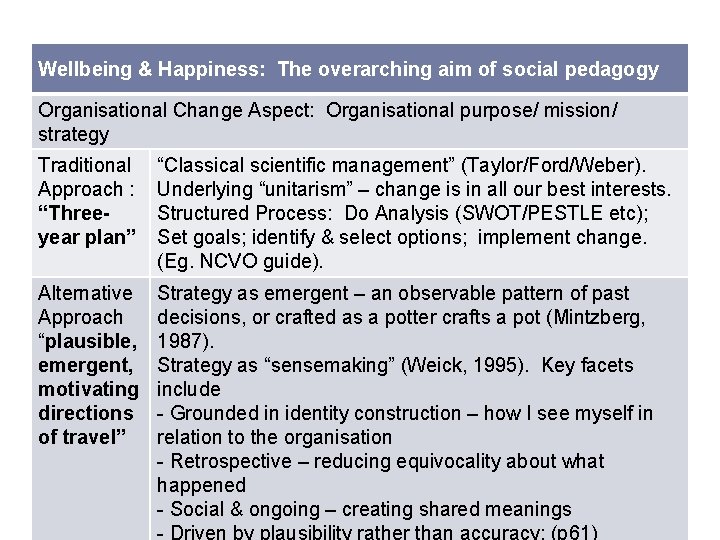
Wellbeing & Happiness: The overarching aim of social pedagogy Organisational Change Aspect: Organisational purpose/ mission/ strategy Traditional Approach : “Threeyear plan” “Classical scientific management” (Taylor/Ford/Weber). Underlying “unitarism” – change is in all our best interests. Structured Process: Do Analysis (SWOT/PESTLE etc); Set goals; identify & select options; implement change. (Eg. NCVO guide). Alternative Approach “plausible, emergent, motivating directions of travel” Strategy as emergent – an observable pattern of past decisions, or crafted as a potter crafts a pot (Mintzberg, 1987). Strategy as “sensemaking” (Weick, 1995). Key facets include - Grounded in identity construction – how I see myself in relation to the organisation - Retrospective – reducing equivocality about what happened - Social & ongoing – creating shared meanings - Driven by plausibility rather than accuracy: (p 61) 9
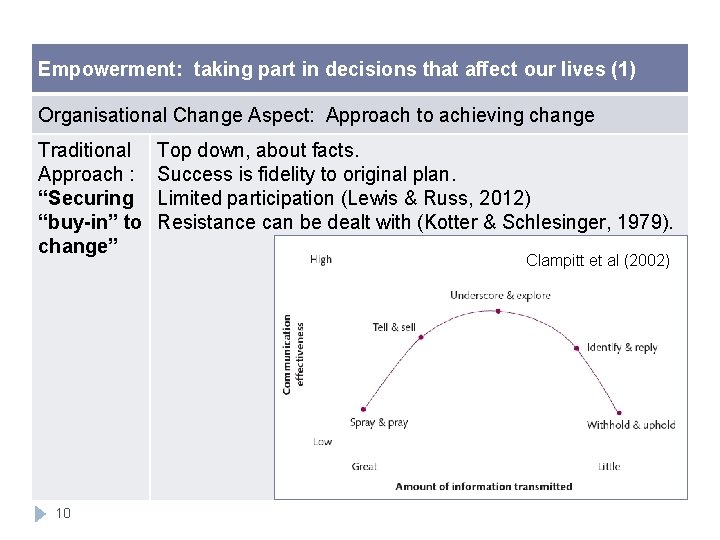
Empowerment: taking part in decisions that affect our lives (1) Organisational Change Aspect: Approach to achieving change Traditional Approach : “Securing “buy-in” to change” 10 Top down, about facts. Success is fidelity to original plan. Limited participation (Lewis & Russ, 2012) Resistance can be dealt with (Kotter & Schlesinger, 1979). Clampitt et al (2002)
Empowerment: taking part in decisions that affect our lives (2) Organisational Change Aspect: Approach to achieving change Alternative Approach “Conversations for change; resistance is an indicator to listen more. ” 11 Changing the conversation is achieving the change e. g. the novel concept of “internal customer”(Barrett et al, 1995). “A discourse-centred” understanding of organisational change” (Grant & Marshak, 2011) - Discourse is constructive; changing the dominant discourse leads to change; - Change narratives are constructed & disseminated via conversations - Change discourses emerge from a continuous, iterative & recursive process - Alternative discourses exist and may be drawn upon. Resistance is not a thing that “happens over there” but as a perception held by the change agent (Ford et al, 2008). “Resistance” as a resource – to hear what people are saying and engage in the conversation. Important therefore to encourage “resistance” to be open. Can we talk about change without using the word “resistance”?
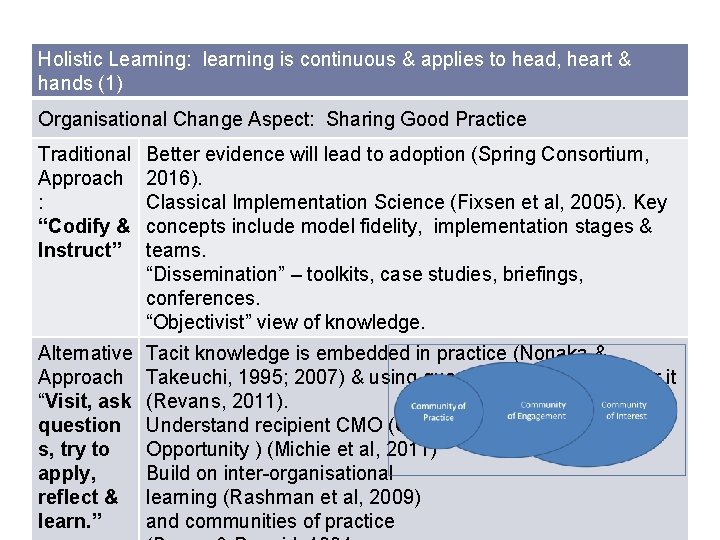
Holistic Learning: learning is continuous & applies to head, heart & hands (1) Organisational Change Aspect: Sharing Good Practice Traditional Approach : “Codify & Instruct” Better evidence will lead to adoption (Spring Consortium, 2016). Classical Implementation Science (Fixsen et al, 2005). Key concepts include model fidelity, implementation stages & teams. “Dissemination” – toolkits, case studies, briefings, conferences. “Objectivist” view of knowledge. Alternative Approach “Visit, ask question s, try to apply, reflect & 12 learn. ” Tacit knowledge is embedded in practice (Nonaka & Takeuchi, 1995; 2007) & using questions helps to uncover it (Revans, 2011). Understand recipient CMO (Capability, Motivation, Opportunity ) (Michie et al, 2011) Build on inter-organisational learning (Rashman et al, 2009) and communities of practice
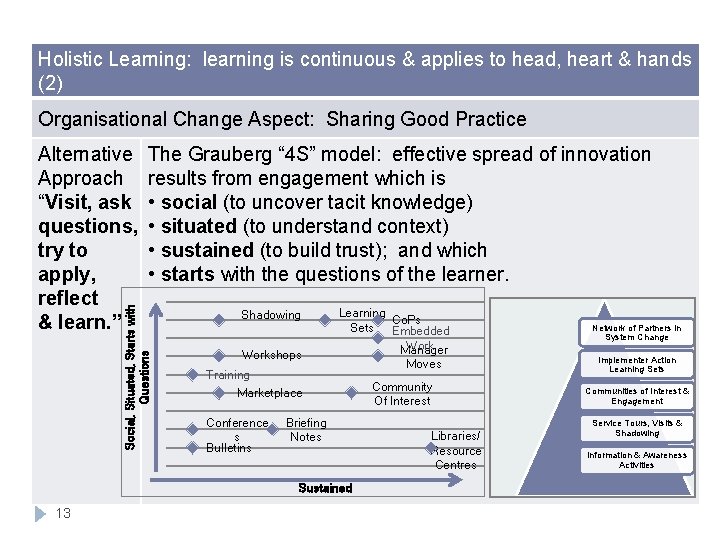
Holistic Learning: learning is continuous & applies to head, heart & hands (2) Organisational Change Aspect: Sharing Good Practice The Grauberg “ 4 S” model: effective spread of innovation results from engagement which is • social (to uncover tacit knowledge) • situated (to understand context) • sustained (to build trust); and which • starts with the questions of the learner. Social, Situated, Starts with Questions Alternative Approach “Visit, ask questions, try to apply, reflect & learn. ” Shadowing Workshops Learning Co. Ps Sets Embedded Work Manager Training Marketplace Conference s Bulletins Briefing Notes Sustained 13 Moves Community Of Interest Libraries/ Resource Centres Network of Partners in System Change Implementer Action Learning Sets Communities of Interest & Engagement Service Tours, Visits & Shadowing Information & Awareness Activities
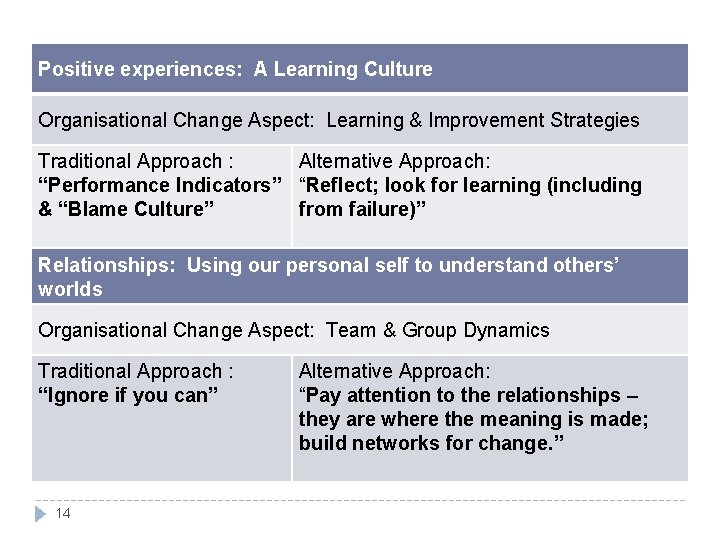
Positive experiences: A Learning Culture Organisational Change Aspect: Learning & Improvement Strategies Traditional Approach : Alternative Approach: “Performance Indicators” “Reflect; look for learning (including & “Blame Culture” from failure)” Relationships: Using our personal self to understand others’ worlds Organisational Change Aspect: Team & Group Dynamics Traditional Approach : “Ignore if you can” 14 Alternative Approach: “Pay attention to the relationships – they are where the meaning is made; build networks for change. ”
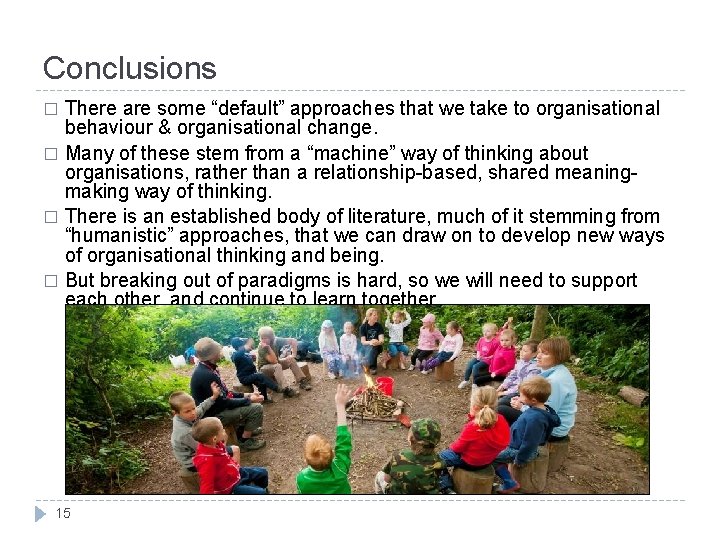
Conclusions There are some “default” approaches that we take to organisational behaviour & organisational change. � Many of these stem from a “machine” way of thinking about organisations, rather than a relationship-based, shared meaningmaking way of thinking. � There is an established body of literature, much of it stemming from “humanistic” approaches, that we can draw on to develop new ways of organisational thinking and being. � But breaking out of paradigms is hard, so we will need to support each other, and continue to learn together. � 15
References � � � � � Albury, D. (2016) What works in spreading innovation? London. Barrett, F. J. (1995) The Central Role of Discourse in Large-Scale Change: A Social Construction Perspective. The Journal of Applied Behavioral Science, 31(3), 352 -372. Beckhard, R. & Harris, R. T. (1987) Organizational Transitions: Managing Complex Change. Reading, Mass. : Addison-Wesley. Boyd, N. M. & Bright, D. S. (2007) Appreciative inquiry as a mode of action research for community psychology. Journal of Community Psychology, 35(8), 1019 -1036. Brown, J. S. & Duguid, P. (1991) Organizational Learning and Communities-of. Practice: Toward a Unified View of Working, Learning, and Innovation. Organization Science, 2(1), 40 -57. Bruce, I. , Copeman, C. , Forrest, A. , Lesirge, R. , Palmer, P. & Patel, A. (2012) Tools for Tomorrow: A practical guide to strategic planning for voluntary organisations. London: NCVO. Bushe, G. R. (2013) Dialogic OD A Theory of Practice. OD Practitioner. , 45(1), 11 -17. Cameron, C. (2016) Social Pedagogy in the UK Today: Findings from Evaluations of Training and Development Initiatives. Pedagogia Social. Revista Interuniversitaria. , 27, 199 -223. Clampitt, P. G. , De. Koch, R. J. & Cashman, T. (2000) A strategy for communicating about uncertainty. Academy of Management Executive, 14(4), 41 -57. Eichsteller, G. & Holthoff, S. (2012) The Art of Being a Social Pedagogue : Developing Cultural Change in Children’s Homes in Essex. The International Journal of Social Pedagogy, 1(1), 30 -46. 16
References (cont) � � � Fixsen, D. , Naoom, S. , Blase, K. , Friedman, R. & Wallace, F. (2005) Implementation Research: A Synthesis of the Literature. Tamps, FL. Ford, J. D. , Ford, L. W. & D'Amelio, A. (2008) Resistance to change: The rest of the story. Academy of Management Review, 33(2), 362 -377. Grant, D. & Marshak, R. J. (2011) Toward a Discourse-Centered Understanding of Organizational Change. The Journal of Applied Behavioural Science, 47(2), 204 -235. Kaska, M. (2015) Social Pedagogy: An invitation. London: Jacaranda Recruitment Ltd. Kotter, J. P. (2007) Leading Change: Why Transformation Efforts Fail. Harvard Business Review, (January 2007). Kotter, J. P. & Schlesinger, L. A. (1979) Choosing strategies for change. Harvard Business Review, (March-April), 106 -114. Leavy, B. (2011) Leading adaptive change by harnessing the power of positive deviance. Strategy & Leadership, 39(2), 18 -27. Lewis, L. K. & Russ, T. L. (2012) Soliciting and using input during organizational change initiatives: What are practitioners doing. Management Communication Quarterly, 26(2), 267 -294. Michie, S. , van Stralen, M. M. & West, R. (2011) The behaviour change wheel: a new method for characterising and designing behaviour change interventions. Implementation science, 6(1), 42. Mintzberg, H. (1987) Crafting strategy. Harvard Business Review, 65(4), 66 -75. Morgan, G. (1997) Images of organization. [2 nd ed. ]; London: Sage. 17
References (cont) � � � � � Nonaka, I. (2007) The Knowledge-Creating Company. Harvard Business Review, 85(7/8), 162 -171. Nonaka, I. & Takeuchi, H. (1995) The knowledge-creating company: How Japanese companies create the dynamics of innovation. Oxford: Oxford University Press. Petrie, P. , Boddy, J. , Cameron, C. , Heptinstall, E. , Mc. Quail, S. , Simon, A. & Wigfall, V. (2009) Pedagogy - a holistic, personal approach to work with children and young people, across services: European models for practice, training, education and qualification. London: Thomas Coram Research Unit, Institute of Education. Rashman, L. , Withers, E. & Hartley, J. (2009) Organizational learning and knowledge in public service organizations: a systematic review of the literature. International Journal of Management Reviews, 11(4), 463 -494. Revans, R. (2011) ABC of action learning. Swansea: Gower Publishing, Ltd. Spring-Consortium (2016) Children’s Social Care Innovation Programme Interim Learning Report, 2016. Available online: http: //springconsortium. com/wpcontent/uploads/2015/01/Df. E-Innovation-Programme-Interim-Learning-Report. pdf [Accessed 30 March 2016]. Van der Ven, A. H. & Poole, M. S. (1995) Explaining Development and Change in Organizations. Academy of Management Review, 20(3). Weick, K. E. (1995) Sensemaking in Organizations. London: Sage Publications. Wenger, E. (1998) Communities of practice: learning, meaning, and identity. Cambridge, UK: Cambridge University Press. 18
- Slides: 18