
Social order LO 1 To identify the two
- Slides: 11
Social order LO 1. To identify the two sociological approaches to social order 2. To examine their arguments and solutions to social order.
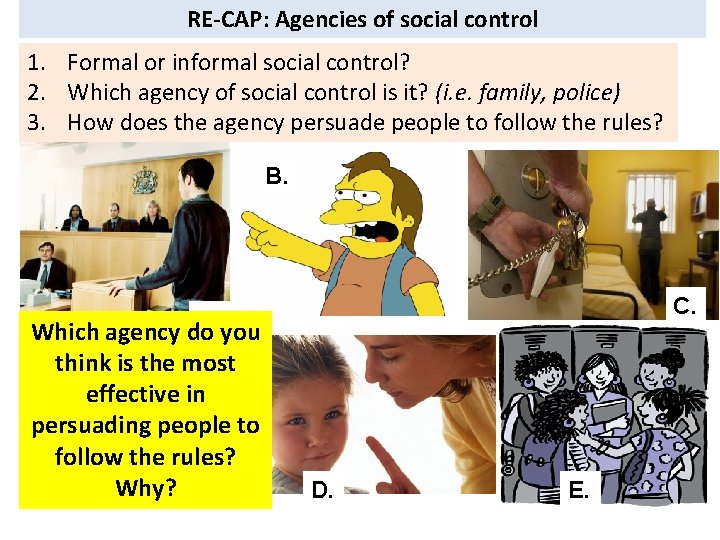
RE-CAP: Agencies of social control 1. Formal or informal social control? 2. Which agency of social control is it? (i. e. family, police) 3. How does the agency persuade people to follow the rules? B. A. you Which agency do think is the most effective in persuading people to follow the rules? Why? C. D. E.
Starter activity: Recap from previous lesson 1. Explain what sociologists mean by social control. (4 marks) D(define) social control is defined as …… E(explain) there are different agencies of social control ………. E(example) an example of a ……… control is ………. . C(criticise/compare) social control is never absolute because. . 2. Describe one agency of informal social control and explain how it can influence people’s behaviour. (5 marks) Describe one agency /2 1 Mark – one agent is …………… 2 Marks – through this agency, the individual …………………. . Explain how the agency can influence people’s behaviour /3 3 Marks – one well explained point AND one simple point.
PEER MARKING 1. Explain what sociologists mean by social control (4 marks) Mark Scheme Award 1 mark for each part of DEEC Define (1) – clear definition (the methods used to persuade people to conform to the rules) Explain (1) – one point to explain (e. g. there are two types of social control, social control aims to establish social order, control our behaviour through rewards or sanctions) Example (1) – one example (e. g. an example of formal social control are prisons which deter people from committing crime because going is unpleasant) Criticise/compare (1) – one criticism (social control is never absolute, since there is always deviance / criminality)
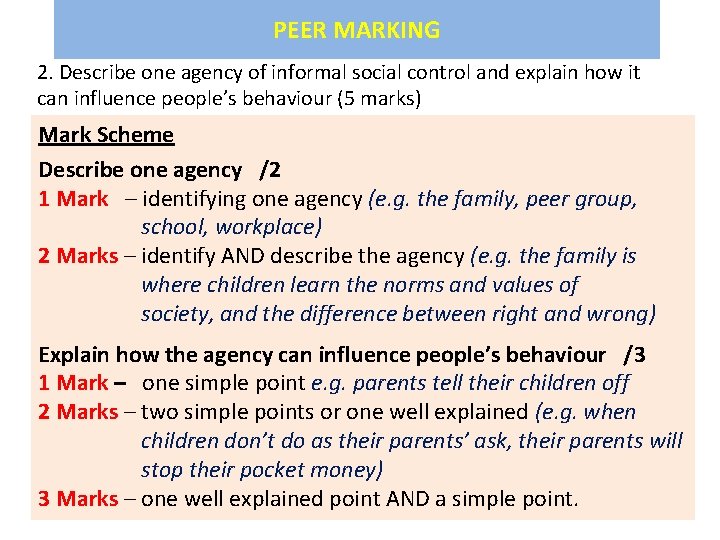
PEER MARKING 2. Describe one agency of informal social control and explain how it can influence people’s behaviour (5 marks) Mark Scheme Describe one agency /2 1 Mark – identifying one agency (e. g. the family, peer group, school, workplace) 2 Marks – identify AND describe the agency (e. g. the family is where children learn the norms and values of society, and the difference between right and wrong) Explain how the agency can influence people’s behaviour /3 1 Mark – one simple point e. g. parents tell their children off 2 Marks – two simple points or one well explained (e. g. when children don’t do as their parents’ ask, their parents will stop their pocket money) 3 Marks – one well explained point AND a simple point.
Social order Learning Objective: Grade C –describe the two approaches of social order. Grade B – explain the difference between the two approaches of social order. Grade A/A* - evaluate the two approaches of social order.
Why does society need people to follow rules? What happens when rules are followed? Ø So that there is SOCIAL ORDER Ø This is when society is stable and runs smoothly (i. e. Social Cohesion) Ø Without social order, there would be chaos There are TWO approaches as to how this social order is created and maintained
The consensus approach • This is a functionalist view • Maintaining social order requires individuals and groups to co-operate and work together. • Functionalists argue that a society is based on consensus (agreement) on norms and values social order happens when people agree upon and share the same norms and values. • The process of socialisation -where people learn the shared norms and values of society- is how this consensus is achieved.
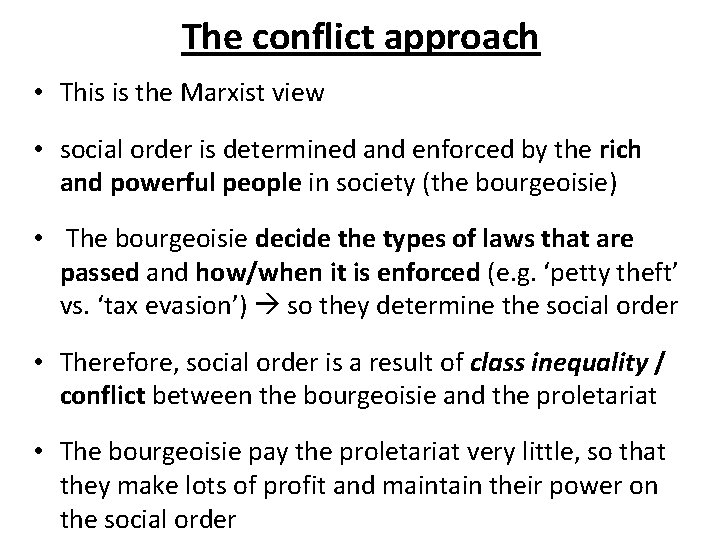
The conflict approach • This is the Marxist view • social order is determined and enforced by the rich and powerful people in society (the bourgeoisie) • The bourgeoisie decide the types of laws that are passed and how/when it is enforced (e. g. ‘petty theft’ vs. ‘tax evasion’) so they determine the social order • Therefore, social order is a result of class inequality / conflict between the bourgeoisie and the proletariat • The bourgeoisie pay the proletariat very little, so that they make lots of profit and maintain their power on the social order
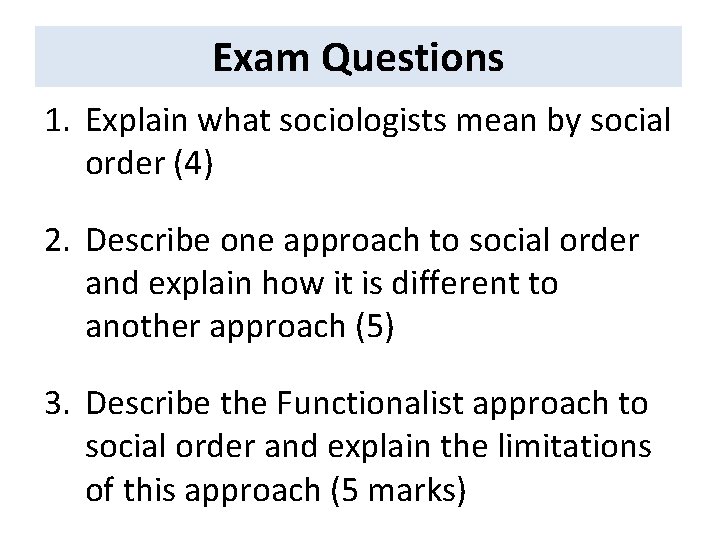
Exam Questions 1. Explain what sociologists mean by social order (4) 2. Describe one approach to social order and explain how it is different to another approach (5) 3. Describe the Functionalist approach to social order and explain the limitations of this approach (5 marks)
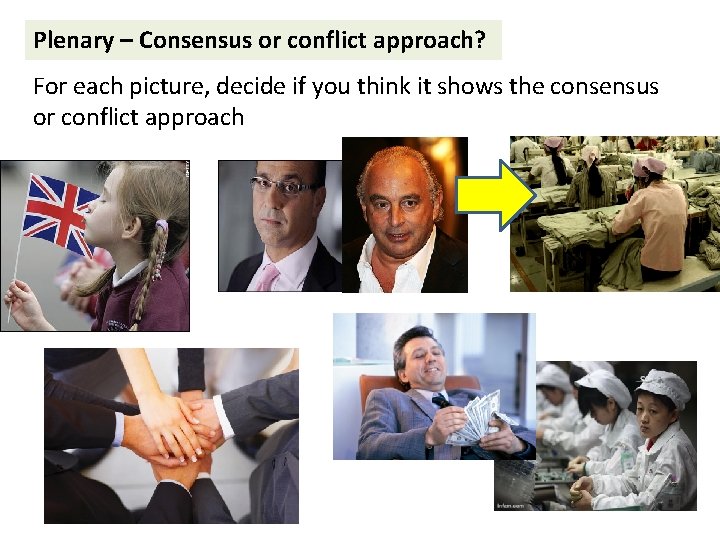
Plenary – Consensus or conflict approach? For each picture, decide if you think it shows the consensus or conflict approach