
Social Norms and Teenage Driver Distractions Maryam Merrikhpour
- Slides: 20
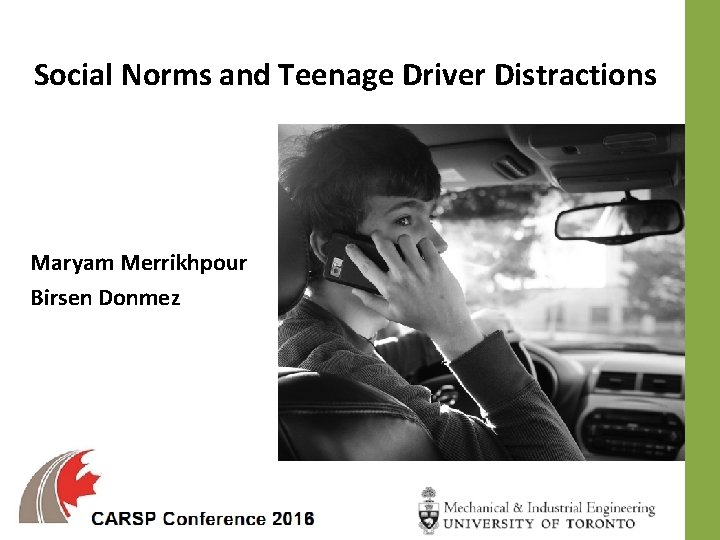
Social Norms and Teenage Driver Distractions Maryam Merrikhpour Birsen Donmez
Motivation Driver distraction is a significant contributing factor in teenage driver crashes (Ferguson, 2003; Shope et al. , 2008; Williams, 2003) . • 20% of all crashes involving 15 -18 year old drivers (Curry, Hafetz, Kallan, Winston, & Durbin, 2011) • 10% of fatal crashes among 15 -19 year old drivers in the U. S. (NHTSA, 2016) 2
Background • Growing interest in using motivational techniques to change behaviour • Providing information on social norms as one of th most notable techniques Social norms • Descriptive norms • Injunctive norms 3
Theory of Social Norms (Berkowitz & Perkins, 1987; Berkowitz, 2004) • People have strong preferences to behave similarly to those around them. • Individuals misperceive social norms. • Misperceptions cause individuals to change their behaviour. • Revealing actual norms can reduce the occurrence of problematic behaviours. 4
Objectives • Investigate the existence of misperceived social norms among teens • Examine the correlations between social norms (parents and peers) and teens’ distraction 5
Hypotheses • Teens’ overestimation of social norms • Positive correlations between social norms and teens’ distraction • Larger correlations with: • Perceived norms compared to actual norms • Peers’ norms compared to parents’ norms • Same-gender referents’ compared to opposite-gender referents’ norms 6
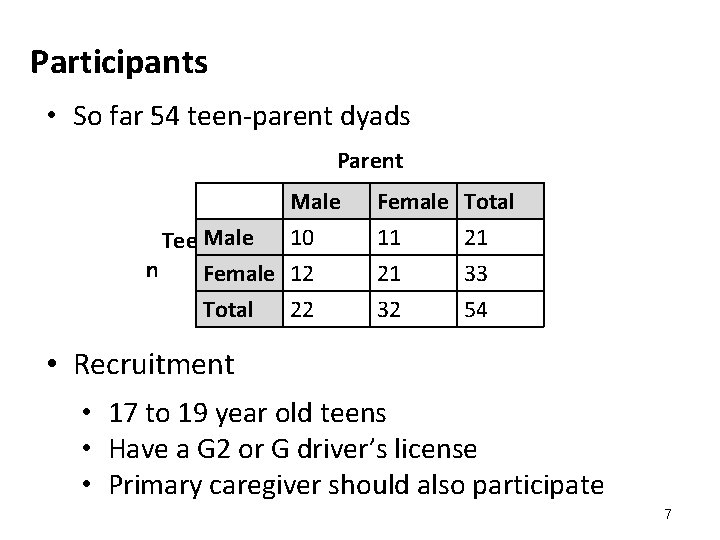
Participants • So far 54 teen-parent dyads Parent Male 10 Tee Male n Female 12 Total 22 Female Total 11 21 21 33 32 54 • Recruitment • 17 to 19 year old teens • Have a G 2 or G driver’s license • Primary caregiver should also participate 7
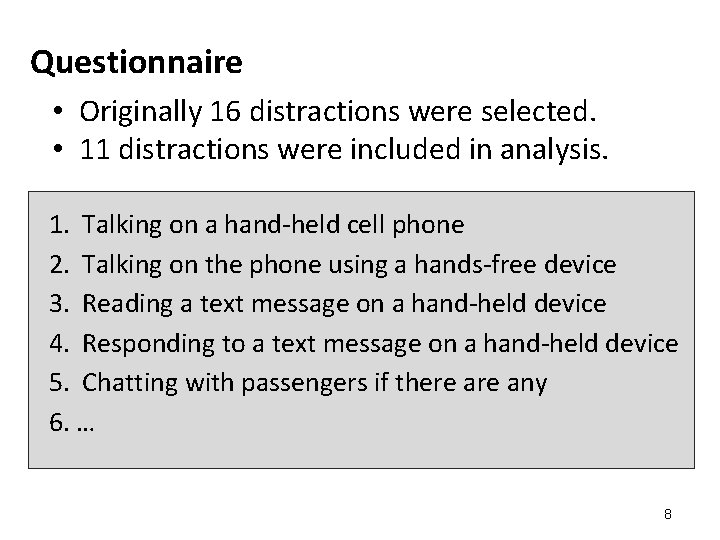
Questionnaire • Originally 16 distractions were selected. • 11 distractions were included in analysis. 1. Talking on a hand-held cell phone 2. Talking on the phone using a hands-free device 3. Reading a text message on a hand-held device 4. Responding to a text message on a hand-held device 5. Chatting with passengers if there any 6. … 8
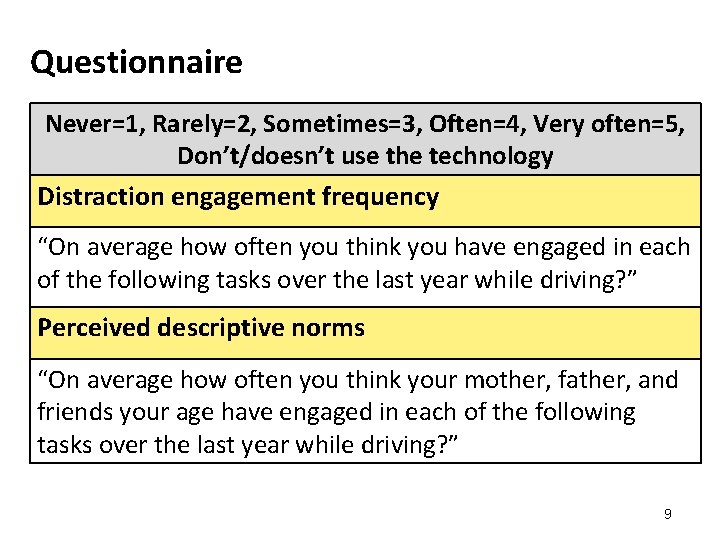
Questionnaire Never=1, Rarely=2, Sometimes=3, Often=4, Very often=5, Don’t/doesn’t use the technology Distraction engagement frequency “On average how often you think you have engaged in each of the following tasks over the last year while driving? ” Perceived descriptive norms “On average how often you think your mother, father, and friends your age have engaged in each of the following tasks over the last year while driving? ” 9
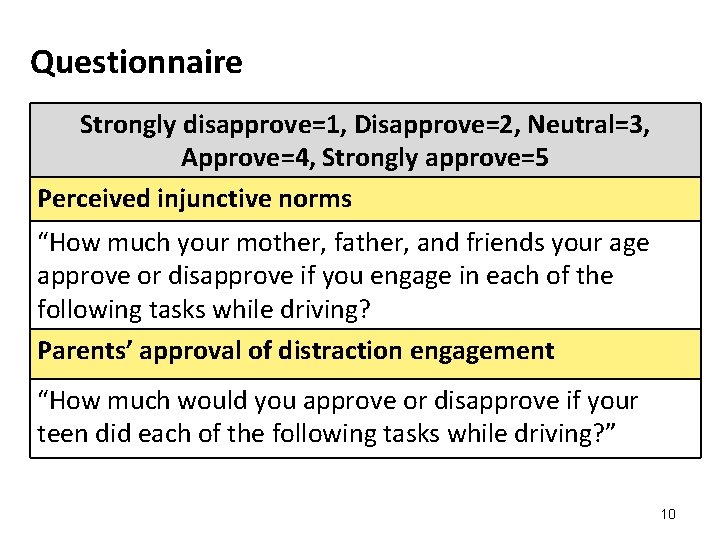
Questionnaire Strongly disapprove=1, Disapprove=2, Neutral=3, Approve=4, Strongly approve=5 Perceived injunctive norms “How much your mother, father, and friends your age approve or disapprove if you engage in each of the following tasks while driving? Parents’ approval of distraction engagement “How much would you approve or disapprove if your teen did each of the following tasks while driving? ” 10
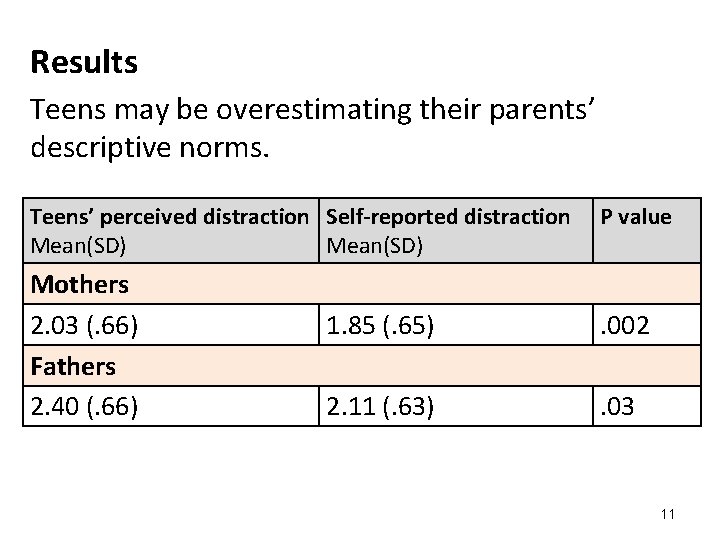
Results Teens may be overestimating their parents’ descriptive norms. Teens’ perceived distraction Self-reported distraction Mean(SD) Mothers 2. 03 (. 66) Fathers 2. 40 (. 66) P value 1. 85 (. 65) . 002 2. 11 (. 63) . 03 11
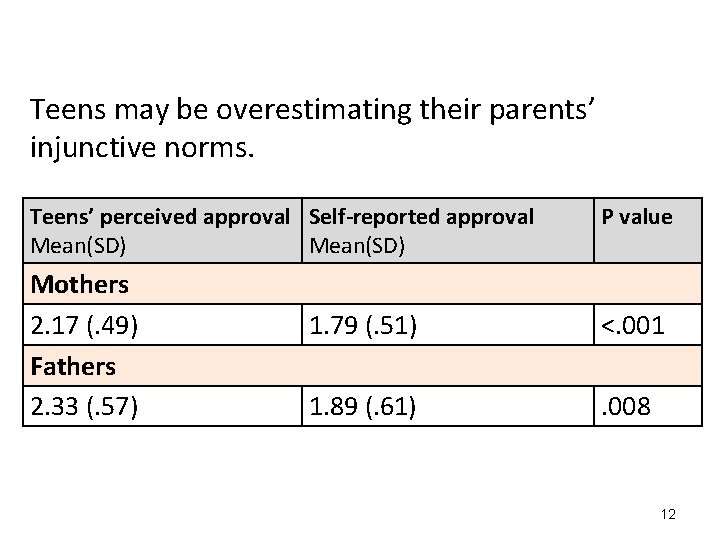
Teens may be overestimating their parents’ injunctive norms. Teens’ perceived approval Self-reported approval Mean(SD) Mothers 2. 17 (. 49) Fathers 2. 33 (. 57) P value 1. 79 (. 51) <. 001 1. 89 (. 61) . 008 12
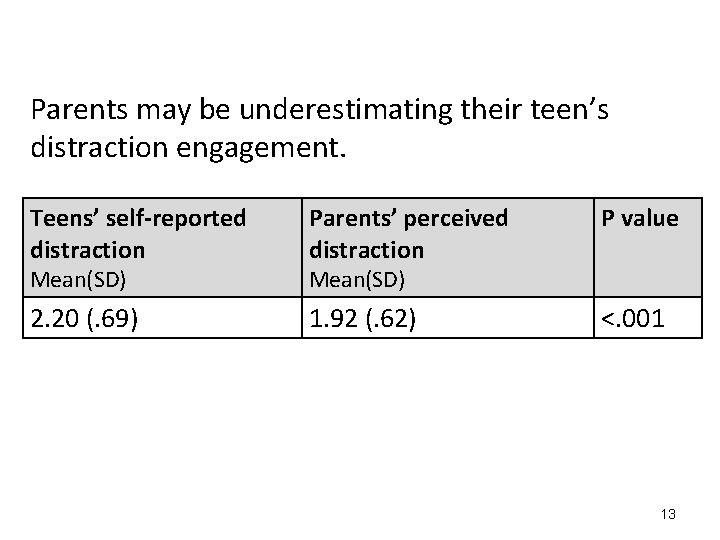
Parents may be underestimating their teen’s distraction engagement. Teens’ self-reported distraction Parents’ perceived distraction P value 2. 20 (. 69) 1. 92 (. 62) <. 001 Mean(SD) 13
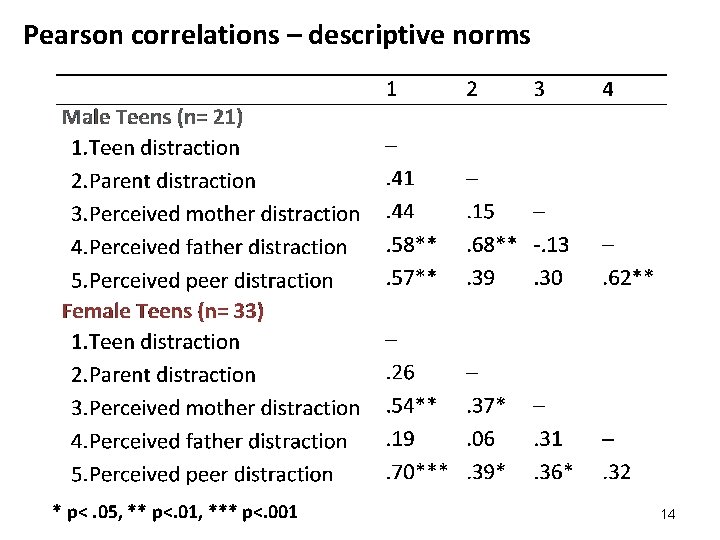
Pearson correlations – descriptive norms * p<. 05, ** p<. 01, *** p<. 001 14
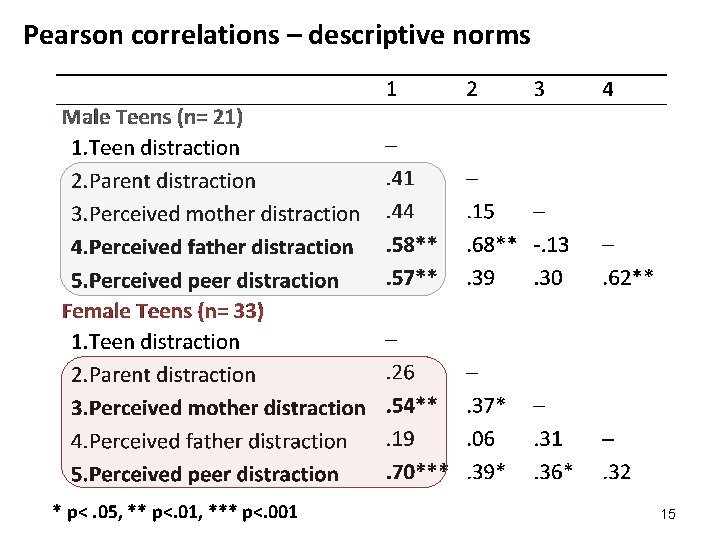
Pearson correlations – descriptive norms * p<. 05, ** p<. 01, *** p<. 001 15
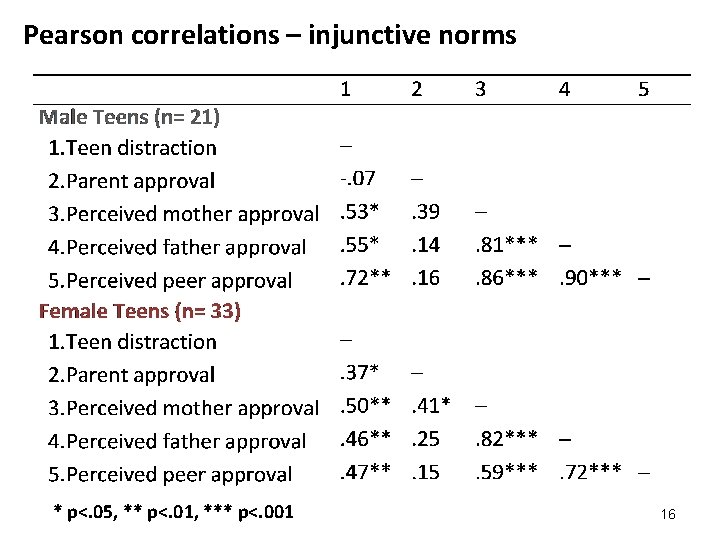
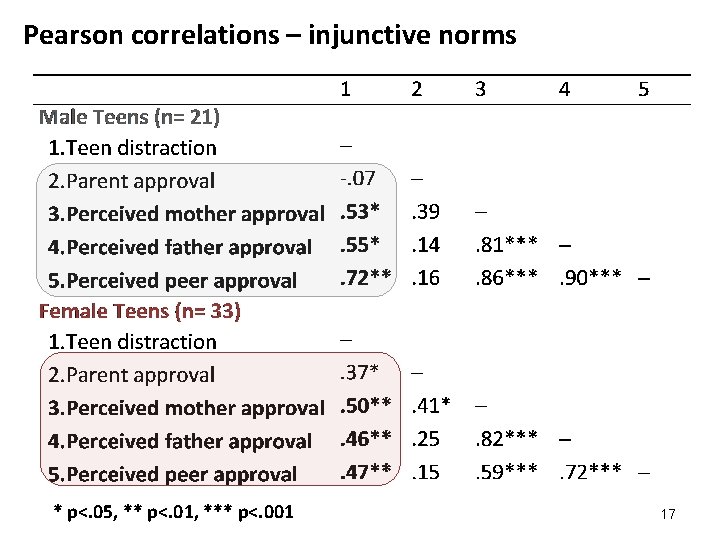
Pearson correlations – injunctive norms * p<. 05, ** p<. 01, *** p<. 001 16
Pearson correlations – injunctive norms * p<. 05, ** p<. 01, *** p<. 001 17
Conclusions • Teens may overestimate their parents’ distraction engagement and approval of distraction. • Parents may underestimate their teens’ distraction engagement. • Teens’ perceived descriptive and injunctive norms for both parents and peers were highly positively correlated with teens’ self-reported distraction engagement. 18
Conclusions • Larger correlation was observed for: • Same-gender parents compared to opposite gender. • Perceived norms compared to actual norms 19
Acknowledgments 20