
Social Network Analysis A flavour of the basics
Social Network Analysis - A flavour of the basics Vicky Murphy victoria. murphy@open. ac. uk 16 July 2020
Introduction time
Activity time part 1: What is SNA? Thoughts in the chat box/ poll pod….
Vicky’s definition It’s a methodology / framework / approach that emphasises the importance of connections and relationships It can be quantitative, qualitative or mixed It can be done at the ego level or the network level Lots of cool graphics!
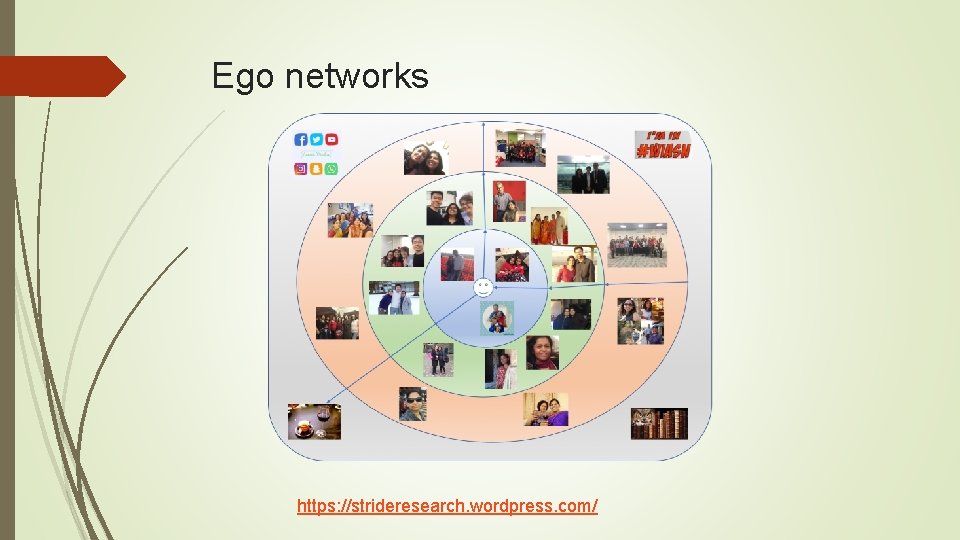
Ego networks https: //strideresearch. wordpress. com/
Common data collection methods egolevel analysis Interviews Surveys Observation Data mining (e. g. , Twitter/ emails)
Ego-level data collection Focuses on the connections of an individual Can be qualitative – who’s provided the most support for you in your career as a musician? Tell me more about that. Can be quantitative Count the number Classify each connection and calculate diversity Statistics – BE CAREFUL WITH INFERENTIAL STATISTICS Crossley, N. , Bellotti, E. , Edwards, G. , Everett, M. G. , Koskinen, J. , & Tranmer, M. (2015). Social network analysis for ego-nets: Social network analysis for actor-centred networks. Sage.
Ego networks: Examples Meisel, M. K. , Clifton, A. D. , Mac. Killop, J. , & Goodie, A. S. (2015). A social network analysis approach to alcohol use and co-occurring addictive behavior in young adults. Addictive Behaviors, 51, 72 -79. 1. Research question: Do alcohol users know other alcohol users? 2. Data collection: Survey asking people to list 30 ‘alters’ who had the most significant impact on the respondent’s life in the past year plus how much alcohol they consumed 3. Data analysis: Correlations, cluster analysis, ANOVA between clusters 4. Results: Drinkers are more likely to know other drinkers
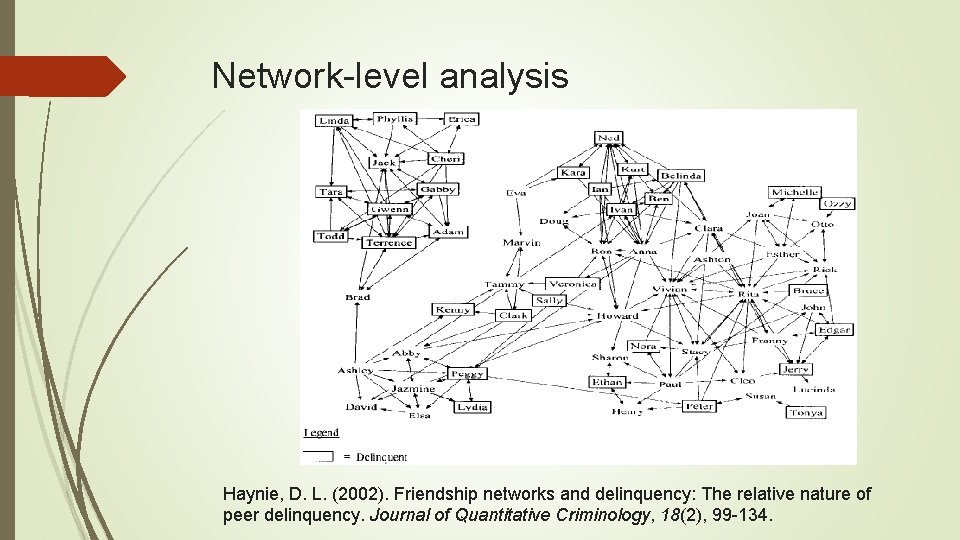
Network-level analysis Haynie, D. L. (2002). Friendship networks and delinquency: The relative nature of peer delinquency. Journal of Quantitative Criminology, 18(2), 99 -134.
Definitions Edge = arrow from one person to another Node = person Density = are there lots of connections? Centrality = are lots of people connected to an actor? Clique = a group who are connected to each other but not in general to others Distance = how many connections to get from one person to another?
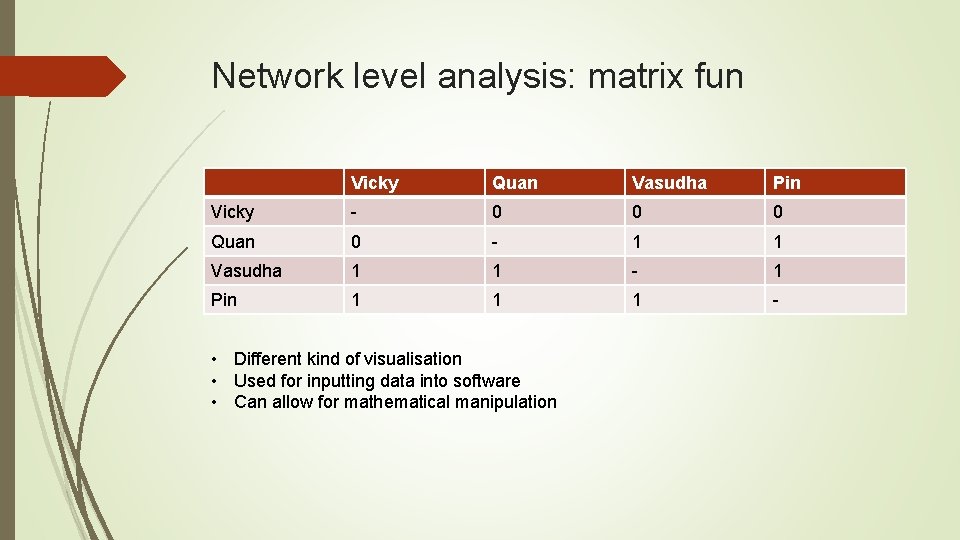
Network level analysis: matrix fun Vicky Quan Vasudha Pin Vicky - 0 0 0 Quan 0 - 1 1 Vasudha 1 1 - 1 Pin 1 1 1 - • Different kind of visualisation • Used for inputting data into software • Can allow for mathematical manipulation
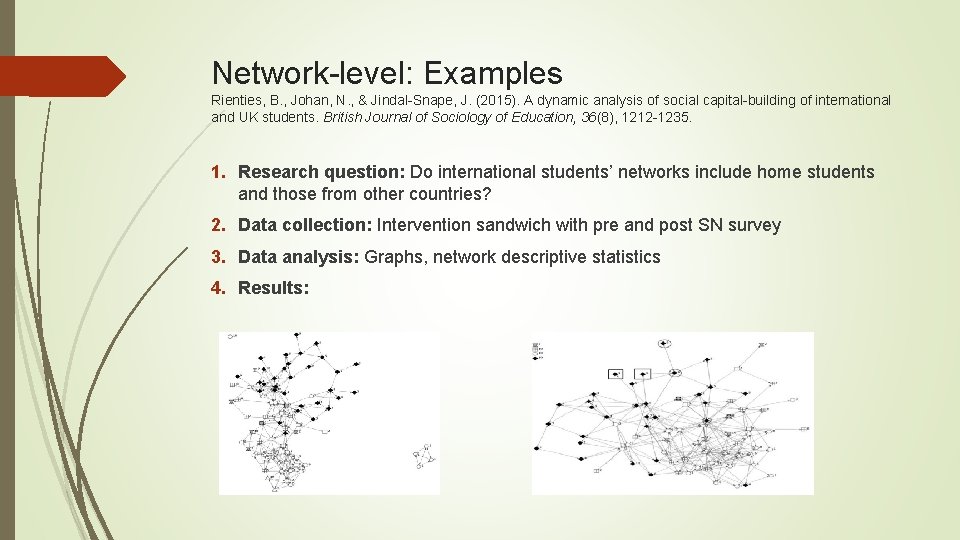
Network-level: Examples Rienties, B. , Johan, N. , & Jindal-Snape, J. (2015). A dynamic analysis of social capital-building of international and UK students. British Journal of Sociology of Education, 36(8), 1212 -1235. 1. Research question: Do international students’ networks include home students and those from other countries? 2. Data collection: Intervention sandwich with pre and post SN survey 3. Data analysis: Graphs, network descriptive statistics 4. Results:
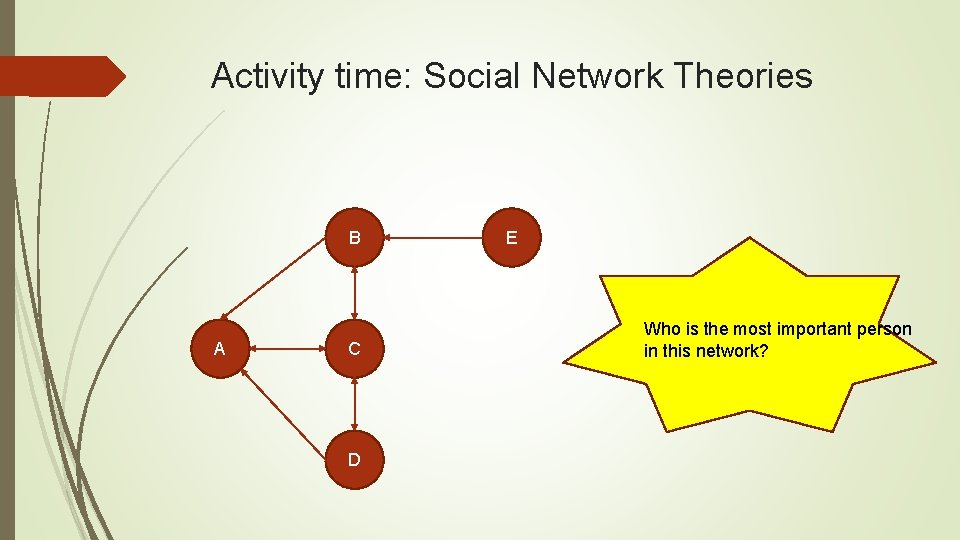
Activity time: Social Network Theories B A C D E Who is the most important person in this network?
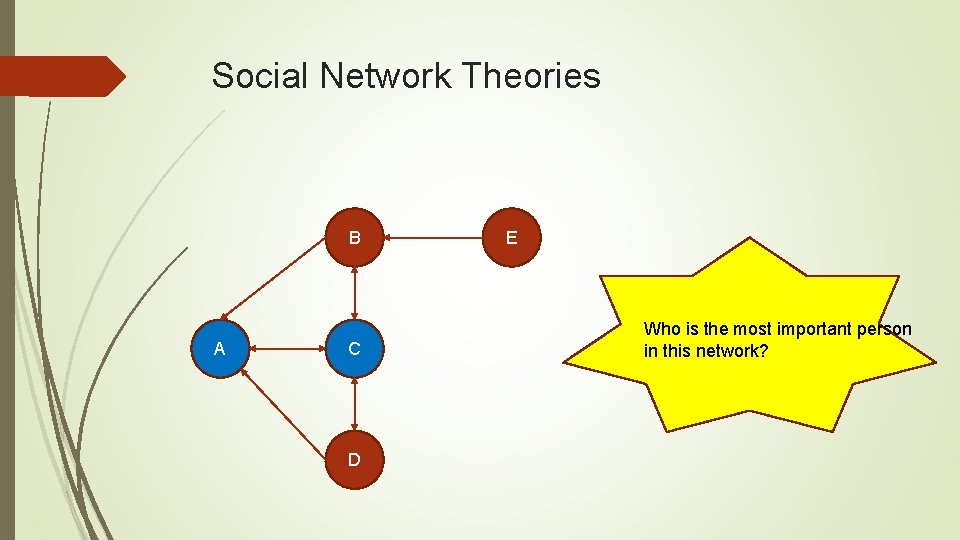
Social Network Theories B A C D E Who is the most important person in this network?
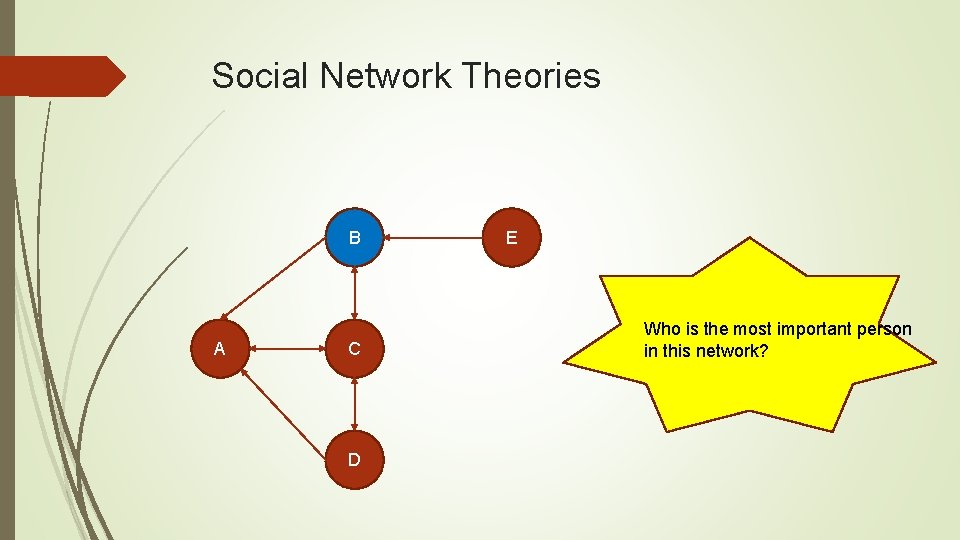
Social Network Theories B A C D E Who is the most important person in this network?
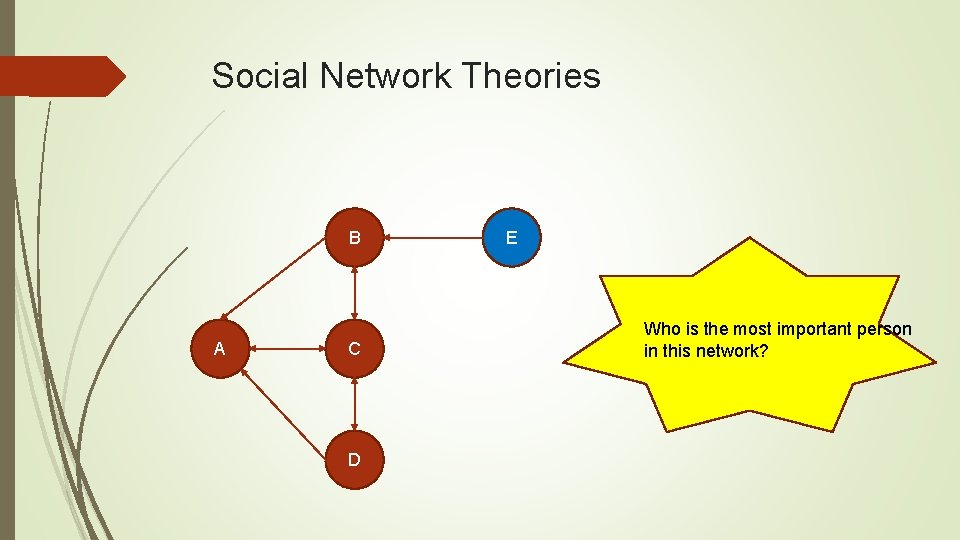
Social Network Theories B A C D E Who is the most important person in this network?
Social Network Theories Small world theory Everyone is connected and ideas and resources will flow through the connections that people have. The number of steps it takes to get from one person to another influences how things flow de Sola Pool, I. , & Kochen, M. (1978). Contacts and influence. Social networks, 1(1), 5 -51. https: //doi. org/10. 1016/0378 -8733(78)90011 -4 Weak and strong ties Strong and weak ties have different properties -> weak ties can offer unique perspectives but aren’t usually good for the transfer of complex ideas that require a lot of common background knowledge to understand. Granovetter, M. S. (1973). The Strength of Weak Ties. The American Journal of Sociology, 78(6), 1360– 1380. https: //doi. org/10. 1086/225469
Social Network Analysis Difficulties - You can get very complex networks? How can you deal with huge quantities of data? How can you visualise complex networks in a way that is useful? - Ethics - Incomplete data/ response rate - Defining terms - Questionnaire set up / misinterpreted questions - Networks are fluid/ day of the week - Multiple networks - Very good at understanding what, but not always explain the why
Any Questions?
Resources for SNA Wasserman, S. , & Faust, K. (1994). Social network analysis: Methods and applications (Vol. 8). Cambridge university press. Knoke, D. , & Yang, S. (2008). Social network analysis (Vol. 154). Sage. Carolan, B. V. (2013). Social network analysis and education: Theory, methods & applications. Sage Publications. Hanneman, R. A. and Riddle, M. (2005). Introduction to social network methods. Riverside, CA: University of California, Riverside ( published in digital form at http: //faculty. ucr. edu/~hanneman/ ) Hakkarainen, K. P. , Palonen, T. , Paavola, S. , & Lehtinen, E. (2004). Communities of networked expertise: Professional and educational perspectives.
- Slides: 20