
Social Movements Media and Technology Introduction to Sociology
- Slides: 29
Social Movements, Media, and Technology Introduction to Sociology
Collective Behavior Collective behavior is non-institutionalized activity in which several people voluntarily engage. There are three forms: 1. A crowd is a large number of people in close proximity • Casual crowds are in the same place at the same time but aren’t really interacting • Conventional crowds gather for a regular scheduled event • Expressive crowds join together to express emotion • Acting crowds focus on a specific goal or action 2. A mass is a relatively large group with a common interest 3. A public is an unorganized, diffused group who share ideas
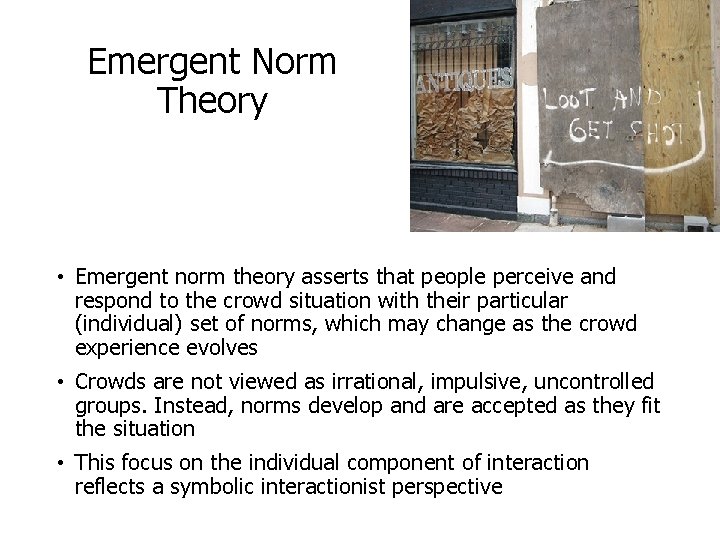
Emergent Norm Theory • Emergent norm theory asserts that people perceive and respond to the crowd situation with their particular (individual) set of norms, which may change as the crowd experience evolves • Crowds are not viewed as irrational, impulsive, uncontrolled groups. Instead, norms develop and are accepted as they fit the situation • This focus on the individual component of interaction reflects a symbolic interactionist perspective
Functionalism: Value-added Theory Each condition increases the likeliness of collective behavior: 1. Structural conduciveness: people are aware of the problem and can gather, ideally in an open area 2. Structural strain: people’s expectations about the situation at hand being unmet, causing tension and strain 3. Growth and spread of a generalized belief: a problem is clearly identified and attributed to a person or group 4. Precipitating factors: a dramatic event spurs collective behavior 5. Mobilization for action: leaders emerge to direct a crowd to action 6. Social control: agents (i. e. police) break up the collective behavior episode
When do Revolutions Happen? • A revolution is more possible when expected need satisfaction and actual need satisfaction are out of sync • As actual need satisfaction trends downward and away from what a formerly prosperous people have come to expect—an intolerable point is reached, and revolution occurs • Thus, change comes not from the very bottom of the social hierarchy, but from somewhere in the middle
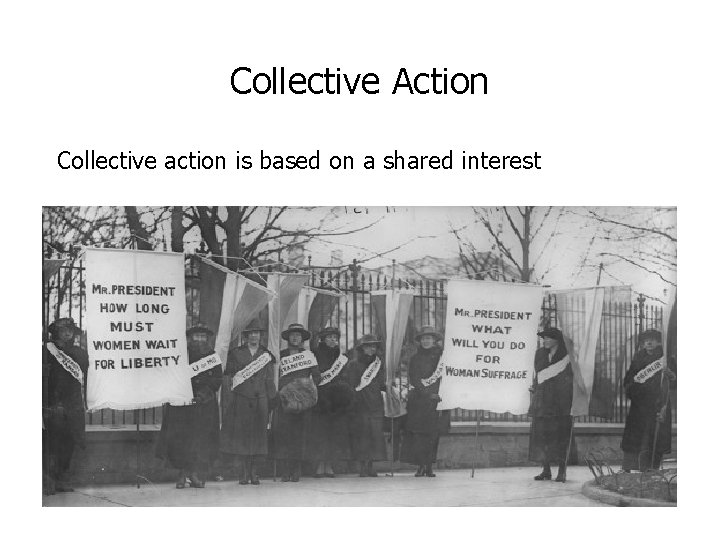
Collective Action Collective action is based on a shared interest
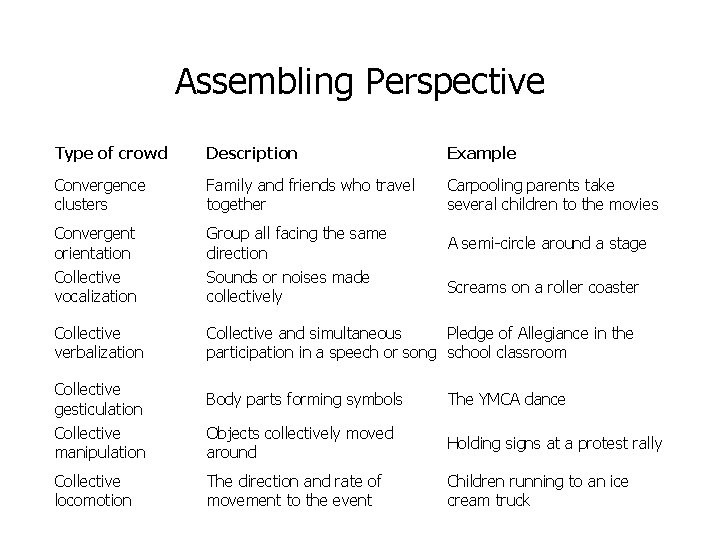
Assembling Perspective Type of crowd Description Example Convergence clusters Family and friends who travel together Carpooling parents take several children to the movies Convergent orientation Group all facing the same direction A semi-circle around a stage Collective vocalization Sounds or noises made collectively Screams on a roller coaster Collective verbalization Collective and simultaneous Pledge of Allegiance in the participation in a speech or song school classroom Collective gesticulation Body parts forming symbols The YMCA dance Collective manipulation Objects collectively moved around Holding signs at a protest rally Collective locomotion The direction and rate of movement to the event Children running to an ice cream truck
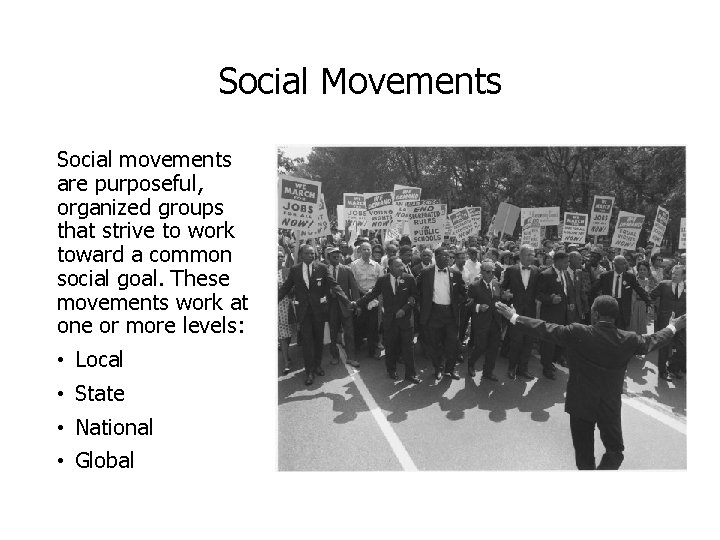
Social Movements Social movements are purposeful, organized groups that strive to work toward a common social goal. These movements work at one or more levels: • Local • State • National • Global
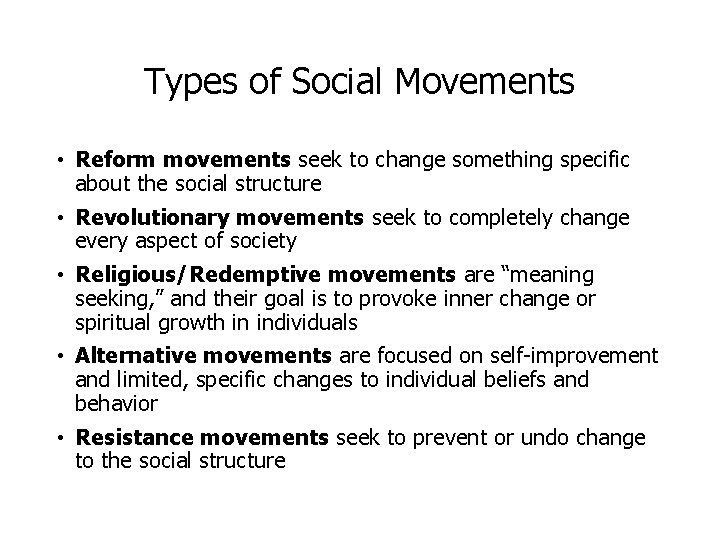
Types of Social Movements • Reform movements seek to change something specific about the social structure • Revolutionary movements seek to completely change every aspect of society • Religious/Redemptive movements are “meaning seeking, ” and their goal is to provoke inner change or spiritual growth in individuals • Alternative movements are focused on self-improvement and limited, specific changes to individual beliefs and behavior • Resistance movements seek to prevent or undo change to the social structure
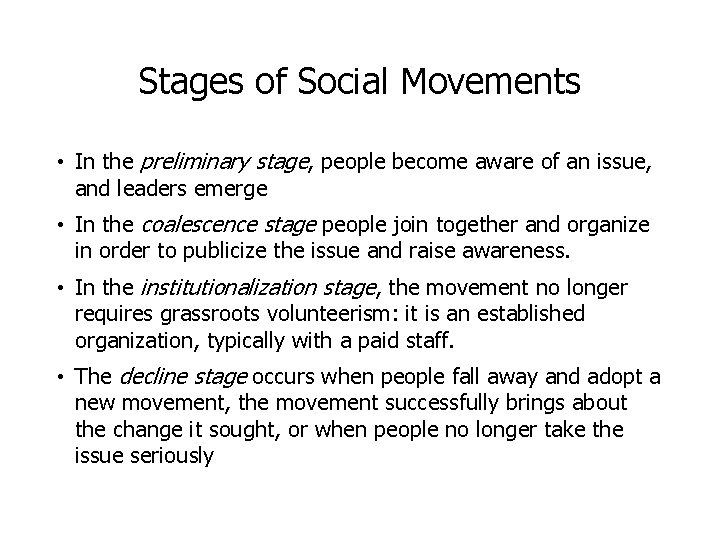
Stages of Social Movements • In the preliminary stage, people become aware of an issue, and leaders emerge • In the coalescence stage people join together and organize in order to publicize the issue and raise awareness. • In the institutionalization stage, the movement no longer requires grassroots volunteerism: it is an established organization, typically with a paid staff. • The decline stage occurs when people fall away and adopt a new movement, the movement successfully brings about the change it sought, or when people no longer take the issue seriously
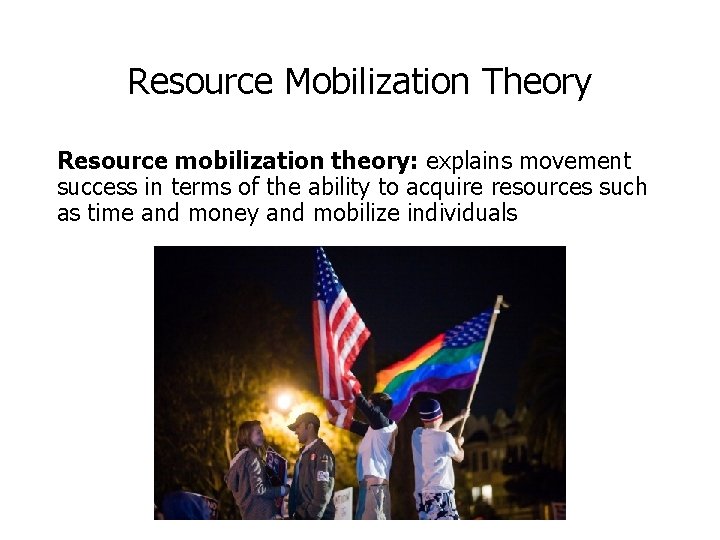
Resource Mobilization Theory Resource mobilization theory: explains movement success in terms of the ability to acquire resources such as time and money and mobilize individuals
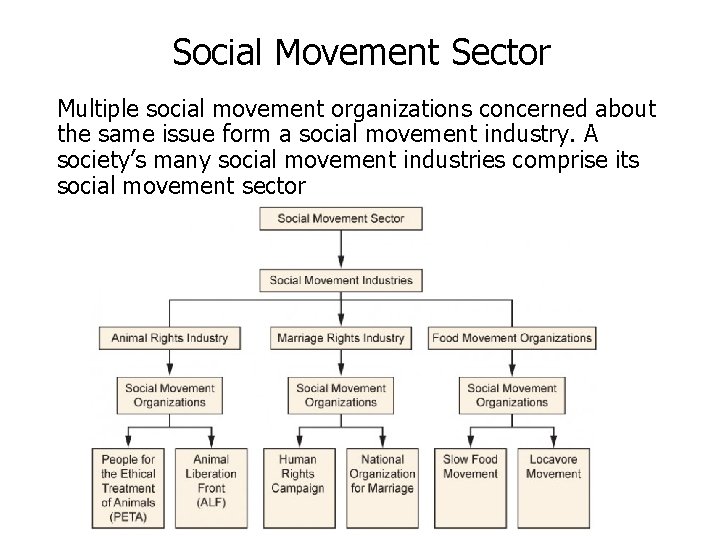
Social Movement Sector Multiple social movement organizations concerned about the same issue form a social movement industry. A society’s many social movement industries comprise its social movement sector
Frames Sociologists have developed the concept of frames to explain how individuals identify and understand social events and which norms they should follow in any given situation.
Frame Analysis Successful social movements use three kinds of frames to further their goals: 1. Diagnostic framing: states the problem in a clear, easily understood way. When applying diagnostic frames, there are no shades of gray: instead, there is the belief that what “they” do is wrong and this is how “we” will fix it. 2. Prognostic framing: offers a solution and states how it will be implemented. 3. Motivational framing: the call to action: what should you do once you agree with the diagnostic frame and believe in the prognostic frame?
Frame Alignment Process When social movements link their goals, a frame alignment process occurs: • Bridging connects uninvolved individuals and unorganized or ineffective groups with social movements that share similar goals to create a new, stronger social movement organization • In the amplification model, organizations seek to expand their core ideas to mobilize more people for their cause • In extension, social movements mutually promote each other, even when they do not share immediate goals • Transformation is a complete revision of goals and may result from success
New Social Movement Theory • Attempts to explain the proliferation of postindustrial and postmodern movements that are difficult to analyze using traditional social movement theories • revolves around understanding movements as they relate to politics, identity, culture, and social change • a macro-level, global analysis of social movements
Case Study: Occupy Wall Street differed from models of social movements in three main ways: 1. It lacked a single message 2. It was a leaderless organization 3. Its target was financial institutions instead of the government
Social Change • Social change is the change in a society created through social movements as well as through external factors like environmental shifts or technological innovations • Modernization is the process that increases the amount of specialization and differentiation of structure in societies
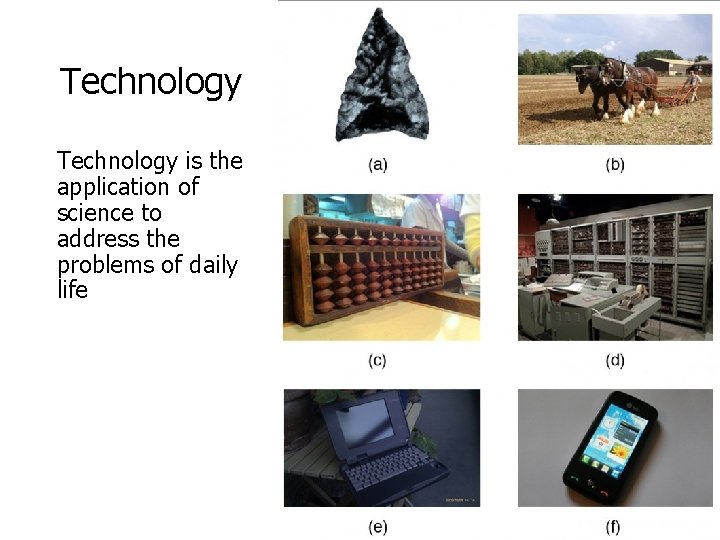
Technology is the application of science to address the problems of daily life
Technology and Social Stratification • Not everyone has equal access which creates a gap called the digital divide • The knowledge gap is the lack of knowledge or information caused by the digital divide that keeps those who were not exposed to technology from gaining marketable skills
Social Issues Arising from Technology • Net neutrality is the principle that all Internet data should be treated equally by internet service providers • Privacy and Security
Media Consolidation • Media includes all print, digital, and electronic means of communication • Media consolidation is a process in which fewer and fewer owners control the majority of media outlets. This creates an oligopoly in which a few firms dominate the media marketplace
Media Homogenization and Fragmentation • The mainstream news and entertainment are increasingly homogenized meaning that different news outlets all tell the same stories, using the same sources, resulting in the same message, presented with only slight variations • The opposite process is occurring in the newer media streams. With so many choices and with many people getting news through social media, people increasingly customize their news experience, minimizing their opportunity to encounter information that does not jive with their worldview
Functionalist Views of the Role of Media • • • Commercial Entertainment Information Social norm Life-changing
Issues of Concern to Conflict Theorists • Differential access to media and technology embodied in the digital divide • Who controls the media and how do they shape messages? • How does media promotes the norms of upper-middleclass white people in the United States while minimizing the presence of the working class, especially people of color?
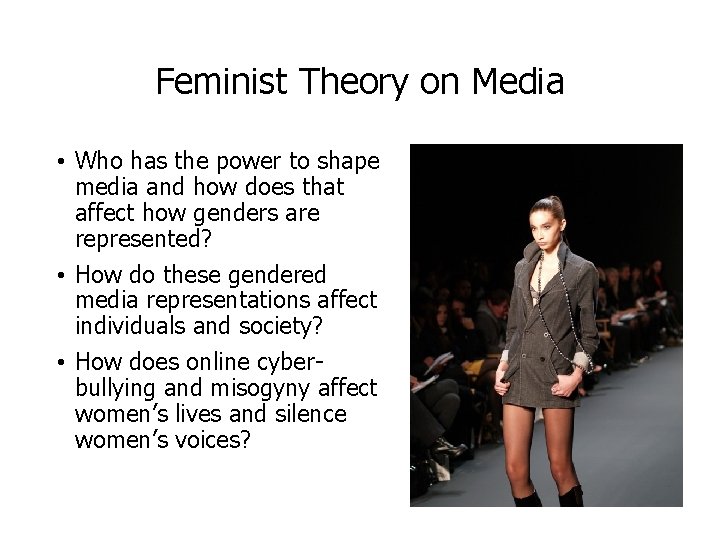
Feminist Theory on Media • Who has the power to shape media and how does that affect how genders are represented? • How do these gendered media representations affect individuals and society? • How does online cyberbullying and misogyny affect women’s lives and silence women’s voices?
Symbolic Interactionist View of Media • Media constructs our reality in a number of ways. For some, the people they watch on a screen can become a primary group or a reference group • While media may indeed be the medium to spread the message of rich white males, some forms of media allow competing constructions of reality to appear • Symbolic-Interactionists might also study how people interact with advertising
Practice Question The rise of social media has lowered the barriers to entry in media and weakened traditional gatekeepers since people can share content with one another directly. How has this affected society?
Quick Review • What are the causes of collective behavior, social movements, and social change? How do they develop? • How does technology affect society? • What is the role of the media in society and how has that role evolved? • How do different sociological perspectives analyze media and technology?