
Social Movements Civil Rights as a Movement Model
- Slides: 29
Social Movements: Civil Rights as a Movement Model Chapter 12 CHAPTER 12 Social Movements: Civil Rights as a Movement Model
A Social Movement Defined • Social movement: – A sustained challenge to those in power put forth by individuals, acting in concert with others, who have been excluded from the political process or who consider themselves political outsiders CHAPTER 12 Social Movements: Civil Rights as a Movement Model
A Social Movement Defined • Conditions that give rise to social movements – – Shared grievances Supportive environment Catalyst Catalytic leadership CHAPTER 12 Social Movements: Civil Rights as a Movement Model
A Social Movement Defined • Social movements and democracy – Social movements enhance democracy by bringing previously excluded groups into the political process – Social movements can sway public opinion CHAPTER 12 Social Movements: Civil Rights as a Movement Model
A Social Movement Defined • Social movements and democracy (cont. ) – A principal objective of social movements is to change public policy – Social movements increase political participation – Social movements can bring about change in the structure of political institutions – Some social movements have worked to decrease the political access of oppressed groups • White supremacy/separatist movement CHAPTER 12 Social Movements: Civil Rights as a Movement Model
Successful American Social Movements • The Civil Rights Movement – Plessy v. Ferguson (1896) – Jim Crow laws – “Separate but Equal” doctrine CHAPTER 12 Social Movements: Civil Rights as a Movement Model
Successful American Social Movements • The Civil Rights Movement (cont. ) – Start of the movement: 1900– 1920 • • Lynching Resurgence of the Ku Klux Klan NAACP: founded in 1909 World War I CHAPTER 12 Social Movements: Civil Rights as a Movement Model
Successful American Social Movements • The Civil Rights Movement (cont. ) – Movement spurred by New Deal and World War II: 1930– 1950 • New Deal programs • Missouri ex rel Gaines v. Canada (1939) • World War II – Returning Black veterans demanding civil rights CHAPTER 12 Social Movements: Civil Rights as a Movement Model
Successful American Social Movements • The Civil Rights Movement (cont. ) – Modern phase begins: 1950– 1960 • Boycotts, sit-ins, and demonstrations • Southern Christian Leadership Conference (SCLC) • White Citizens Council CHAPTER 12 Social Movements: Civil Rights as a Movement Model
Successful American Social Movements • The Civil Rights Movement (cont. ) – Nonviolent civil disobedience increases: 1960– 1965 • Student Non-Violent Coordinating Committee (SNCC) • Congress of Racial Equality (CORE) • Catalytic leadership: Dr. Martin Luther King Jr. – See “Our Voices: Excerpt from Martin Luther King Jr. ’s Letter from Birmingham Jail” • Birmingham, AL: Police Commissioner “Bull” Connor and violent reactions to demonstrators CHAPTER 12 Social Movements: Civil Rights as a Movement Model
Successful American Social Movements • The Civil Rights Movement (cont. ) – Nonviolent civil disobedience increases: 1960– 1965 • 1963: March on Washington • Civil Rights Act of 1964 • Voting Rights Act of 1965 CHAPTER 12 Social Movements: Civil Rights as a Movement Model
Successful American Social Movements • The Women’s Suffrage and Women’s Rights Movements – The first stage of the women’s rights movement • 1848: Seneca Falls Convention • Women’s movement split over the Fifteenth Amendment • National Woman Suffrage Association (NWSA) versus American Woman Suffrage Association (AWSA) • 1890: NWSA and AWSA reunited to create the National American Woman Suffrage Association (NAWSA) CHAPTER 12 Social Movements: Civil Rights as a Movement Model
Successful American Social Movements • The Women’s Suffrage and Women’s Rights Movements (cont. ) – The first stage of the women’s rights movement • 1920: Passage of the Nineteenth Amendment • 1923: First draft of the Equal Rights Amendment CHAPTER 12 Social Movements: Civil Rights as a Movement Model
Successful American Social Movements • The Women’s Suffrage and Women’s Rights Movements (cont. ) – The second stage of the women’s rights movement (beginning in 1960 s) • President Kennedy appointed Esther Peterson as the Head of the Department of Labor’s Women’s Bureau – Development of a Presidential Commission on the Status of Women • 1963 report from the Commission on the Status of Women documenting widespread discrimination against women CHAPTER 12 Social Movements: Civil Rights as a Movement Model
Successful American Social Movements • The Women’s Suffrage and Women’s Rights Movements (cont. ) – The second stage of the women’s rights movement (beginning in 1960 s) • 1963: The Feminine Mystique • 1966: National Organization for Women (NOW) • 1972: Equal Rights Amendment (ERA) – STOP ERA campaign – See “Evaluating Equality: What Arguments Did Supporters and Opponents of the ERA Put Forth? ” CHAPTER 12 Social Movements: Civil Rights as a Movement Model
Successful American Social Movements • The Labor Movement – 1868: Establishment of 8 -hour work day for federal workers – 1886: American Federation of Labor (AFL) – 1925: Brotherhood of Sleeping Car Porters and Maids • First labor union organized by African Americans CHAPTER 12 Social Movements: Civil Rights as a Movement Model
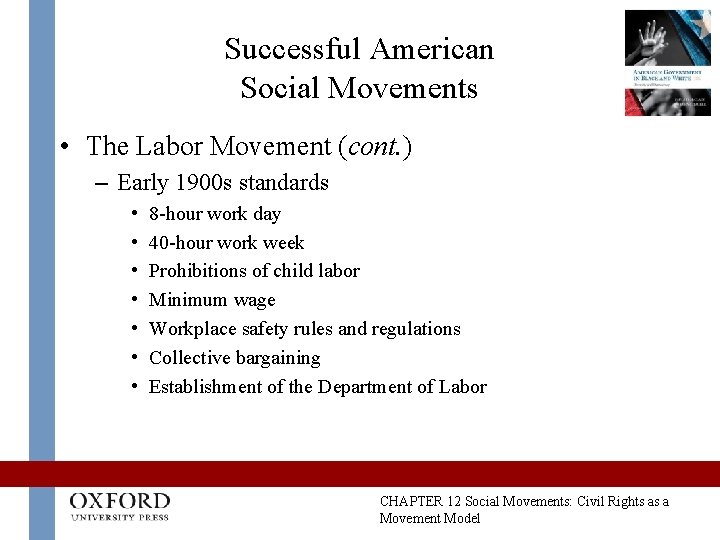
Successful American Social Movements • The Labor Movement (cont. ) – Early 1900 s standards • • 8 -hour work day 40 -hour work week Prohibitions of child labor Minimum wage Workplace safety rules and regulations Collective bargaining Establishment of the Department of Labor CHAPTER 12 Social Movements: Civil Rights as a Movement Model
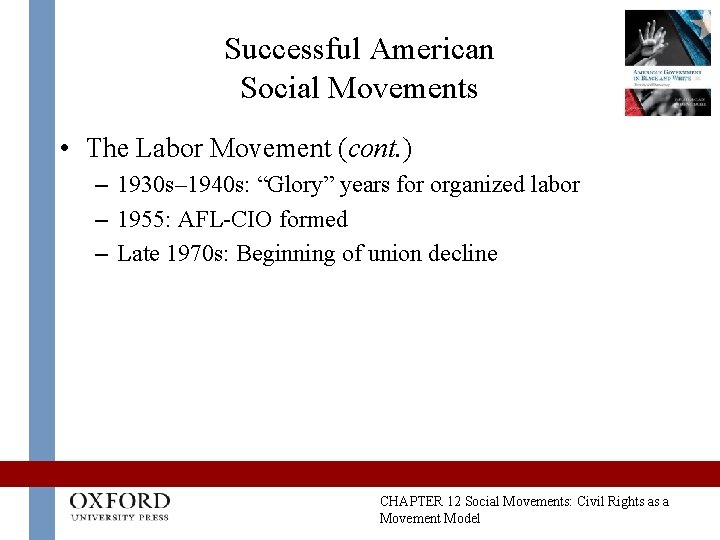
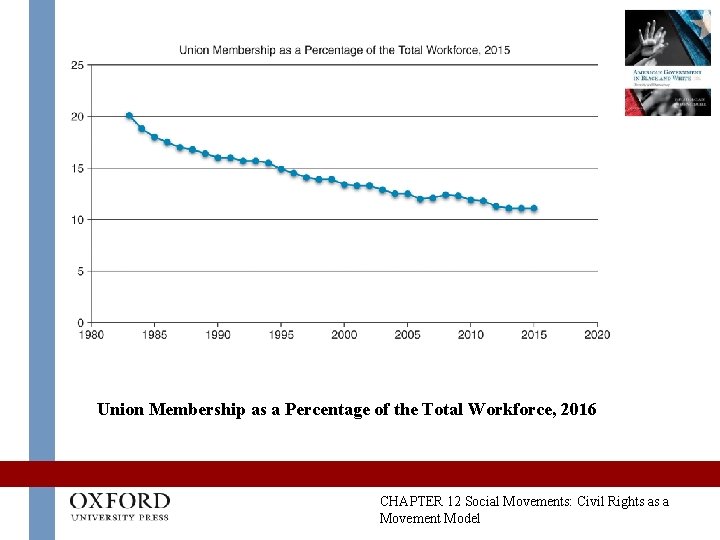
Successful American Social Movements • The Labor Movement (cont. ) – 1930 s– 1940 s: “Glory” years for organized labor – 1955: AFL-CIO formed – Late 1970 s: Beginning of union decline CHAPTER 12 Social Movements: Civil Rights as a Movement Model
Union Membership as a Percentage of the Total Workforce, 2016 CHAPTER 12 Social Movements: Civil Rights as a Movement Model
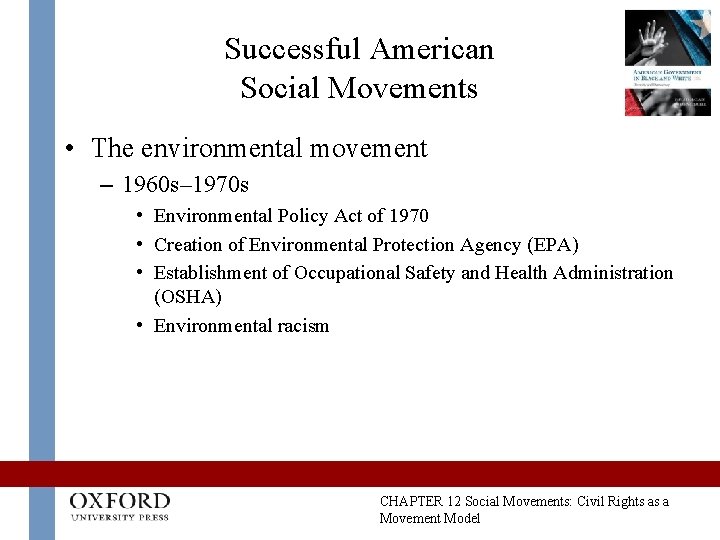
Successful American Social Movements • The environmental movement – 1960 s– 1970 s • Environmental Policy Act of 1970 • Creation of Environmental Protection Agency (EPA) • Establishment of Occupational Safety and Health Administration (OSHA) • Environmental racism CHAPTER 12 Social Movements: Civil Rights as a Movement Model
Successful American Social Movements • The anti–Vietnam War movement – Vietnam War (1959– 1975) • • U. S. college student reactions to religious intolerance in Vietnam 1965: Antiwar demonstrations, draft card burnings 1968: Democratic National Convention Protest against the Selective Service deferment options for middleand upper-class men and male college students • Protest against racial and ethnic minorities bearing much of the burden of the war CHAPTER 12 Social Movements: Civil Rights as a Movement Model
Successful American Social Movements • Lesbian, gay, bisexual, and transgender (LGBT) movement – – Dates back to eighteenth and nineteenth centuries 1924: Society for Human Rights 1950: Mattachine Society 1970 s: Gay liberation movement and lesbian feminism • 1969: Stonewall riots led to the broader modern movement – 2009: Matthew Shepard & James Byrd Jr. Hate Crimes Prevention Act CHAPTER 12 Social Movements: Civil Rights as a Movement Model
Successful American Social Movements • Lesbian, gay, bisexual, and transgender movement (cont. ) – Civil unions and same-sex marriage – 2011: Repeal of “Don’t Ask, Don’t Tell” military policy – Increasing favorable public opinion for state-recognized same-sex marriage – Obergefell v. Hodges (2015) – North Carolina’s HB 2 • Transgender “bathroom bill” CHAPTER 12 Social Movements: Civil Rights as a Movement Model
Other Important U. S. Social Movements • The Chicano civil rights movement – Began in 1940 s – Influenced by Black civil rights movement – 1968 mass walkouts of high school students over poor education and discrimination CHAPTER 12 Social Movements: Civil Rights as a Movement Model
Other Important U. S. Social Movements • American Indian movement – 1924: U. S. citizenship for American Indians – Suffrage with the Voting Rights Act of 1965 – 1968: American Indian Movement (AIM) • Mass demonstrations in the 1970 s CHAPTER 12 Social Movements: Civil Rights as a Movement Model
Other Important U. S. Social Movements • Asian American movement – Late 1960 s • Antinuclear movement – 1970 s • Religious fundamentalist movement – Greater political influence by 1990 s CHAPTER 12 Social Movements: Civil Rights as a Movement Model
Why Some Social Movements Decline and Some Fail • Factors that contribute to social movement decline – – Factionalism Changes in public opinion Countermovements Success CHAPTER 12 Social Movements: Civil Rights as a Movement Model
Why Some Social Movements Decline and Some Fail • Factors that contribute to social movement failure – Broad or unrealistic goals – Inability to organize effectively – Suppression • Physical, legal, or violent force CHAPTER 12 Social Movements: Civil Rights as a Movement Model
Social Movement or Political Activism? • Social movements are difficult to develop and sustain • Black Lives Matter • Political activism versus social movement – Time horizons • Corporate “astroturfing” – Tea Party CHAPTER 12 Social Movements: Civil Rights as a Movement Model