
Social Movements and Social Change in the Global
Social Movements and Social Change in the Global Community 18 Sociology in Modules 3 rd edition Richard T. Schaefer Copyright © 2016 Mc. Graw-Hill Education. All rights reserved. No reproduction or distribution without the prior written consent of Mc. Graw-Hill Education.
Collective Behavior • Collective behavior: “relatively spontaneous and unstructured behavior of a group of people who are reacting to a common influence in an ambiguous situation” (Smelser) Slide 2 Copyright © 2016 Mc. Graw-Hill Education. All rights reserved. No reproduction or distribution without the prior written consent of Mc. Graw-Hill Education.
Theories of Collective Behavior • Emergent-Norm Perspective (Turner and Killian) – During an episode of collective behavior, a definition of what is considered appropriate behavior emerges from the crowd – New norm may arise in an ambiguous situation • Latitude for a wide range of acts within a general framework established by the emergent norm Slide 3 Copyright © 2016 Mc. Graw-Hill Education. All rights reserved. No reproduction or distribution without the prior written consent of Mc. Graw-Hill Education.
Theories of Collective Behavior • Value-Added Perspective (Smelser) – Six determinants of collective behavior • • • Structural conduciveness Structural strain A generalized belief A precipitating factor Mobilization for action Exercise of social control – Relates collective behavior to overall structure of society Slide 4 Copyright © 2016 Mc. Graw-Hill Education. All rights reserved. No reproduction or distribution without the prior written consent of Mc. Graw-Hill Education.

Theories of Collective Behavior • Assembling Perspective (Mc. Phail and Miller) – People and organizations consciously respond to one another’s actions – Periodic assemblies include recurring, relatively routine gatherings • Scheduled in advance – Nonperiodic assemblies: demonstrations, parades, gatherings at scenes of accidents • Result from word-of-mouth Slide 5 Copyright © 2016 Mc. Graw-Hill Education. All rights reserved. No reproduction or distribution without the prior written consent of Mc. Graw-Hill Education.
Forms of Collective Behavior • Many forms of collective behavior – Fads and fashions – Crowds – Disaster behavior – Panics and crazes – Rumors – Public opinion – Social movements Slide 6 Copyright © 2016 Mc. Graw-Hill Education. All rights reserved. No reproduction or distribution without the prior written consent of Mc. Graw-Hill Education.

Crowds • Crowd: a temporary gathering of people in close proximity who share a common focus or interest – Not totally lacking in structure – New meaning in Internet age • Crowdsourcing • Flash mob: a group of people organized by social media to assemble suddenly in a public space, perform some collective activity, and then quickly disperse Slide 7 Copyright © 2016 Mc. Graw-Hill Education. All rights reserved. No reproduction or distribution without the prior written consent of Mc. Graw-Hill Education.
Disaster Behavior • Disaster: a sudden or disruptive event or set of events that overtaxes a community’s resources, so that outside aid is necessary • Disaster Research – Field studies of natural and technological disasters Slide 8 Copyright © 2016 Mc. Graw-Hill Education. All rights reserved. No reproduction or distribution without the prior written consent of Mc. Graw-Hill Education.
Disaster Behavior • Case Studies: Collapse of the World Trade Center and Hurricane Katrina – September 11, 2001: within hours an incident command post and emergency operations center established – Hurricane Katrina: lack of coordination stymied government authorities; centralization of decision making took days instead of hours Slide 9 Copyright © 2016 Mc. Graw-Hill Education. All rights reserved. No reproduction or distribution without the prior written consent of Mc. Graw-Hill Education.
Fads and Fashions • Fads: temporary patterns of behavior involving large numbers of people – Generally short-lived, viewed with amusement • Fashions: pleasurable mass involvements that feature a certain amount of acceptance by society and have little historical continuity – Wider implications, can reflect wealth and status Slide 10 Copyright © 2016 Mc. Graw-Hill Education. All rights reserved. No reproduction or distribution without the prior written consent of Mc. Graw-Hill Education.
Panics and Crazes • Craze: an exciting mass involvement that lasts for a relatively long period • Panic: a fearful arousal or collective fight based on a generalized belief that may or may not be accurate – Belief that there is insufficient time or means to avoid injury • Panics are flights from something; crazes are movements toward something Slide 11 Copyright © 2016 Mc. Graw-Hill Education. All rights reserved. No reproduction or distribution without the prior written consent of Mc. Graw-Hill Education.
Rumors • Rumor: a piece of information gathered informally that is used to interpret an ambiguous situation – Provide a group with a shared belief – Can serve as a means of adapting to change Slide 12 Copyright © 2016 Mc. Graw-Hill Education. All rights reserved. No reproduction or distribution without the prior written consent of Mc. Graw-Hill Education.
Public and Public Opinions • Public: a dispersed group of people, not necessarily in contact with one another, who share an interest in an issue • Public opinion: expression or attitudes on matters of public policy that are communicated to decision makers – Must have both public and a decision maker – Polls and surveys play major role Slide 13 Copyright © 2016 Mc. Graw-Hill Education. All rights reserved. No reproduction or distribution without the prior written consent of Mc. Graw-Hill Education.
Social Movements • Social movement: organized collective activity to bring about or resist fundamental change in an existing group or society (Benford) – Social movements have had dramatic impact on course of history and evolution of social structure – Functionalists: social movements contribute to formation of public opinion – Increasingly taking on international dimension Slide 14 Copyright © 2016 Mc. Graw-Hill Education. All rights reserved. No reproduction or distribution without the prior written consent of Mc. Graw-Hill Education.
The Emergence of Social Movements • Relative Deprivation Approach – Relative deprivation: conscious feeling of negative discrepancy between legitimate expectations and present actualities – Before discontent is channeled into a social movement, people must feel they: • Have a right to their goals • Perceive they cannot attain goals through conventional means Slide 15 Copyright © 2016 Mc. Graw-Hill Education. All rights reserved. No reproduction or distribution without the prior written consent of Mc. Graw-Hill Education.
The Emergence of Social Movements • Resource Mobilization Approach – Resource mobilization: ways a social movement utilizes such resources as money, political influence, access to the media, and workers • Leadership a central factor • Often mobilized by institutional insiders • Marx: leaders would need to help workers overcome false consciousness—attitudes that do not reflect workers’ objective position Slide 16 Copyright © 2016 Mc. Graw-Hill Education. All rights reserved. No reproduction or distribution without the prior written consent of Mc. Graw-Hill Education.
Gender and Social Movements • Women find it more difficult than men to assume leadership positions in social movement organizations • Gender can affect the way we view organized efforts to bring about or resist change Slide 17 Copyright © 2016 Mc. Graw-Hill Education. All rights reserved. No reproduction or distribution without the prior written consent of Mc. Graw-Hill Education.
New Social Movements • New social movement: organized collective activity that addresses values and social identities, as well as improvements in quality of life – New social movements generally do not view government as their ally – Members of new social movements show little inclination to accept established authority – Environmental movement has global focus Slide 18 Copyright © 2016 Mc. Graw-Hill Education. All rights reserved. No reproduction or distribution without the prior written consent of Mc. Graw-Hill Education.
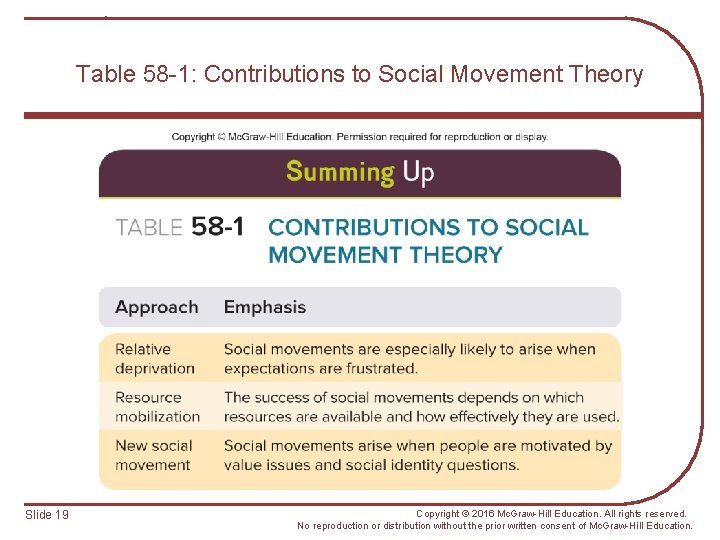
Table 58 -1: Contributions to Social Movement Theory Slide 19 Copyright © 2016 Mc. Graw-Hill Education. All rights reserved. No reproduction or distribution without the prior written consent of Mc. Graw-Hill Education.
Communications and the Globalization of Social Movements • Global text-messaging and the Internet allow activists to reach people – TV and the Internet often convey false sense of intimacy and immediacy – More social movements being mounted on the Web – Computer-mediated communication (CMC): communicative interaction through two or more networked devices Slide 20 Copyright © 2016 Mc. Graw-Hill Education. All rights reserved. No reproduction or distribution without the prior written consent of Mc. Graw-Hill Education.
Social Change • Theories of Social Change – Evolutionary – Functionalist – Conflict • Social change can occur so slowly, almost undetectable; but can also happen rapidly • Modern world’s diversity and complexity make explanation difficult Slide 21 Copyright © 2016 Mc. Graw-Hill Education. All rights reserved. No reproduction or distribution without the prior written consent of Mc. Graw-Hill Education.
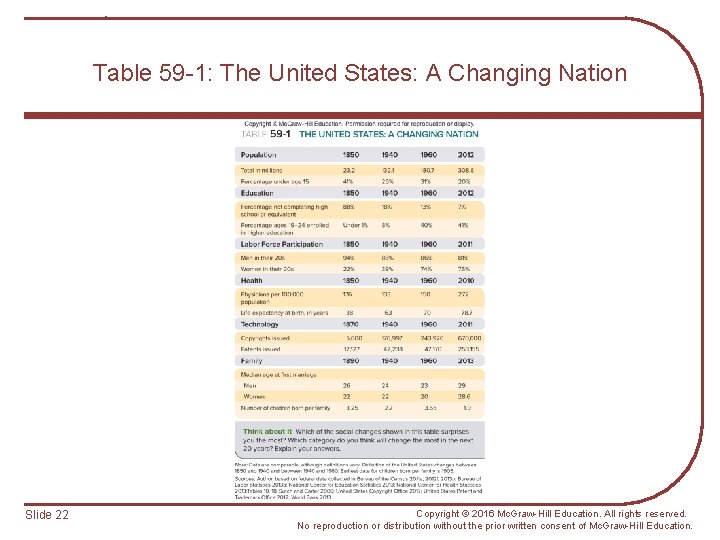
Table 59 -1: The United States: A Changing Nation Slide 22 Copyright © 2016 Mc. Graw-Hill Education. All rights reserved. No reproduction or distribution without the prior written consent of Mc. Graw-Hill Education.
Evolutionary Theory • Evolutionary theory views society as moving in a definite direction – Comte: human societies moving forward in their thinking, from mythology to scientific method – Durkheim: society progresses from simple to more complex social organization Slide 23 Copyright © 2016 Mc. Graw-Hill Education. All rights reserved. No reproduction or distribution without the prior written consent of Mc. Graw-Hill Education.
Functionalist Perspective • Equilibrium model: as changes occur in one part of society, adjustments must be made in other parts • Parsons: four processes of social change – Differentiation – Adaptive upgrading – Inclusion – Value generalization Slide 24 Copyright © 2016 Mc. Graw-Hill Education. All rights reserved. No reproduction or distribution without the prior written consent of Mc. Graw-Hill Education.
Conflict Perspective • Change needed to correct social injustices and inequalities • Marxist view of social change appeals because it does not restrict people to passive roles • Dahrendorf: functionalist and conflict approaches compatible Slide 25 Copyright © 2016 Mc. Graw-Hill Education. All rights reserved. No reproduction or distribution without the prior written consent of Mc. Graw-Hill Education.
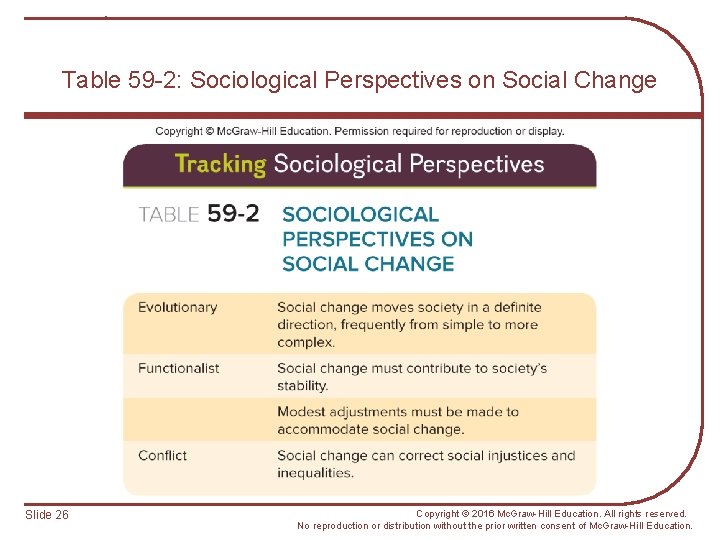
Table 59 -2: Sociological Perspectives on Social Change Slide 26 Copyright © 2016 Mc. Graw-Hill Education. All rights reserved. No reproduction or distribution without the prior written consent of Mc. Graw-Hill Education.
Resistance to Social Change • Resistance may be due to: – Economic factors – Cultural factors – Reluctance to use or fear of technology • Vested interests: people who will suffer in the event of social change (Veblen) Slide 27 Copyright © 2016 Mc. Graw-Hill Education. All rights reserved. No reproduction or distribution without the prior written consent of Mc. Graw-Hill Education.
Economic and Cultural Factors • Companies may resist social change by cutting corners or lobbying for eased regulations • NIMBY: “not in my backyard” – On world stage, “not on planet Earth” • Culture lag: period of maladjustment when nonmaterial culture is still struggling to adapt to new material conditions Slide 28 Copyright © 2016 Mc. Graw-Hill Education. All rights reserved. No reproduction or distribution without the prior written consent of Mc. Graw-Hill Education.
Resistance to Technology • Technology: cultural information about ways in which material resources of environment may be used to satisfy human needs and desires • Luddites: resisted Industrial Revolution; some raided factories, destroyed machinery – Some people resist postindustrial expansion of industrialization Slide 29 Copyright © 2016 Mc. Graw-Hill Education. All rights reserved. No reproduction or distribution without the prior written consent of Mc. Graw-Hill Education.
Global Social Change • Recent past a dramatic time in history – Collapse of communism – Terrorism in various parts of world – Major regime changes and severe economic disruptions – Spread of AIDS – Computer revolution – Cloning Slide 30 Copyright © 2016 Mc. Graw-Hill Education. All rights reserved. No reproduction or distribution without the prior written consent of Mc. Graw-Hill Education.
Anticipating Change • In era of global change, is change possible to predict? – Collins: Soviet expansionism resulted in an overextension of resources in 1980 – Hallinan: need to move beyond restrictive models of social change • Sociologists must learn to predict upheavals and major chaotic shifts Slide 31 Copyright © 2016 Mc. Graw-Hill Education. All rights reserved. No reproduction or distribution without the prior written consent of Mc. Graw-Hill Education.
Social Change in Dubai • Went from pearl-fishing village to tax-free information-technology hub – Constitutional monarchy, but relatively progressive for Arab state – Environmentally, cost of lavish lifestyle exorbitant – Poor treatment of immigrant laborers – 2008 economic downturn difficult for Dubai, but economy back on the move by 2010 Slide 32 Copyright © 2016 Mc. Graw-Hill Education. All rights reserved. No reproduction or distribution without the prior written consent of Mc. Graw-Hill Education.
Technology and the Future • Technological advances have brought striking changes to cultures, patterns of socialization, social institutions, and day -to-day social interactions Slide 33 Copyright © 2016 Mc. Graw-Hill Education. All rights reserved. No reproduction or distribution without the prior written consent of Mc. Graw-Hill Education.
Computer Technology • Effects of computers noteworthy with regard to Internet – In 2012, Internet reached 2. 3 billion users • Anyone can reach Internet with a phone line, a computer, and a modem, but not everyone can get onto information highway • Core nations have near-monopoly on information technology – Effect on people’s jobs Slide 34 Copyright © 2016 Mc. Graw-Hill Education. All rights reserved. No reproduction or distribution without the prior written consent of Mc. Graw-Hill Education.
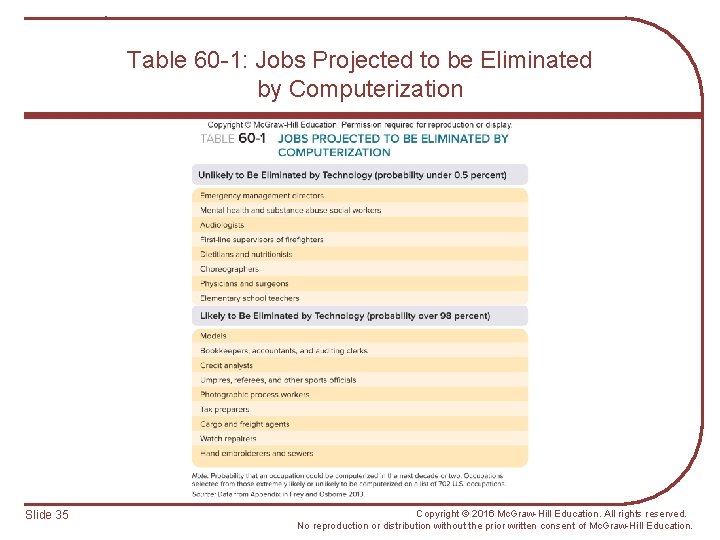
Table 60 -1: Jobs Projected to be Eliminated by Computerization Slide 35 Copyright © 2016 Mc. Graw-Hill Education. All rights reserved. No reproduction or distribution without the prior written consent of Mc. Graw-Hill Education.
Privacy and Censorship in a Global Village • Complex issues of privacy and censorship can be considered examples of culture lag – Functionalists take generally positive view of Internet – Conflict theorists stress most powerful groups will use technology to violate privacy of less powerful • People seem to be less vigilant today about maintaining privacy than they were before information age Slide 36 Copyright © 2016 Mc. Graw-Hill Education. All rights reserved. No reproduction or distribution without the prior written consent of Mc. Graw-Hill Education.
Biotechnology and the Gene Pool • Sex selection of fetuses, genetically engineered organisms, and cloning of sheep, cows, and other animals are among significant advances – Biotechnological advances have raised many difficult ethical and political questions • Altering the gene pool • Genetically Modified (GM) food – Notable success in treatment of traumatic injuries Slide 37 Copyright © 2016 Mc. Graw-Hill Education. All rights reserved. No reproduction or distribution without the prior written consent of Mc. Graw-Hill Education.
Social Policy and Globalization: Transnationals • Millions of migrant laborers play roles in global economy – Fill jobs where shortages exist in labor market – Do not become wealthy, but consider themselves better off than they were in their native country – Citizens of host countries often react negatively Slide 38 Copyright © 2016 Mc. Graw-Hill Education. All rights reserved. No reproduction or distribution without the prior written consent of Mc. Graw-Hill Education.
Social Policy and Globalization: Transnationals • Looking at the Issue – 2013: 232 million international migrants • 3% of world’s population – Globalization changed immigrant experience and labor market – Transnationals: immigrants who sustain multiple social relationships that link their societies of origin with the societies of settlement Slide 39 Copyright © 2016 Mc. Graw-Hill Education. All rights reserved. No reproduction or distribution without the prior written consent of Mc. Graw-Hill Education.
Social Policy and Globalization: Transnationals • Applying Sociology – Functionalists: free flow of immigrants is way for economies to maximize human labor – Conflict theorists: globalization increases economic gulf between developed and developing countries – Interactionists: interested in the day-to-day relationships transnationals have with people around them Slide 40 Copyright © 2016 Mc. Graw-Hill Education. All rights reserved. No reproduction or distribution without the prior written consent of Mc. Graw-Hill Education.
Social Policy and Globalization: Transnationals • Initiating Policy – Transnationals face continuing adjustment problems in their new home countries – Often encounter difficult living and working conditions – Voter eligibility remains unresolved – Public attitudes and government policies have not kept pace – General public’s attitude toward illegal immigrants remains hostile, especially in U. S. Slide 41 Copyright © 2016 Mc. Graw-Hill Education. All rights reserved. No reproduction or distribution without the prior written consent of Mc. Graw-Hill Education.
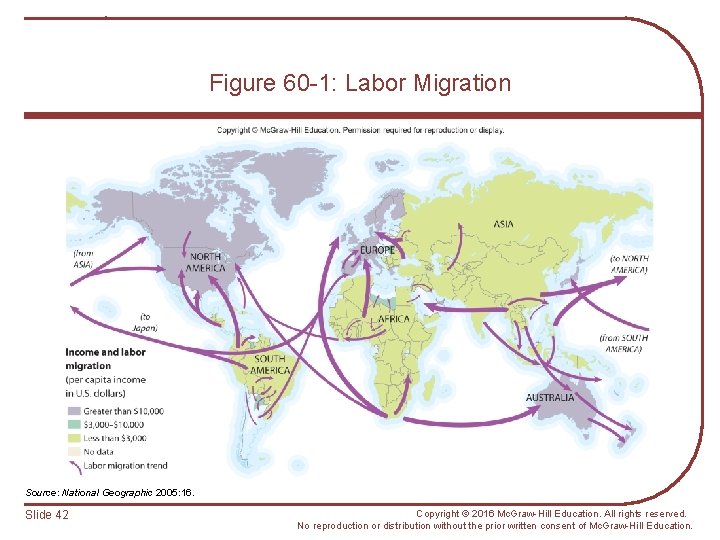
Figure 60 -1: Labor Migration Source: National Geographic 2005: 16. Slide 42 Copyright © 2016 Mc. Graw-Hill Education. All rights reserved. No reproduction or distribution without the prior written consent of Mc. Graw-Hill Education.
Sociology in the Global Community 58 -1: Women’s Social Movements in South Korea and India – What do you think might explain the differences between women’s social movements and issues in South Korea and in India? – What would happen if “powerless” people in the United States formed a social movement of their own? Would it succeed? Why or why not? Slide 43 Copyright © 2016 Mc. Graw-Hill Education. All rights reserved. No reproduction or distribution without the prior written consent of Mc. Graw-Hill Education.
Our Wired World 58 -2: Organizing for Controversy via Computer-Mediated Communication – Have you ever been involved in a social or political movement whose legitimacy some people considered questionable? If so, what was the movement, and what were the objections to it? Did you consider the objections to be legitimate? – Can any social movement be free from controversy? Would you want to live in a society in which controversy is not tolerated? Slide 44 Copyright © 2016 Mc. Graw-Hill Education. All rights reserved. No reproduction or distribution without the prior written consent of Mc. Graw-Hill Education.
Our Wired World 60 -1: The Internet’s Global Profile – Of the three figures shown on the following slides, which do you think presents the most sociologically significant statistics? Explain. – Why do you think the use of Chinese on the Internet has increased so dramatically in just a decade? What kind of information would you expect to find in Chinese? Who would use it? Slide 45 Copyright © 2016 Mc. Graw-Hill Education. All rights reserved. No reproduction or distribution without the prior written consent of Mc. Graw-Hill Education.
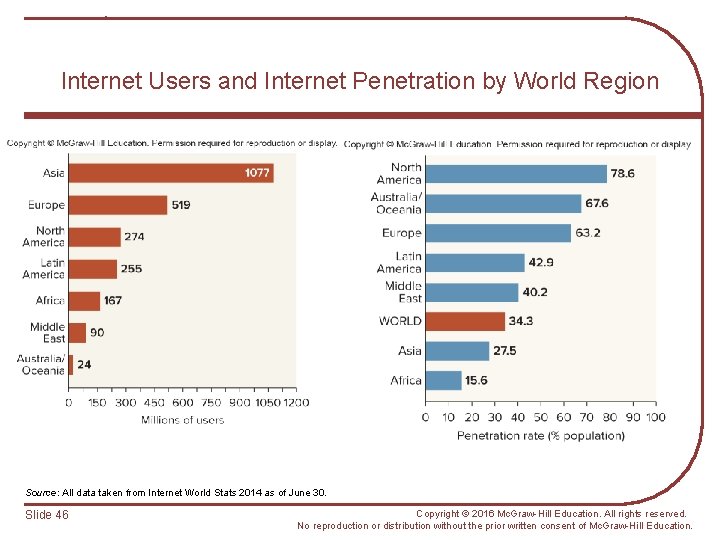
Internet Users and Internet Penetration by World Region Source: All data taken from Internet World Stats 2014 as of June 30. Slide 46 Copyright © 2016 Mc. Graw-Hill Education. All rights reserved. No reproduction or distribution without the prior written consent of Mc. Graw-Hill Education.
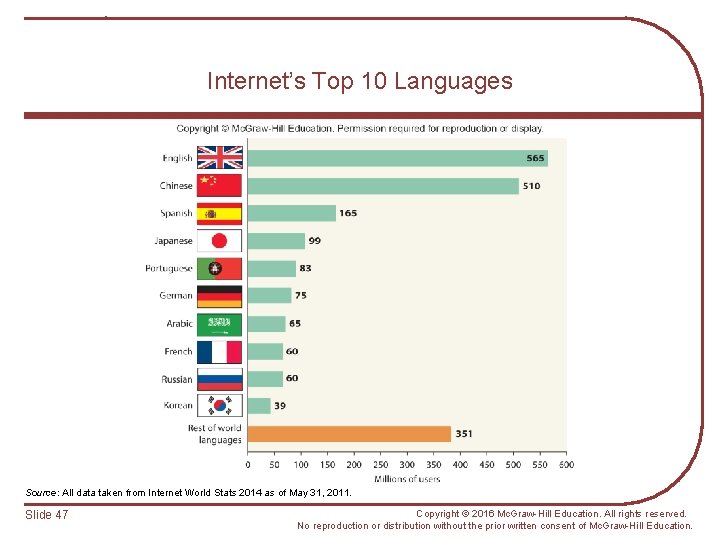
Internet’s Top 10 Languages Source: All data taken from Internet World Stats 2014 as of May 31, 2011. Slide 47 Copyright © 2016 Mc. Graw-Hill Education. All rights reserved. No reproduction or distribution without the prior written consent of Mc. Graw-Hill Education.
- Slides: 47