
SOCIAL MOBILIZATION AND NUTRITION ADVOCACY KEY CONCEPTS Social

SOCIAL MOBILIZATION AND NUTRITION ADVOCACY
KEY CONCEPTS Social Mobilization and Advocacy are important strategies and processes to achieve nutritional goals because of the multifactorial causality of malnutrition. As such actions address malnutrition lie in the hands of various sectors and personalities who need to recognize that there is a problem that they can help solve in cooperation and collaboration with one another. the resources needed to address malnutrition. Furthermore, no single organization has all the resources needed to address malnutrition.
• WHAT IS NUTRITION ADVOCACY • Nutrition advocacy is a platform to create movement toward greater political and social commitment for nutrition in a country. It is planned, systematic and deliberate process that is define and shaped by the specific country context. • There’s specific focus on nutrition in emergencies and influencing policies , practice and behaviors of relevant stakeholders based on cluster partner’s expertise and common experiences.
• • • SOCIAL MOBILIZATION AND NUTRITION ADVOCACY It is a process of generating and sustaining using various means and approaches the active and coordinated action and participation of various sectors of all levels to facilitate and accelerate the improvement of the nutrition situation of society in general, with focus on disadvantages groups.
• AS A PROCESS • 1. Begins with a conscious recognition of problems affecting communities particularly, disadvantaged • e. g. poor, infants, children, women • 2. Generates acceptance of new problemsolving ideas, technologies and approaches
• 3. Initiates discussion and decision making for political will, commitment and action. • 4. Bring together those who are affected by the problem and those who can contribute to its solution through linking, networking and organizing. • 5. Uses all available and potential communication, resources, mechanisms, methods, tools and techniques.
• 6. Monitor and evaluate approaches in term of impact or solving or reducing the identified problems. • 7. Sustain awareness, cooperation and commitment generated to achieve common goals.

• PRINCIPLES • 1. Social Mobilization can take place only to the extent that those effected by the problem and those who can act on the problem are in constant interaction with each other. • 2. The closer the link among those who have the problem , the greater the likelihood that can find their own solutions.
• 3. The closer the link among those who can make the positive contribution to the problems the higher the degree of convergence of efforts and resources in reaching those who have the
• AIMS • 1. Commit key decision makers to provide financial and political support for effective and sustained delivery of services. • 2. Motivate service providers to increase the quality and effectiveness of service with more concerns for the users. • 3. Empower communities to demand satisfaction of their needs.
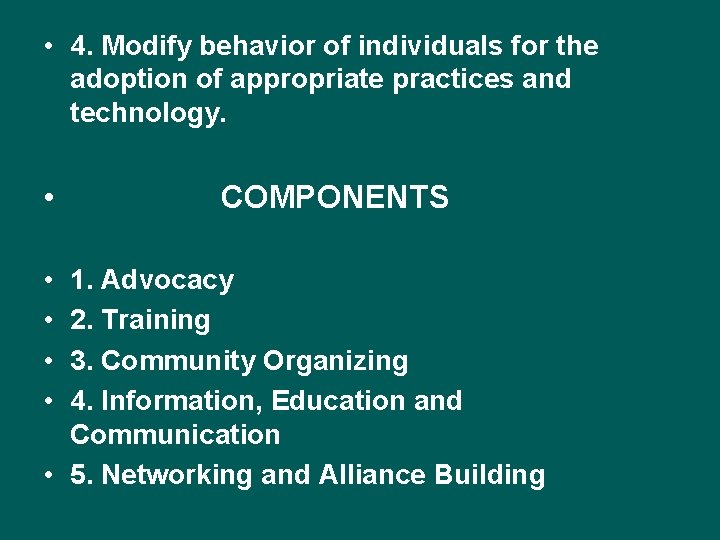
• 4. Modify behavior of individuals for the adoption of appropriate practices and technology. • • • COMPONENTS 1. Advocacy 2. Training 3. Community Organizing 4. Information, Education and Communication • 5. Networking and Alliance Building
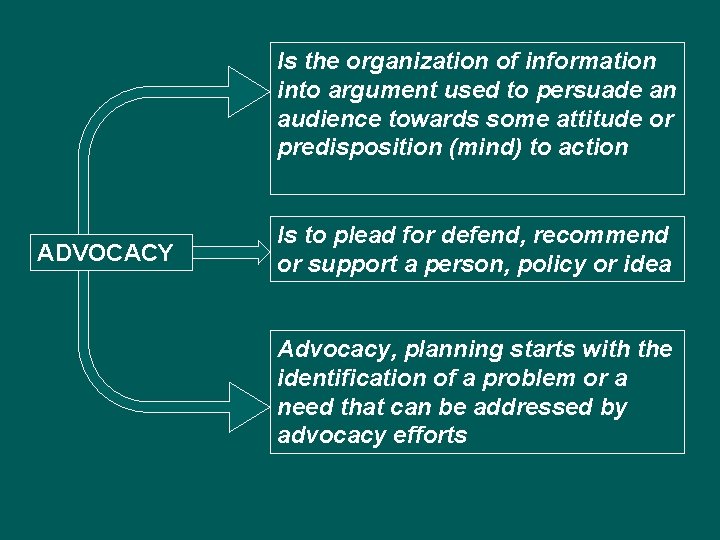
Is the organization of information into argument used to persuade an audience towards some attitude or predisposition (mind) to action ADVOCACY Is to plead for defend, recommend or support a person, policy or idea Advocacy, planning starts with the identification of a problem or a need that can be addressed by advocacy efforts
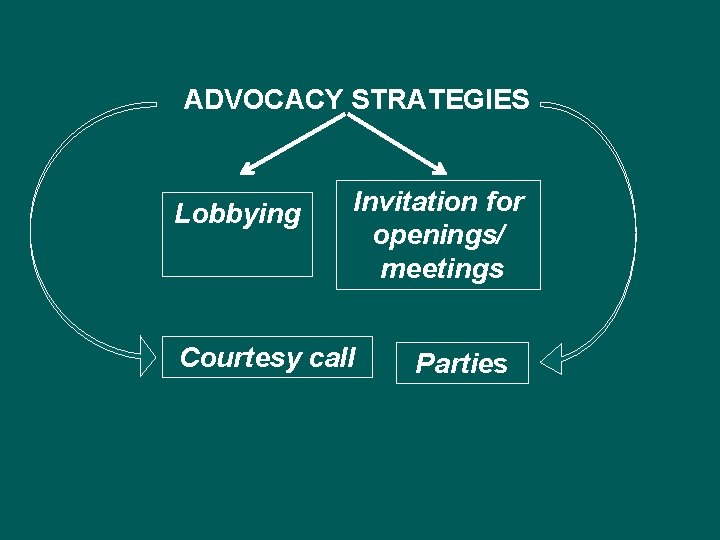
ADVOCACY STRATEGIES Lobbying Invitation for openings/ meetings Courtesy call Parties
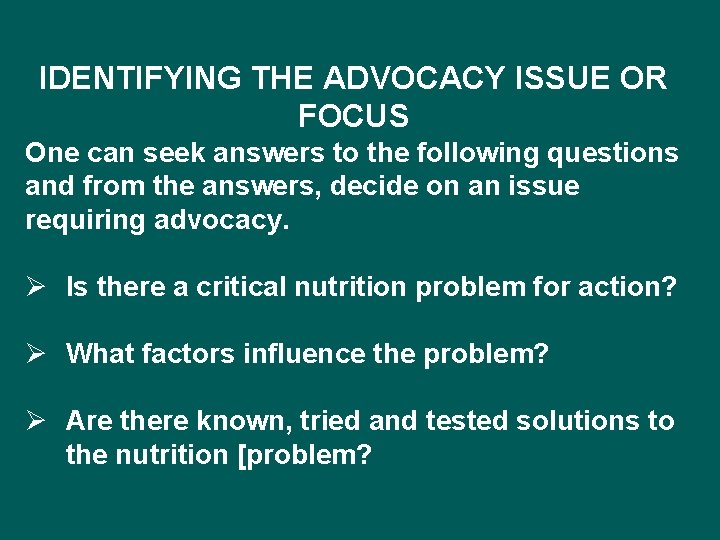
IDENTIFYING THE ADVOCACY ISSUE OR FOCUS One can seek answers to the following questions and from the answers, decide on an issue requiring advocacy. Ø Is there a critical nutrition problem for action? Ø What factors influence the problem? Ø Are there known, tried and tested solutions to the nutrition [problem?
Ø What are the problems and constraints in implementing these actions or solutions to the problem? Is the difficulty related to a lack of a policy? or on the lack of appropriate programs to implement the policy? or on shortcomings in implementing programs and projects? Are these difficulties due to:
a. Lack of awareness or clear understanding of the nutritional problem itself? b. Lack of appreciation of the negative consequences of the nutritional problems? or of the gains in addressing this problems? Ø Is there a common understanding of what needs to be done? Among whom? If not, why not? And what can be done to achieve the common understanding among important stakeholders?
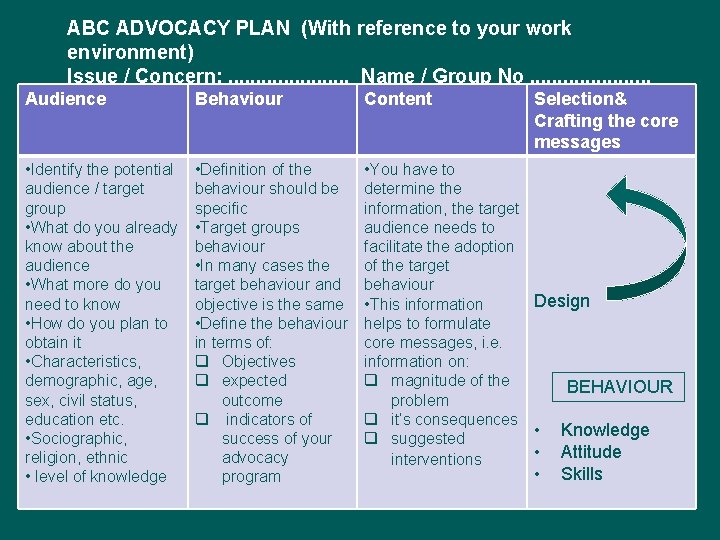
ABC ADVOCACY PLAN (With reference to your work environment) Issue / Concern: . . Name / Group No. . . . . Audience Behaviour Content Selection& Crafting the core messages • Identify the potential audience / target group • What do you already know about the audience • What more do you need to know • How do you plan to obtain it • Characteristics, demographic, age, sex, civil status, education etc. • Sociographic, religion, ethnic • level of knowledge • Definition of the behaviour should be specific • Target groups behaviour • In many cases the target behaviour and objective is the same • Define the behaviour in terms of: q Objectives q expected outcome q indicators of success of your advocacy program • You have to determine the information, the target audience needs to facilitate the adoption of the target behaviour Design • This information helps to formulate core messages, i. e. information on: q magnitude of the BEHAVIOUR problem q it’s consequences • Knowledge q suggested • Attitude interventions • Skills
Selecting a CONCERN which can be addressed through advocacy v Participation should specify your concern (problem) v Explain how such problem affects in achieving nutrition goals v Causes of the problem
EXPLAINING AUDIENCE SOC -MOB audience ! Target groups are mainly two: 1. Those who are directly affected by the problem, i. e. the poor, young children, women, adolescents etc. 2. Those who can make positive contribution to the solution of the nutritional problem
EXPLAINING BEHAVIOUR (concern: underweight children in the community) OBJECTIVE Children 0 -60 months old completely weigh regularly within the 5 year period EXPECTED OUTCOME/S • Better nutritional status of children • Low prevalence of diseases in children INDICATORS OF SUCCESS Number of children weighed by age monthly /quarterly
EXPLAINING CONTENT Participants will proceed designing specific core messages (one specific message by a participant / group) MESSAGE PREPARATION 1. Decide on the objective of the message • Is it to inform? explain? • Educate? Arouse curiosity? • Promote sustained change in a particular attitude or behaviour
2. Limited message to one piece of information 3. Keep the message short and simple 4. Make the message more action oriented SELECTING AND CRAFTING THE CORE MESSAGE • Information gathered may be packed around a core message • Core message may be crafted using various appeals
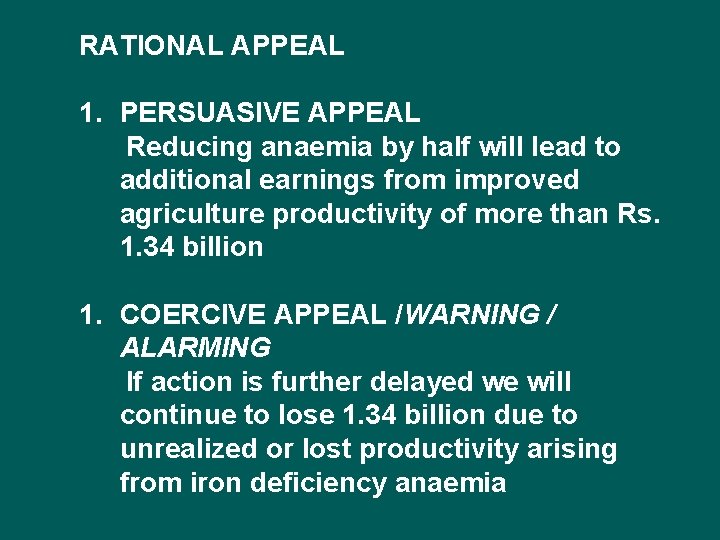
RATIONAL APPEAL 1. PERSUASIVE APPEAL Reducing anaemia by half will lead to additional earnings from improved agriculture productivity of more than Rs. 1. 34 billion 1. COERCIVE APPEAL /WARNING / ALARMING If action is further delayed we will continue to lose 1. 34 billion due to unrealized or lost productivity arising from iron deficiency anaemia
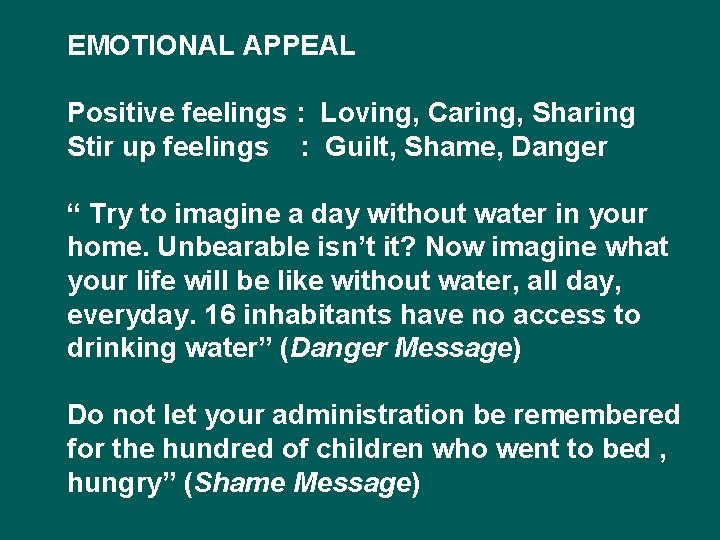
EMOTIONAL APPEAL Positive feelings : Loving, Caring, Sharing Stir up feelings : Guilt, Shame, Danger “ Try to imagine a day without water in your home. Unbearable isn’t it? Now imagine what your life will be like without water, all day, everyday. 16 inhabitants have no access to drinking water” (Danger Message) Do not let your administration be remembered for the hundred of children who went to bed , hungry” (Shame Message)
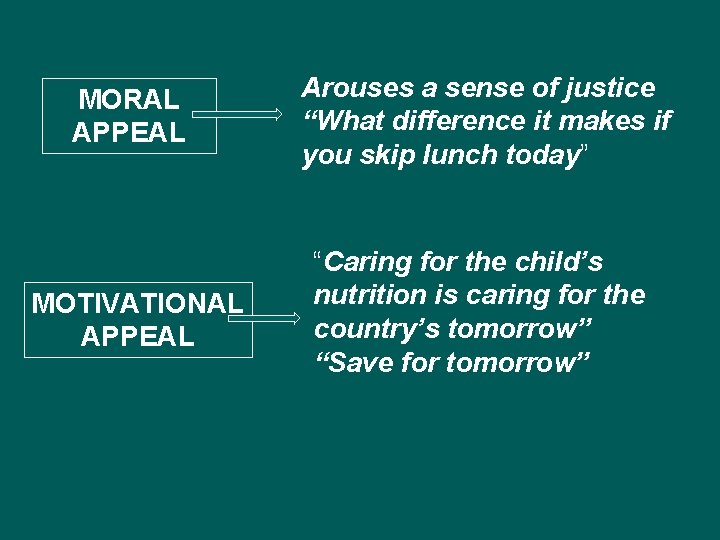
MORAL APPEAL MOTIVATIONAL APPEAL Arouses a sense of justice “What difference it makes if you skip lunch today” “Caring for the child’s nutrition is caring for the country’s tomorrow” “Save for tomorrow”
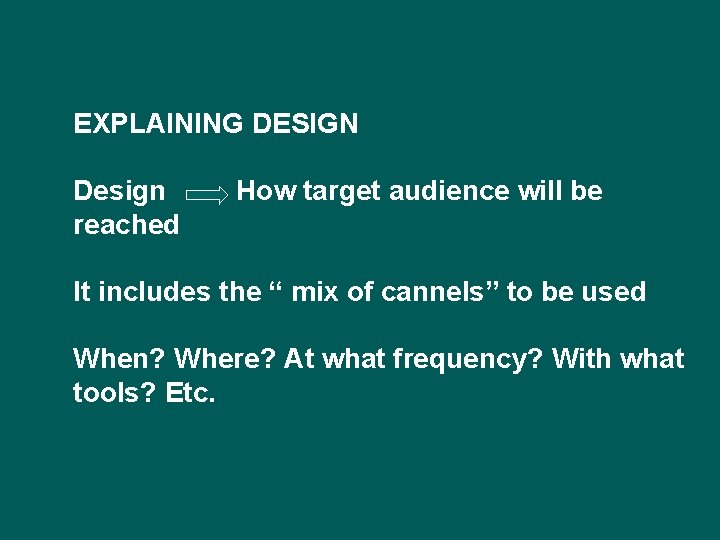
EXPLAINING DESIGN Design reached How target audience will be It includes the “ mix of cannels” to be used When? Where? At what frequency? With what tools? Etc.
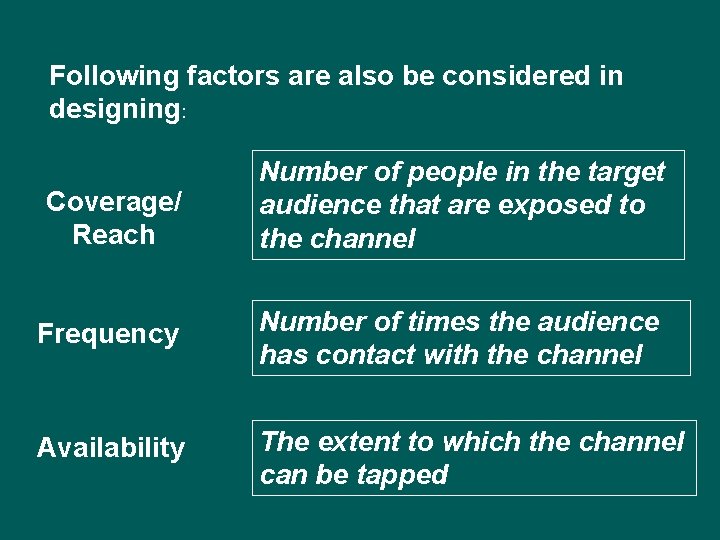
Following factors are also be considered in designing: Coverage/ Reach Number of people in the target audience that are exposed to the channel Frequency Number of times the audience has contact with the channel Availability The extent to which the channel can be tapped
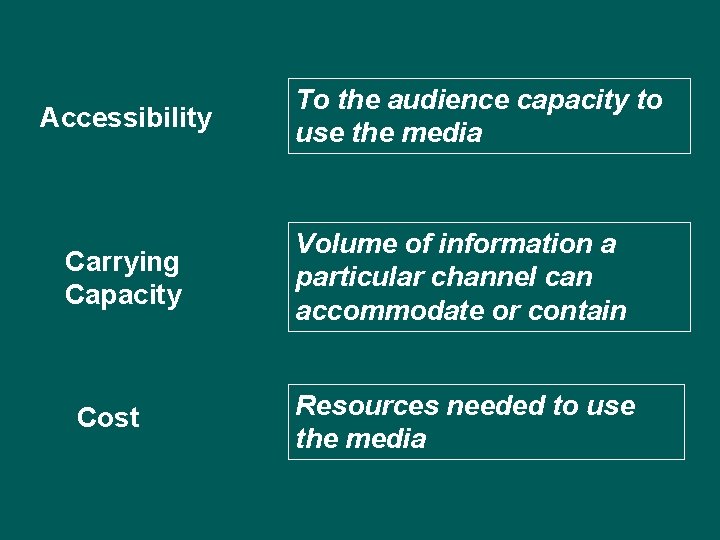
Accessibility Carrying Capacity Cost To the audience capacity to use the media Volume of information a particular channel can accommodate or contain Resources needed to use the media
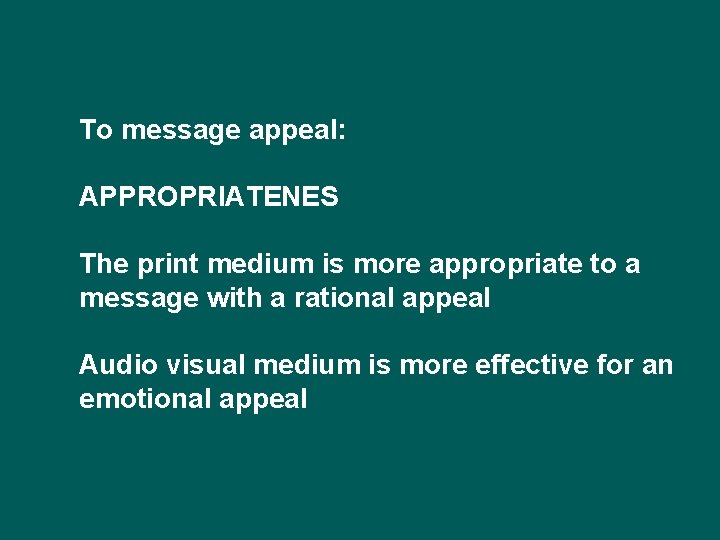
To message appeal: APPROPRIATENES The print medium is more appropriate to a message with a rational appeal Audio visual medium is more effective for an emotional appeal
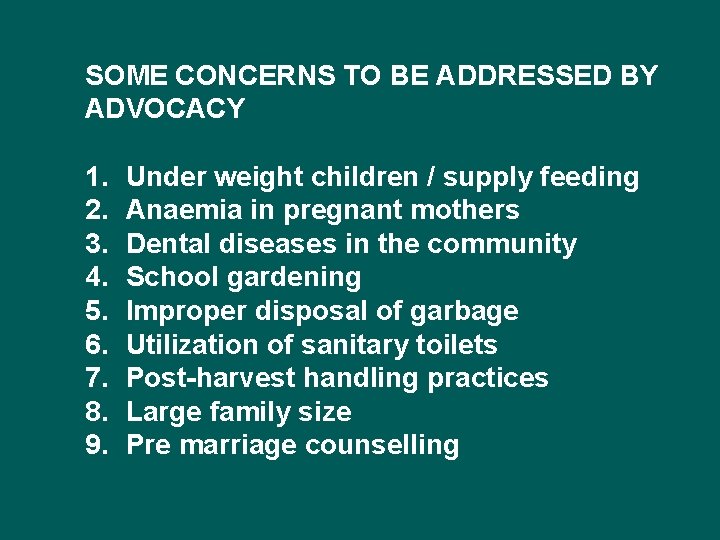
SOME CONCERNS TO BE ADDRESSED BY ADVOCACY 1. 2. 3. 4. 5. 6. 7. 8. 9. Under weight children / supply feeding Anaemia in pregnant mothers Dental diseases in the community School gardening Improper disposal of garbage Utilization of sanitary toilets Post-harvest handling practices Large family size Pre marriage counselling
10. Pre and post natal check up target mothers 11. Goiter control 12. Short-self life of home made goods (candies, bread, cookies. ) 13. Diet during pregnancy and lactation 14. Breast feeding promotion 15. Selection of food for the family 16. Caring of children during sickness 17. Drinking of boiled - cool water
- Slides: 31