
Social Mobility Barometer Public attitudes to social mobility
Social Mobility Barometer Public attitudes to social mobility in the UK, 2021 March 2021
About the Commission The Social Mobility Commission is an advisory non-departmental public body established under the Life Chances Act 2010 as modified by the Welfare Reform and Work Act 2016. It has a duty to assess progress in improving social mobility in the UK and to promote social mobility in England. It consists of twelve commissioners and is supported by a small secretariat. The Commission board comprises: Interim Co-Chairs • Steven Cooper, Chair of Experian UK and incoming CEO of Aldermore Bank Plc • Sandra Wallace, Partner and Joint Managing Director at law firm DLA Piper Commissioners • Saeed Atcha MBE, Chief Executive of the charity Youth Leads UK • Alastair Da Costa, Chair of Capital City College Group • Pippa Dunn, Co-Founder of Broody, helping entrepreneurs and start ups • Sam Friedman, Associate Professor in Sociology at the London School of Economics • Harvey Matthewson, Aviation Activity Officer at Aerobility, a charity for disabled people • Jessica Oghenegweke, BBC Earth Kids presenter and student at Brunel University • Farrah Storr, Editor-in-Chief of ELLE UK • Jody Walker, Director of retail company TJX Europe • Liz Williams MBE, CEO of Future. Dot. Now, a coalition focused on accelerating digital skills • Sammy Wright, Vice-Principal of Southmoor Academy in Sunderland The functions of the Commission include: • monitoring progress on improving social mobility. • providing published advice to ministers on matters relating to social mobility. • undertaking social mobility advocacy Social Mobility Commission, Sanctuary Buildings, 20 Great Smith Street London SW 1 P 3 BT contact@socialmobilitycommission. gov. uk Social Mobility Commission 2
Foreword Everyone’s lives have been turned upside down in the last year but those from disadvantaged backgrounds have fared so much the worst. More likely to lose their jobs, miss out on home schooling or fail to get an apprenticeship, they are also more likely to be in front line jobs and at greater risk of catching the virus. Our latest Social Mobility Barometer 2021 surveys 4, 693 UK adults and gives a timely snapshot of perceptions of where the pandemic has impacted most, who has suffered and what needs to be done by government and others. It reveals that most people think that COVID-19 has had the biggest impact on mental health (55%) and social interaction (44%) but also that the pandemic has led to even greater social inequality. The You. Gov poll shows that over half (56%) of all adults in the UK think that social inequality has increased as a result of the pandemic. Almost four fifths (79%) of adults believe there is now a large gap between social classes in Britain with 34% stating that it’s a very large gap. In 2019, our State of the Nation report revealed that social mobility had stagnated for at least four years, with big increases in child poverty since 2012. Now without urgent, targeted action, social mobility looks set to go backwards and the attainment gap between the wealthy and disadvantaged will grow ever wider. The respondents say that boosting employment (47%) and addressing people’s mental health (46%) should be the top priorities for the government’s recovery programme, followed by access to education (33%). Schools, employers and government all have their part to play. The Commission has recently called for more digital access for children, extra teaching hours to allow pupils to catch up and more opportunities for apprenticeships – all of which help disadvantaged families. Regional differences in perception are also apparent, despite the national reach of the pandemic. Over a third (35%) of those living in the North of England felt COVID-19 had impacted on employment in their area more than other parts of the country, while only 17% said the same in parts of the South. Social Mobility Commission 3
Foreword (continued) There were also big regional differences in perceptions of opportunities. People in London are much more likely to think the opportunities to progress in their area are ‘good’ (74%) than people in the North East (31%). Our research last autumn, looking at socio-economic data throughout England, showed dramatic differences in earnings for those from disadvantaged backgrounds depending on where they lived. This year we hope to work with central government, local leaders and metro mayors to share best practice and encourage more targeted action in the “coldest spots” across England. The social mobility agenda could not be more relevant than it is now. The pandemic is exposing those without jobs, welfare claimants, people in cramped housing with no outside space, and students fearful of their future. There are families without basic provisions – let alone laptops. The Commission wishes to seize this moment of greater public awareness to help drive and deliver an agenda for fairness and equal opportunity, particularly in the regions. Our move to the Cabinet Office next month should let us help shape that agenda from the heart of Whitehall. The poll shows that people think that local and central government should do more to boost social mobility. Our job in the next few months is to help ensure that happens. Steven Cooper and Sandra Wallace Interim Co-Chairs of the Social Mobility Commission 4
Methodology All figures, unless otherwise stated, are from You. Gov Plc. Total sample size was 4, 693 adults. Fieldwork was undertaken between 27 January - 1 February 2021. The survey was carried out online. The figures have been weighted and are representative of all UK adults (aged 18+). You. Gov ensured that the survey was representative based on several criteria: • • Age Gender Political attention Region Social grade Education level General election vote in 2019 EU referendum vote in 2016 You. Gov is registered with the Information Commissioner and is a member of the British Polling Council Social Mobility Commission 5
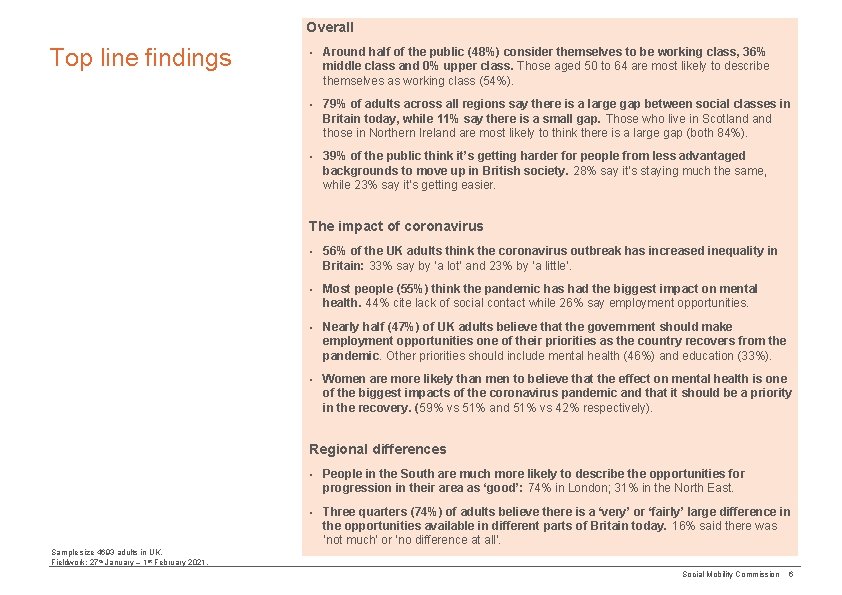
Overall Top line findings • Around half of the public (48%) consider themselves to be working class, 36% middle class and 0% upper class. Those aged 50 to 64 are most likely to describe themselves as working class (54%). • 79% of adults across all regions say there is a large gap between social classes in Britain today, while 11% say there is a small gap. Those who live in Scotland those in Northern Ireland are most likely to think there is a large gap (both 84%). • 39% of the public think it’s getting harder for people from less advantaged backgrounds to move up in British society. 28% say it’s staying much the same, while 23% say it’s getting easier. The impact of coronavirus • 56% of the UK adults think the coronavirus outbreak has increased inequality in Britain: 33% say by ‘a lot’ and 23% by ‘a little’. • Most people (55%) think the pandemic has had the biggest impact on mental health. 44% cite lack of social contact while 26% say employment opportunities. • Nearly half (47%) of UK adults believe that the government should make employment opportunities one of their priorities as the country recovers from the pandemic. Other priorities should include mental health (46%) and education (33%). • Women are more likely than men to believe that the effect on mental health is one of the biggest impacts of the coronavirus pandemic and that it should be a priority in the recovery. (59% vs 51% and 51% vs 42% respectively). Regional differences • People in the South are much more likely to describe the opportunities for progression in their area as ‘good’: 74% in London; 31% in the North East. • Three quarters (74%) of adults believe there is a ‘very’ or ‘fairly’ large difference in the opportunities available in different parts of Britain today. 16% said there was ‘not much’ or ‘no difference at all’. Sample size 4693 adults in UK. Fieldwork: 27 th January – 1 st February 2021. Social Mobility Commission 6
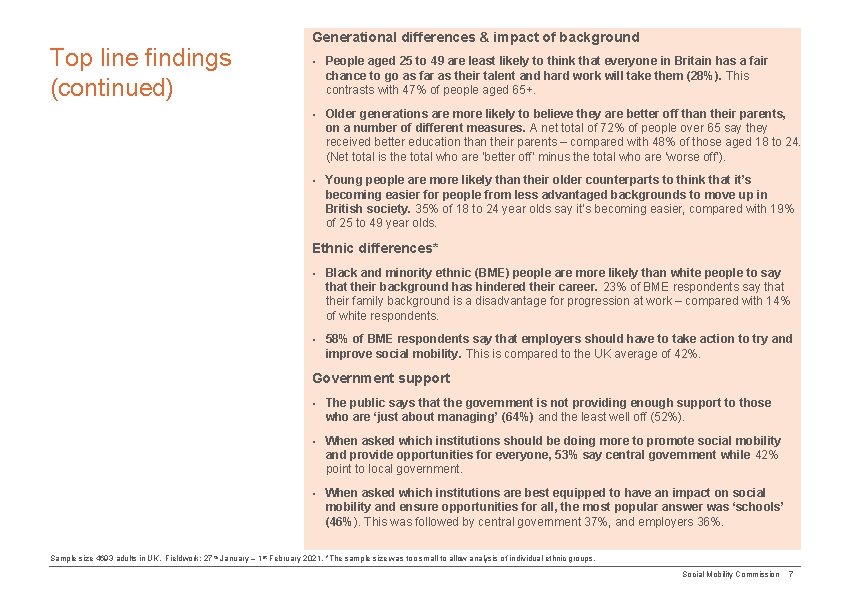
Top line findings (continued) Generational differences & impact of background • People aged 25 to 49 are least likely to think that everyone in Britain has a fair chance to go as far as their talent and hard work will take them (28%). This contrasts with 47% of people aged 65+. • Older generations are more likely to believe they are better off than their parents, on a number of different measures. A net total of 72% of people over 65 say they received better education than their parents – compared with 48% of those aged 18 to 24. (Net total is the total who are ‘better off’ minus the total who are ‘worse off’). • Young people are more likely than their older counterparts to think that it’s becoming easier for people from less advantaged backgrounds to move up in British society. 35% of 18 to 24 year olds say it’s becoming easier, compared with 19% of 25 to 49 year olds. Ethnic differences* • Black and minority ethnic (BME) people are more likely than white people to say that their background has hindered their career. 23% of BME respondents say that their family background is a disadvantage for progression at work – compared with 14% of white respondents. • 58% of BME respondents say that employers should have to take action to try and improve social mobility. This is compared to the UK average of 42%. Government support • The public says that the government is not providing enough support to those who are ‘just about managing’ (64%) and the least well off (52%). • When asked which institutions should be doing more to promote social mobility and provide opportunities for everyone, 53% say central government while 42% point to local government. • When asked which institutions are best equipped to have an impact on social mobility and ensure opportunities for all, the most popular answer was ‘schools’ (46%). This was followed by central government 37%, and employers 36%. Sample size 4693 adults in UK. Fieldwork: 27 th January – 1 st February 2021. *The sample size was too small to allow analysis of individual ethnic groups. Social Mobility Commission 7
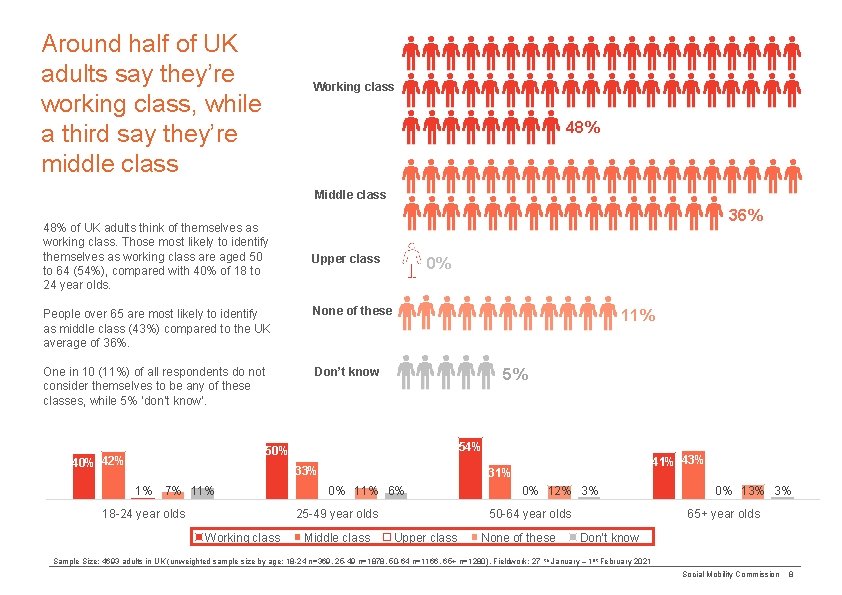
Around half of UK adults say they’re working class, while a third say they’re middle class Working class 48% Middle class 48% of UK adults think of themselves as working class. Those most likely to identify themselves as working class are aged 50 to 64 (54%), compared with 40% of 18 to 24 year olds. 36% Upper class People over 65 are most likely to identify as middle class (43%) compared to the UK average of 36%. None of these One in 10 (11%) of all respondents do not consider themselves to be any of these classes, while 5% ‘don’t know’. Don’t know 0% 11% 5% 54% 50% 42% 33% 1% 7% 11% 18 -24 year olds 31% 0% 11% 6% 25 -49 year olds Working class 41% 43% Middle class 0% 12% 3% 50 -64 year olds Upper class None of these Sample Size: 4693 adults in UK (unweighted sample size by age: 18 -24 n=369, 25 -49 n=1878, 50 -64 n=1166, 65+ n=1280). Fieldwork: 27 th 0% 13% 3% 65+ year olds Don’t know January – 1 st February 2021 Social Mobility Commission 8
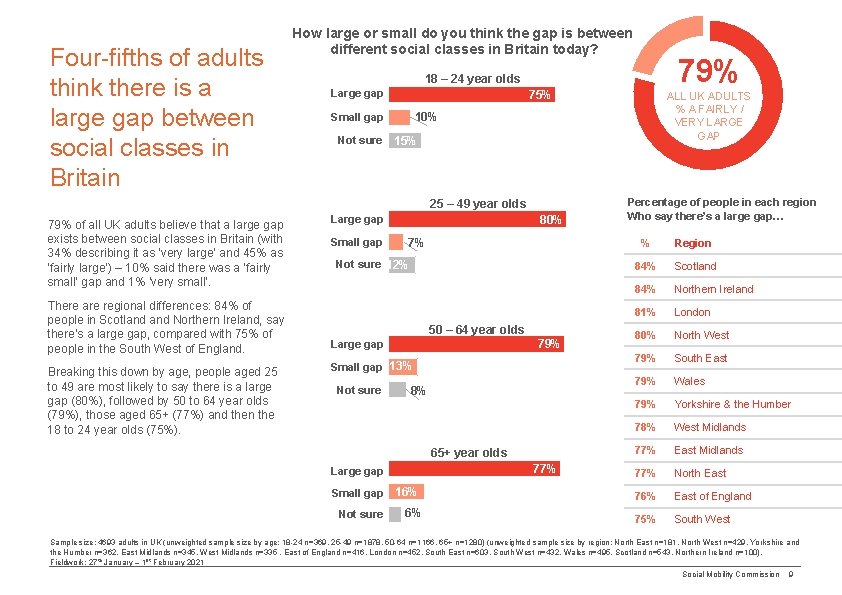
Four-fifths of adults think there is a large gap between social classes in Britain How large or small do you think the gap is between different social classes in Britain today? Large gap 75% Not sure 15% There are regional differences: 84% of people in Scotland Northern Ireland, say there’s a large gap, compared with 75% of people in the South West of England. Breaking this down by age, people aged 25 to 49 are most likely to say there is a large gap (80%), followed by 50 to 64 year olds (79%), those aged 65+ (77%) and then the 18 to 24 year olds (75%). 80% Large gap Small gap 7% Not sure 12% 50 – 64 year olds 79% Large gap Small gap 13% Not sure 8% 65+ year olds 77% Large gap Small gap Not sure ALL UK ADULTS % A FAIRLY / VERY LARGE GAP 10% Small gap 25 – 49 year olds 79% of all UK adults believe that a large gap exists between social classes in Britain (with 34% describing it as ‘very large’ and 45% as ‘fairly large’) – 10% said there was a ‘fairly small’ gap and 1% ‘very small’. 79% 18 – 24 year olds 16% 6% Percentage of people in each region Who say there’s a large gap… % Region 84% Scotland 84% Northern Ireland 81% London 80% North West 79% South East 79% Wales 79% Yorkshire & the Humber 78% West Midlands 77% East Midlands 77% North East 76% East of England 75% South West Sample size: 4693 adults in UK (unweighted sample size by age: 18 -24 n=369, 25 -49 n=1878, 50 -64 n=1166, 65+ n=1280) (unweighted sample size by region: North East n=181, North West n=429, Yorkshire and the Humber n=362, East Midlands n=345, West Midlands n=335 , East of England n=416, London n=452, South East n=603, South West n=432, Wales n=495, Scotland n=543, Northern Ireland n=100). Fieldwork: 27 th January – 1 st February 2021 Social Mobility Commission 9
The impact of coronavirus Social Mobility Commission
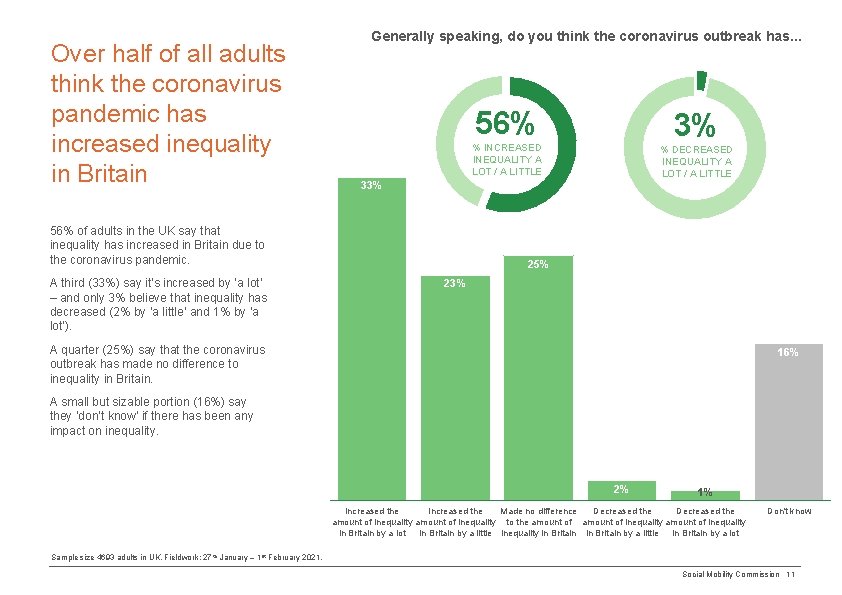
Over half of all adults think the coronavirus pandemic has increased inequality in Britain Generally speaking, do you think the coronavirus outbreak has. . . 56% % INCREASED INEQUALITY A LOT / A LITTLE % DECREASED INEQUALITY A LOT / A LITTLE 33% 56% of adults in the UK say that inequality has increased in Britain due to the coronavirus pandemic. A third (33%) say it’s increased by ‘a lot’ – and only 3% believe that inequality has decreased (2% by ‘a little’ and 1% by ‘a lot’). 3% 25% 23% A quarter (25%) say that the coronavirus outbreak has made no difference to inequality in Britain. 16% A small but sizable portion (16%) say they ‘don’t know’ if there has been any impact on inequality. 2% 1% Increased the Made no difference Decreased the amount of inequality to the amount of inequality in Britain by a lot in Britain by a little inequality in Britain by a little in Britain by a lot Don't know Sample size 4693 adults in UK. Fieldwork: 27 th January – 1 st February 2021. Social Mobility Commission 11
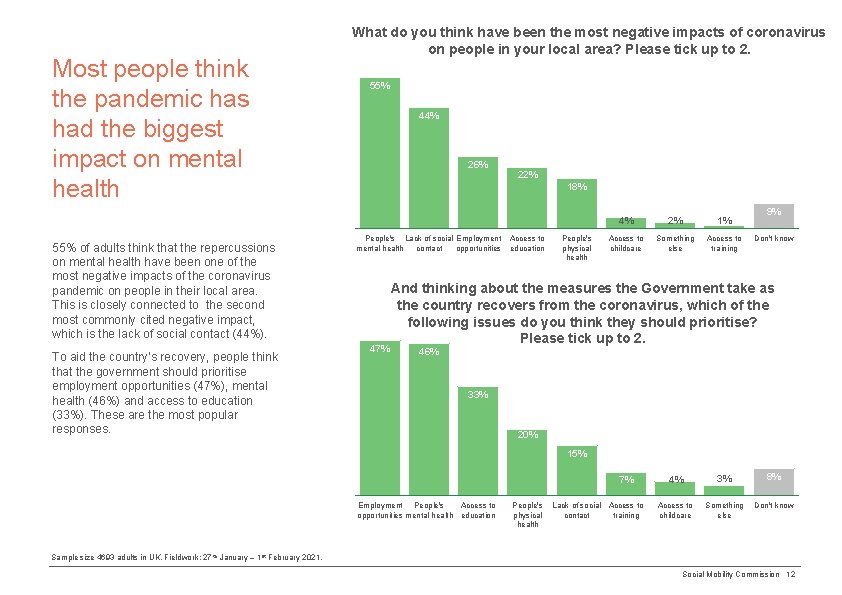
Most people think the pandemic has had the biggest impact on mental health 55% of adults think that the repercussions on mental health have been one of the most negative impacts of the coronavirus pandemic on people in their local area. This is closely connected to the second most commonly cited negative impact, which is the lack of social contact (44%). To aid the country’s recovery, people think that the government should prioritise employment opportunities (47%), mental health (46%) and access to education (33%). These are the most popular responses. What do you think have been the most negative impacts of coronavirus on people in your local area? Please tick up to 2. 55% 44% 26% 22% 18% People's Lack of social Employmental health contact opportunities 47% Access to education People's physical health 4% 2% 1% Access to childcare Something else Access to training 9% Don't know And thinking about the measures the Government take as the country recovers from the coronavirus, which of the following issues do you think they should prioritise? Please tick up to 2. 46% 33% 20% 15% 7% Employment People's Access to opportunities mental health education People's physical health Lack of social Access to contact training 4% 3% 8% Access to childcare Something else Don't know Sample size 4693 adults in UK. Fieldwork: 27 th January – 1 st February 2021. Social Mobility Commission 12
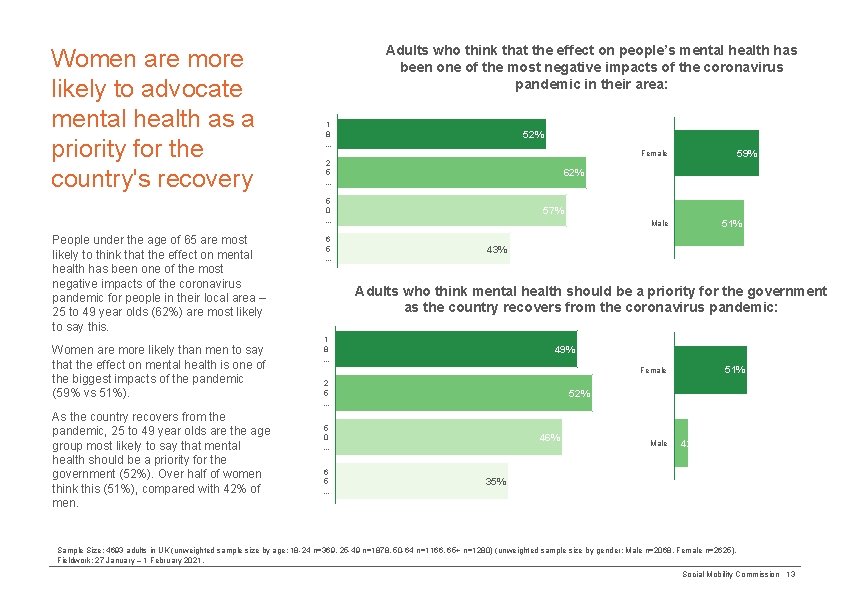
Women are more likely to advocate mental health as a priority for the country's recovery Adults who think that the effect on people’s mental health has been one of the most negative impacts of the coronavirus pandemic in their area: 1 8. . . 52% 62% 5 0. . . People under the age of 65 are most likely to think that the effect on mental health has been one of the most negative impacts of the coronavirus pandemic for people in their local area – 25 to 49 year olds (62%) are most likely to say this. Women are more likely than men to say that the effect on mental health is one of the biggest impacts of the pandemic (59% vs 51%). As the country recovers from the pandemic, 25 to 49 year olds are the age group most likely to say that mental health should be a priority for the government (52%). Over half of women think this (51%), compared with 42% of men. 59% Female 2 5. . . 6 5. . . 57% 51% Male 43% Adults who think mental health should be a priority for the government as the country recovers from the coronavirus pandemic: 1 8. . . 49% 51% Female 2 5. . . 52% 5 0. . . 6 5. . . 46% Male 42% 35% Sample Size: 4693 adults in UK (unweighted sample size by age: 18 -24 n=369, 25 -49 n=1878, 50 -64 n=1166, 65+ n=1280) (unweighted sample size by gender: Male n=2068, Female n=2625). Fieldwork: 27 January – 1 February 2021. Social Mobility Commission 13
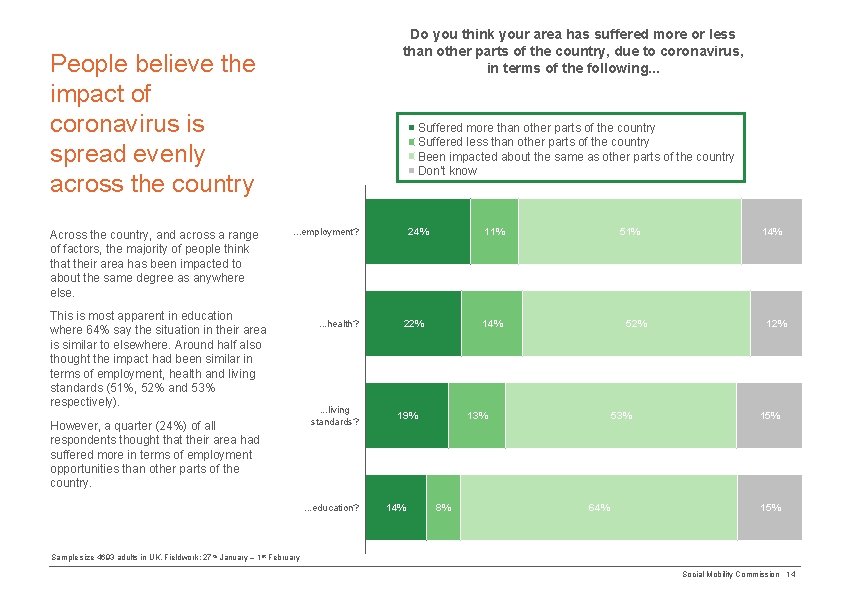
Do you think your area has suffered more or less than other parts of the country, due to coronavirus, in terms of the following. . . People believe the impact of coronavirus is spread evenly across the country Across the country, and across a range of factors, the majority of people think that their area has been impacted to about the same degree as anywhere else. Suffered more than other parts of the country Suffered less than other parts of the country Been impacted about the same as other parts of the country Don't know 24% . . . employment? This is most apparent in education where 64% say the situation in their area is similar to elsewhere. Around half also thought the impact had been similar in terms of employment, health and living standards (51%, 52% and 53% respectively). However, a quarter (24%) of all respondents thought that their area had suffered more in terms of employment opportunities than other parts of the country. . health? . . . living standards? . . . education? 11% 22% 14% 19% 14% 51% 52% 13% 8% 53% 64% 12% 15% Sample size 4693 adults in UK. Fieldwork: 27 th January – 1 st February Social Mobility Commission 14
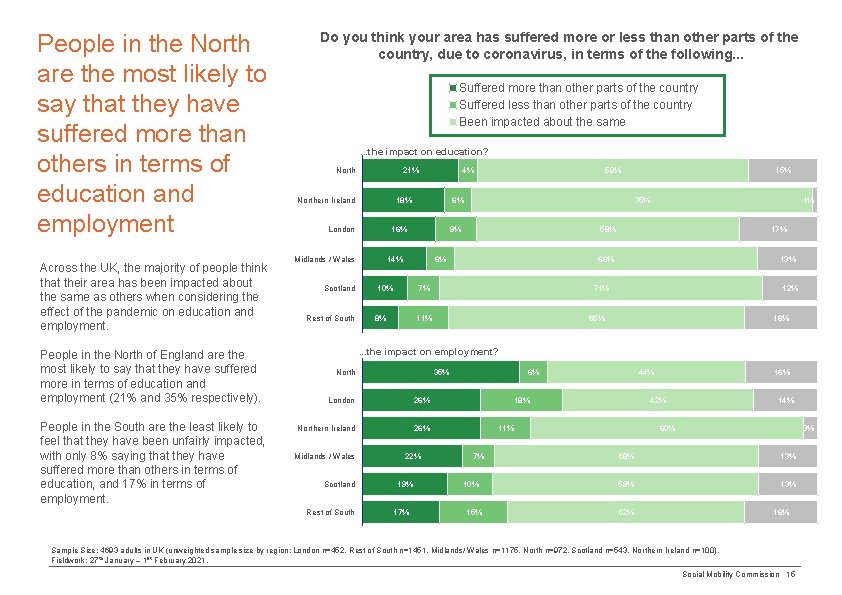
People in the North are the most likely to say that they have suffered more than others in terms of education and employment Across the UK, the majority of people think that their area has been impacted about the same as others when considering the effect of the pandemic on education and employment. People in the North of England are the most likely to say that they have suffered more in terms of education and employment (21% and 35% respectively). People in the South are the least likely to feel that they have been unfairly impacted, with only 8% saying that they have suffered more than others in terms of education, and 17% in terms of employment. Do you think your area has suffered more or less than other parts of the country, due to coronavirus, in terms of the following. . . Suffered more than other parts of the country Suffered less than other parts of the country Been impacted about the same. . . the impact on education? 21% Northern Ireland 18% London Rest of South 59% 6% 16% Midlands / Wales Scotland 4% 75% 9% 14% 17% 66% 7% 8% 1% 58% 6% 10% 15% 13% 71% 12% 65% 16% . . . the impact on employment? North 35% London 26% Northern Ireland 26% Midlands / Wales Scotland Rest of South 22% 19% 17% 6% 44% 18% 42% 11% 7% 10% 15% 16% 14% 60% 3% 58% 13% 59% 13% 52% 16% Sample Size: 4693 adults in UK (unweighted sample size by region: London n=452, Rest of South n=1451, Midlands/ Wales n=1175, North n=972, Scotland n=543, Northern Ireland n=100). Fieldwork: 27 th January – 1 st February 2021. Social Mobility Commission 15
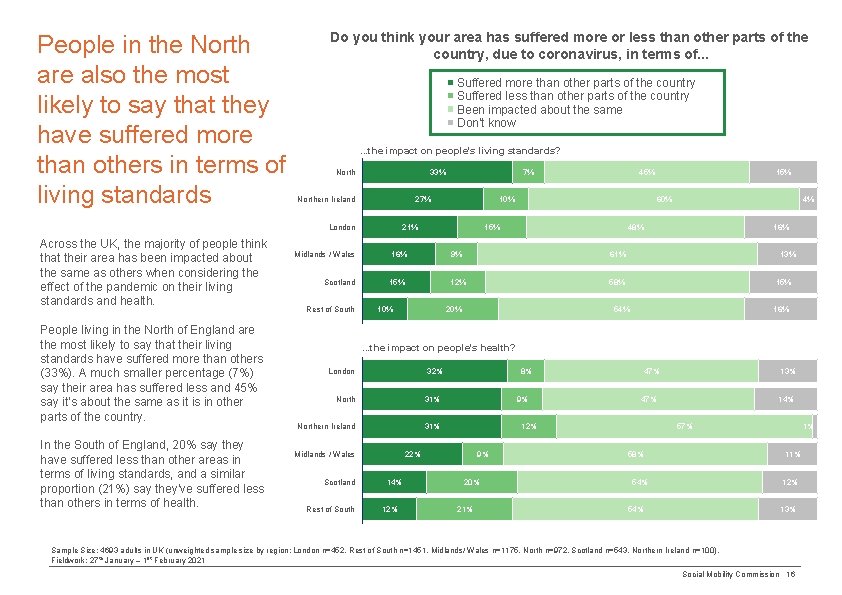
People in the North are also the most likely to say that they have suffered more than others in terms of living standards Do you think your area has suffered more or less than other parts of the country, due to coronavirus, in terms of. . . Suffered more than other parts of the country Suffered less than other parts of the country Been impacted about the same Don't know. . . the impact on people's living standards? North 33% Northern Ireland 27% London Across the UK, the majority of people think that their area has been impacted about the same as others when considering the effect of the pandemic on their living standards and health. People living in the North of England are the most likely to say that their living standards have suffered more than others (33%). A much smaller percentage (7%) say their area has suffered less and 45% say it’s about the same as it is in other parts of the country. In the South of England, 20% say they have suffered less than other areas in terms of living standards, and a similar proportion (21%) say they’ve suffered less than others in terms of health. Midlands / Wales Scotland Rest of South 7% 45% 10% 21% 60% 15% 16% 15% 10% 15% 4% 48% 9% 61% 12% 58% 20% 16% 13% 15% 54% 16% . . . the impact on people's health? London 32% North 31% Northern Ireland 31% Midlands / Wales Scotland Rest of South 8% 9% 12% 9% 20% 21% 13% 47% 12% 22% 14% 47% 14% 57% 58% 1% 11% 54% 12% 54% 13% Sample Size: 4693 adults in UK (unweighted sample size by region: London n=452, Rest of South n=1451, Midlands/ Wales n=1175, North n=972, Scotland n=543, Northern Ireland n=100). Fieldwork: 27 th January – 1 st February 2021 Social Mobility Commission 16
The impact of background Social Mobility Commission
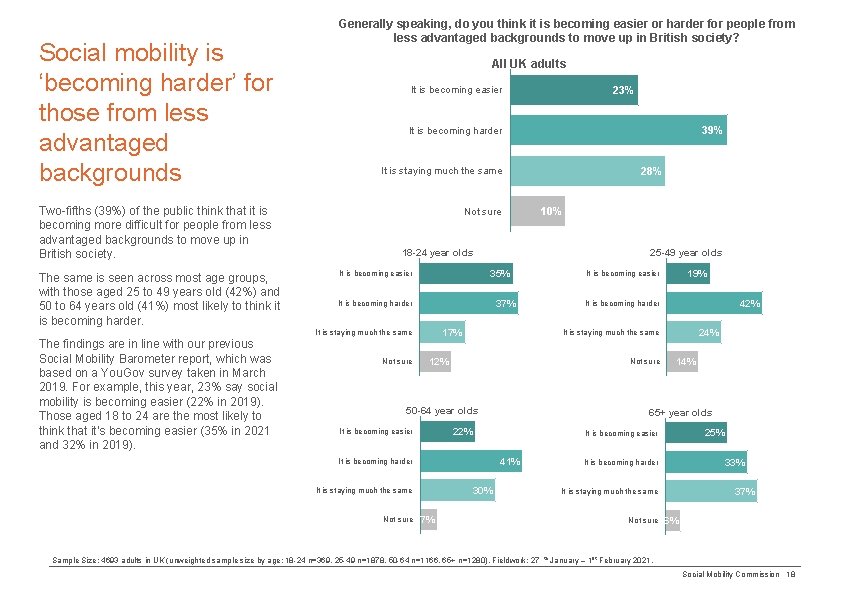
Social mobility is ‘becoming harder’ for those from less advantaged backgrounds Two-fifths (39%) of the public think that it is becoming more difficult for people from less advantaged backgrounds to move up in British society. The same is seen across most age groups, with those aged 25 to 49 years old (42%) and 50 to 64 years old (41%) most likely to think it is becoming harder. Generally speaking, do you think it is becoming easier or harder for people from less advantaged backgrounds to move up in British society? All UK adults 39% It is becoming harder 28% It is staying much the same Not sure 10% 18 -24 year olds 25 -49 year olds 35% It is becoming easier Not sure 50 -64 year olds 14% 65+ year olds 22% 25% It is becoming easier 41% It is becoming harder Not sure 24% It is staying much the same 12% 37% It is staying much the same 7% Sample Size: 4693 adults in UK (unweighted sample size by age: 18 -24 n=369, 25 -49 n=1878, 50 -64 n=1166, 65+ n=1280). Fieldwork: 27 33% It is becoming harder 30% It is staying much the same 42% It is becoming harder 17% It is becoming easier 19% It is becoming easier 37% It is becoming harder It is staying much the same The findings are in line with our previous Social Mobility Barometer report, which was based on a You. Gov survey taken in March 2019. For example, this year, 23% say social mobility is becoming easier (22% in 2019). Those aged 18 to 24 are the most likely to think that it’s becoming easier (35% in 2021 and 32% in 2019). 23% It is becoming easier Not sure th 6% January – 1 st February 2021. Social Mobility Commission 18
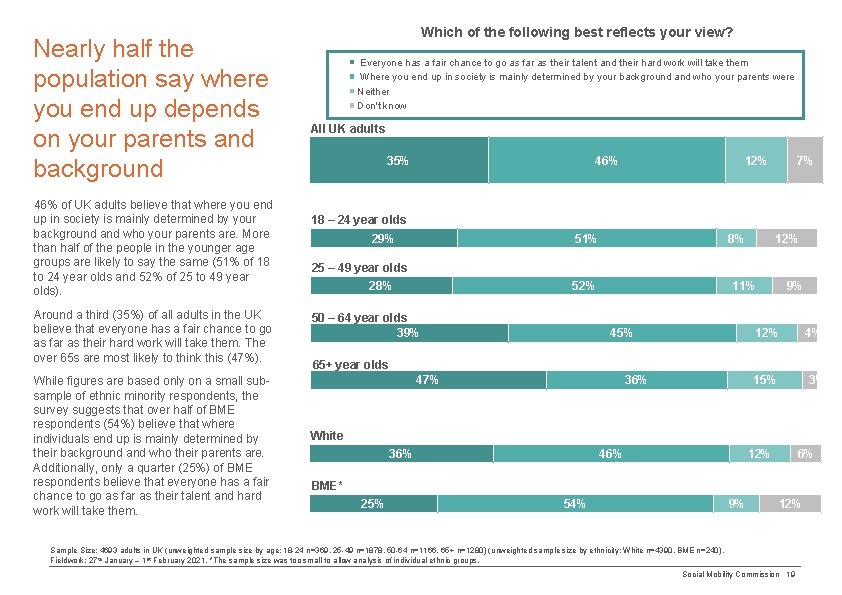
Nearly half the population say where you end up depends on your parents and background 46% of UK adults believe that where you end up in society is mainly determined by your background and who your parents are. More than half of the people in the younger age groups are likely to say the same (51% of 18 to 24 year olds and 52% of 25 to 49 year olds). Around a third (35%) of all adults in the UK believe that everyone has a fair chance to go as far as their hard work will take them. The over 65 s are most likely to think this (47%). While figures are based only on a small subsample of ethnic minority respondents, the survey suggests that over half of BME respondents (54%) believe that where individuals end up is mainly determined by their background and who their parents are. Additionally, only a quarter (25%) of BME respondents believe that everyone has a fair chance to go as far as their talent and hard work will take them. Which of the following best reflects your view? Everyone has a fair chance to go as far as their talent and their hard work will take them Where you end up in society is mainly determined by your background and who your parents were Neither Don't know All UK adults 35% 46% 12% 7% 18 – 24 year olds 29% 51% 8% 12% 25 – 49 year olds 28% 52% 50 – 64 year olds 39% 11% 45% 9% 12% 4% 65+ year olds 47% 36% 15% 3% White 36% 46% 12% 6% BME* 25% 54% 9% 12% Sample Size: 4693 adults in UK (unweighted sample size by age: 18 -24 n=369, 25 -49 n=1878, 50 -64 n=1166, 65+ n=1280) (unweighted sample size by ethnicity: White n=4390, BME n=240). Fieldwork: 27 th January – 1 st February 2021. *The sample size was too small to allow analysis of individual ethnic groups. Social Mobility Commission 19
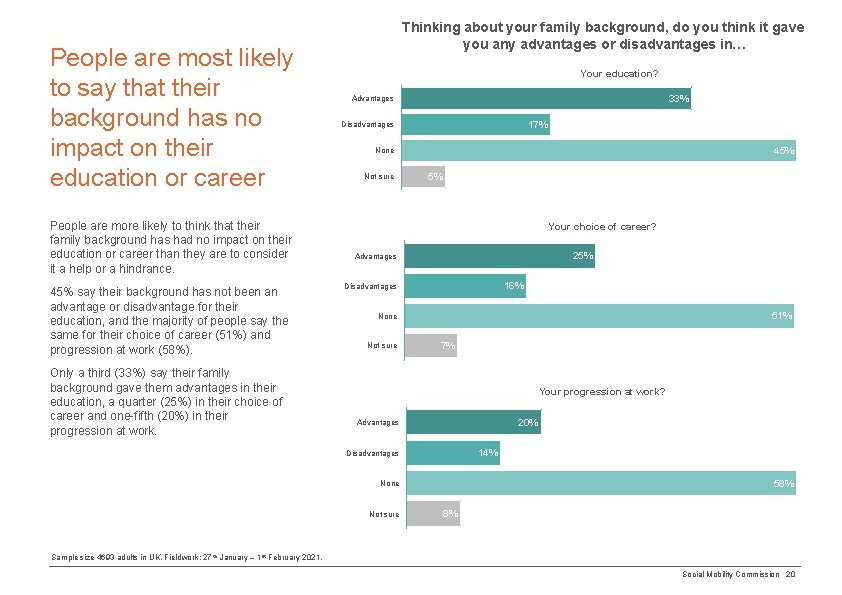
People are most likely to say that their background has no impact on their education or career People are more likely to think that their family background has had no impact on their education or career than they are to consider it a help or a hindrance. 45% say their background has not been an advantage or disadvantage for their education, and the majority of people say the same for their choice of career (51%) and progression at work (58%). Only a third (33%) say their family background gave them advantages in their education, a quarter (25%) in their choice of career and one-fifth (20%) in their progression at work. Thinking about your family background, do you think it gave you any advantages or disadvantages in… Your education? 33% Advantages 17% Disadvantages 45% None Not sure 5% Your choice of career? 25% Advantages 16% Disadvantages 51% None Not sure 7% Your progression at work? 20% Advantages 14% Disadvantages 58% None Not sure 8% Sample size 4693 adults in UK. Fieldwork: 27 th January – 1 st February 2021. Social Mobility Commission 20
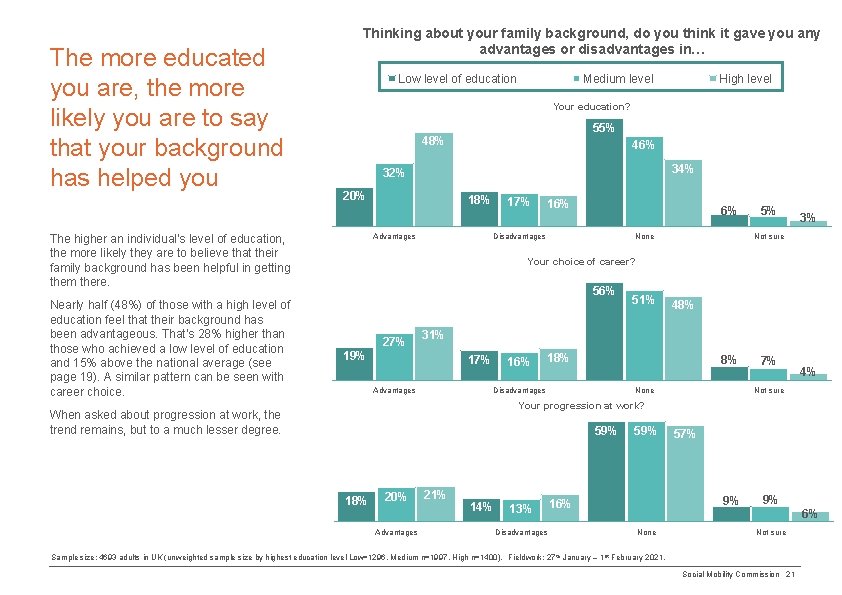
The more educated you are, the more likely you are to say that your background has helped you Thinking about your family background, do you think it gave you any advantages or disadvantages in… Low level of education High level Your education? 55% 48% 46% 34% 32% 20% The higher an individual's level of education, the more likely they are to believe that their family background has been helpful in getting them there. Nearly half (48%) of those with a high level of education feel that their background has been advantageous. That’s 28% higher than those who achieved a low level of education and 15% above the national average (see page 19). A similar pattern can be seen with career choice. Medium level 18% Advantages 17% 16% 6% Disadvantages None 5% 3% Not sure Your choice of career? 56% 27% 51% 48% 31% 19% 17% Advantages 16% 18% 8% Disadvantages None 7% 4% Not sure Your progression at work? When asked about progression at work, the trend remains, but to a much lesser degree. 59% 18% 20% Advantages 21% 14% 13% Disadvantages 59% 57% 9% 16% None 9% 6% Not sure Sample size: 4693 adults in UK (unweighted sample size by highest education level Low=1296, Medium n=1997, High n=1400). Fieldwork: 27 th January – 1 st February 2021. Social Mobility Commission 21
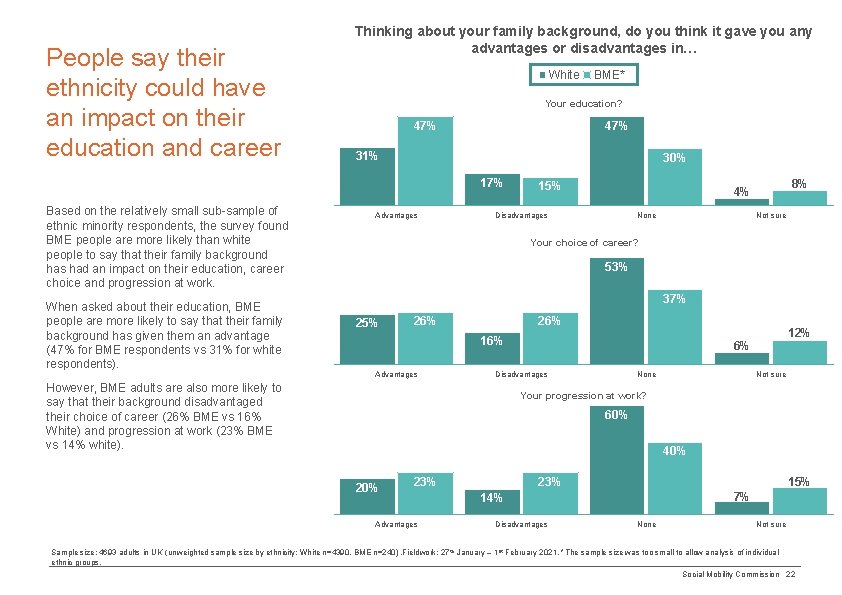
People say their ethnicity could have an impact on their education and career Thinking about your family background, do you think it gave you any advantages or disadvantages in… White Your education? 47% 31% 30% 17% Based on the relatively small sub-sample of ethnic minority respondents, the survey found BME people are more likely than white people to say that their family background has had an impact on their education, career choice and progression at work. When asked about their education, BME people are more likely to say that their family background has given them an advantage (47% for BME respondents vs 31% for white respondents). BME* Advantages 15% 8% 4% Disadvantages None Not sure Your choice of career? 53% 37% 25% 26% 16% Advantages Disadvantages However, BME adults are also more likely to say that their background disadvantaged their choice of career (26% BME vs 16% White) and progression at work (23% BME vs 14% white). 12% 6% None Not sure Your progression at work? 60% 40% 23% Advantages 15% 23% 7% 14% Disadvantages None Not sure Sample size: 4693 adults in UK (unweighted sample size by ethnicity: White n=4390, BME n=240). Fieldwork: 27 th January – 1 st February 2021. *The sample size was too small to allow analysis of individual ethnic groups. Social Mobility Commission 22
Are things better than they used to be? Social Mobility Commission
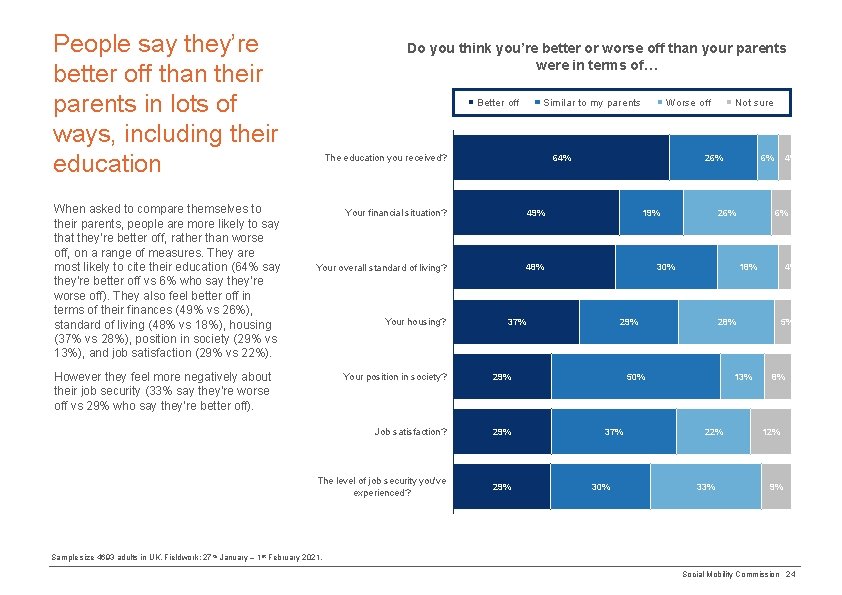
People say they’re better off than their parents in lots of ways, including their education When asked to compare themselves to their parents, people are more likely to say that they’re better off, rather than worse off, on a range of measures. They are most likely to cite their education (64% say they’re better off vs 6% who say they’re worse off). They also feel better off in terms of their finances (49% vs 26%), standard of living (48% vs 18%), housing (37% vs 28%), position in society (29% vs 13%), and job satisfaction (29% vs 22%). Do you think you’re better or worse off than your parents were in terms of… Better off Similar to my parents The education you received? 64% Your financial situation? 49% Your overall standard of living? 48% Your housing? However they feel more negatively about their job security (33% say they’re worse off vs 29% who say they’re better off). Worse off 26% 19% 29% Job satisfaction? 29% The level of job security you've experienced? 29% 6% 26% 30% 37% Your position in society? Not sure 4% 28% 50% 30% 6% 18% 29% 37% 4% 13% 22% 33% 5% 8% 12% 9% Sample size 4693 adults in UK. Fieldwork: 27 th January – 1 st February 2021. Social Mobility Commission 24
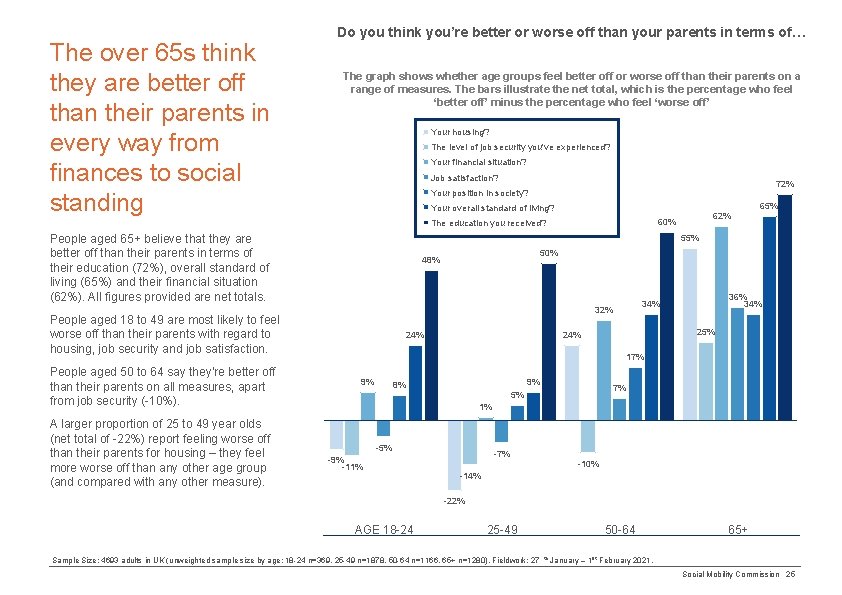
The over 65 s think they are better off than their parents in every way from finances to social standing Do you think you’re better or worse off than your parents in terms of… The graph shows whether age groups feel better off or worse off than their parents on a range of measures. The bars illustrate the net total, which is the percentage who feel ‘better off’ minus the percentage who feel ‘worse off’ Your housing? The level of job security you've experienced? Your financial situation? Job satisfaction? 72% Your position in society? Your overall standard of living? 60% The education you received? People aged 65+ believe that they are better off than their parents in terms of their education (72%), overall standard of living (65%) and their financial situation (62%). All figures provided are net totals. A larger proportion of 25 to 49 year olds (net total of -22%) report feeling worse off than their parents for housing – they feel more worse off than any other age group (and compared with any other measure). 65% 50% 48% 24% 36% 34% 32% People aged 18 to 49 are most likely to feel worse off than their parents with regard to housing, job security and job satisfaction. People aged 50 to 64 say they’re better off than their parents on all measures, apart from job security (-10%). 62% 25% 24% 17% 9% 9% 8% 7% 5% 1% -5% -9% -11% -7% -10% -14% -22% AGE 18 -24 25 -49 Sample Size: 4693 adults in UK (unweighted sample size by age: 18 -24 n=369, 25 -49 n=1878, 50 -64 n=1166, 65+ n=1280). Fieldwork: 27 50 -64 th 65+ January – 1 st February 2021. Social Mobility Commission 25
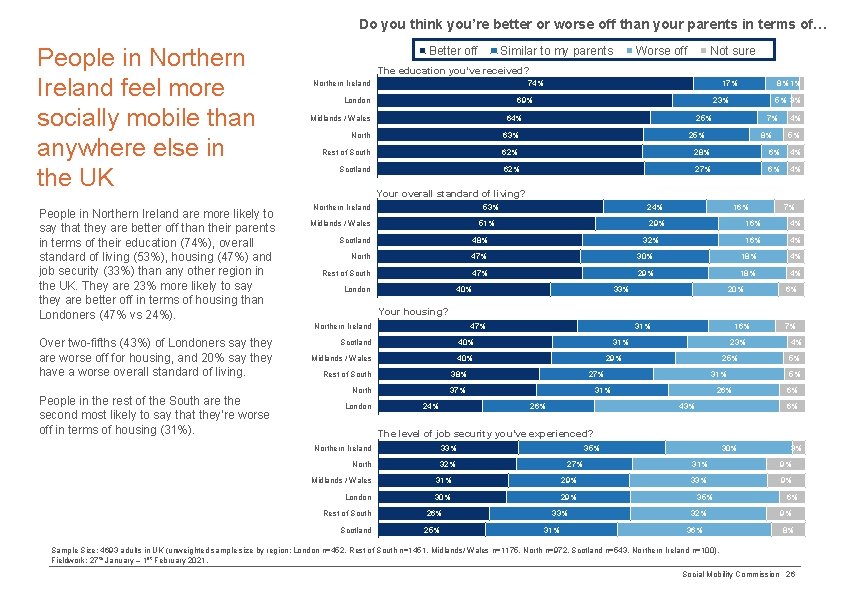
Do you think you’re better or worse off than your parents in terms of… People in Northern Ireland feel more socially mobile than anywhere else in the UK People in Northern Ireland are more likely to say that they are better off than their parents in terms of their education (74%), overall standard of living (53%), housing (47%) and job security (33%) than any other region in the UK. They are 23% more likely to say they are better off in terms of housing than Londoners (47% vs 24%). Better off People in the rest of the South are the second most likely to say that they’re worse off in terms of housing (31%). Worse off Not sure The education you’ve received? Northern Ireland 74% London 17% 69% 8% 1% 23% 64% Midlands / Wales 5% 3% 25% 7% 25% 4% North 63% Rest of South 62% 28% 6% 4% Scotland 62% 27% 6% 4% 8% 5% Your overall standard of living? Northern Ireland 53% Midlands / Wales 24% 51% 16% 29% 16% 4% 48% North 47% 30% 18% 4% Rest of South 47% 29% 18% 4% London 32% 7% Scotland 40% 33% 20% 6% Your housing? Northern Ireland Over two-fifths (43%) of Londoners say they are worse off for housing, and 20% say they have a worse overall standard of living. Similar to my parents 47% Scotland 40% Midlands / Wales 40% Rest of South 38% North 37% London 24% 31% 16% 31% 23% 29% 25% 27% 31% 26% 43% 7% 4% 5% 5% 6% 6% The level of job security you’ve experienced? Northern Ireland 33% North 32% 35% 27% Midlands / Wales 31% 29% London 30% 29% Rest of South 26% Scotland 25% 33% 31% 30% 3% 31% 9% 33% 9% 35% 32% 36% 6% 9% 8% Sample Size: 4693 adults in UK (unweighted sample size by region: London n=452, Rest of South n=1451, Midlands/ Wales n=1175, North n=972, Scotland n=543, Northern Ireland n=100). Fieldwork: 27 th January – 1 st February 2021. Social Mobility Commission 26
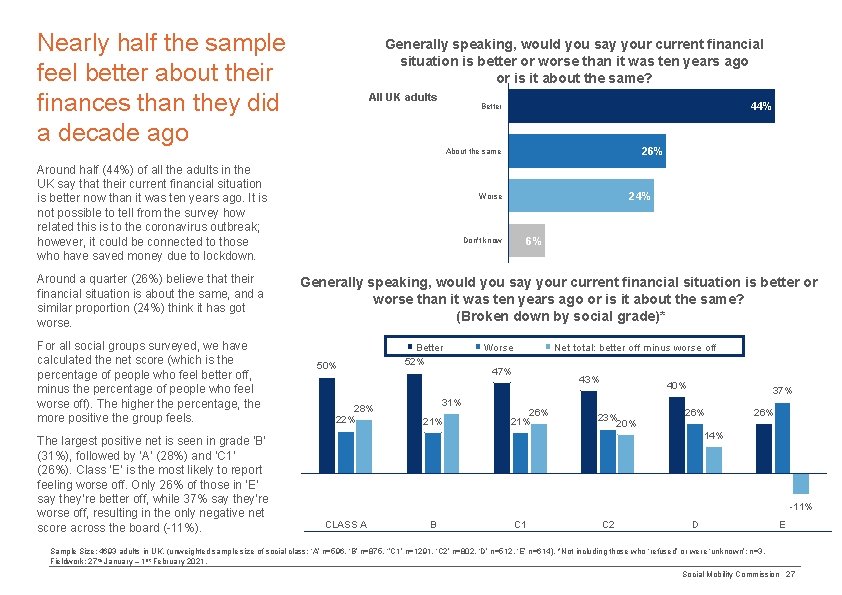
Nearly half the sample feel better about their finances than they did a decade ago Generally speaking, would you say your current financial situation is better or worse than it was ten years ago or is it about the same? All UK adults 44% Better 26% About the same Around half (44%) of all the adults in the UK say that their current financial situation is better now than it was ten years ago. It is not possible to tell from the survey how related this is to the coronavirus outbreak; however, it could be connected to those who have saved money due to lockdown. Around a quarter (26%) believe that their financial situation is about the same, and a similar proportion (24%) think it has got worse. For all social groups surveyed, we have calculated the net score (which is the percentage of people who feel better off, minus the percentage of people who feel worse off). The higher the percentage, the more positive the group feels. The largest positive net is seen in grade ‘B’ (31%), followed by ‘A’ (28%) and ‘C 1’ (26%). Class ‘E’ is the most likely to report feeling worse off. Only 26% of those in ‘E’ say they’re better off, while 37% say they’re worse off, resulting in the only negative net score across the board (-11%). 24% Worse 6% Don't know Generally speaking, would you say your current financial situation is better or worse than it was ten years ago or is it about the same? (Broken down by social grade)* 50% 28% 22% Better 52% 31% 21% Worse Net total: better off minus worse off 47% 43% 26% 21% 40% 23% 20% 37% 26% 14% -11% CLASS A B C 1 C 2 D E Sample Size: 4693 adults in UK. (unweighted sample size of social class: ‘A’ n=596, ‘B’ n=875, ‘’C 1’ n=1291, ‘C 2’ n=802, ‘D’ n=512, ‘E’ n=614). *Not including those who ‘refused’ or were ‘unknown’: n=3. Fieldwork: 27 th January – 1 st February 2021. Social Mobility Commission 27
Generational differences Social Mobility Commission
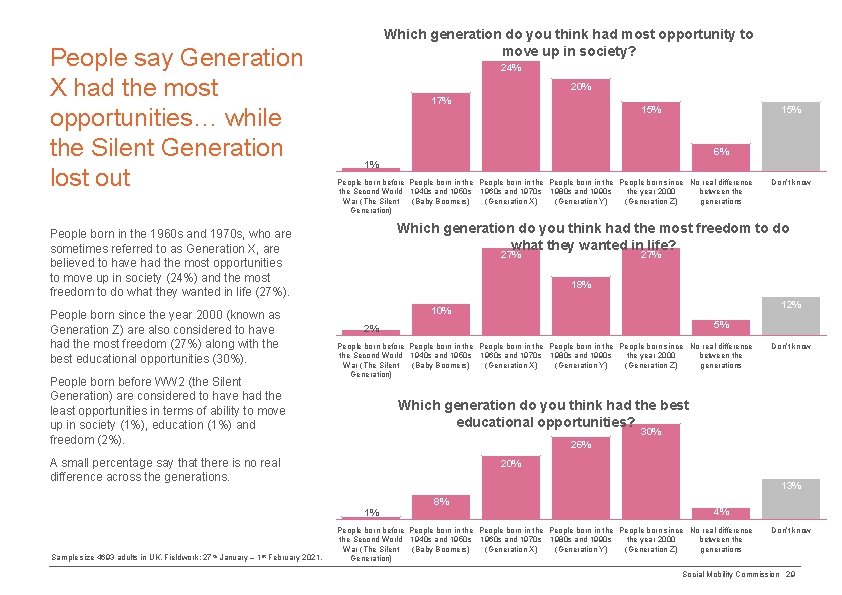
People say Generation X had the most opportunities… while the Silent Generation lost out Which generation do you think had most opportunity to move up in society? 24% 20% 17% People born before WW 2 (the Silent Generation) are considered to have had the least opportunities in terms of ability to move up in society (1%), education (1%) and freedom (2%). 1% People born before People born in the People born since No real difference the Second World 1940 s and 1950 s 1960 s and 1970 s 1980 s and 1990 s the year 2000 between the War (The Silent (Baby Boomers) (Generation X) (Generation Y) (Generation Z) generations Generation) Don’t know Which generation do you think had the most freedom to do what they wanted in life? 27% 18% 12% 10% 5% 2% People born before People born in the People born since No real difference the Second World 1940 s and 1950 s 1960 s and 1970 s 1980 s and 1990 s the year 2000 between the War (The Silent (Baby Boomers) (Generation X) (Generation Y) (Generation Z) generations Generation) Don’t know Which generation do you think had the best educational opportunities? 30% 26% A small percentage say that there is no real difference across the generations. 20% 13% 1% Sample size 4693 adults in UK. Fieldwork: 27 th January – 1 st February 2021. 15% 6% People born in the 1960 s and 1970 s, who are sometimes referred to as Generation X, are believed to have had the most opportunities to move up in society (24%) and the most freedom to do what they wanted in life (27%). People born since the year 2000 (known as Generation Z) are also considered to have had the most freedom (27%) along with the best educational opportunities (30%). 15% 8% 4% People born before People born in the People born since No real difference the Second World 1940 s and 1950 s 1960 s and 1970 s 1980 s and 1990 s the year 2000 between the War (The Silent (Baby Boomers) (Generation X) (Generation Y) (Generation Z) generations Generation) Don’t know Social Mobility Commission 29
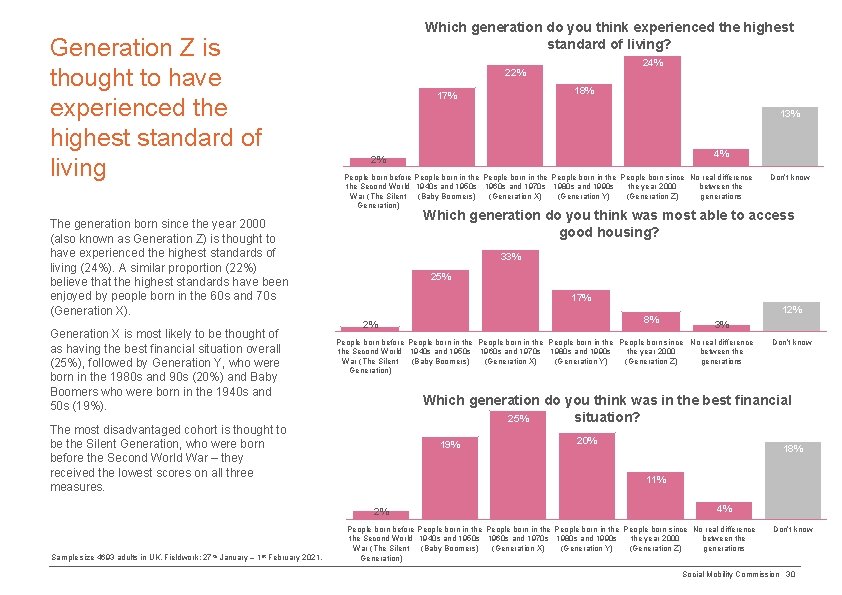
Generation Z is thought to have experienced the highest standard of living Which generation do you think experienced the highest standard of living? 13% 4% 2% People born before People born in the People born since No real difference the Second World 1940 s and 1950 s 1960 s and 1970 s 1980 s and 1990 s the year 2000 between the War (The Silent (Baby Boomers) (Generation X) (Generation Y) (Generation Z) generations Generation) Don’t know Which generation do you think was most able to access good housing? 33% 25% 17% 8% 2% 12% 3% People born before People born in the People born since No real difference the Second World 1940 s and 1950 s 1960 s and 1970 s 1980 s and 1990 s the year 2000 between the War (The Silent (Baby Boomers) (Generation X) (Generation Y) (Generation Z) generations Generation) Don’t know Which generation do you think was in the best financial 25% situation? The most disadvantaged cohort is thought to be the Silent Generation, who were born before the Second World War – they received the lowest scores on all three measures. 19% 20% 18% 11% 2% Sample size 4693 adults in UK. Fieldwork: 27 th January – 1 st February 2021. 18% 17% The generation born since the year 2000 (also known as Generation Z) is thought to have experienced the highest standards of living (24%). A similar proportion (22%) believe that the highest standards have been enjoyed by people born in the 60 s and 70 s (Generation X). Generation X is most likely to be thought of as having the best financial situation overall (25%), followed by Generation Y, who were born in the 1980 s and 90 s (20%) and Baby Boomers who were born in the 1940 s and 50 s (19%). 24% 22% 4% People born before People born in the People born since No real difference the Second World 1940 s and 1950 s 1960 s and 1970 s 1980 s and 1990 s the year 2000 between the War (The Silent (Baby Boomers) (Generation X) (Generation Y) (Generation Z) generations Generation) Don’t know Social Mobility Commission 30
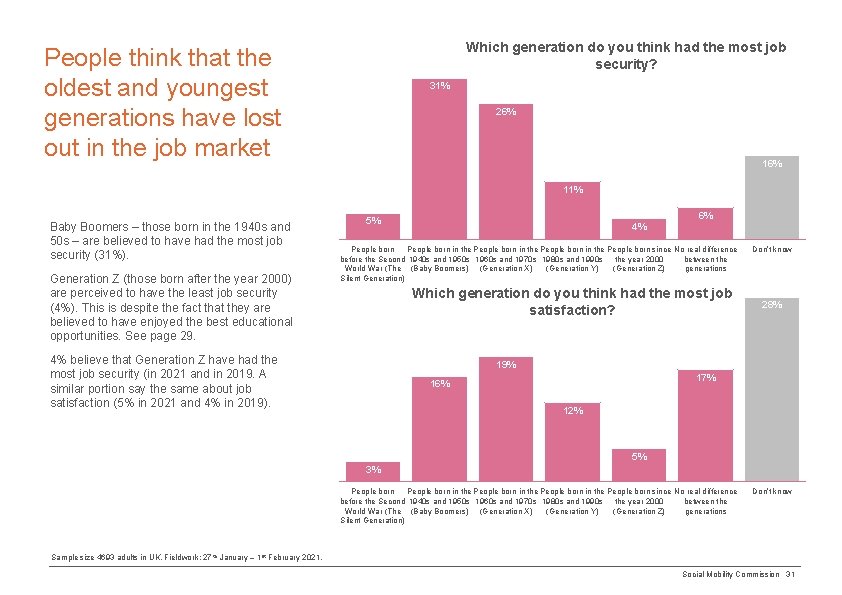
Which generation do you think had the most job security? People think that the oldest and youngest generations have lost out in the job market 31% 26% 11% Baby Boomers – those born in the 1940 s and 50 s – are believed to have had the most job security (31%). Generation Z (those born after the year 2000) are perceived to have the least job security (4%). This is despite the fact that they are believed to have enjoyed the best educational opportunities. See page 29. 5% 4% 6% People born in the People born since No real difference before the Second 1940 s and 1950 s 1960 s and 1970 s 1980 s and 1990 s the year 2000 between the World War (The (Baby Boomers) (Generation X) (Generation Y) (Generation Z) generations Silent Generation) Which generation do you think had the most job satisfaction? 4% believe that Generation Z have had the most job security (in 2021 and in 2019. A similar portion say the same about job satisfaction (5% in 2021 and 4% in 2019). Don’t know 28% 19% 17% 16% 12% 5% 3% People born in the People born since No real difference before the Second 1940 s and 1950 s 1960 s and 1970 s 1980 s and 1990 s the year 2000 between the World War (The (Baby Boomers) (Generation X) (Generation Y) (Generation Z) generations Silent Generation) Don’t know Sample size 4693 adults in UK. Fieldwork: 27 th January – 1 st February 2021. Social Mobility Commission 31
Regional differences Social Mobility Commission
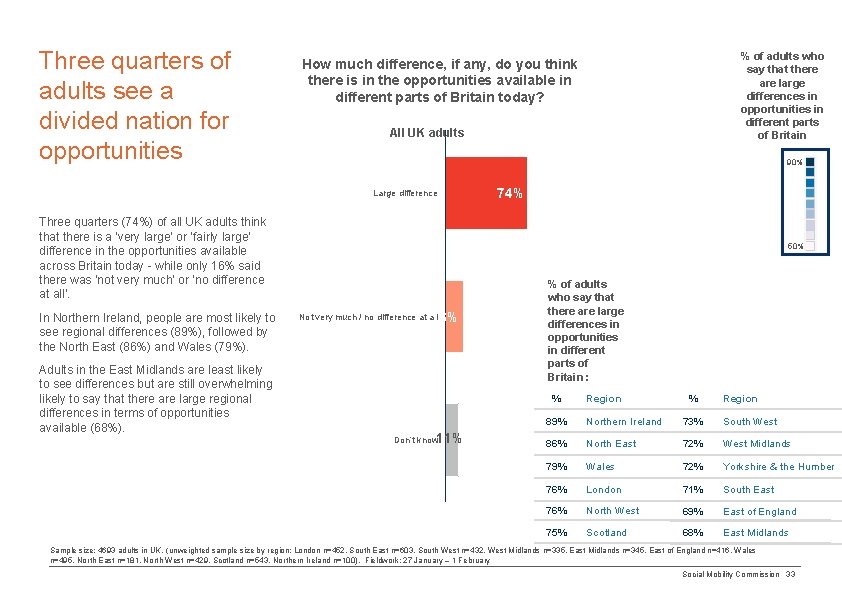
Three quarters of adults see a divided nation for opportunities 75% All UK adults 90% Large difference Three quarters (74%) of all UK adults think that there is a ‘very large’ or ‘fairly large’ difference in the opportunities available across Britain today - while only 16% said there was ‘not very much’ or ‘no difference at all’. In Northern Ireland, people are most likely to see regional differences (89%), followed by the North East (86%) and Wales (79%). Adults in the East Midlands are least likely to see differences but are still overwhelming likely to say that there are large regional differences in terms of opportunities available (68%). % of adults who say that there are large differences in opportunities in different parts of Britain How much difference, if any, do you think there is in the opportunities available in different parts of Britain today? 86% 74% 89% 76% 72% 50% 68% Not very much / no difference at all 16% % of adults who say that there are large differences in opportunities in different parts of Britain : % Don’t know 11% Region 72% 69% 76% 73% % 71% Region 89% Northern Ireland 73% South West 86% North East 72% West Midlands 79% Wales 72% Yorkshire & the Humber 76% London 71% South East 76% North West 69% East of England 75% Scotland 68% East Midlands Sample size: 4693 adults in UK. (unweighted sample size by region: London n=452, South East n=603, South West n=432, West Midlands n=335, East Midlands n=345, East of England n=416, Wales n=495, North East n=181, North West n=429, Scotland n=543, Northern Ireland n=100). Fieldwork: 27 January – 1 February Social Mobility Commission 33
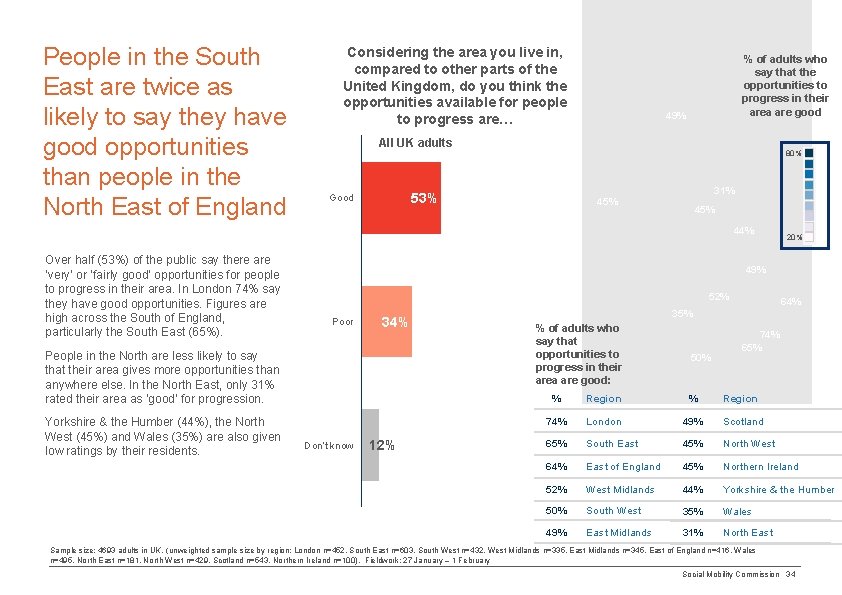
People in the South East are twice as likely to say they have good opportunities than people in the North East of England Considering the area you live in, compared to other parts of the United Kingdom, do you think the opportunities available for people to progress are… % of adults who say that the opportunities to progress in their area are good 49% All UK adults 80% 31% 53% Good 45% 44% Over half (53%) of the public say there are ‘very’ or ‘fairly good’ opportunities for people to progress in their area. In London 74% say they have good opportunities. Figures are high across the South of England, particularly the South East (65%). 49% 52% Poor 34% People in the North are less likely to say that their area gives more opportunities than anywhere else. In the North East, only 31% rated their area as ‘good’ for progression. Yorkshire & the Humber (44%), the North West (45%) and Wales (35%) are also given low ratings by their residents. 20% Don’t know 12% 64% 35% % of adults who say that opportunities to progress in their area are good: 50% 74% 65% % Region 74% London 49% Scotland 65% South East 45% North West 64% East of England 45% Northern Ireland 52% West Midlands 44% Yorkshire & the Humber 50% South West 35% Wales 49% East Midlands 31% North East Sample size: 4693 adults in UK. (unweighted sample size by region: London n=452, South East n=603, South West n=432, West Midlands n=335, East Midlands n=345, East of England n=416, Wales n=495, North East n=181, North West n=429, Scotland n=543, Northern Ireland n=100). Fieldwork: 27 January – 1 February Social Mobility Commission 34
Support from government and employers Social Mobility Commission
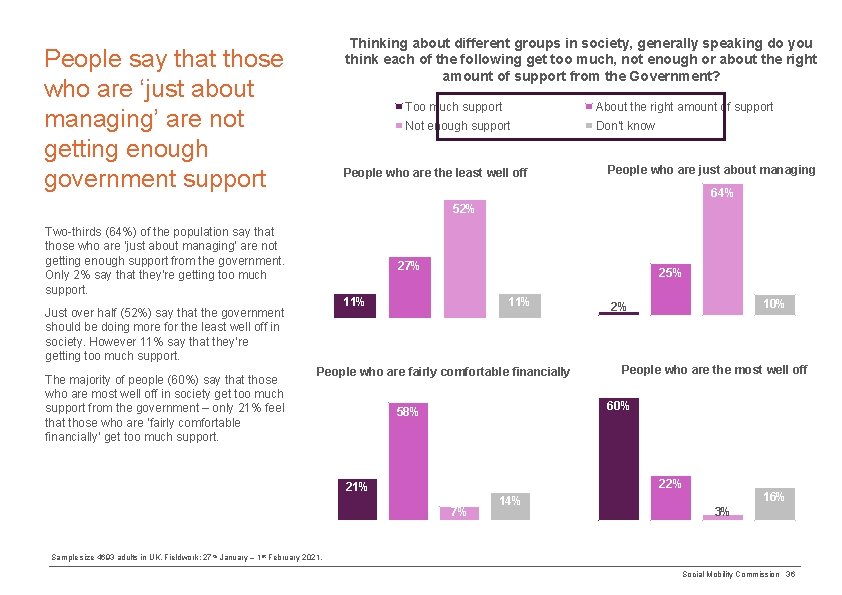
Thinking about different groups in society, generally speaking do you think each of the following get too much, not enough or about the right amount of support from the Government? People say that those who are ‘just about managing’ are not getting enough government support Too much support About the right amount of support Not enough support Don’t know People who are the least well off People who are just about managing 64% 52% Two-thirds (64%) of the population say that those who are ‘just about managing’ are not getting enough support from the government. Only 2% say that they’re getting too much support. 27% 11% Just over half (52%) say that the government should be doing more for the least well off in society. However 11% say that they’re getting too much support. The majority of people (60%) say that those who are most well off in society get too much support from the government – only 21% feel that those who are ‘fairly comfortable financially’ get too much support. 25% 11% People who are fairly comfortable financially 10% 2% People who are the most well off 60% 58% 22% 21% 7% 14% 16% 3% Sample size 4693 adults in UK. Fieldwork: 27 th January – 1 st February 2021. Social Mobility Commission 36
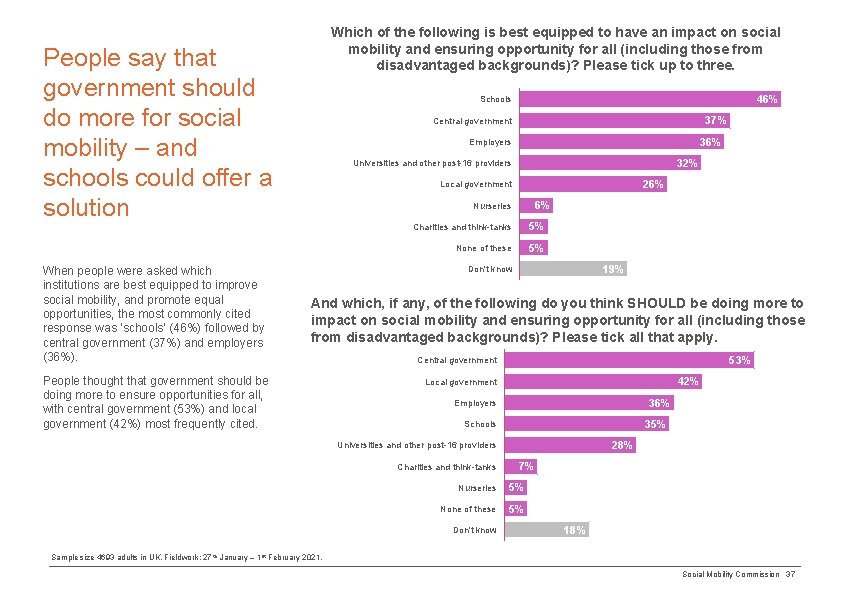
Which of the following is best equipped to have an impact on social mobility and ensuring opportunity for all (including those from disadvantaged backgrounds)? Please tick up to three. People say that government should do more for social mobility – and schools could offer a solution When people were asked which institutions are best equipped to improve social mobility, and promote equal opportunities, the most commonly cited response was ‘schools’ (46%) followed by central government (37%) and employers (36%). 46% Schools 37% Central government 36% Employers 32% Universities and other post-16 providers 26% Local government 6% Nurseries Charities and think-tanks 5% None of these 5% 19% Don't know And which, if any, of the following do you think SHOULD be doing more to impact on social mobility and ensuring opportunity for all (including those from disadvantaged backgrounds)? Please tick all that apply. People thought that government should be doing more to ensure opportunities for all, with central government (53%) and local government (42%) most frequently cited. 53% Central government 42% Local government 36% Employers 35% Schools 28% Universities and other post-16 providers Charities and think-tanks 7% Nurseries 5% None of these 5% Don't know 18% Sample size 4693 adults in UK. Fieldwork: 27 th January – 1 st February 2021. Social Mobility Commission 37
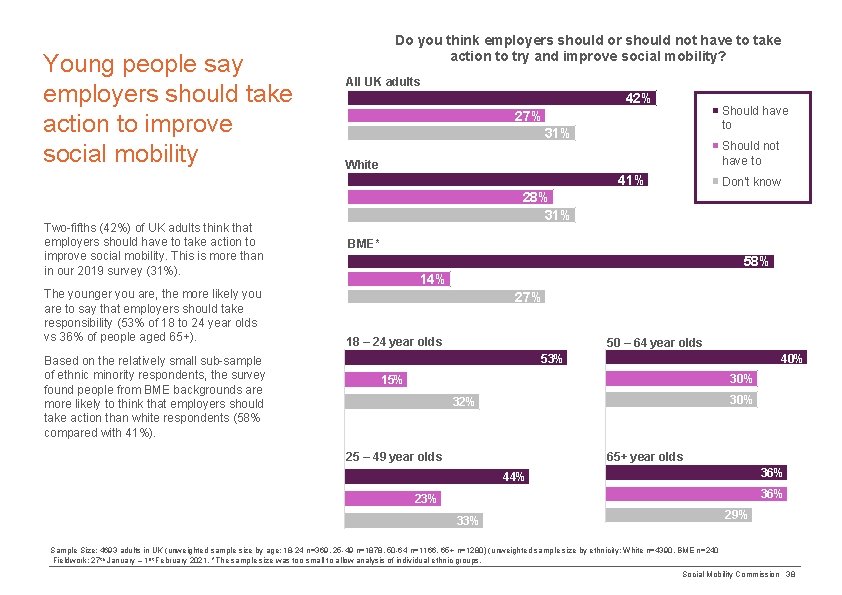
Young people say employers should take action to improve social mobility Do you think employers should or should not have to take action to try and improve social mobility? All UK adults 42% Should have to 27% 31% Should not have to White 41% Two-fifths (42%) of UK adults think that employers should have to take action to improve social mobility. This is more than in our 2019 survey (31%). The younger you are, the more likely you are to say that employers should take responsibility (53% of 18 to 24 year olds vs 36% of people aged 65+). Based on the relatively small sub-sample of ethnic minority respondents, the survey found people from BME backgrounds are more likely to think that employers should take action than white respondents (58% compared with 41%). Don't know 28% 31% BME* 58% 14% 27% 18 – 24 year olds 50 – 64 year olds 53% 40% 30% 15% 30% 32% 25 – 49 year olds 65+ year olds 36% 44% 36% 23% 29% 33% Sample Size: 4693 adults in UK (unweighted sample size by age: 18 -24 n=369, 25 -49 n=1878, 50 -64 n=1166, 65+ n=1280) (unweighted sample size by ethnicity: White n=4390, BME n=240 Fieldwork: 27 th January – 1 st February 2021. *The sample size was too small to allow analysis of individual ethnic groups. Social Mobility Commission 38
Trends over time Social Mobility Commission
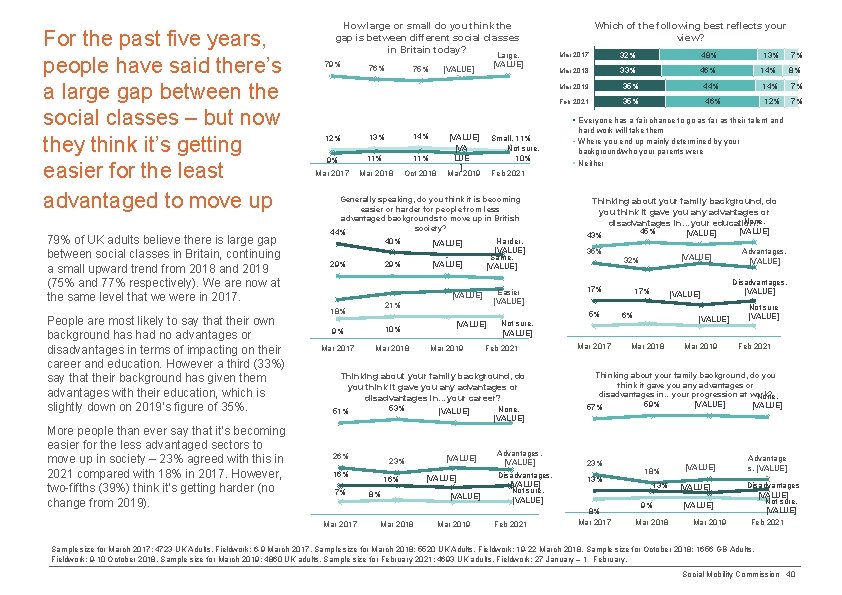
For the past five years, people have said there’s a large gap between the social classes – but now they think it’s getting easier for the least advantaged to move up 79% of UK adults believe there is large gap between social classes in Britain, continuing a small upward trend from 2018 and 2019 (75% and 77% respectively). We are now at the same level that we were in 2017. People are most likely to say that their own background has had no advantages or disadvantages in terms of impacting on their career and education. However a third (33%) say that their background has given them advantages with their education, which is slightly down on 2019’s figure of 35%. More people than ever say that it’s becoming easier for the less advantaged sectors to move up in society – 23% agreed with this in 2021 compared with 18% in 2017. However, two-fifths (39%) think it’s getting harder (no change from 2019). How large or small do you think the gap is between different social classes in Britain today? Large, 79% 76% [VALUE] 75% 12% 13% 14% 9% 11% Mar 2017 Mar 2018 Oct 2018 [VALUE] [VA LUE ] Mar 2019 Small, 11% Not sure, 10% 29% [VALUE] Harder, [VALUE] Same, [VALUE] Easier [VALUE] 21% 18% 10% Mar 2017 Mar 2018 [VALUE] 48% Mar 2018 33% 46% Mar 2019 53% 51% 26% 23% 16% 8% Mar 2018 [VALUE] Mar 2019 13% 7% 14% 8% Mar 2019 35% 44% 14% 7% Feb 2021 35% 46% 12% 7% Everyone has a fair chance to go as far as their talent and hard work will take them Where you end up mainly determined by your background/who your parents were Neither Thinking about your family background, do you think it gave you any advantages or None, disadvantages in…your education? Feb 2021 None, [VALUE] Advantages, [VALUE] Disadvantages, [VALUE] Not sure, [VALUE] Feb 2021 45% 43% 35% Mar 2017 [VALUE] 32% 17% Not sure, [VALUE] Thinking about your family background, do you think it gave you any advantages or disadvantages in…your career? Mar 2017 32% 5% 9% 7% Mar 2017 Feb 2021 Generally speaking, do you think it is becoming easier or harder for people from less advantaged backgrounds to move up in British society? 44% 40% Which of the following best reflects your view? 17% [VALUE] 6% [VALUE] Mar 2018 Mar 2019 [VALUE] Advantages, [VALUE] Disadvantages, [VALUE] Not sure [VALUE] Feb 2021 Thinking about your family background, do you think it gave you any advantages or disadvantages in…your progression at work? None, 59% [VALUE] 57% 23% 13% 8% Mar 2017 18% 13% 9% Mar 2018 [VALUE] Mar 2019 Advantage s, [VALUE] Disadvantages [VALUE] Not sure, [VALUE] Feb 2021 Sample size for March 2017: 4723 UK Adults. Fieldwork: 6 -9 March 2017. Sample size for March 2018: 5520 UK Adults. Fieldwork: 19 -22 March 2018. Sample size for October 2018: 1656 GB Adults. Fieldwork: 9 -10 October 2018. Sample size for March 2019: 4860 UK adults. Sample size for February 2021: 4693 UK adults. Fieldwork: 27 January – 1 February. Social Mobility Commission 40
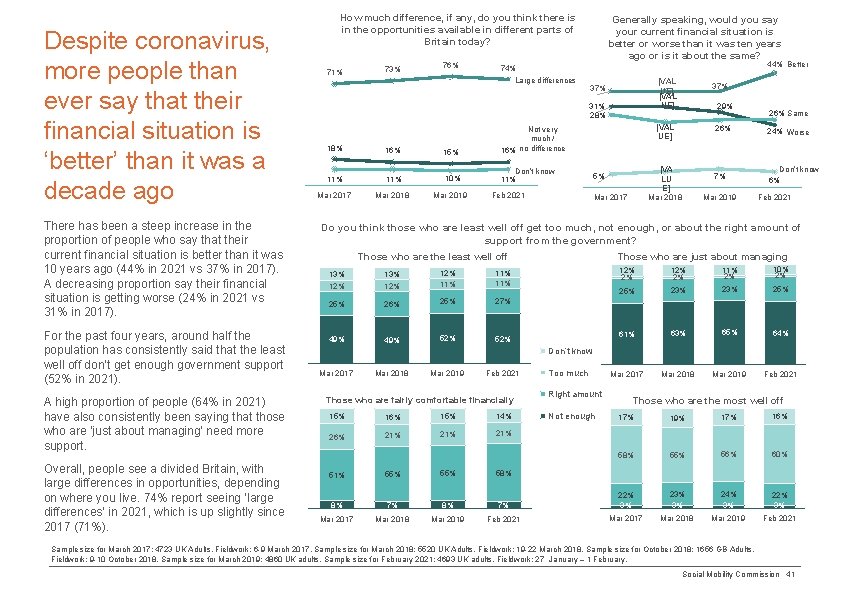
Despite coronavirus, more people than ever say that their financial situation is ‘better’ than it was a decade ago There has been a steep increase in the proportion of people who say that their current financial situation is better than it was 10 years ago (44% in 2021 vs 37% in 2017). A decreasing proportion say their financial situation is getting worse (24% in 2021 vs 31% in 2017). For the past four years, around half the population has consistently said that the least well off don’t get enough government support (52% in 2021). A high proportion of people (64% in 2021) have also consistently been saying that those who are ‘just about managing’ need more support. Overall, people see a divided Britain, with large differences in opportunities, depending on where you live. 74% report seeing ‘large differences’ in 2021, which is up slightly since 2017 (71%). How much difference, if any, do you think there is in the opportunities available in different parts of Britain today? 71% 73% 76% Generally speaking, would you say your current financial situation is better or worse than it was ten years ago or is it about the same? 44% Better 74% Large differences [VAL UE] 37% 31% 28% 16% 15% Not very much / 16% no difference 11% 10% Don’t know 11% Mar 2017 Mar 2018 Mar 2019 Feb 2021 37% 29% [VAL UE] [VA LU E] Mar 2018 5% Mar 2017 26% Same 26% 24% Worse 7% Don’t know 6% Mar 2019 Feb 2021 Do you think those who are least well off get too much, not enough, or about the right amount of support from the government? Those who are the least well off 12% 13% 12% 11% 11% 25% 26% 25% 27% 49% 52% 13% Those who are just about managing 12% 2% 11% 2% 10% 2% 25% 23% 25% 61% 63% 65% 64% Mar 2017 Mar 2018 Mar 2019 Feb 2021 Don’t know Mar 2017 Mar 2018 Mar 2019 Feb 2021 Those who are fairly comfortable financially 15% 26% 15% 14% 21% 21% Too much Right amount Not enough Those who are the most well off 17% 19% 17% 16% 58% 55% 56% 60% 51% 55% 58% 8% 7% 22% 3% 23% 3% 24% 3% 22% 3% Mar 2017 Mar 2018 Mar 2019 Feb 2021 Sample size for March 2017: 4723 UK Adults. Fieldwork: 6 -9 March 2017. Sample size for March 2018: 5520 UK Adults. Fieldwork: 19 -22 March 2018. Sample size for October 2018: 1656 GB Adults. Fieldwork: 9 -10 October 2018. Sample size for March 2019: 4860 UK adults. Sample size for February 2021: 4693 UK adults. Fieldwork: 27 January – 1 February. Social Mobility Commission 41
Any enquiries regarding this publication should be sent to us at the Social Mobility Commission, Sanctuary Buildings, 20 Great Smith Street, London, SW 1 P 3 BT. Email: contact@socialmobilitycommission. gov. uk This document is also available from our website at: https: //www. gov. uk/government/organisations/social-mobility-commission © Copyright 2021 Social Mobility Commission 42
- Slides: 42