
Social Media Use and Adolescent Internalizing Symptoms The
- Slides: 1
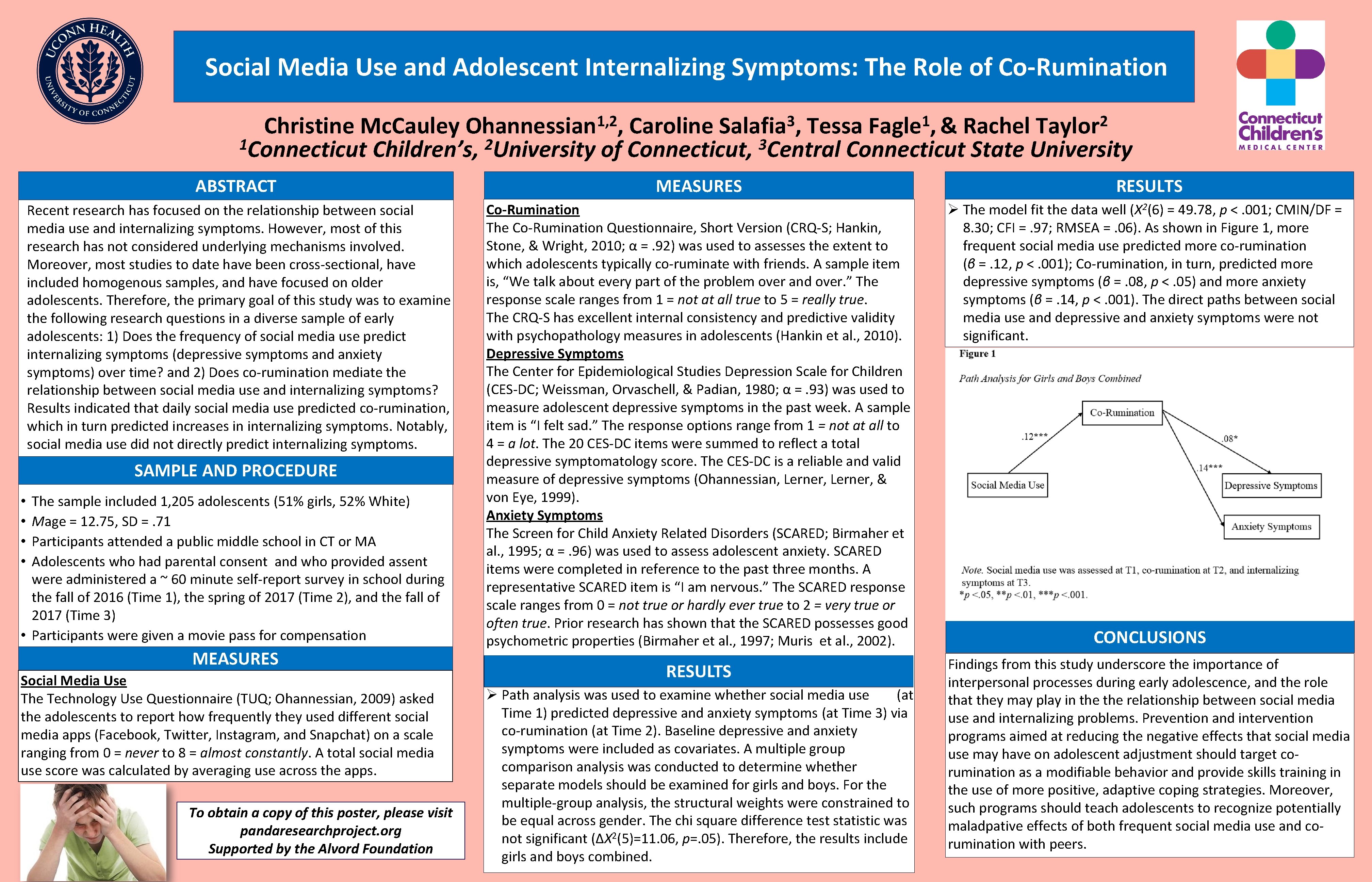
Social Media Use and Adolescent Internalizing Symptoms: The Role of Co-Rumination 1, 2 3 1 2 Christine Mc. Cauley Ohannessian , Caroline Salafia , Tessa Fagle , & Rachel Taylor 1 Connecticut Children’s, 2 University of Connecticut, 3 Central Connecticut State University ABSTRACT MEASURES RESULTS Recent research has focused on the relationship between social media use and internalizing symptoms. However, most of this research has not considered underlying mechanisms involved. Moreover, most studies to date have been cross-sectional, have included homogenous samples, and have focused on older adolescents. Therefore, the primary goal of this study was to examine the following research questions in a diverse sample of early adolescents: 1) Does the frequency of social media use predict internalizing symptoms (depressive symptoms and anxiety symptoms) over time? and 2) Does co-rumination mediate the relationship between social media use and internalizing symptoms? Results indicated that daily social media use predicted co-rumination, which in turn predicted increases in internalizing symptoms. Notably, social media use did not directly predict internalizing symptoms. Co-Rumination The Co-Rumination Questionnaire, Short Version (CRQ-S; Hankin, Stone, & Wright, 2010; α =. 92) was used to assesses the extent to which adolescents typically co-ruminate with friends. A sample item is, “We talk about every part of the problem over and over. ” The response scale ranges from 1 = not at all true to 5 = really true. The CRQ-S has excellent internal consistency and predictive validity with psychopathology measures in adolescents (Hankin et al. , 2010). Depressive Symptoms The Center for Epidemiological Studies Depression Scale for Children (CES-DC; Weissman, Orvaschell, & Padian, 1980; α =. 93) was used to measure adolescent depressive symptoms in the past week. A sample item is “I felt sad. ” The response options range from 1 = not at all to 4 = a lot. The 20 CES-DC items were summed to reflect a total depressive symptomatology score. The CES-DC is a reliable and valid measure of depressive symptoms (Ohannessian, Lerner, & von Eye, 1999). Anxiety Symptoms The Screen for Child Anxiety Related Disorders (SCARED; Birmaher et al. , 1995; α =. 96) was used to assess adolescent anxiety. SCARED items were completed in reference to the past three months. A representative SCARED item is “I am nervous. ” The SCARED response scale ranges from 0 = not true or hardly ever true to 2 = very true or often true. Prior research has shown that the SCARED possesses good psychometric properties (Birmaher et al. , 1997; Muris et al. , 2002). Ø The model fit the data well (Х 2(6) = 49. 78, p <. 001; CMIN/DF = 8. 30; CFI =. 97; RMSEA =. 06). As shown in Figure 1, more frequent social media use predicted more co-rumination (β =. 12, p <. 001); Co-rumination, in turn, predicted more depressive symptoms (β =. 08, p <. 05) and more anxiety symptoms (β =. 14, p <. 001). The direct paths between social media use and depressive and anxiety symptoms were not significant. SAMPLE AND PROCEDURE The sample included 1, 205 adolescents (51% girls, 52% White) Mage = 12. 75, SD =. 71 Participants attended a public middle school in CT or MA Adolescents who had parental consent and who provided assent were administered a ~ 60 minute self-report survey in school during the fall of 2016 (Time 1), the spring of 2017 (Time 2), and the fall of 2017 (Time 3) • Participants were given a movie pass for compensation • • MEASURES Social Media Use The Technology Use Questionnaire (TUQ; Ohannessian, 2009) asked the adolescents to report how frequently they used different social media apps (Facebook, Twitter, Instagram, and Snapchat) on a scale ranging from 0 = never to 8 = almost constantly. A total social media use score was calculated by averaging use across the apps. To obtain a copy of this poster, please visit pandaresearchproject. org Supported by the Alvord Foundation Ø Path analysis was used to examine whether social media use (at Time 1) predicted depressive and anxiety symptoms (at Time 3) via co-rumination (at Time 2). Baseline depressive and anxiety symptoms were included as covariates. A multiple group comparison analysis was conducted to determine whether separate models should be examined for girls and boys. For the multiple-group analysis, the structural weights were constrained to be equal across gender. The chi square difference test statistic was not significant (ΔΧ 2(5)=11. 06, p=. 05). Therefore, the results include girls and boys combined. CONCLUSIONS Findings from this study underscore the importance of interpersonal processes during early adolescence, and the role that they may play in the relationship between social media use and internalizing problems. Prevention and intervention programs aimed at reducing the negative effects that social media use may have on adolescent adjustment should target corumination as a modifiable behavior and provide skills training in the use of more positive, adaptive coping strategies. Moreover, such programs should teach adolescents to recognize potentially maladpative effects of both frequent social media use and corumination with peers.