
Social Media Social Change 517 Robert Bodle Overview
Social Media & Social Change 5/17 Robert Bodle
Overview Intro Syllabus Affordances Technology and Society Theories of Social Change Class Discussion Lab (8 -9: 30 pm)
Social media and social change in the news 2008 US Elections 2009 Iranian Elections 2010 Tunisian Revolution 2011 Uprisings in Egypt, Syria, Yemen, Jordan, Libya
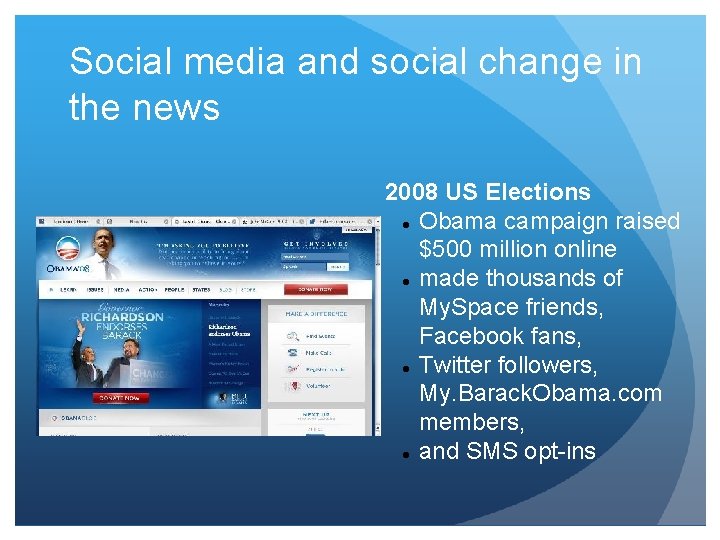
Social media and social change in the news 2008 US Elections Obama campaign raised $500 million online made thousands of My. Space friends, Facebook fans, Twitter followers, My. Barack. Obama. com members, and SMS opt-ins
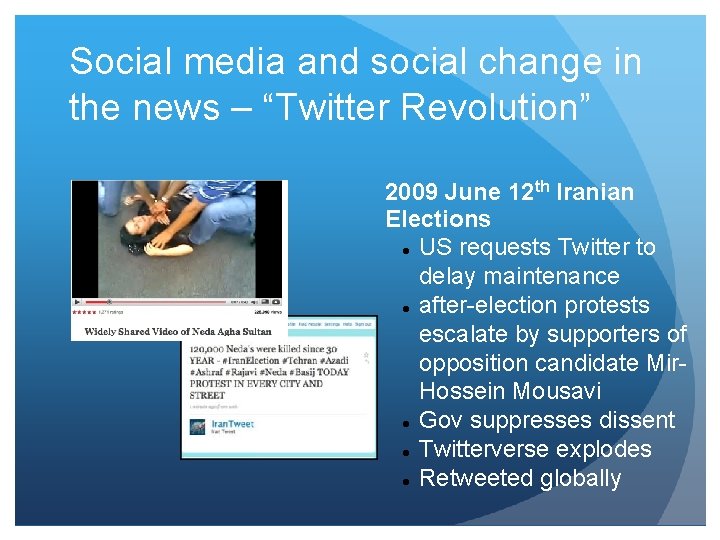
Social media and social change in the news – “Twitter Revolution” 2009 June 12 th Iranian Elections US requests Twitter to delay maintenance after-election protests escalate by supporters of opposition candidate Mir. Hossein Mousavi Gov suppresses dissent Twitterverse explodes Retweeted globally
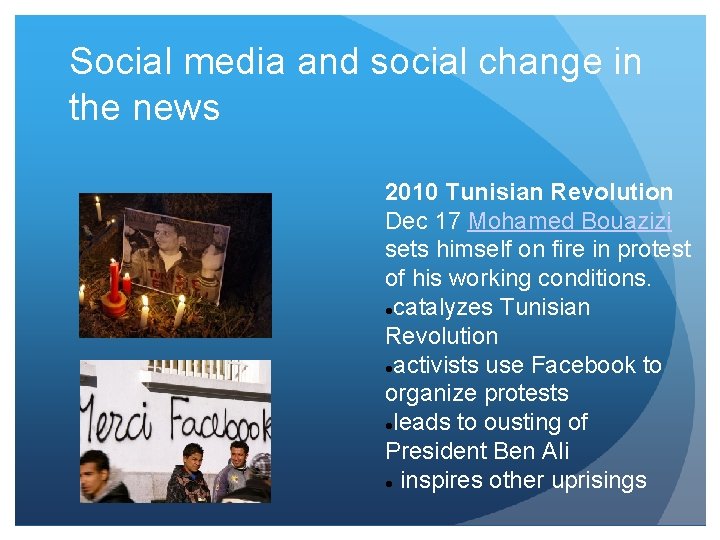
Social media and social change in the news 2010 Tunisian Revolution Dec 17 Mohamed Bouazizi sets himself on fire in protest of his working conditions. catalyzes Tunisian Revolution activists use Facebook to organize protests leads to ousting of President Ben Ali inspires other uprisings
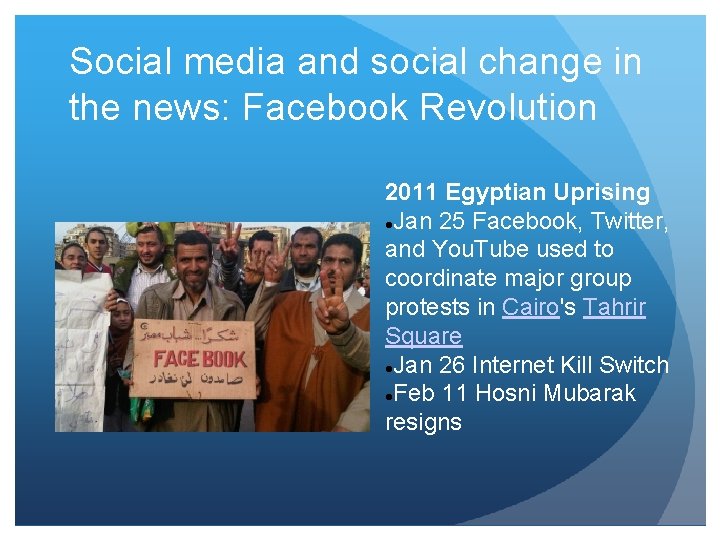
Social media and social change in the news: Facebook Revolution 2011 Egyptian Uprising Jan 25 Facebook, Twitter, and You. Tube used to coordinate major group protests in Cairo's Tahrir Square Jan 26 Internet Kill Switch Feb 11 Hosni Mubarak resigns
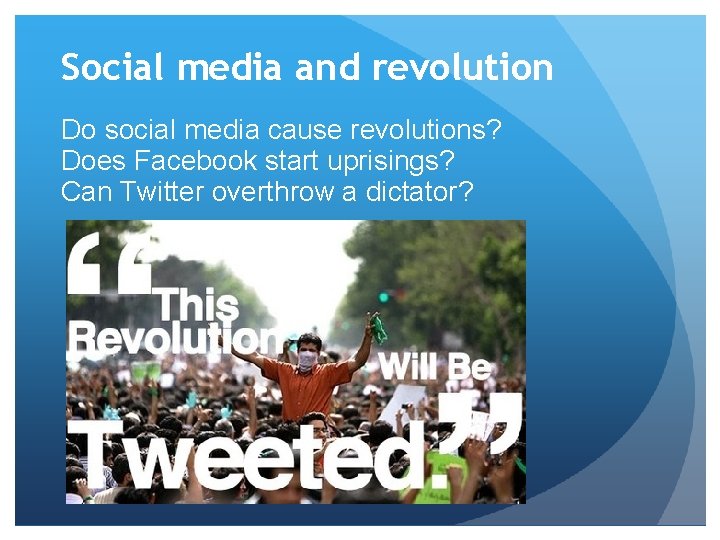
Social media and revolution Do social media cause revolutions? Does Facebook start uprisings? Can Twitter overthrow a dictator?
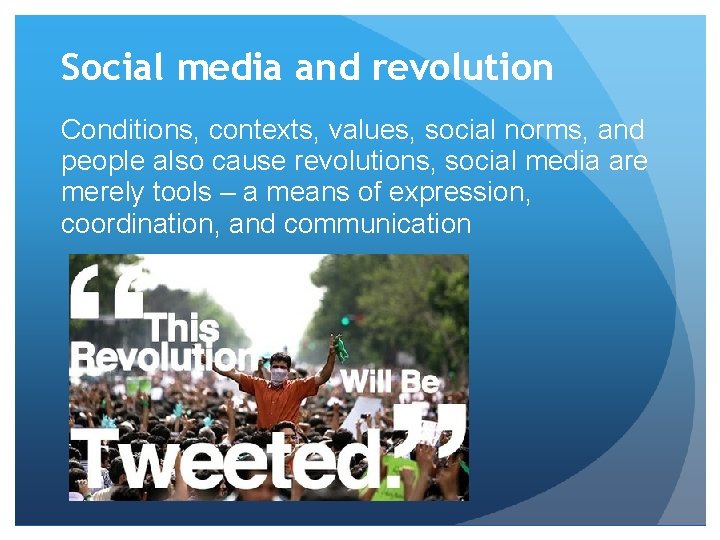
Social media and revolution Conditions, contexts, values, social norms, and people also cause revolutions, social media are merely tools – a means of expression, coordination, and communication
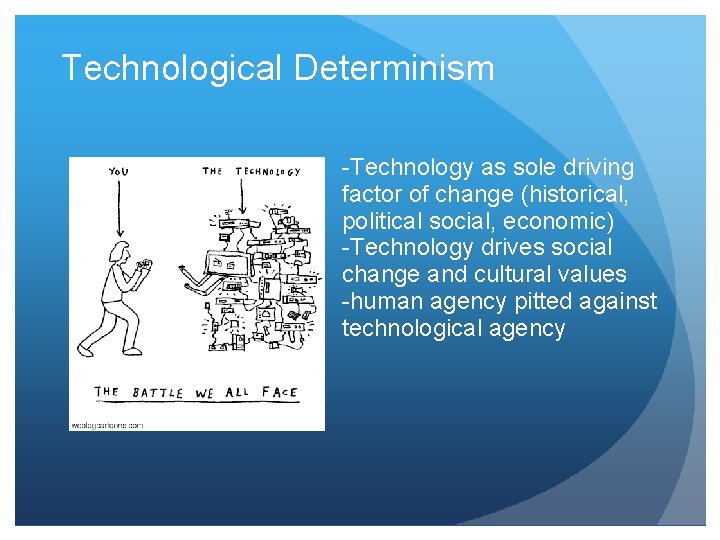
Technological Determinism -Technology as sole driving factor of change (historical, political social, economic) -Technology drives social change and cultural values -human agency pitted against technological agency
Frameworks for understanding causation between technology & society 1) Technological Determinism 2) Social Construction of Technology 3) Social Shaping perspective 4) Domestication
Frameworks for understanding causation between technology & society 1) Technological Determinism Technology mostly influences consequences Technology is most important causal agent Technology makes change
Frameworks for understanding causation between technology & society 2) Social Construction of Technology People have causal agency People mostly influence consequences People are the most important causal agent People makes change
Frameworks for understanding causation between technology & society 3) Social Shaping perspective A mix of affordances and unexpected ways people make use of those affordances Both people and technology make change
Frameworks for understanding causation between technology & society 4) Domestication of technology New technologies deeply embedded in daily life Difficult to determine between technological or human causal agency Technology is almost invisible
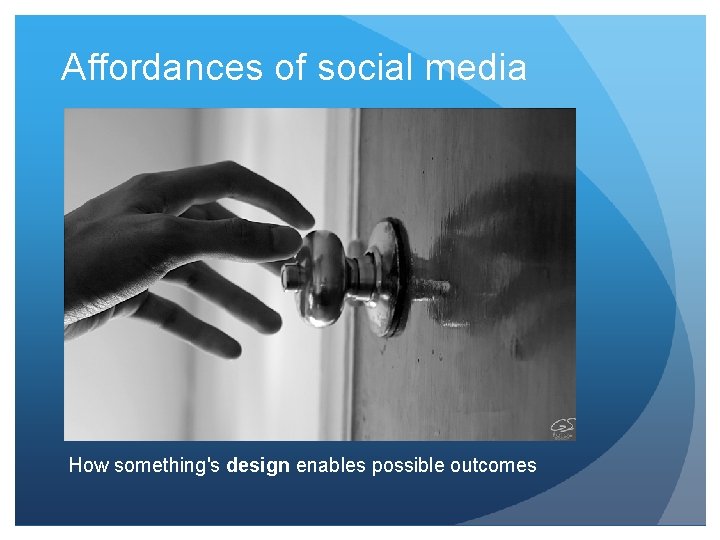
Affordances of social media How something's design enables possible outcomes
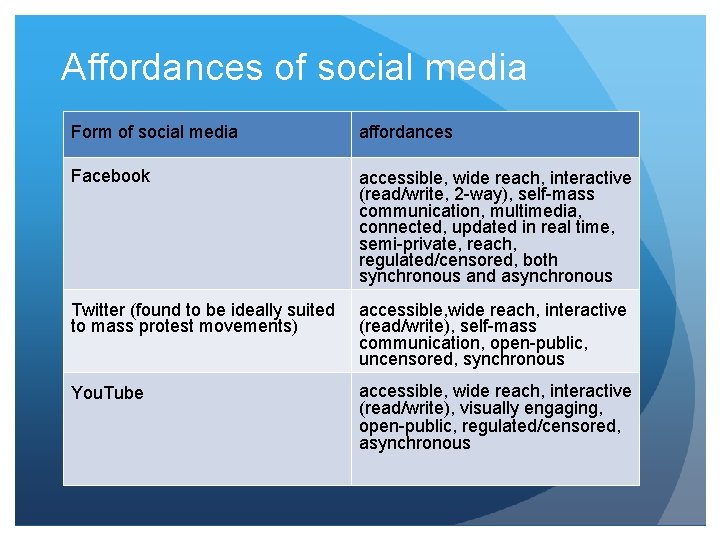
Affordances of social media Form of social media affordances Facebook accessible, wide reach, interactive (read/write, 2 -way), self-mass communication, multimedia, connected, updated in real time, semi-private, reach, regulated/censored, both synchronous and asynchronous Twitter (found to be ideally suited to mass protest movements) accessible, wide reach, interactive (read/write), self-mass communication, open-public, uncensored, synchronous You. Tube accessible, wide reach, interactive (read/write), visually engaging, open-public, regulated/censored, asynchronous
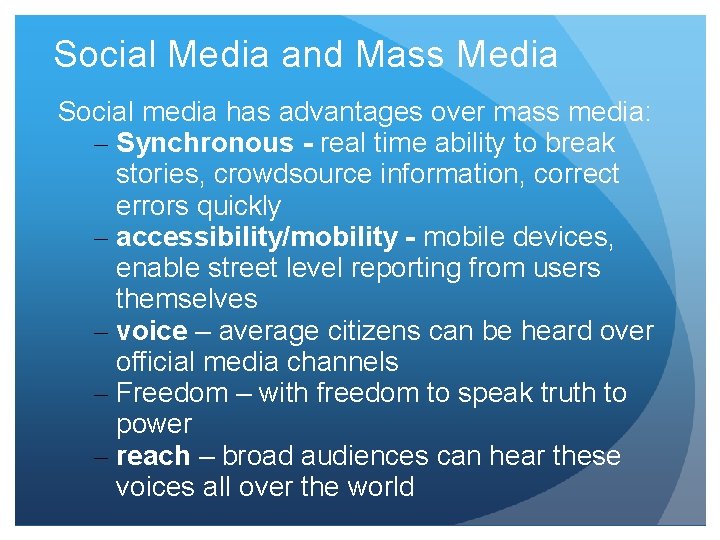
Social Media and Mass Media Social media has advantages over mass media: – Synchronous - real time ability to break stories, crowdsource information, correct errors quickly – accessibility/mobility - mobile devices, enable street level reporting from users themselves – voice – average citizens can be heard over official media channels – Freedom – with freedom to speak truth to power – reach – broad audiences can hear these voices all over the world
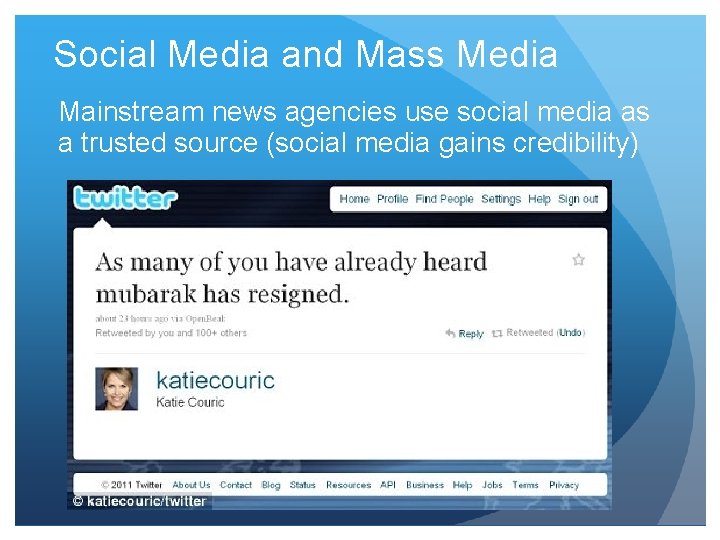
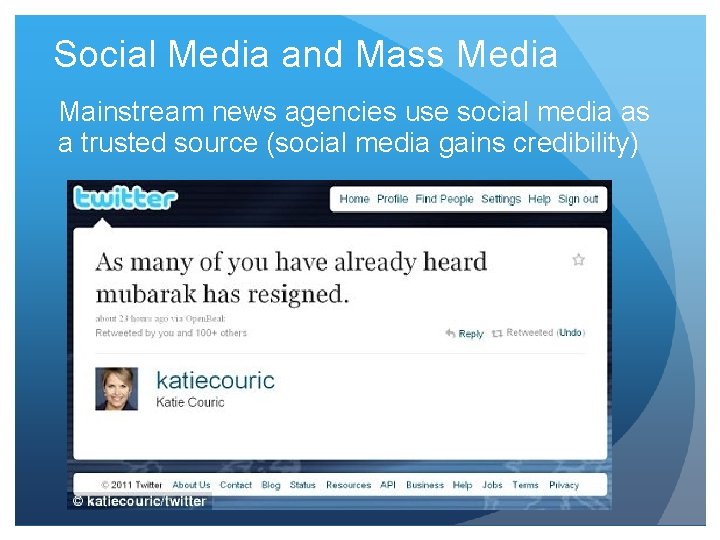
Social Media and Mass Media Mainstream news agencies use social media as a trusted source (social media gains credibility)
Social Media and Mass Media Mainstream news agencies use social media as a trusted source (social media gains credibility)
Explaining social change: social movement theory Media Frames Approach (Entman, 1993) – frames tell an audience how to think about something by defining an issue through • Selection • Exclusion • Emphasis • Elaboration Frames organize, structure, and illuminate meaning, and can also mobilize participation.
social movement theory Three collective action frames • Diagnostic – define problem, assign blame • Prognostic – detail possible solutions • Motivational – incite individuals to act
social movement theory (cont. ) Dynamics of contention (Tarrow & Tilly, 2001) – Situating social movements alongside industrial conflicts, wars, politics, nationalism, democratization to identify causes or causal relationships. 1) Mechanisms of diffusion 2) Attribution of similarity 3) Emulation
social movement theory (cont. ) 1) Mechanisms of diffusion – how information is transferred along line of interaction. 2) Attribution of similarity – how mutual identification between people is sufficient to justify common action. 3) Emulation – how collective action can be modeled on the action of others
social movement theory (cont. ) Trigger theories (things to trigger social change) – Dramatic events or crises (Castells, 2001) – “Moral shocks” that raise a sense of outrage in people inclined toward political action (Jasper, 1997) – Suddenly “imposed grievance” or “political event” that motivates ordinary citizens to get politically active (Opp, 2009).
social movement theory (cont. ) Two caveats to using social movement theory to understand social change and realize effective media use: – 1) still unclear whether social media creates new forms of activism or increases established forms of activism – 2) theorizing social movements or social change online must maintain a sustained attention to the persistent inequality in ICT access and digital media literacies.
Discussion (small groups) 1) Authors Kahn and Kellner suggest that “the internet is a contested terrain” (2004, p. 94). What do the authors mean by this? 2) According to Joyce, what are digital optimists, pessimists, and persistents (pp. 10 -14)? Which one are you? 3) Why does Scholtz in the chapter “Infrastructure” liken Facebook to a digital cage (p. 30)? Do you agree with him?
LAB Class Wiki
Social Media and Social Change Robert Bodle
- Slides: 29