
Social Media Cyberbullying and Mental Health A Comparison
Social Media, Cyberbullying, and Mental Health: A Comparison of Adolescents With and Without Disabilities A Ruderman Family Foundation White Paper October 17, 2019 Shai Fuxman, Ed. D Shari Kessel Schneider, MSPH Miriam Heyman, Ph. D
About the Ruderman Family Foundation We are an international leader in disability inclusion. We view inclusion as central to civil rights, social justice, and diversity. We elevate public awareness and destigmatize all types of disability, including mental illness.
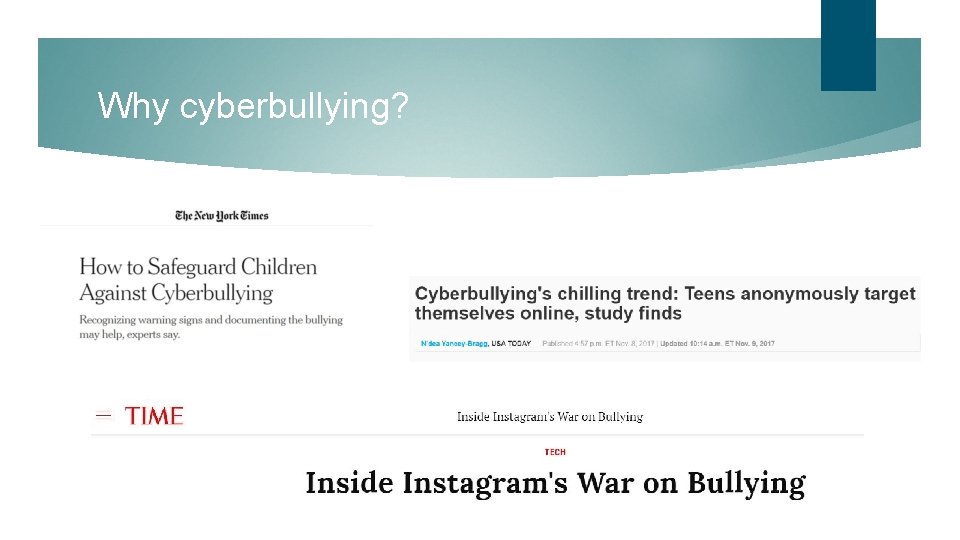
Why cyberbullying?
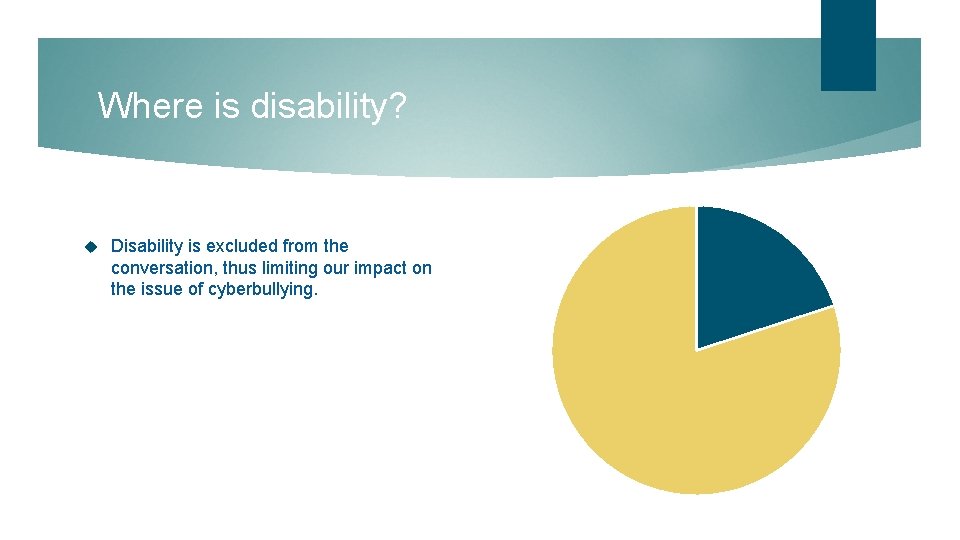
Where is disability? Disability is excluded from the conversation, thus limiting our impact on the issue of cyberbullying.
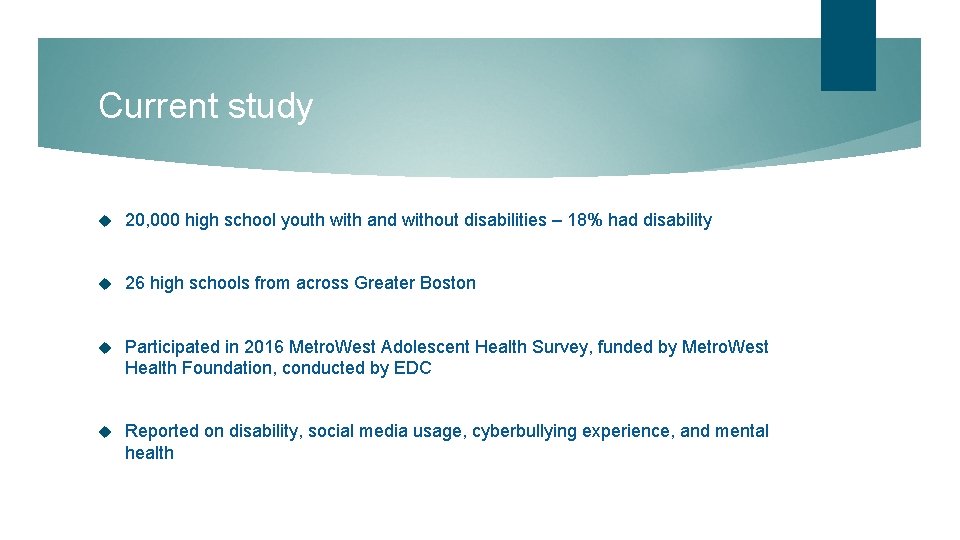
Current study 20, 000 high school youth with and without disabilities – 18% had disability 26 high schools from across Greater Boston Participated in 2016 Metro. West Adolescent Health Survey, funded by Metro. West Health Foundation, conducted by EDC Reported on disability, social media usage, cyberbullying experience, and mental health
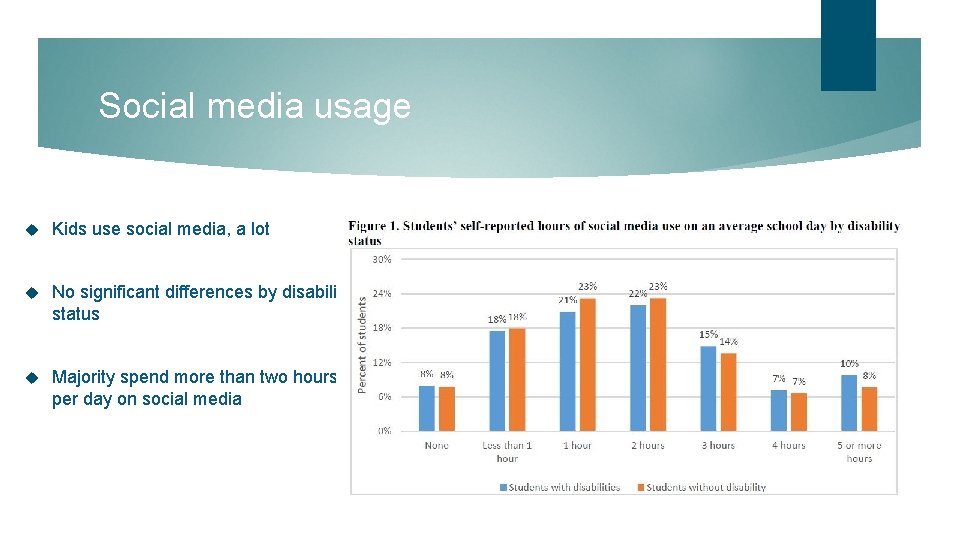
Social media usage Kids use social media, a lot No significant differences by disability status Majority spend more than two hours per day on social media
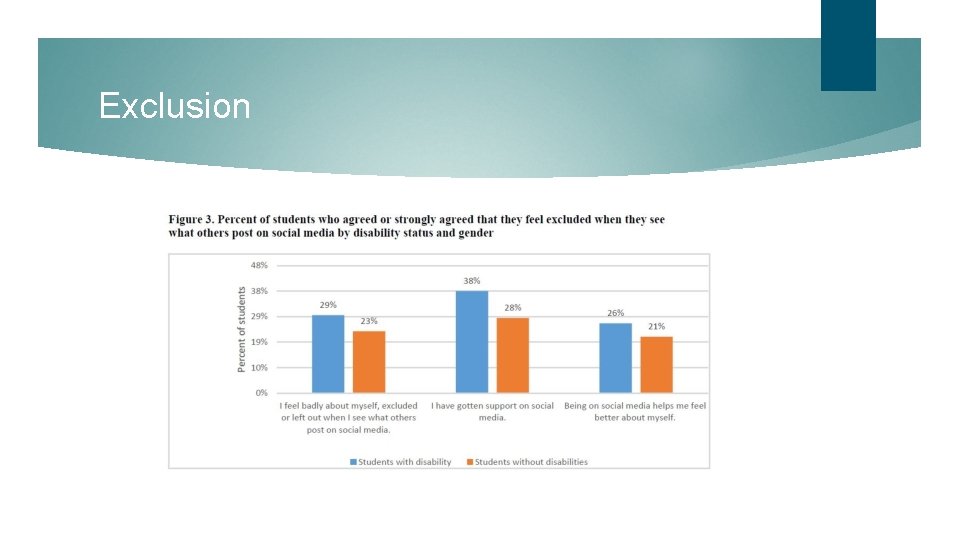
Exclusion
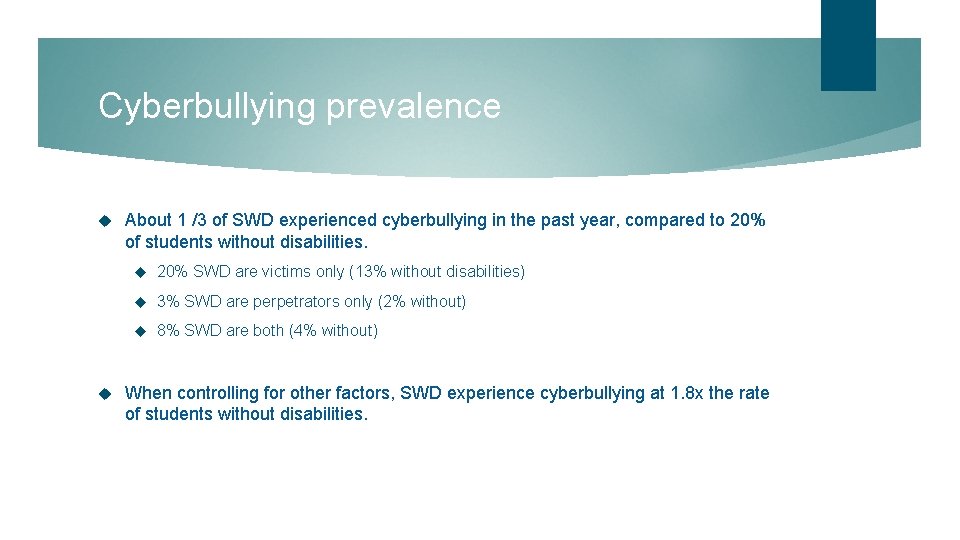
Cyberbullying prevalence About 1 /3 of SWD experienced cyberbullying in the past year, compared to 20% of students without disabilities. 20% SWD are victims only (13% without disabilities) 3% SWD are perpetrators only (2% without) 8% SWD are both (4% without) When controlling for other factors, SWD experience cyberbullying at 1. 8 x the rate of students without disabilities.
Cyberbullying and depressive symptoms During the past 12 months, did you ever feel so sad or hopeless every day for two weeks or more in a row that you stopped doing some usual activities? There is a link between cyberbullying involvement and depressive symptoms for all students. Students involved in cyberbullying – as a victim, perpetrator, or both – are more likely to experience depression than students who do not experience cyberbullying at all. 34%, 24%, and 41% respectively vs. 13%
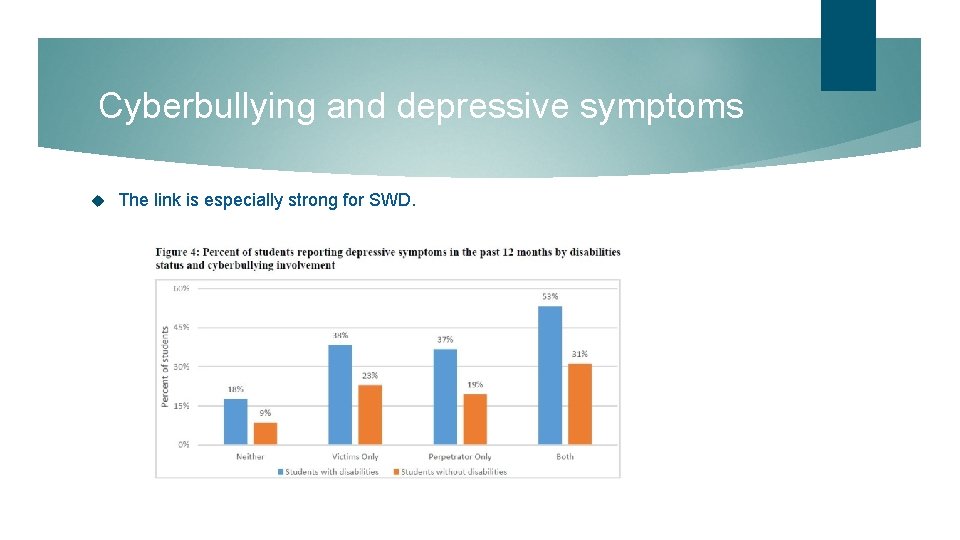
Cyberbullying and depressive symptoms The link is especially strong for SWD.
Similar pattern for suicidality During the past 12 months did you… Ever seriously consider attempting suicide? Made a plan about how you would attempt suicide? Attempt suicide? Cyberbullying is a risk factor for all students, and an especially salient risk factor for SWD.
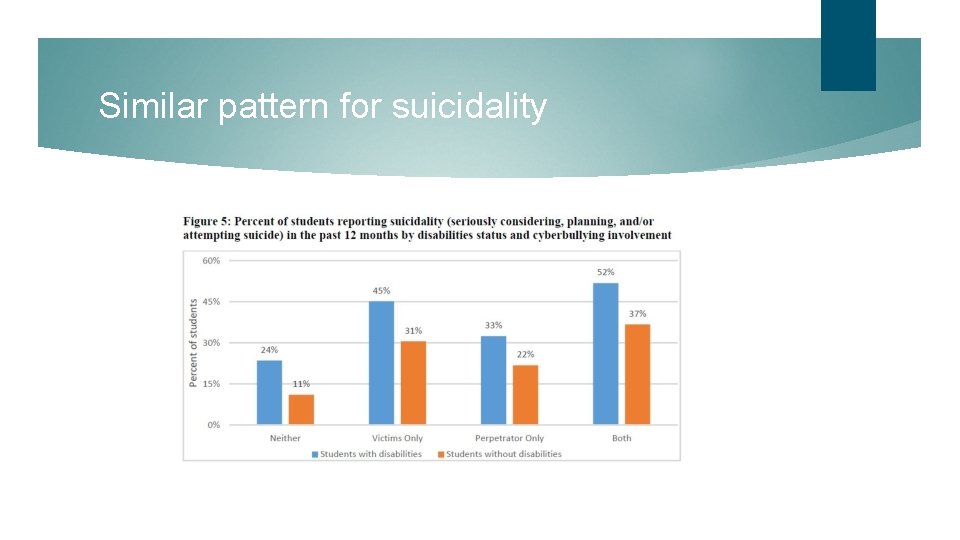
Similar pattern for suicidality
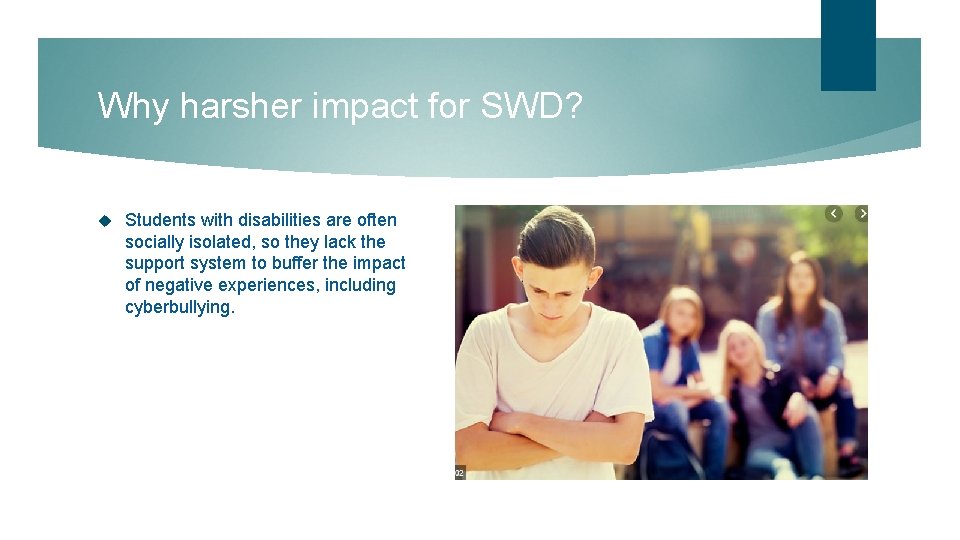
Why harsher impact for SWD? Students with disabilities are often socially isolated, so they lack the support system to buffer the impact of negative experiences, including cyberbullying.
Is there a bright side? Students with disabilities are especially likely to receive social support online. 38% versus 28% Challenge for educators, policy makers, and parents: How can we harness the power of social media to advance connectedness for all students, including those with and without disabilities? SWD more likely to experience both positive and negative impacts of social media.
What are the implications? Social media industry: Utilize creativity, ingenuity, and resources Parents Talk to your children, encourage kindness, only allow interaction with trusted others, monitor regularly and respond immediately. Educators Lessons about values such as kindness should explicitly address online behavior. Teach students about their obligations as bystanders (online and offline). Teach students how to respond (block and report users) and not retaliate. Infuse instruction about disability and inclusion throughout the curriculum.
Conclusions Concerning rates of cyberbullying for all students, especially SWD. Though we can’t assume causation in the link between CB and MH, involvement in CB is a strong indicator of support needs. There are lots of bystanders – everyone can play a role in advancing online safety and connection. Pay attention to both victims and perpetrators – there is a large overlap. The solution is not to end or even reduce social media, but to use it well.
Resources Stopbullying. gov CDC’s Disability and Safety: Information about Bullying Net. Martz Workshop Digital Youth With Disabilities, from John D. and Catherine T. Mac. Arthur Foundation on Digital Media and Learning
Thank You
- Slides: 18