
Social Learning Natalie Dolan Tayler Lenart Joe Letke
- Slides: 8
Social Learning Natalie Dolan, Tayler Lenart, Joe Letke, Melanie Battaglia, Kelly Schreuder, Max Jansons
Types Of Learning �Classical Conditioning: Learning by association �Operant Conditioning: Learning through reinforcement �Social Learning: Learning by observing and imitating �Cognitive Learning: Learning through mental processing
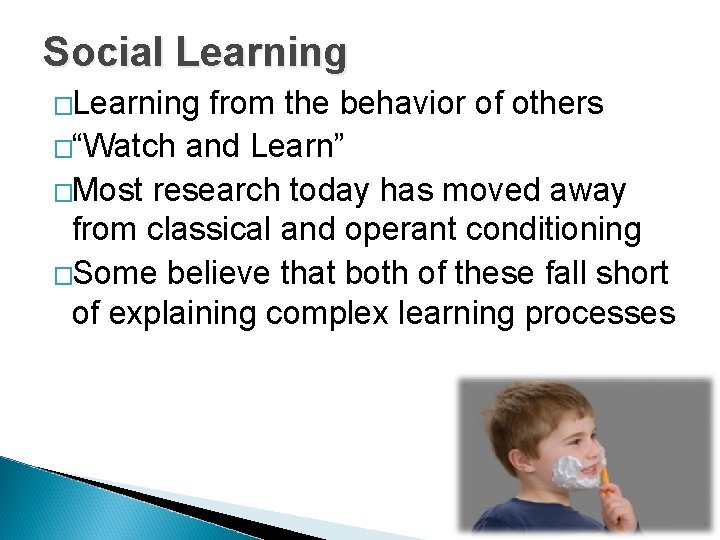
Social Learning �Learning from the behavior of others �“Watch and Learn” �Most research today has moved away from classical and operant conditioning �Some believe that both of these fall short of explaining complex learning processes
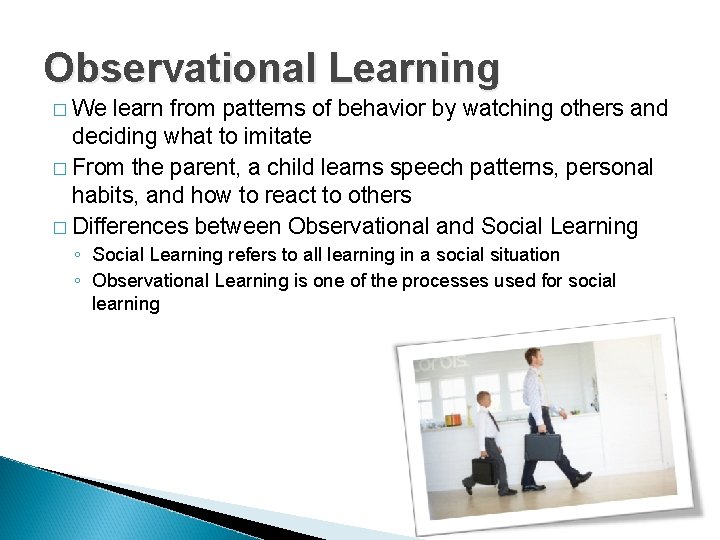
Observational Learning � We learn from patterns of behavior by watching others and deciding what to imitate � From the parent, a child learns speech patterns, personal habits, and how to react to others � Differences between Observational and Social Learning ◦ Social Learning refers to all learning in a social situation ◦ Observational Learning is one of the processes used for social learning
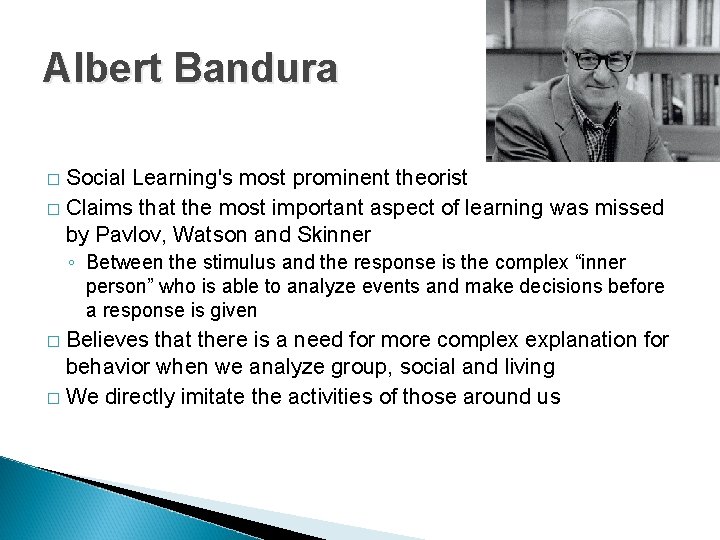
Albert Bandura Social Learning's most prominent theorist � Claims that the most important aspect of learning was missed by Pavlov, Watson and Skinner � ◦ Between the stimulus and the response is the complex “inner person” who is able to analyze events and make decisions before a response is given Believes that there is a need for more complex explanation for behavior when we analyze group, social and living � We directly imitate the activities of those around us �
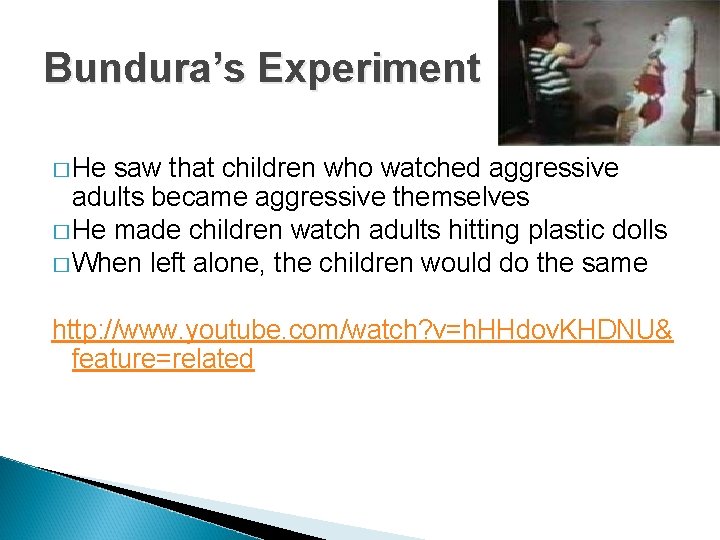
Bundura’s Experiment � He saw that children who watched aggressive adults became aggressive themselves � He made children watch adults hitting plastic dolls � When left alone, the children would do the same http: //www. youtube. com/watch? v=h. HHdov. KHDNU& feature=related
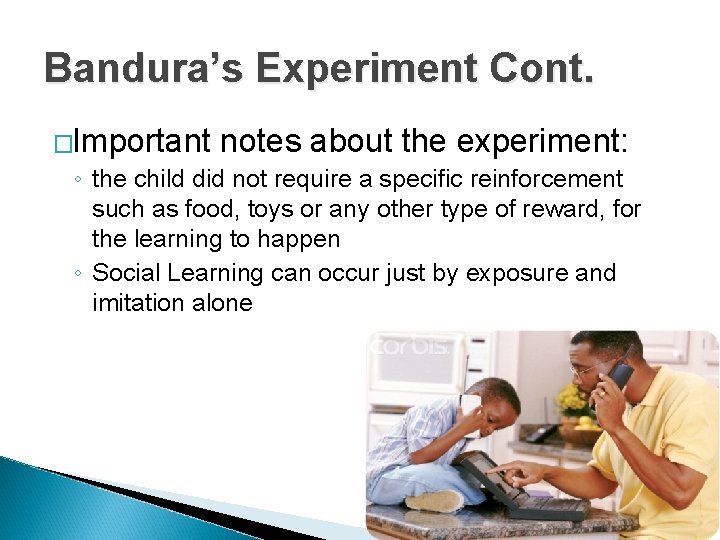
Bandura’s Experiment Cont. �Important notes about the experiment: ◦ the child did not require a specific reinforcement such as food, toys or any other type of reward, for the learning to happen ◦ Social Learning can occur just by exposure and imitation alone
Breaking Bad Habits � There are 5 methods that can be used to break habits � 1. Remove, avoid or delay reinforcement- no snacks until 30 minutes after you have finished your homework � 2. Do not remove reinforcement, but find a new behavior to get that reinforcement- instead of watching TV after school, read a book � 3. Narrow or avoid the stimuli (or cues) that precede the habit- not going to the grocery store when you are hungry � 4. Break the chain- avoid distractions � 5. Monitor the bad habit- focus on your bad habit