
Social Kinds and Comparative Research Dan Little University


- Slides: 63
Social Kinds and Comparative Research Dan Little University of Michigan-Dearborn February, 2002
What is comparative inquiry? l It is social or political research that focuses on the causes and effects of social structures and dynamics and pays close attention to cross-case comparisons l Identify similar structures and processes in different social and historical settings l Example: How does micro-organizational structure affect the incidence of corruption? 2
Causal reasoning in comparative inquiry l several distinct goals are possible: – identify common processes; generalization – identify singular or exceptional processes; differentiation l. A common research goal: identify the causal properties of a specified set of structures, variables, or circumstances 3
Explanation l What states of affairs support the question “what is the explanation of X? ” – Why did event E occur [in the way that it did]? – Why are X’s usually P [revolutions usually violent]? – What are the causes of regularity R [democracies don’t go to war with each other]? 4
Method l select a set of cases in which the variables of interest are present (or absent); examine outcomes; examine mechanisms and processes l Probe the causal characteristics of these structures through observation of their behavior in different settings. l Employ Mill’s methods of similarity and 5 difference
Examples l Robert Brenner on England France in the case of modernizing agriculture l Atul Kohli on poverty reform in three states in India l Theda Skocpol on revolution in China, Russia, France l Robert Klitgard on corruption 6
Ontology 7
The defining question for this paper l Comparative inquiry presupposes that there are social things and implies that they fall into categories that can be reidentified across historical and social contexts. l What ontological and conceptual assumptions must we make in order to be able to support comparative social research? 8
Why is there a problem of social ontology? l Asking “why are X’s P” implies that we can identify multiple X’s. l Asking “why do revolutions occur in agrarian settings? ” implies, likewise, that there are multiple instances of revolution. l We can also ask “What are X’s -- e. g. , revolutions? ” 9
Why is there a problem of social ontology? l These questions imply that there is an important commonality among the things called “X”. l These questions presume that we can identify a group of events under the rubric “revolution”, and then ask whethere are underlying causal, structural, or agency features that these events share. 10
Why is there a problem of social ontology? l That is: to do comparative research we must be able to identify historical “things” and subsume these things under “concepts. ” 11
Explanation presupposes ontology l So we must be able to identify individual entities, structures, and events. l And we must be able to classify these. l If we want to arrive at generalizations across cases, then we need to be able to put forward concepts that identify properties and things that can be identified in the several cases. 12
Limits of “operationalization” l There is a common impulse to offer a behavioral/ operational/ observational definition of the variable of interest. l “By ‘riot’ we will refer to incidents of violence involving 6 or more people. ” l But: we often wish to capture theoretical constructs that do not reduce to an operational definition. 13
Things 14
Ontology l What exists? l What logical features must things satisfy in order to be things? l Do things fall into types of things? l Do things fall into kinds of things? 15
Ontological questions l Do revolutions exist? l Did feudalism exist in 12 th century France? l Did feudalism exist in Meiji Japan? l Does feudalism exist? l Did the Chinese revolution exist? l Did landlord power exist in 1930 s China? 16
A simple world l things exist l things have real causal properties and relations l things can be composed into complexes or “systems” based on their causal properties l complex or system things can persist or change 17
A simple social ontology l individuals, relations, institutions exist l individuals have agency within constraints l institutions evolve to satisfy individual and collective purposes l institutions and organizations have powers l institutions have properties of organization and functioning 18
Higher-level social entities l State, class, taxation system, religion, Islam-these are non-essentialist concepts that pick out clusters of institutions based on observable features and paradigm instances. They do not constitute kinds. l Likewise: the political, the social, the religious as “realms”; these concepts too are descriptive rather than types. 19
Concepts 20
Social concepts l Uses of social concepts – to classify – to categorize – to explain – to identify individual social occurrences or events 21
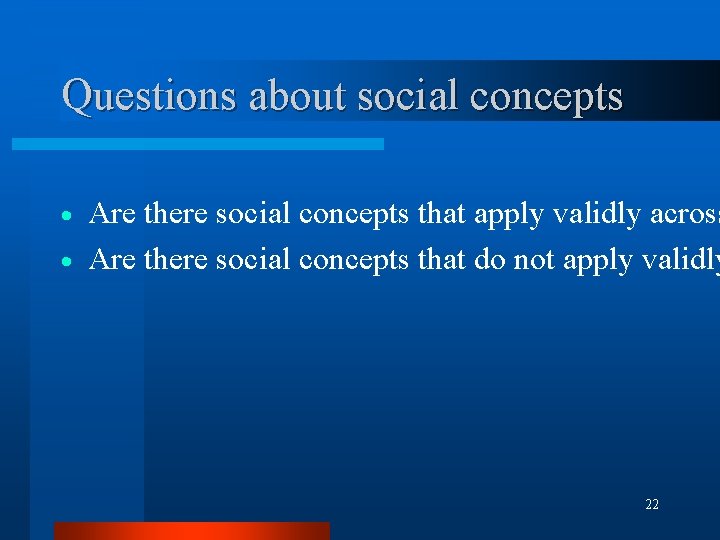
Questions about social concepts Are there social concepts that apply validly across · Are there social concepts that do not apply validly · 22
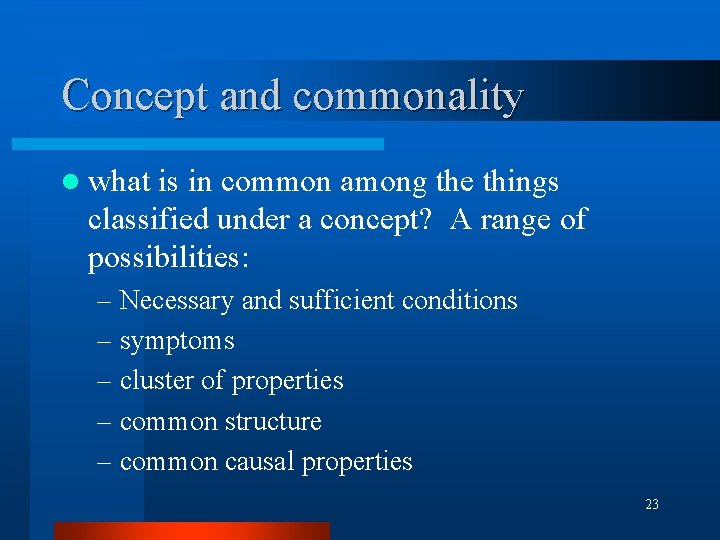
Concept and commonality l what is in common among the things classified under a concept? A range of possibilities: – Necessary and sufficient conditions – symptoms – cluster of properties – common structure – common causal properties 23
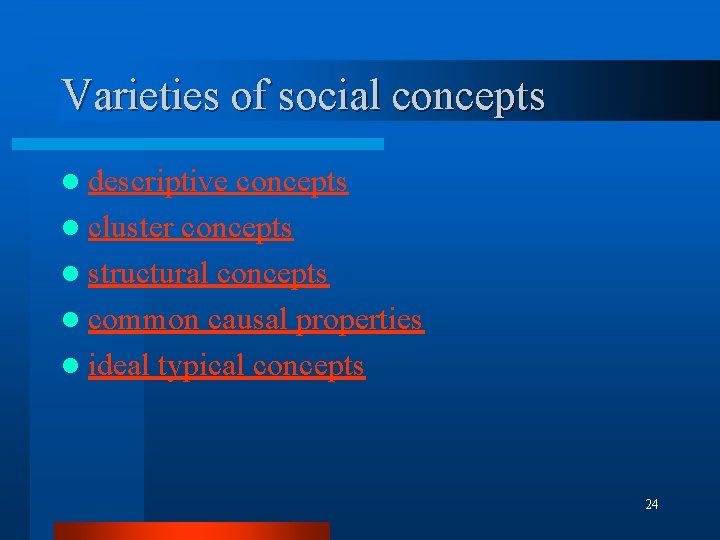
Varieties of social concepts l descriptive concepts l cluster concepts l structural concepts l common causal properties l ideal typical concepts 24
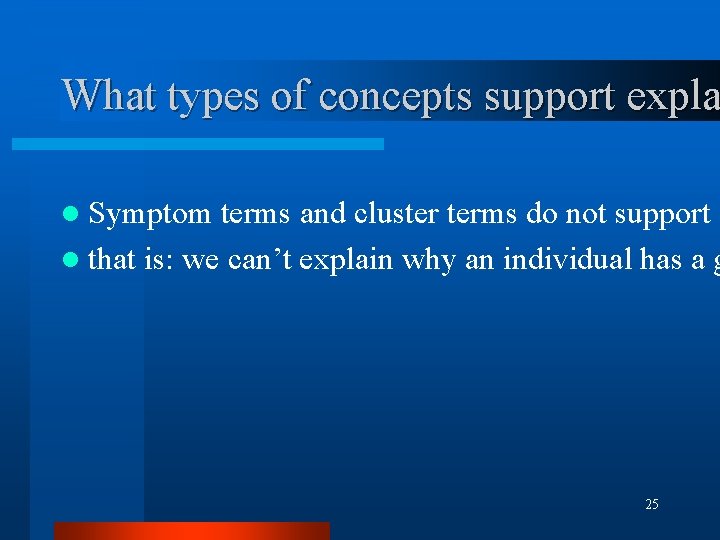
What types of concepts support expla l Symptom terms and cluster terms do not support e l that is: we can’t explain why an individual has a g 25
What types of concepts support expla l structural and causal terms do support explanation l that is: we can explain why the individual has a gi l E. g. x is conductive because it is a metal 26
Ways that concepts connect to phenom l reference l ostension l concepts single out discrete and definite classes o l loose indication of a domain of phenomena which 27
Realism and nominalism l We can interpret social concepts as a linguistic convenience (nominalism); l or as referential to underlying social entities (realism, essentialism) 28
Reification l the error of reification consists in the social scientist’s assumption that, because he has a concept of X, that X really exists and has an underlying coherent essence. Because the concept of feudalism can be applied to Britain, Japan, and China, the historian may be led to assume that there is a common essence among these. 29
Reification l Instead, the terms are nominalistic groupings. l The concepts are more like ideal types or descriptive concepts than kind terms. 30
Examples of social concepts · Proto-industrialization · · · Feudalism Theatre state of Bali Famine Grain riot City 31
Conclusions 32
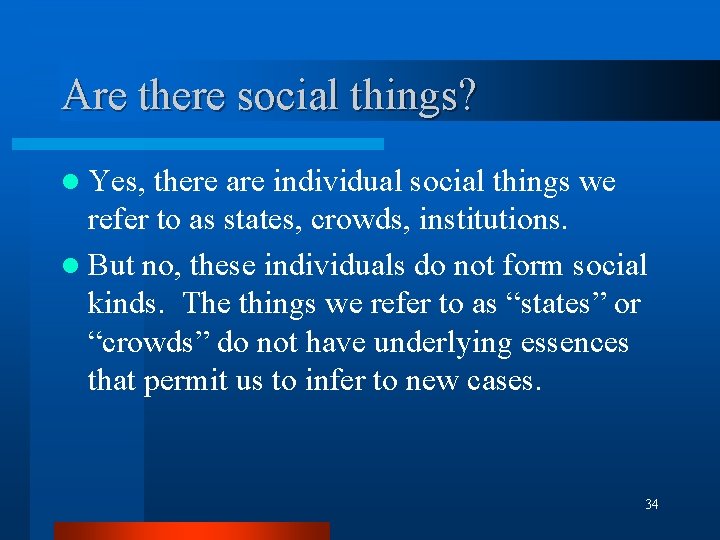
Are there social things? l Do social structures have the features of permanence, demarcation, and reidentification that allow us to call them “things”? l Are social structures more like molecules or clouds? l Do states, societies, crowds, organizations, institutions, mobs, or classes exist? 33
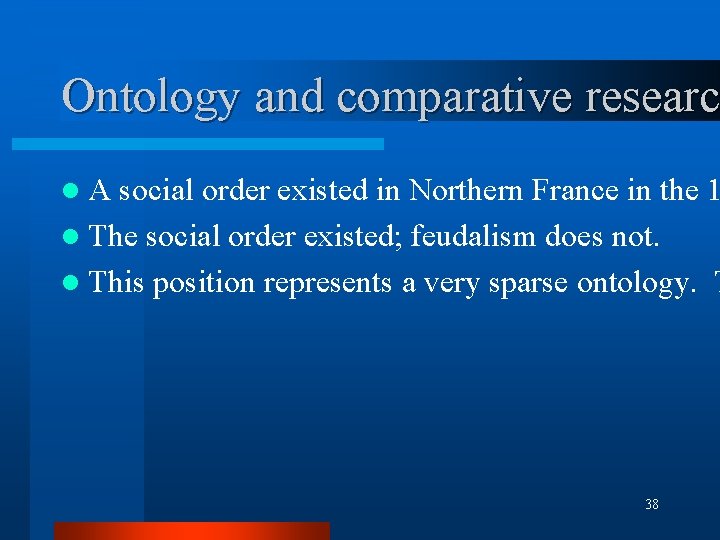
Are there social things? l Yes, there are individual social things we refer to as states, crowds, institutions. l But no, these individuals do not form social kinds. The things we refer to as “states” or “crowds” do not have underlying essences that permit us to infer to new cases. 34
Doubt about social kinds l Terms like feudalism, proto-industrialization, revo 35
Doubt about social kinds l We can be realist about social things--relations, in 36
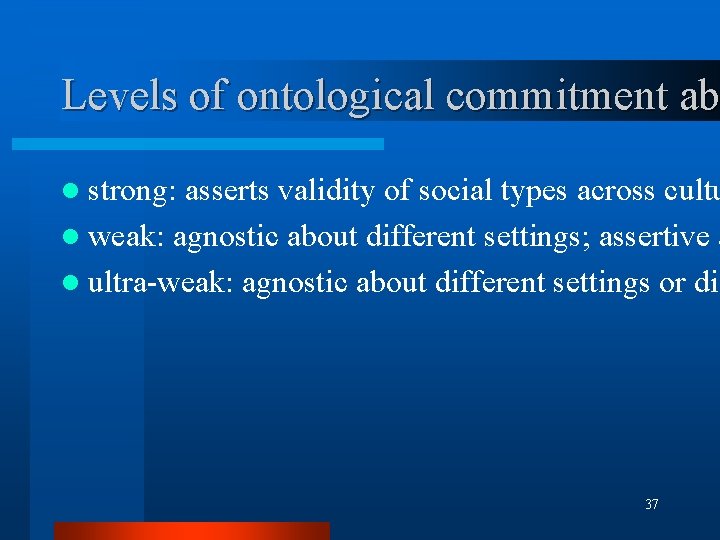
Levels of ontological commitment ab l strong: asserts validity of social types across cultu l weak: agnostic about different settings; assertive a l ultra-weak: agnostic about different settings or dis 37
Ontology and comparative researc l. A social order existed in Northern France in the 1 l The social order existed; feudalism does not. l This position represents a very sparse ontology. T 38
Ontology and comparative researc l Is this approach enough for comparative research? 39
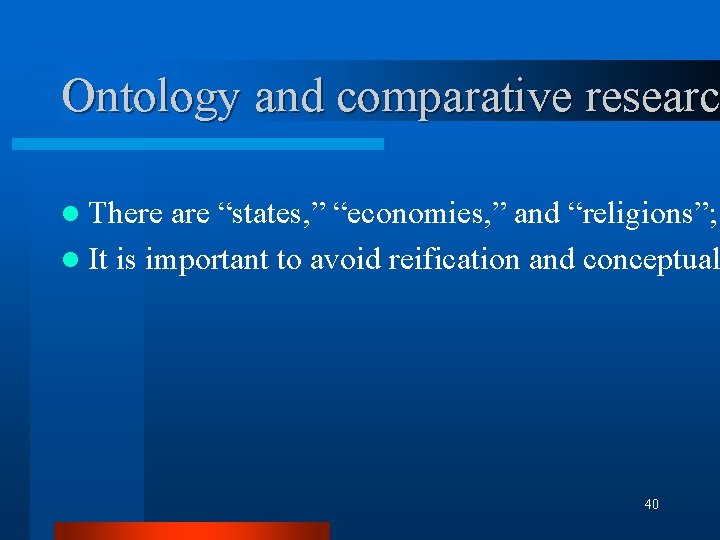
Ontology and comparative researc l There are “states, ” “economies, ” and “religions”; l It is important to avoid reification and conceptual 40
END 41
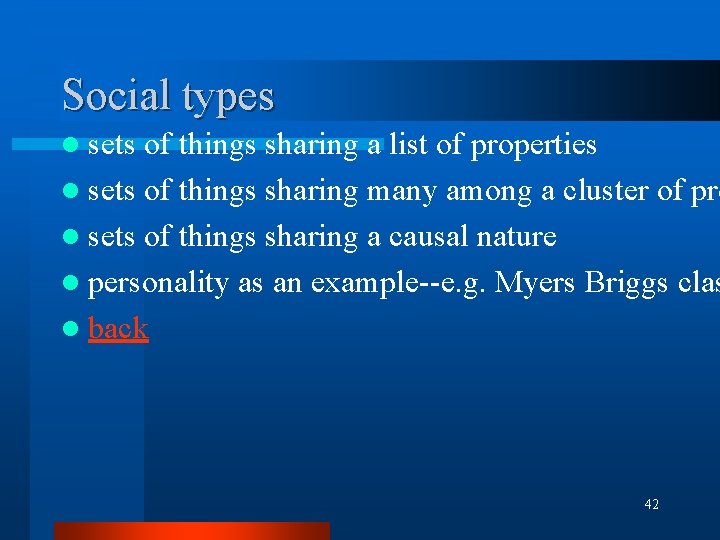
Social types l sets of things sharing a list of properties l sets of things sharing many among a cluster of pro l sets of things sharing a causal nature l personality as an example--e. g. Myers Briggs clas l back 42
Social kinds l When “things” fall into groups that share deep, explanatorily relevant properties, we refer to the groups as “kinds”. l “Metal” constitutes a kind; “plastic” does not. “Gold” versus “candy” l Are revolutions, riots, or kinship systems “social kinds”? l back 43
Ideal typical concept l ideal portrait of a set of processes l pure construct of typical relationships l stereotyped or paradigmatic descriptionof a partic l e. g. the idea of the medieval urban economy l back 44
Descriptive concepts l concepts that identify a group of entities in terms l “symptom” concepts l operational concepts--defined in terms of specific l e. g. “naval powers”, “famine” l back 45
Structural concepts that identify a group of entities in terms l presupposition: that there is a common structure l e. g. free-market commodity regime l back 46
Causal concepts that group entities in terms of – common causal history (volcano) – common causal properties (enzyme) l e. g. free rider problem, collective action problem, l back 47
Cluster concepts l concepts encompassing a variety of phenomena th l e. g. authoritarian state, subsistence farming l back 48
logical requirements for things l temporal persistence and continuity; l criteria of reidentification; l reasonably clear boundaries l Note that these are Kantian criteria. 49
Thing and continuity l How much change can occur before we say that the thing is no longer the same? The Heraclitus point. l Is the Chinese state the same historical entity in the Han Dynasty and the Qing Dynasty (separated by 2000 years and substantial institutional change)? l back 50
Proto-industrialization definition l “development of rural regions in which a large pa 51
Proto-industrialization l industrial production within agrarian social relatio l merchant capital directs production over many sm l presupposition: these relations can be identified in l back 52
Theatre state in Bali l Negara -- a construction of the highly specific ensemble of institutions, values, and relations that made up the pre-colonial Indonesian state. l Geertz maintains that this is a concept, not an individual; he estimates hundreds or thousands of negaras in Indonesian history. 53
Theatre state ( cont) l So: it is cross-time but not cross-culture. l There is one type -- negara -- that recurs over hundreds of years in Indonesian culture. l Geertz asserts no cross-context validity of the concept. There are no negara in other cultures. l Back 54
City l What is a city? l A human settlement with minimum size, density, and heterogeneity (Wirth, quoted by Skinner) l Can classify cities by multiple dichotomies; preindustrial-modern; civilization-primitive; region l can look for generalizations within 55 categories.
City (cont) l Or: can look for differentiation and covariation of properties l On this approach the concept is not highly structured or theoretically informed; instead, the researcher identifies the phenomenon loosely and examines the particular instances closely. l Back 56
Famine l an extended period of time in a significant geographical region in which large numbers of people have insufficient food to satisfy subsistence needs, and which results in numerous excess mortality. l The definition does not presuppose common structure or causation. 57
Famine (cont) l Why do famines occur? l It is possible that there are multiple answers, corresponding to multiple sub-types of the behaviorally defined “famine”. l That is: a behavioral concept is entirely open to multiple underlying causal etiology. 58
Famine (cont) l So: “is famine a kind? ” is an empirical and substantive question; not a conceptual question. l Back 59
Grain riot l Thompson: not simply “rebellion of the belly”--a spontaneous, spasmodic instinctive reaction to hunger (186) l Rather, a nuanced collective event that is complex, culturally-mediated, and meaningful. l The grain riot is typically informed by a legitimising notion (188); a moral economy 60 of the crowd.
Grain riot (cont) l “The food riot in eighteenth-century England was a highly complex form of direct popular action, disciplined and with clear objectives” (188). l This is a discovery, however; not part of the concept of “grain riot”. l Back 61
Feudalism l the central paradigm instance: the socialeconomic order found in France in the 9 th century l features include: domaine agriculture, serfdom, infeudation of political authority, military prowess concentrated on the lord. The seigneurie. 62
Feudalism (cont) l The question “Was the 12 th century Polish social regime an instance of feudalism? ” is a substantive question. The historian will find points of similarity and difference. l The question cannot be answered on conceptual grounds. l back 63