
Social justice spatial justice Rosie Alexander Twitter rosie

- Slides: 14
Social justice / spatial justice Rosie Alexander Twitter: @rosie 148 rosie@rosiealexander. co. uk
Structure of today’s session • Introduce the concept of spatial justice • Explore spatial justice in our own lives • Reflect on spatial justice in careers work.
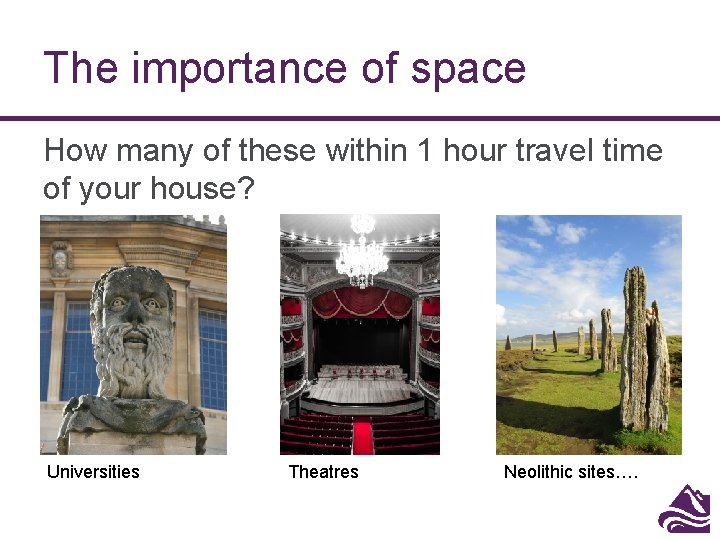
The importance of space How many of these within 1 hour travel time of your house? Universities Theatres Neolithic sites….
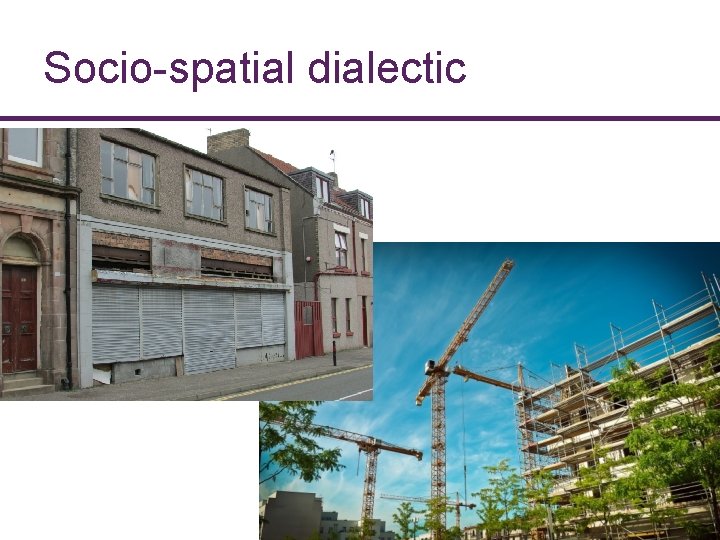
Socio-spatial dialectic
Spatial Justice Spatial justice as such is not a substitute or alternative to social, economic, or other forms of justice but rather a way of looking at justice from a critical spatial perspective. From this viewpoint, there is always a relevant spatial dimension to justice while at the same time all geographies have expressions of justice and injustice built into them. (Soja, 2009, p. 2)
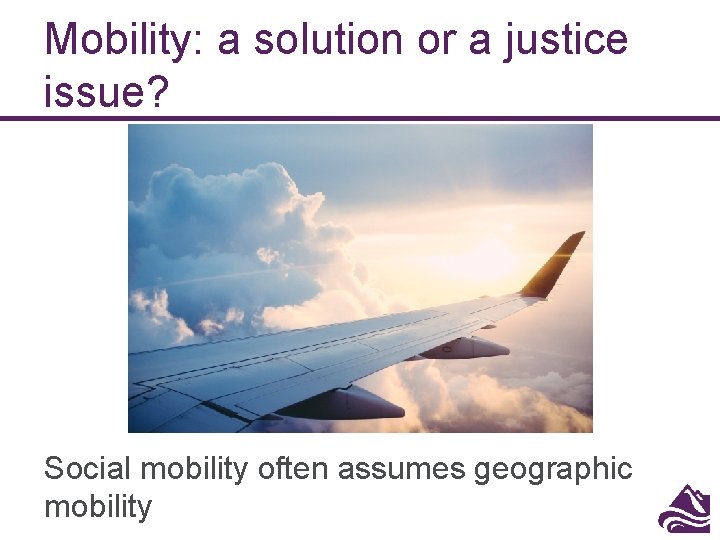
Mobility: a solution or a justice issue? Social mobility often assumes geographic mobility
IMPLICATIONS FOR OUR WORK
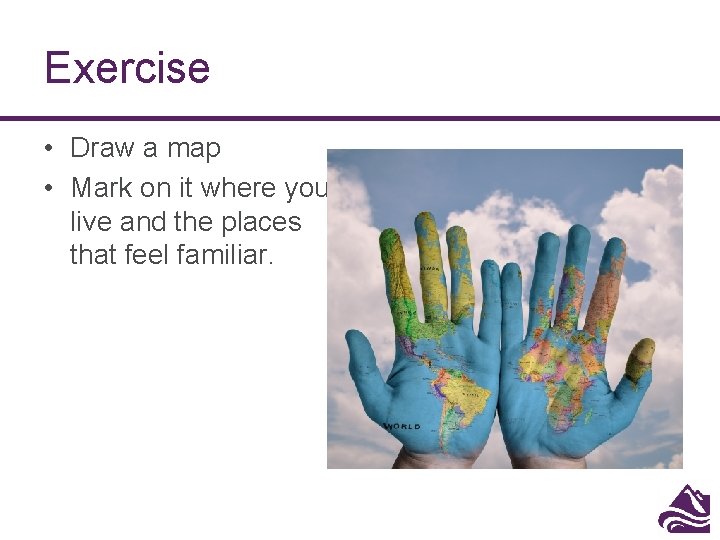
Exercise • Draw a map • Mark on it where you live and the places that feel familiar.
Exercise 1 cont. Work with a partner – look at each others’ maps • What do you notice compared to your partner? • How would it feel to move to a place which is ‘familiar’? How would it feel to move to a place which is ‘unfamiliar’? • With the places that are ‘familiar’ – why are they familiar to you? • What impact might your immediate space and your ‘familiar’ spaces have on your choices? • How have your experiences of space changed through time?
Uneven experiences of space • People have different accessibility to different places and opportunities • It is easier to move to or engage with opportunities in ‘familiar’ places • People have different experiences of mobility shaped by a range of factors: – – Physical Economic Social Biographical
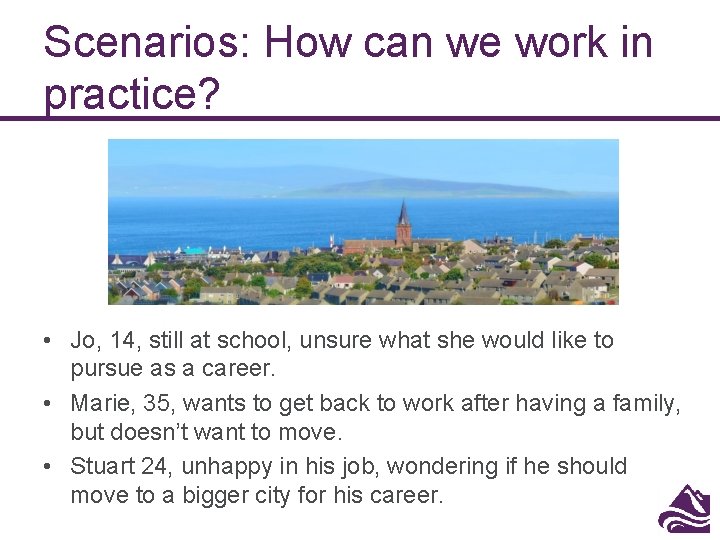
Scenarios: How can we work in practice? • Jo, 14, still at school, unsure what she would like to pursue as a career. • Marie, 35, wants to get back to work after having a family, but doesn’t want to move. • Stuart 24, unhappy in his job, wondering if he should move to a bigger city for his career.
Practical approaches • Raise awareness of geography – Where do you see yourself in the future? • Identify and address barriers – What can you access locally? – Where might you move to? How can you move? • Question what is ‘normal’ – What appeals to you about staying / leaving?
More radical approaches? • Group exercises and careers education • Advocacy on behalf of clients for mobility resources or geographical inclusivity • Changing the models / the narrative we work with.
Further reading • Alexander, R. (2018). Social Justice and Geographical Location in Career Guidance. In Hooley, Sultana, & Thomsen, Career Guidance for Social Justice: Contesting Neoliberalism (pp. 77– 91). New York London: Routledge/Taylor & Francis Group. • Soja, E. W. (2010). Seeking spatial justice. Minneapolis: University of Minnesota Press.