
Social Interactions in Belugas Delphinapterus leucas Stephanie Leson
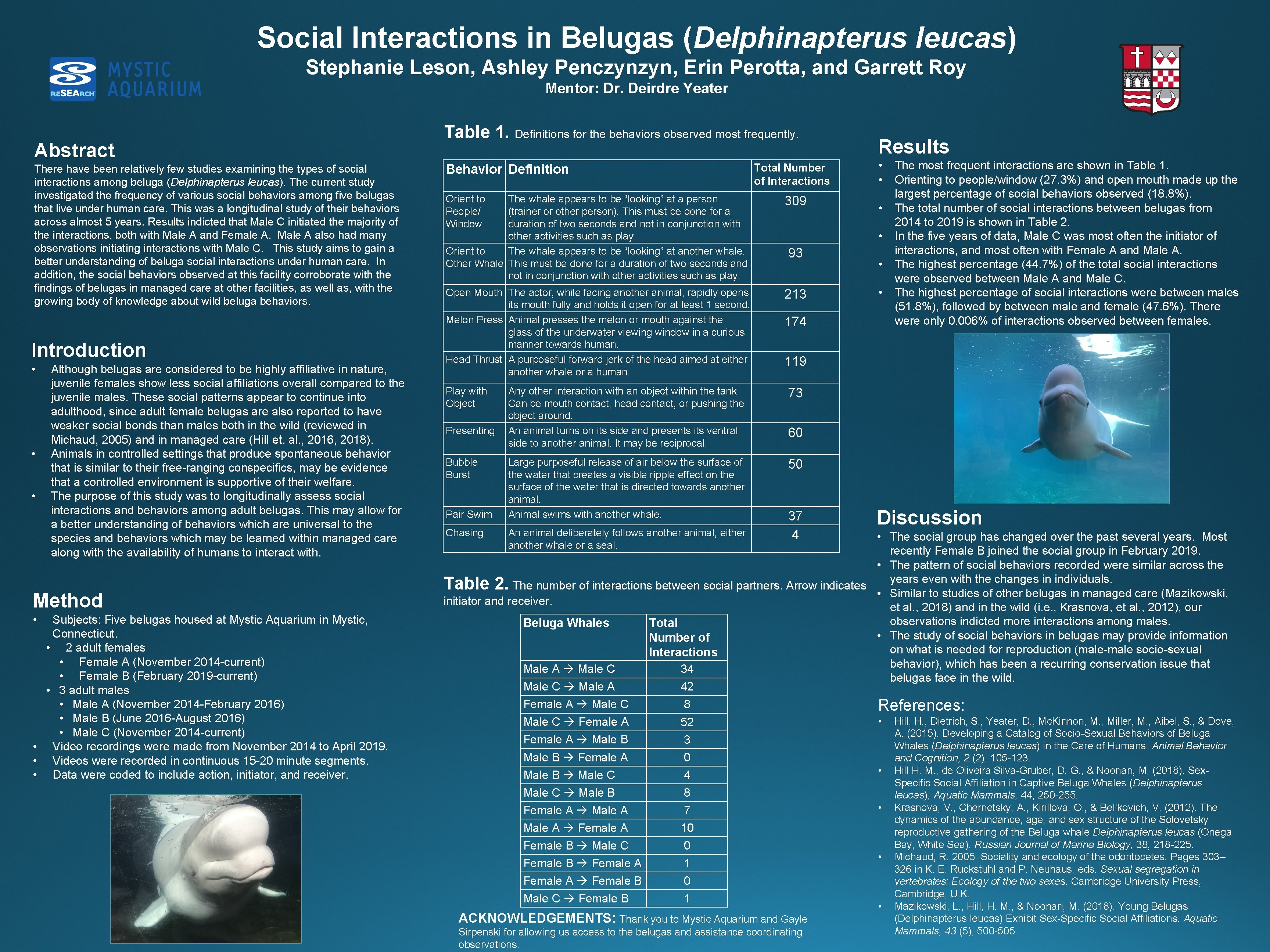
Social Interactions in Belugas (Delphinapterus leucas) Stephanie Leson, Ashley Penczynzyn, Erin Perotta, and Garrett Roy Mentor: Dr. Deirdre Yeater Abstract There have been relatively few studies examining the types of social interactions among beluga (Delphinapterus leucas). The current study investigated the frequency of various social behaviors among five belugas that live under human care. This was a longitudinal study of their behaviors across almost 5 years. Results indicted that Male C initiated the majority of the interactions, both with Male A and Female A. Male A also had many observations initiating interactions with Male C. This study aims to gain a better understanding of beluga social interactions under human care. In addition, the social behaviors observed at this facility corroborate with the findings of belugas in managed care at other facilities, as well as, with the growing body of knowledge about wild beluga behaviors. Introduction • • • Although belugas are considered to be highly affiliative in nature, juvenile females show less social affiliations overall compared to the juvenile males. These social patterns appear to continue into adulthood, since adult female belugas are also reported to have weaker social bonds than males both in the wild (reviewed in Michaud, 2005) and in managed care (Hill et. al. , 2016, 2018). Animals in controlled settings that produce spontaneous behavior that is similar to their free-ranging conspecifics, may be evidence that a controlled environment is supportive of their welfare. The purpose of this study was to longitudinally assess social interactions and behaviors among adult belugas. This may allow for a better understanding of behaviors which are universal to the species and behaviors which may be learned within managed care along with the availability of humans to interact with. Method • Subjects: Five belugas housed at Mystic Aquarium in Mystic, Connecticut. • 2 adult females • Female A (November 2014 -current) • Female B (February 2019 -current) • 3 adult males • Male A (November 2014 -February 2016) • Male B (June 2016 -August 2016) • Male C (November 2014 -current) • Video recordings were made from November 2014 to April 2019. • Videos were recorded in continuous 15 -20 minute segments. • Data were coded to include action, initiator, and receiver. Table 1. Definitions for the behaviors observed most frequently. Behavior Definition Orient to People/ Window Total Number of Interactions The whale appears to be “looking” at a person (trainer or other person). This must be done for a duration of two seconds and not in conjunction with other activities such as play. Orient to The whale appears to be “looking” at another whale. Other Whale This must be done for a duration of two seconds and not in conjunction with other activities such as play. 309 Open Mouth The actor, while facing another animal, rapidly opens its mouth fully and holds it open for at least 1 second. Melon Press Animal presses the melon or mouth against the glass of the underwater viewing window in a curious manner towards human. Head Thrust A purposeful forward jerk of the head aimed at either another whale or a human. 213 Play with Object Presenting Bubble Burst Pair Swim Chasing • • 93 • • 174 The most frequent interactions are shown in Table 1. Orienting to people/window (27. 3%) and open mouth made up the largest percentage of social behaviors observed (18. 8%). The total number of social interactions between belugas from 2014 to 2019 is shown in Table 2. In the five years of data, Male C was most often the initiator of interactions, and most often with Female A and Male A. The highest percentage (44. 7%) of the total social interactions were observed between Male A and Male C. The highest percentage of social interactions were between males (51. 8%), followed by between male and female (47. 6%). There were only 0. 006% of interactions observed between females. 119 Any other interaction with an object within the tank. Can be mouth contact, head contact, or pushing the object around. An animal turns on its side and presents its ventral side to another animal. It may be reciprocal. 73 Large purposeful release of air below the surface of the water that creates a visible ripple effect on the surface of the water that is directed towards another animal. Animal swims with another whale. 50 An animal deliberately follows another animal, either another whale or a seal. Results 60 37 4 Discussion • The social group has changed over the past several years. Most recently Female B joined the social group in February 2019. • The pattern of social behaviors recorded were similar across the years even with the changes in individuals. Table 2. The number of interactions between social partners. Arrow indicates • Similar to studies of other belugas in managed care (Mazikowski, initiator and receiver. et al. , 2018) and in the wild (i. e. , Krasnova, et al. , 2012), our observations indicted more interactions among males. Beluga Whales Total • The study of social behaviors in belugas may provide information Number of on what is needed for reproduction (male-male socio-sexual Interactions behavior), which has been a recurring conservation issue that Male A Male C 34 belugas face in the wild. Male C Male A 42 Female A Male C 8 References: • Hill, H. , Dietrich, S. , Yeater, D. , Mc. Kinnon, M. , Miller, M. , Aibel, S. , & Dove, Male C Female A 52 A. (2015). Developing a Catalog of Socio-Sexual Behaviors of Beluga Female A Male B 3 Whales (Delphinapterus leucas) in the Care of Humans. Animal Behavior Male B Female A 0 and Cognition, 2 (2), 105 -123. • Hill H. M. , de Oliveira Silva-Gruber, D. G. , & Noonan, M. (2018). Sex. Male B Male C 4 Specific Social Affiliation in Captive Beluga Whales (Delphinapterus Male C Male B 8 leucas), Aquatic Mammals, 44, 250 -255. • Krasnova, V. , Chernetsky, A. , Kirillova, O. , & Bel’kovich, V. (2012). The Female A Male A 7 dynamics of the abundance, age, and sex structure of the Solovetsky Male A Female A 10 reproductive gathering of the Beluga whale Delphinapterus leucas (Onega Bay, White Sea). Russian Journal of Marine Biology, 38, 218 -225. Female B Male C 0 • Michaud, R. 2005. Sociality and ecology of the odontocetes. Pages 303– Female B Female A 1 326 in K. E. Ruckstuhl and P. Neuhaus, eds. Sexual segregation in Female A Female B 0 vertebrates: Ecology of the two sexes. Cambridge University Press, Cambridge, U. K. Male C Female B 1 ACKNOWLEDGEMENTS: Thank you to Mystic Aquarium and Gayle Sirpenski for allowing us access to the belugas and assistance coordinating observations. • Mazikowski, L. , Hill, H. M. , & Noonan, M. (2018). Young Belugas (Delphinapterus leucas) Exhibit Sex-Specific Social Affiliations. Aquatic Mammals, 43 (5), 500 -505.
- Slides: 1