
SOCIAL INSTITUTIONS The concept of institution is one

- Slides: 5
SOCIAL INSTITUTIONS The concept of institution is one of the most important in the entire field of Sociology. In fact, Durkheim has gone to the extent of defining sociology as the science of social institutions. Definition: The social structure and machinery through which human society organises, directs and executes the multifarious activities required to satisfy human needs. Examples: Kinship, Marriage, Family etc.
CHARACTERISTICS OF SOCIAL INSTITUTIONS The main characteristics of social institutions are as follows: – Universality –They exist in all the societies and all the stages of social development. Basic institutions like marriage, family etc. – Social by nature - Institutions come into being due to collective activities of the people. – Standardised norms -These are prescribed ways of doing things. – Means to satisfy needs - They cater to the satisfaction of some basic and vital needs of man. – Controlling mechanism - Institutions like religion, morality, state law etc. , control the behaviour of man. – Relatively permanent - Changes take place slowly and gradually in them. – Oral and written tradition - Institutions may persist as oral or written traditions.
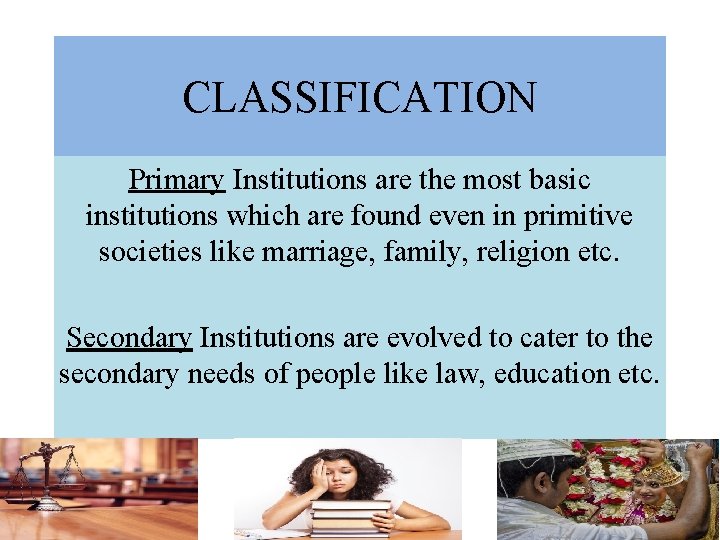
CLASSIFICATION Primary Institutions are the most basic institutions which are found even in primitive societies like marriage, family, religion etc. Secondary Institutions are evolved to cater to the secondary needs of people like law, education etc.
FUNCTIONS OF SOCIAL INSTITUTIONS Institution has great functional importance. The main functions are as follows: • Institutions cater to the satisfaction of needs: – The need for self perpetuation – Perpetuation – Self expression • Institutions control human behavior: Organize and regulate social behavior.
FUNCTIONS OF SOCIAL INSTITUTIONS • Simplify actions for the individual: Institution prescribes a particular behavior to avoid confusion and uncertainties. • Assigns roles and status to the individual: Institution like marriage, family, education provide some social standing for the individual concerned. • Contributes to unity and uniformity: Regulates the relation between individuals.