
Social Informatics guided Social Intelligence Management and its

- Slides: 12
Social Informatics guided Social Intelligence Management and its Analysis in the Asia-Pacific Contexts Shastri L Nimmagadda School of Management (BIS) Curtin University (CBS) Perth, WA, Australia shastri. nimmagadda@curtin. edu. au Torsten Reiners School of Management Curtin Business School Curtin University, Perth, WA, Australia T. Reiners@curtin. edu. au Neel Mani Amity Institute of IT Amity University, Noida, India nmani@amity. com Christine Namugenyi School of IT, Monash Campus Johannesburg, South Africa cnam 0001@student. monash. edu
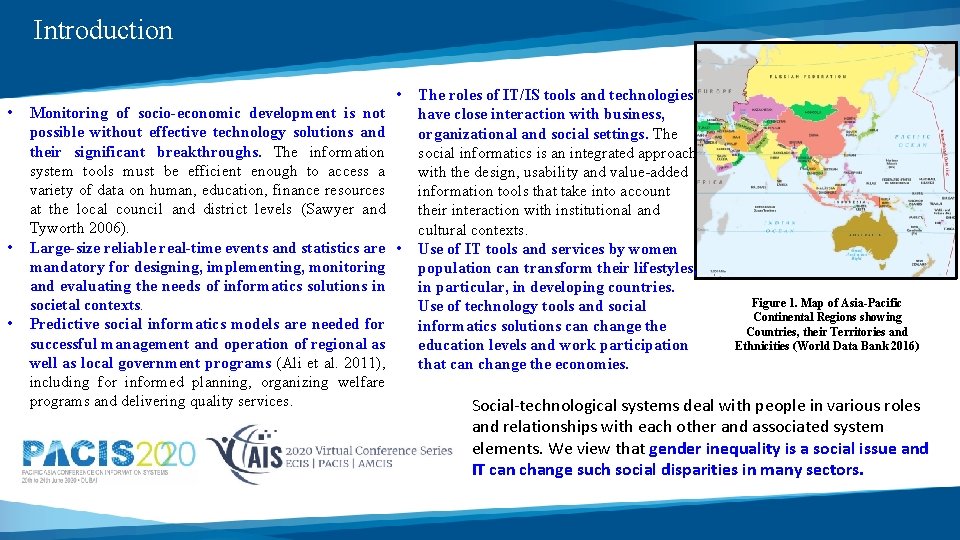
Introduction • • Monitoring of socio-economic development is not possible without effective technology solutions and their significant breakthroughs. The information system tools must be efficient enough to access a variety of data on human, education, finance resources at the local council and district levels (Sawyer and Tyworth 2006). Large-size reliable real-time events and statistics are • mandatory for designing, implementing, monitoring and evaluating the needs of informatics solutions in societal contexts. Predictive social informatics models are needed for successful management and operation of regional as well as local government programs (Ali et al. 2011), including for informed planning, organizing welfare programs and delivering quality services. The roles of IT/IS tools and technologies have close interaction with business, organizational and social settings. The social informatics is an integrated approach with the design, usability and value-added information tools that take into account their interaction with institutional and cultural contexts. Use of IT tools and services by women population can transform their lifestyles, in particular, in developing countries. Use of technology tools and social informatics solutions can change the education levels and work participation that can change the economies. Figure 1. Map of Asia-Pacific Continental Regions showing Countries, their Territories and Ethnicities (World Data Bank 2016) Social-technological systems deal with people in various roles and relationships with each other and associated system elements. We view that gender inequality is a social issue and IT can change such social disparities in many sectors.
Significance and Motivation • In the digital human ecosystem, gender is characterized as a composite supertype entity, differentiating female from the male entity. It attributes to a human being with general behaviour, social interactions, and fundamental rights with a sense of self, all interpreted in various entities and attribute dimensions. In other words, the gender ecosystem is a complex set of relationships among various attribute dimensions and their connectivity. • The socio-economic indicators vary periodically and geographically. For generating knowledge-based social-informatics solutions, we emphasize the significance and interpretation of diverse contexts in digital societal ecosystems. Large volumes of data sources and their varieties existing among various associated digital ecosystems have motivated us to carry out modelling on societal contexts. • In addition, health, education, economics, politics, including work participation are key research areas that attracted the social informatics artefact development and intend to analyze their relationships. • Global Gender Gap Index (GGGI) can measure the relationships and their differences between men and women in business and organization contexts. Technology and women empowerment are other motivations of the current study. Lack of inspiration, role models and associated support information systems have constrained women participation in industries, businesses and organization activities, for which we need to strengthen the IS artefacts that integrate the social informatics architectures.
Social Issues and Technology Challenges • In Asia-Pacific regions, an impediment in its social and economic development is partly because of lack of socialinformatics infrastructure. The socio-economic development indicators vary among different countries depending on socio-economic status including technology adaptations and practices, new innovative economies, respecting gender equality and cultural beliefs. • Due to lack of information and communication technology facilities, the development projects are held up in many countries. We further examine how to create new pathways, and access to existing technology solutions and innovations by analyzing the resources, cross-cultural issues, education, healthcare and community building entities. • We have either poorly managed education systems, or shortage of innovations at the workplace and defective digital transformations. To support evidence-based policies and monitor the socio-economic development projects, grassroots planning, technology solutions, information resources are taken into consideration in our proposed modelling studies. • Indeed lack of information and communication technology infrastructure and social intelligence on resources can preclude government and business organizations implement their policies. Therefore, we consider various attribute dimensions in a holistic data modelling methodology in the form of an integrated multidimensional warehouse system, an inventory development paradigm in a social-informatics solution.
Theoretical Architecture Development Socio-Economic Indicators – Digital Transformation as Informatics Solution • Information system tools and technologies that can make a change, sure for good in social setting is envisaged as social informatics solution. The data acquisition, processing and interpretation of socio-economic indicators can bring out new knowledge and implement its value in social informatics solutions in various organizational and business scenarios. The digital infrastructure and high percentage of internet users have made possible with high levels of innovation. In addition, prosocio-economic infrastructure, pro-business environment with favourable fiscal and tax regimes can help progress the knowledge-based societies. • Gender equality, female work participation, and innovative education systems are added attributes, making the socialfabrics and motivating the informatics solution development. Service-, knowledge-based economies, social informaticsbased economies can even motivate and improve market competitiveness. Broadband network, high-speed internet services can facilitate countries with pro-business, -innovation and -social informatics environments and enable socio-economic development among geographically dispersed populations. • Besides the focus on technology-driven education and workplace innovation, gender equality, cultural diversities must be realized in prosperous economies. To summarize, social indicators such as mean age, geographic-based population, and poverty status are economic indicators.
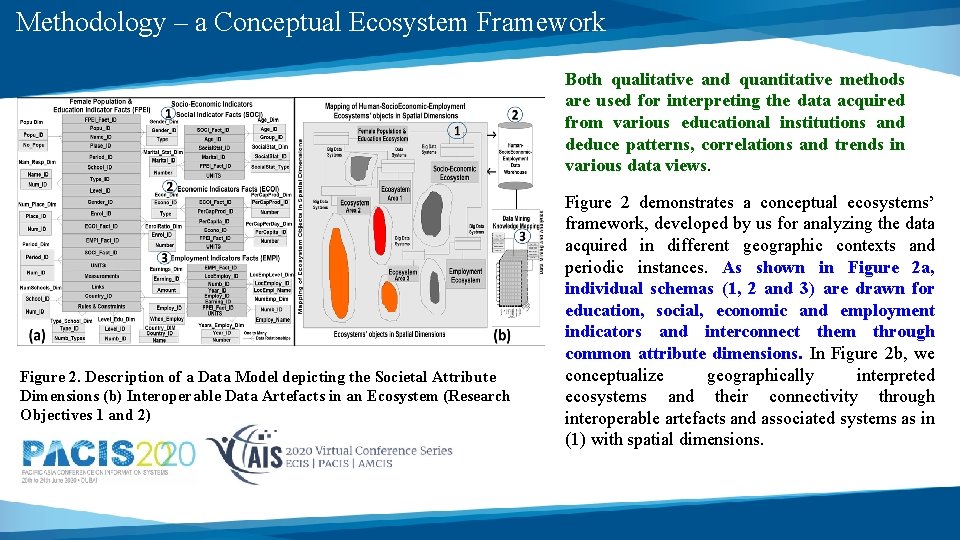
Modelling Social-Data Attribute Dimensions and Facts • • • Management support services, finance and planning, social and demographic characteristics, health services, education and sports, works and technical services, natural resources, community-based services and production and marketing are various attribute dimensions, and their instances are identified. As shown in Figure 2, a construct or data schema is articulated with multiple attribute dimensions and their fact instances in Asia-Pacific contexts. We have followed up the process of organizing and documenting the data in various spatial contexts to explore the informatics solutions in a Human-Socio-Economic-Employment Ecosystem architecture. Several attribute dimensions and facts are interpreted to document, model and integrate gender ecosystems, socioeconomic indicators and employment fact instances. The attribute dimensions analysed in the contexts of social informatics and knowledge obtained in the form of social intelligence are knowledge-based organizational and business perspectives.
Methodology – a Conceptual Ecosystem Framework Both qualitative and quantitative methods are used for interpreting the data acquired from various educational institutions and deduce patterns, correlations and trends in various data views. Figure 2. Description of a Data Model depicting the Societal Attribute Dimensions (b) Interoperable Data Artefacts in an Ecosystem (Research Objectives 1 and 2) Figure 2 demonstrates a conceptual ecosystems’ framework, developed by us for analyzing the data acquired in different geographic contexts and periodic instances. As shown in Figure 2 a, individual schemas (1, 2 and 3) are drawn for education, social, economic and employment indicators and interconnect them through common attribute dimensions. In Figure 2 b, we conceptualize geographically interpreted ecosystems and their connectivity through interoperable artefacts and associated systems as in (1) with spatial dimensions.
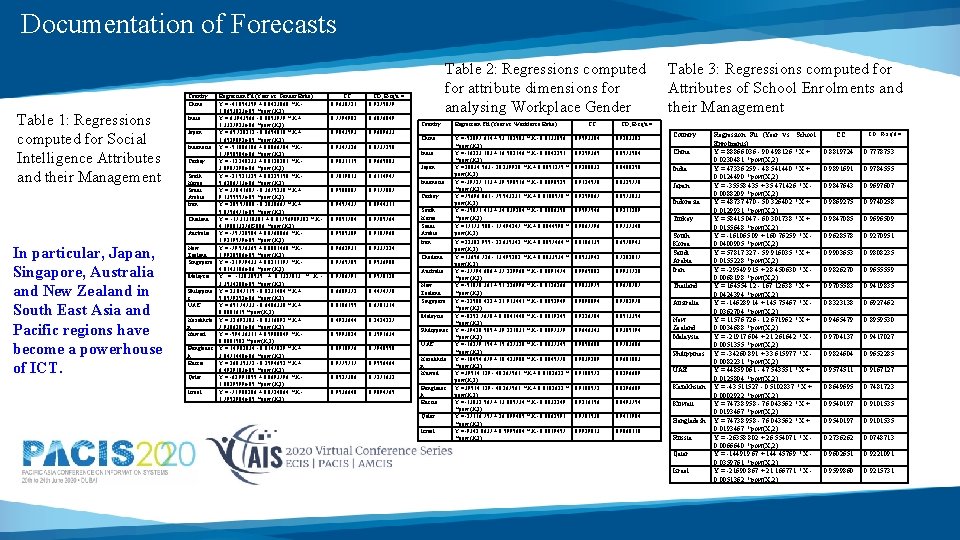
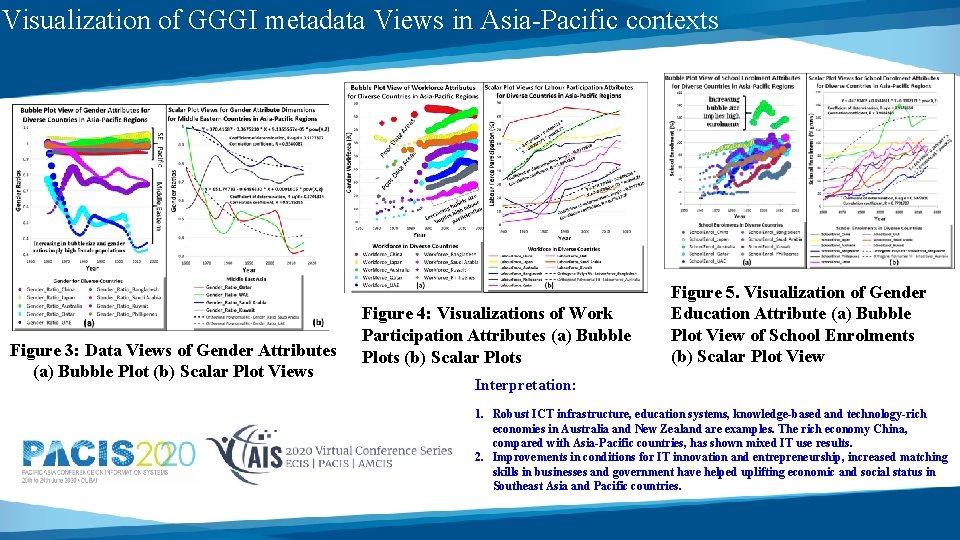
Contribution and Limitations • The data views are analysed for knowledge discovery, evaluating the veracity of data relationships from GGGI metadata. Polynomial regression provides the best approximation of the relationship between the dependent and independent attribute variables. Polynomials essentially fit a wide range of curvature with a broad range of function that can fit with observed events. We have the opportunity of testing regression techniques in societal contexts. • The cubes and cuboid schema views simplify the logical representation of the data with more details within optimized storage spaces. In our analysis, the data relationships among attribute variables are not linear. We visually find scattered observations on the scatter plots, in which case, we interpret curvilinear data relationships. For curvilinear trends, the polynomials are appropriate for fitting with observed data. At places, the data instances fluctuate around the polynomial trend line. • The orthogonal polynomial regression is appropriate and at times necessary for higher-order polynomial fits, if we need to explore the deeper knowledge of gender ecosystems. CC = 0. 8 and CD = 0. 8, are interpreted as benchmarks for favourable attribute dimensions in the societal contexts. As per benchmark instances, we interpret lower gender ratios for countries, India, South Korea, Philippines, UAE, Kazakhstan, Qatar, Kuwait countries. Russia and Kazakhstan have exhibited lesser school enrolments. Iran and Thailand have exhibited poorer female workforce.
Documentation of Forecasts Country China Table 1: Regressions computed for Social Intelligence Attributes and their Management India Japan Indonesia Turkey South Korea Saudi Arabia Iran Thailand Australia In particular, Japan, Singapore, Australia and New Zealand in South East Asia and Pacific regions have become a powerhouse of ICT. New Zealand Singapore Malaysia Philippine s UAE Kazakhsta n Kuwait Banglades h Russia Qatar Israel Regression Fit (Year vs. Gender Ratio) Y = -41. 054359 + 0. 0423068 * X 1. 0653023 e-05 * pow(X, 2) Y = 6. 3943566 - 0. 0053979 * X + 1. 3327923 e-06 * pow(X, 2) Y = 65. 720212 - 0. 0654010 * X + 1. 6529092 e-05 * pow(X, 2) Y = -5. 1806186 + 0. 0066784 * X 1. 7958584 e-06 * pow(X, 2) Y = -12. 248233 + 0. 0128201 * X 3. 0907290 e-06 * pow(X, 2) Y = -21. 521325 + 0. 0225158 * X 5. 6286713 e-06 * pow(X, 2) Y = 370. 41687 - 0. 3675230 * X + 9. 1355557 e-05 * pow(X, 2) Y = 205. 57808 - 0. 2038667 * X + 5. 0756471 e-05 * pow(X, 2) Y = -17. 31310301 + 0. 01756989382 * X 4. 198813276 E-006 * pow(X, 2) Y = -75. 728504 + 0. 0768066 * X 1. 9219579 e-05 * pow(X, 2) Y = -79. 576365 + 0. 0801460 * X 1. 9920506 e-05 * pow(X, 2) Y = -21. 979433 + 0. 0211197 * X 4. 8143186 e-06 * pow(X, 2) Y = -130. 30535 + 0. 1327013 * X 3. 3534208 e-05 * pow(X, 2) Y = 23. 847115 - 0. 0231484 * X + 5. 8579252 e-06 * pow(X, 2) Y = 651. 74733 - 0. 6486330 * X + 0. 0001615 * pow(X, 2) Y = 32. 692303 - 0. 0316892 * X + 7. 9386201 e-06 * pow(X, 2) Y = -594. 36311 + 0. 5980049 * X 0. 0001502 * pow(X, 2) Y = 14. 982834 - 0. 0147029 * X + 3. 8471440 e-06 * pow(X, 2) Y = 260. 35372 - 0. 2594652 * X + 6. 4929183 e-05 * pow(X, 2) Y = -62. 991055 + 0. 0693796 * X 1. 8829599 e-05 * pow(X, 2) Y = -71. 980206 + 0. 0724064 * X 1. 7952984 e-05 * pow(X, 2) CC 0. 9630721 CD, R-sq'd = 0. 9275079 0. 7794902 0. 6076049 0. 9843593 0. 9689633 0. 9347326 0. 8737250 0. 9831115 0. 9665083 0. 7819813 0. 6114947 0. 9580087 0. 9177807 0. 9457437 0. 8944311 0. 9851784 0. 9705764 0. 9585389 0. 9187968 0. 9662931 0. 9337224 0. 9765705 0. 9536900 0. 9786791 0. 9578128 0. 6689372 0. 4474770 0. 8186155 0. 4923644 0. 6701314 0. 2424227 0. 5993024 0. 3591634 0. 8910976 0. 7940550 0. 9775717 0. 9556464 0. 8527386 0. 7271632 0. 9536648 0. 9094765 Table 2: Regressions computed for attribute dimensions for analysing Workplace Gender Country Regression Fit (Year vs. Workforce Ratio) China Y = -52897. 614 + 53. 102583 * X - 0. 0133056 * pow(X, 2) Y = -16223. 103 + 16. 582146 * X - 0. 0042251 * pow(X, 2) Y = 20034. 563 - 20. 239920 * X + 0. 0051275 * pow(X, 2) Y = -39727. 113 + 39. 598516 * X - 0. 0098525 * pow(X, 2) Y = 75696. 861 - 75. 543231 * X + 0. 0188570 * pow(X, 2) Y = -35071. 413 + 34. 839284 * X - 0. 0086350 * pow(X, 2) Y = 17173. 588 - 17. 494247 * X + 0. 0044590 * pow(X, 2) Y = 22302. 955 - 22. 635342 * X + 0. 0057464 * pow(X, 2) Y = 13656. 726 - 13. 495282 * X + 0. 0033534 * pow(X, 2) Y = -37794. 606 + 37. 229960 * X - 0. 0091474 * pow(X, 2) Y = -51870. 361 + 51. 226996 * X - 0. 0126266 * pow(X, 2) Y = -22580. 422 + 21. 913441 * X - 0. 0052949 * pow(X, 2) Y = -8252. 7678 + 8. 0041440 * X - 0. 0019245 * pow(X, 2) Y = -39428. 505 + 39. 221031 * X - 0. 0097379 * pow(X, 2) Y = -16279. 154 + 15. 627320 * X - 0. 0037345 * pow(X, 2) Y = -18454. 679 + 18. 423908 * X - 0. 0045770 * pow(X, 2) Y = 39514. 129 - 40. 267561 * X + 0. 0102622 * pow(X, 2) Y = -13032. 567 + 13. 005734 * X - 0. 0032249 * pow(X, 2) Y = -27116. 757 + 26. 099485 * X - 0. 0062591 * pow(X, 2) Y = -9342. 0637 + 8. 5995684 * X - 0. 0019457 * pow(X, 2) India Japan Indonesia Turkey South Korea Saudi Arabia Iran Thailand Australia New Zealand Singapore Malaysia Philippines UAE Kazakhsta n Kuwait Banglades h Russia Qatar Israel CC Table 3: Regressions computed for Attributes of School Enrolments and their Management CD, R-sq'd = 0. 9593384 0. 9203302 Country 0. 9259365 0. 8573584 China 0. 9208832 0. 8480258 India 0. 9124570 0. 8325778 0. 9259067 0. 8573033 0. 9597546 0. 9211289 0. 9867796 0. 9737340 0. 8106135 0. 6570943 0. 8533942 0. 7282817 0. 9965802 0. 9931720 South Korea Saudi Arabia Iran 0. 9833975 0. 9670707 Thailand 0. 9890894 0. 9782978 Australia 0. 9226784 0. 8513354 0. 9646343 0. 9305194 0. 9850688 0. 9703606 0. 9839209 0. 9681003 0. 9108572 0. 8296609 UAE 0. 9108572 0. 8296609 Kazakhstan 0. 9216156 0. 8493754 Kuwait 0. 9701538 0. 9411984 0. 9929813 0. 9860118 Japan Indonesia Turkey New Zealand Malaysia Philippines Bangladesh Russia Qatar Israel Regression Fit (Year vs. School Enrolments) Y = 88866. 036 - 90. 498126 * X + 0. 0230481 * pow(X, 2) Y = 47336. 259 - 48. 541440 * X + 0. 0124490 * pow(X, 2) Y = -35558. 435 + 35. 471426 * X 0. 0088209 * pow(X, 2) Y = 48737. 470 - 50. 326402 * X + 0. 0129931 * pow(X, 2) Y = 58415. 047 - 60. 301738 * X + 0. 0155648 * pow(X, 2) Y = -161065. 09 + 160. 76259 * X 0. 0400905 * pow(X, 2) Y = 57817. 327 - 59. 916035 * X + 0. 0155228 * pow(X, 2) Y = -29549. 915 + 28. 450630 * X 0. 0068198 * pow(X, 2) Y = 164554. 12 - 167. 12638 * X + 0. 0424394 * pow(X, 2) Y = -146289. 14 + 145. 75467 * X 0. 0362704 * pow(X, 2) Y = 11576. 726 - 12. 671962 * X + 0. 0034688 * pow(X, 2) Y = -21917. 604 + 21. 261642 * X 0. 0051355 * pow(X, 2) Y = -34260. 891 + 33. 615977 * X 0. 0082231 * pow(X, 2) Y = 44859. 061 - 47. 543551 * X + 0. 0125804 * pow(X, 2) Y = -43. 511527 - 0. 5102837 * X + 0. 0002922 * pow(X, 2) Y = 74738. 958 - 76. 043562 * X + 0. 0193467 * pow(X, 2) Y = -26358. 802 + 26. 554071 * X 0. 0066640 * pow(X, 2) Y = -144919. 67 + 144. 45769 * X 0. 0359761 * pow(X, 2) Y = -21690. 867 + 21. 166771 * X 0. 0051362 * pow(X, 2) CC CD, R-sq'd = 0. 8819724 0. 7778753 0. 9891691 0. 9784555 0. 9847643 0. 9697607 0. 9869275 0. 9740258 0. 9847085 0. 9696509 0. 9628578 0. 9270951 0. 9903653 0. 9808235 0. 9826270 0. 9655559 0. 9705583 0. 9419835 0. 8323138 0. 6927462 0. 9465479 0. 8959530 0. 9704137 0. 9417027 0. 9824604 0. 9652285 0. 9574511 0. 9167127 0. 8649695 0. 7481723 0. 9540197 0. 9101535 0. 2736262 0. 0748713 0. 9602651 0. 9221091 0. 9599860 0. 9215731
Visualization of GGGI metadata Views in Asia-Pacific contexts Figure 3: Data Views of Gender Attributes (a) Bubble Plot (b) Scalar Plot Views Figure 4: Visualizations of Work Participation Attributes (a) Bubble Plots (b) Scalar Plots Figure 5. Visualization of Gender Education Attribute (a) Bubble Plot View of School Enrolments (b) Scalar Plot View Interpretation: 1. Robust ICT infrastructure, education systems, knowledge-based and technology-rich economies in Australia and New Zealand are examples. The rich economy China, compared with Asia-Pacific countries, has shown mixed IT use results. 2. Improvements in conditions for IT innovation and entrepreneurship, increased matching skills in businesses and government have helped uplifting economic and social status in Southeast Asia and Pacific countries.
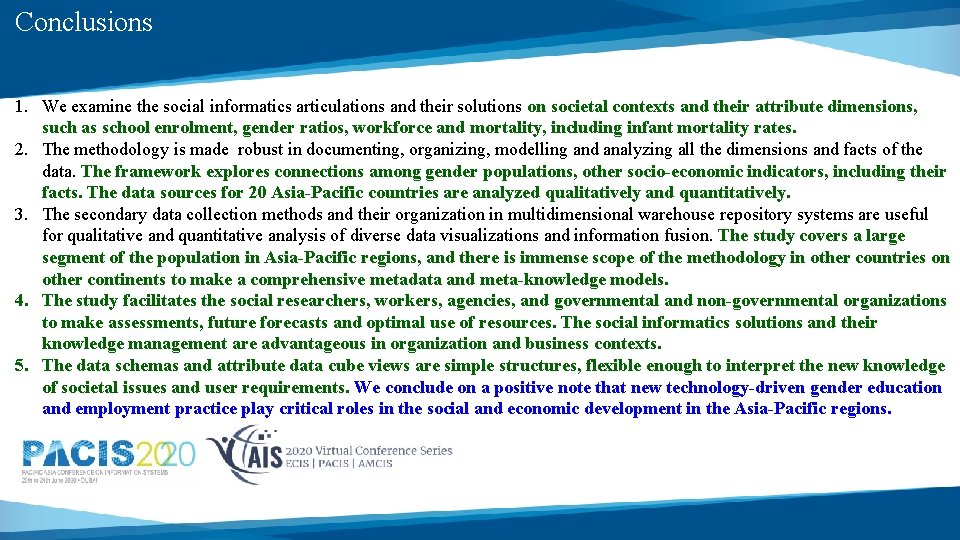
Conclusions 1. We examine the social informatics articulations and their solutions on societal contexts and their attribute dimensions, such as school enrolment, gender ratios, workforce and mortality, including infant mortality rates. 2. The methodology is made robust in documenting, organizing, modelling and analyzing all the dimensions and facts of the data. The framework explores connections among gender populations, other socio-economic indicators, including their facts. The data sources for 20 Asia-Pacific countries are analyzed qualitatively and quantitatively. 3. The secondary data collection methods and their organization in multidimensional warehouse repository systems are useful for qualitative and quantitative analysis of diverse data visualizations and information fusion. The study covers a large segment of the population in Asia-Pacific regions, and there is immense scope of the methodology in other countries on other continents to make a comprehensive metadata and meta-knowledge models. 4. The study facilitates the social researchers, workers, agencies, and governmental and non-governmental organizations to make assessments, future forecasts and optimal use of resources. The social informatics solutions and their knowledge management are advantageous in organization and business contexts. 5. The data schemas and attribute data cube views are simple structures, flexible enough to interpret the new knowledge of societal issues and user requirements. We conclude on a positive note that new technology-driven gender education and employment practice play critical roles in the social and economic development in the Asia-Pacific regions.