
Social Influence Obedience to authority Findings of Milgrams
Social Influence Obedience to authority
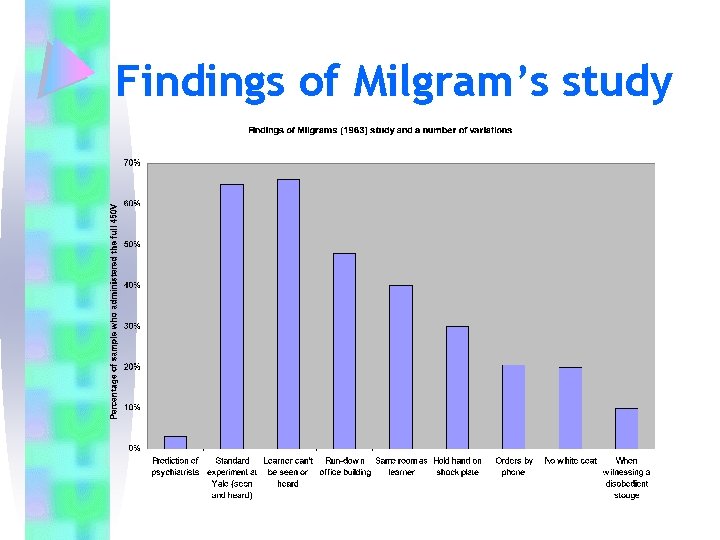
Findings of Milgram’s study
Evaluating Milgram (1963): A question of validity Orne and Holland (1968)
Internal validity The extent to which any change in the DV has been caused by the manipulation of the IV; was the obedience caused by the presence of the experimenter (authority) and their belief in the situation?
Argument 1 • The Pps were not deceived; they worked out that the shocks were not real and this caused them to ‘play along’ with the experimenter • i. e. experimental realism was poor thus lowering internal validity
Evidence against: Pps were taken in by the deception • Rosenhan (1969) replication – 70% said they believed the whole set up. • Turner and Solomon (1962) found that Pps were even willing to receive strong shocks! • Coolican (1996) agrees with Milgram, the film footage shows that Pps were clearly very distressed (driving nails into their skin, one had full blown seizure etc) • Conclusion: Orne and Holland argument about internal validity is fairly weak.
Argument 2: Obedience was caused by demand characteristics • Pps were cued by the experimenter to act in a certain way • May be Pps obeyed because it was an ‘experiment’; this would not have happened in real life. • Evidence to support: Cues such as the white coat were clearly responsible; when it seemed more like a formal experiment obedience was greater
Argument 3: They only obeyed because they were being paid • Payment caused a social contract with experimenter • Obedience was high in a contractual agreement involving money but may not be without this incentive.
External validity • Refers to the extent to which the findings can be generalised to settings outside the immediate context of the experiment, e. g. – Population validity (would results be the same with different age group, gender, etc) – Cultural relativism; do the findings generalise to other cultures – Do they generalise to other more life-like situations, outside the psychologist’s lab? (ecological validity)
Argument 1: Results are generalisable and help explain death camp behaviour (Milgram) • Evidence to support; obedience is higher when there are overt signs of authority/differences in power – Hofling (1966) Yes, obedience was in fact even higher with the nurses in a real hospital setting, 95%. – Bickman (1975) Yes, people would obey trivial orders particularly when person giving orders is dressed in uniform suggesting authority. – Meeus and Raaijmakers (1995) Dutch study 92% obeyed orders to make 15 insulting remarks to a supposed Pp (confederate) in an interview mock up. – Results do generalise across cultures; Smith and Bond (1993) found • 80% willing to give 450 V in Italy, • Austria (85%) • also high in Spain and Germany
- Slides: 10