
Social Influence 1 Discuss the use of two

- Slides: 35
Social Influence 1. Discuss the use of two compliance techniques
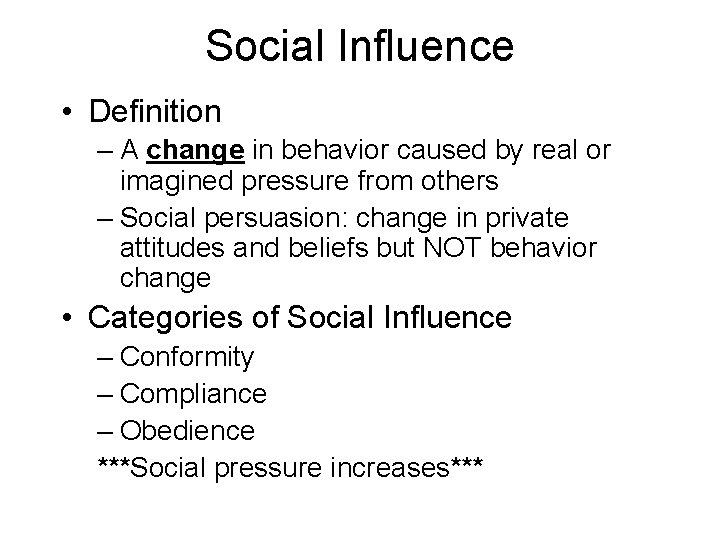
Social Influence • Definition – A change in behavior caused by real or imagined pressure from others – Social persuasion: change in private attitudes and beliefs but NOT behavior change • Categories of Social Influence – Conformity – Compliance – Obedience ***Social pressure increases***
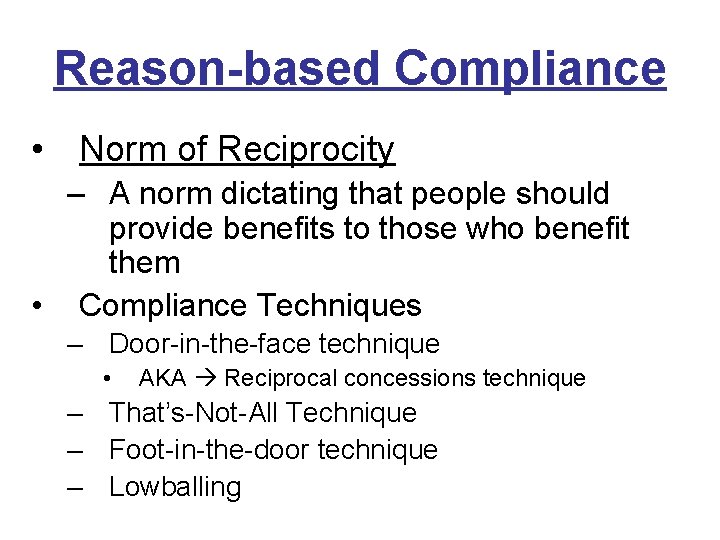
Reason-based Compliance • Norm of Reciprocity – A norm dictating that people should provide benefits to those who benefit them • Compliance Techniques – Door-in-the-face technique • AKA Reciprocal concessions technique – That’s-Not-All Technique – Foot-in-the-door technique – Lowballing
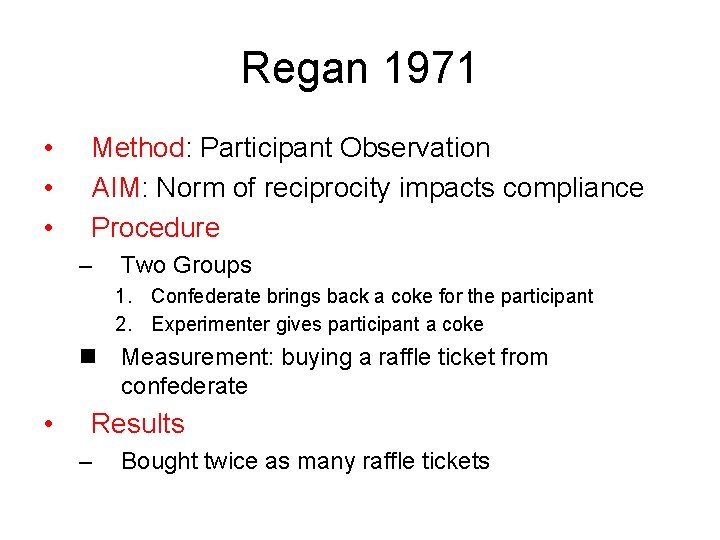
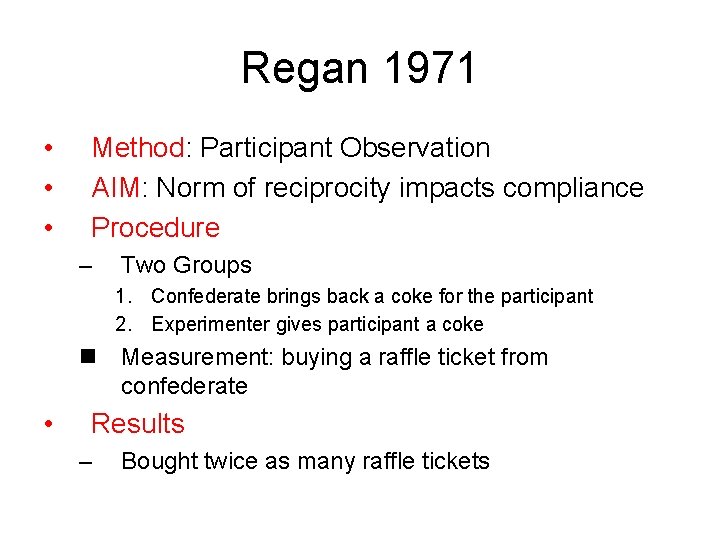
Regan 1971 • • • Method: Participant Observation AIM: Norm of reciprocity impacts compliance Procedure – Two Groups 1. Confederate brings back a coke for the participant 2. Experimenter gives participant a coke n Measurement: buying a raffle ticket from confederate • Results – Bought twice as many raffle tickets
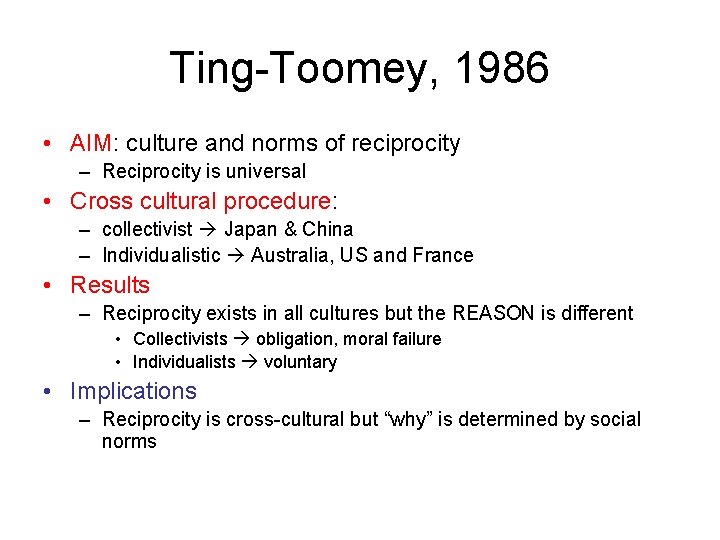
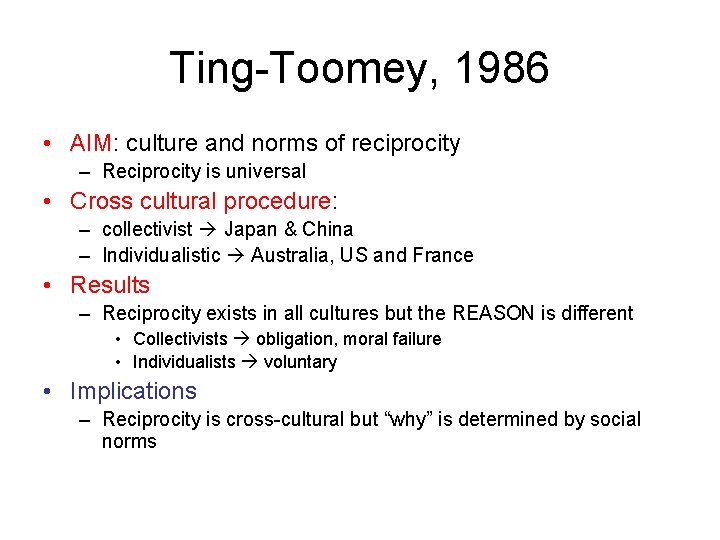
Ting-Toomey, 1986 • AIM: culture and norms of reciprocity – Reciprocity is universal • Cross cultural procedure: – collectivist Japan & China – Individualistic Australia, US and France • Results – Reciprocity exists in all cultures but the REASON is different • Collectivists obligation, moral failure • Individualists voluntary • Implications – Reciprocity is cross-cultural but “why” is determined by social norms
1. Reciprocal Concessions Technique/ Door-in-the-face technique (RCT) • Definition: Ask someone for a LARGE favor and follow-up with a small favor – Small favor seen as a concession • Person may feel compelled to honor
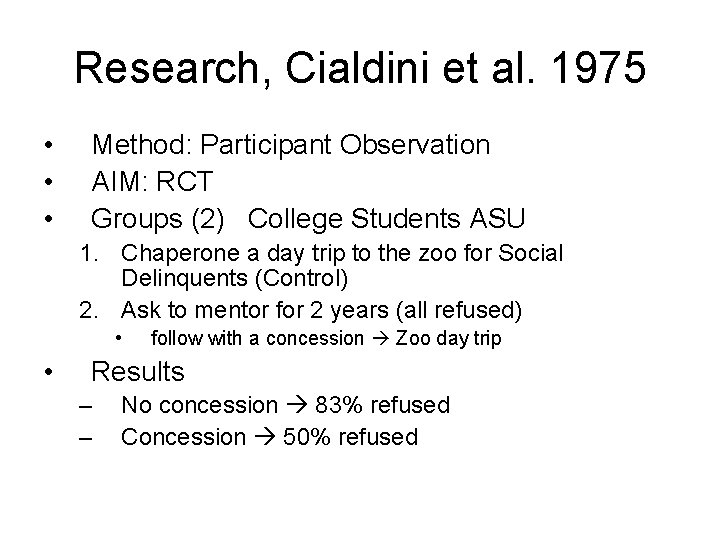
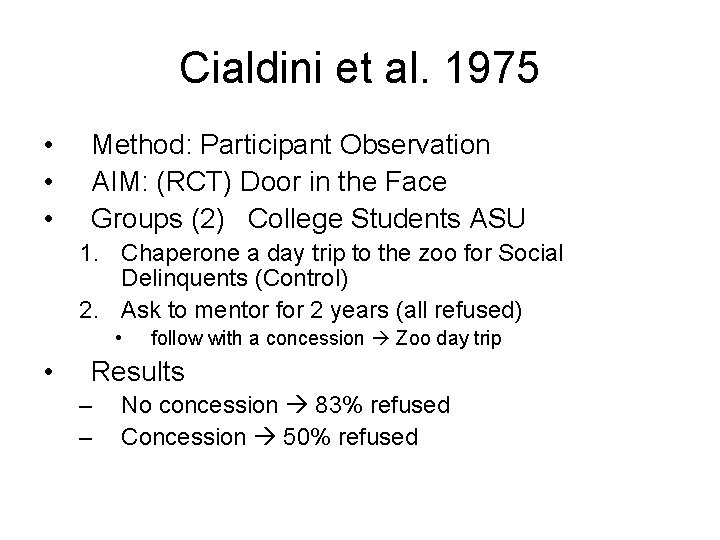
Research, Cialdini et al. 1975 • • • Method: Participant Observation AIM: RCT Groups (2) College Students ASU 1. Chaperone a day trip to the zoo for Social Delinquents (Control) 2. Ask to mentor for 2 years (all refused) • • follow with a concession Zoo day trip Results – – No concession 83% refused Concession 50% refused
2. That’s-Not-All Technique • Definition: – Adding something to an original offer, which is likely to create some pressure to reciprocate • Add-on viewed as a gift • Burger, 1986 – Environment Bake Sale – $0. 75 for a cupcake • Before they walked away, were told it included two medium cookies – Result 40 -73% increase in sales
3. Foot-in-the-Door Technique • Definition for FITD: – Initial small request • Nearly everyone complies – Followed by a larger request involving the real behavior of interest
Lowballing • Similar to FITD: – BUT…changes to a less desirable outcome • Example: – Sign a good car deal and then the salesman changes the terms to make it a worst deal • Why does it work? – Commitment had grown it’s own legs
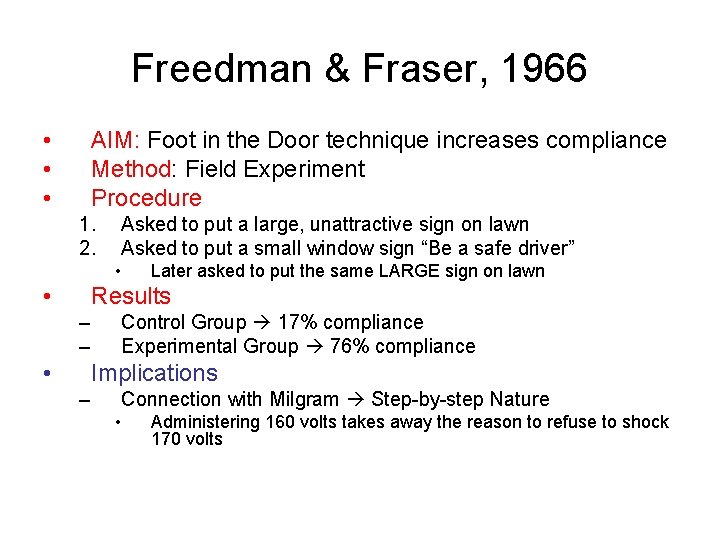
Research, Freedman & Fraser, 1966 • • Method: Field Experiment Procedure 1. Asked to put a large, unattractive sign on lawn 2. Asked to put a small window sign “Be a safe driver” • • Results – – • Later asked to put the same LARGE sign on lawn Control Group 17% compliance Experimental Group 76% compliance Implications – Connection with Milgram Step-by-step Nature • Administering 160 volts takes away the reason to refuse to shock 170 volts
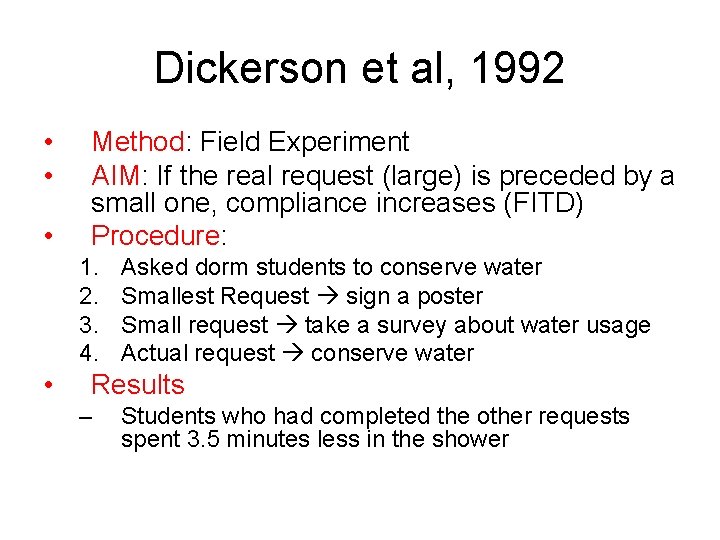
Dickerson et al, 1992 • • • Method: Field Experiment HYPOTHESIS: If the real request (large) is preceded by a small one, compliance increases (FITD) Procedure: 1. 2. 3. 4. • Asked dorm students to conserve water Smallest Request sign a poster Small request take a survey about water usage Actual request conserve water Results – Students who had completed the other requests spent 3. 5 minutes less in the shower
Evaluation of FITD • Is it really about commitment? – People who say “yes” may perceive themselves as being committed • Behave consistently • Need for self-consistency – Works with pro-social requests more – Works if 2 nd request is an extension of 1 st • Most powerful when it relates to self-image – Request needs to connect with what the person cares about • Connect to emotion-based techniques
Create a business plan • Create a business plan for one of the assigned compliance techniques – 2 -3 sentences explaining the plan – Drawing representing the plan
Emotion-Based Approaches 1. Positive Mood – Feeling good makes people more likely to agree to a request 2. Negative Mood – Some bad moods are more likely to increase compliance
1. Positive Mood • Why does it work? 1. Moods color how we interpret events • Request for favors may be viewed as less intrusive and threatening if we are in a good mood 2. “Mood Maintenance” • One way to sustain a good mood is to do something for another person – • Opposite: self-recrimination Research – – Isen, Clark & Schwartz, 1976 Isen and Levin, 1972
Isen and Levin, 1972 • Aim: Positive mood increase compliance • Procedure: – Control: Not given a cookie – Experimental: Given a cookie Variables – Variables • IV: Given a cookie • DV: Rate of compliance to be a confederate (Asked by a different person) – Help the true participant OR hinder the true participant • Results – Cookie increased compliance on the HELP but not the Hinder
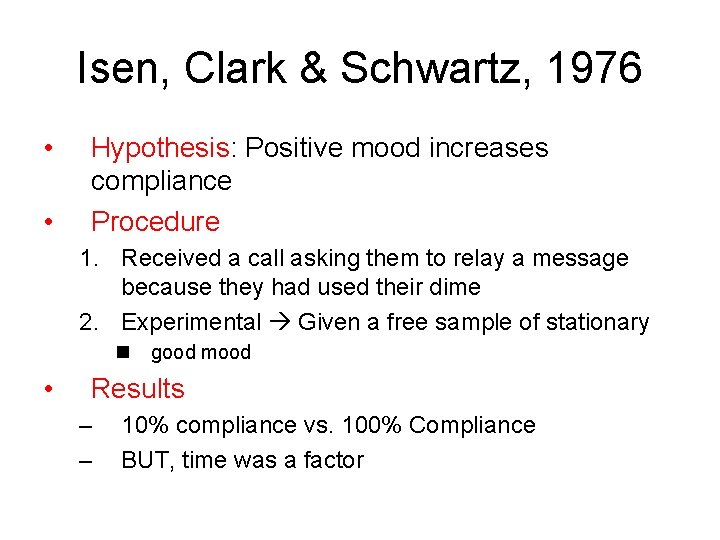
Isen, Clark & Schwartz, 1976 • • Hypothesis: Positive mood increases compliance Procedure 1. Received a call asking them to relay a message because they had used their dime 2. Experimental Given a free sample of stationary n • good mood Results – – 10% compliance vs. 100% Compliance BUT, time was a factor
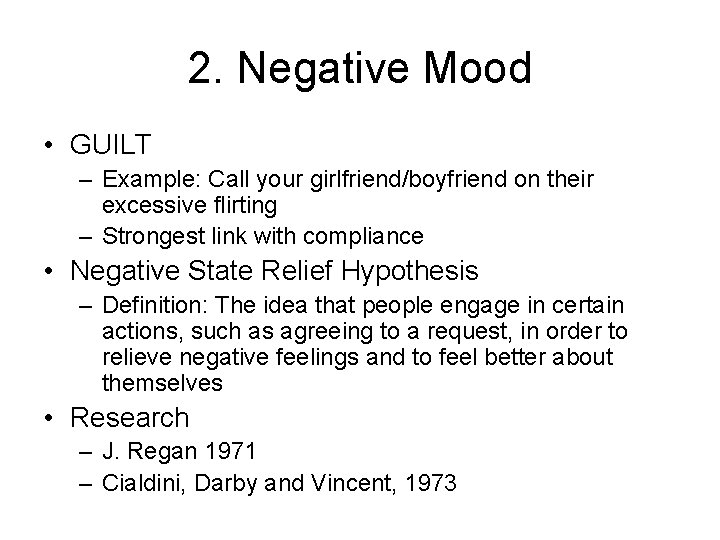
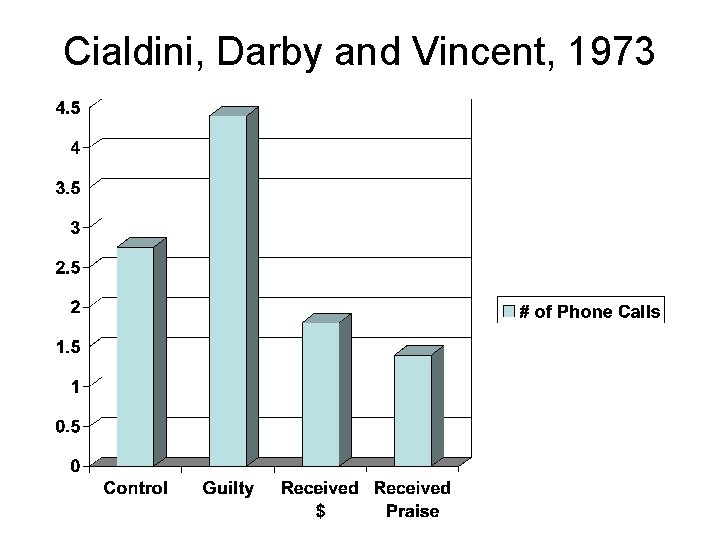
2. Negative Mood • GUILT – Example: Call your girlfriend/boyfriend on their excessive flirting – Strongest link with compliance • Negative State Relief Hypothesis – Definition: The idea that people engage in certain actions, such as agreeing to a request, in order to relieve negative feelings and to feel better about themselves • Research – J. Regan 1971 – Cialdini, Darby and Vincent, 1973
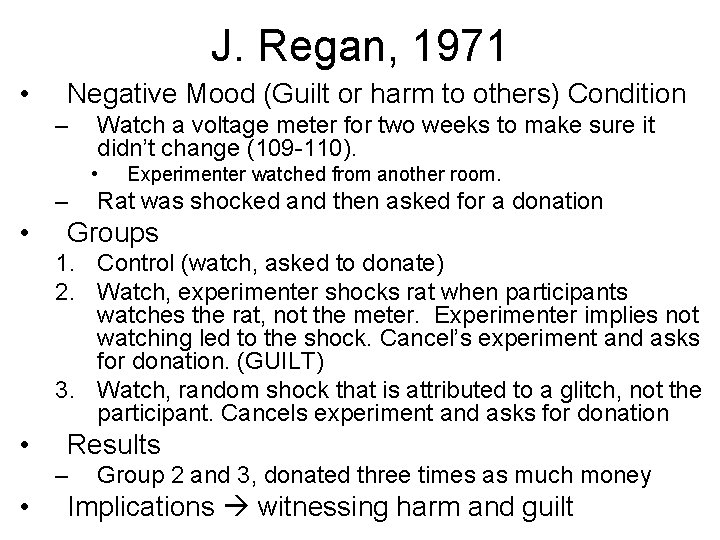
J. Regan, 1971 • Negative Mood (Guilt or harm to others) Condition – Watch a voltage meter for two weeks to make sure it didn’t change (109 -110). • – • Experimenter watched from another room. Rat was shocked and then asked for a donation Groups 1. Control (watch, asked to donate) 2. Watch, experimenter shocks rat when participants watches the rat, not the meter. Experimenter implies not watching led to the shock. Cancel’s experiment and asks for donation. (GUILT) 3. Watch, random shock that is attributed to a glitch, not the participant. Cancels experiment and asks for donation • Results – • Group 2 and 3, donated three times as much money Implications witnessing harm and guilt
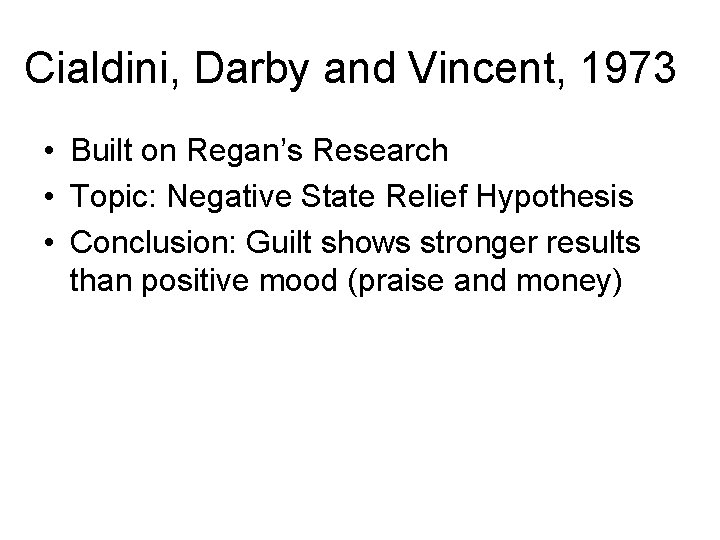
Cialdini, Darby and Vincent, 1973 • Built on Regan’s Research • Topic: Negative State Relief Hypothesis • Conclusion: Guilt shows stronger results than positive mood (praise and money)
Cialdini, Darby and Vincent, 1973
Cross Cultural Research • Morris, Podolny, Ariel, 2001 – Multinational bank…Citibank • Measured employees willingness to comply voluntarily with a request from a coworker for assistance on a task – SURVEY
• United States (market-based) – Reciprocity determined whether the individual would help • China (family based) – Ingroup/outgroup norms. Special emphasis on leaders within their own group • Spain (friendship based) – Loyalty to ones friends, regardless of position or status • Germany (system-based) – Norms and rules determined behavior
“go along to get along” • Three factors effect whether an individual will go with the flow – Approval – Collectivism vs. individualism – rebelliousness
Approval • Strickland & Crowne, 1962 – Step 1 • Personality test to see if the participants had a high need for approval – Step 2 • Put participants in an Asch like test to see if they conform to the group – Result • Higher social approval need, more likely to conform • Individual will even adopt tone of voice and intensity
Positive Aspect of Approval • Could we live in groups without it? • Approval and agreeableness – Warmth, trust and helpfulnees – Do we need these for our society to function?
Collectivism vs. Individualism • Why do some people respond to personal norms rather than personal preference? – Definition of self – Define your self RIGHT NOW!! • Finlay, 1996 – Define yourself in collective or individual terms – Outdoors person vs. Sierra Club Member
Culture and Self • Bond & Smith, 1996 – Cultures differ in the extent to which they are individualistic or collectivistic • Using Asch line-judging test – Collectivistic societies in the East conform to a greater extent than do citizens of the more individualistic West
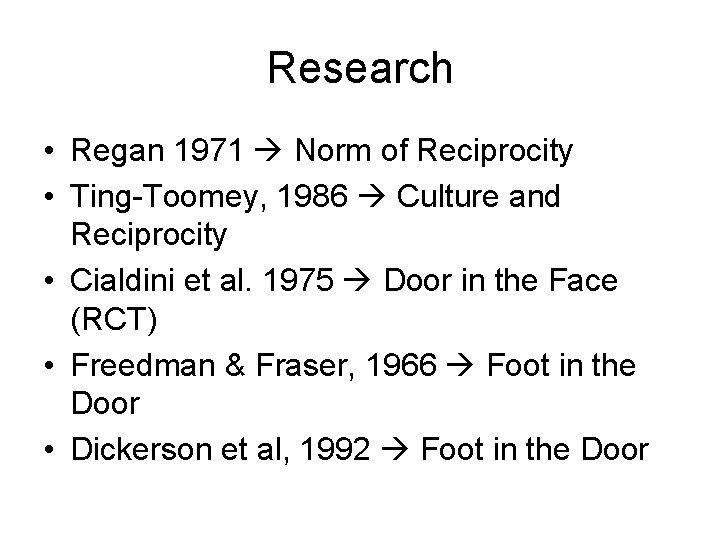
Research • Regan 1971 Norm of Reciprocity • Ting-Toomey, 1986 Culture and Reciprocity • Cialdini et al. 1975 Door in the Face (RCT) • Freedman & Fraser, 1966 Foot in the Door • Dickerson et al, 1992 Foot in the Door
Regan 1971 • • • Method: Participant Observation AIM: Norm of reciprocity impacts compliance Procedure – Two Groups 1. Confederate brings back a coke for the participant 2. Experimenter gives participant a coke n Measurement: buying a raffle ticket from confederate • Results – Bought twice as many raffle tickets
Ting-Toomey, 1986 • AIM: culture and norms of reciprocity – Reciprocity is universal • Cross cultural procedure: – collectivist Japan & China – Individualistic Australia, US and France • Results – Reciprocity exists in all cultures but the REASON is different • Collectivists obligation, moral failure • Individualists voluntary • Implications – Reciprocity is cross-cultural but “why” is determined by social norms
Cialdini et al. 1975 • • • Method: Participant Observation AIM: (RCT) Door in the Face Groups (2) College Students ASU 1. Chaperone a day trip to the zoo for Social Delinquents (Control) 2. Ask to mentor for 2 years (all refused) • • follow with a concession Zoo day trip Results – – No concession 83% refused Concession 50% refused
Freedman & Fraser, 1966 • • • AIM: Foot in the Door technique increases compliance Method: Field Experiment Procedure 1. 2. Asked to put a large, unattractive sign on lawn Asked to put a small window sign “Be a safe driver” • • Later asked to put the same LARGE sign on lawn Results – – • Control Group 17% compliance Experimental Group 76% compliance Implications – Connection with Milgram Step-by-step Nature • Administering 160 volts takes away the reason to refuse to shock 170 volts
Dickerson et al, 1992 • • • Method: Field Experiment AIM: If the real request (large) is preceded by a small one, compliance increases (FITD) Procedure: 1. 2. 3. 4. • Asked dorm students to conserve water Smallest Request sign a poster Small request take a survey about water usage Actual request conserve water Results – Students who had completed the other requests spent 3. 5 minutes less in the shower