
Social inclusion of Roma from segregated communities Best

Social inclusion of Roma from segregated communities Best practices ETP Slovakia – Center for Sustainable Development
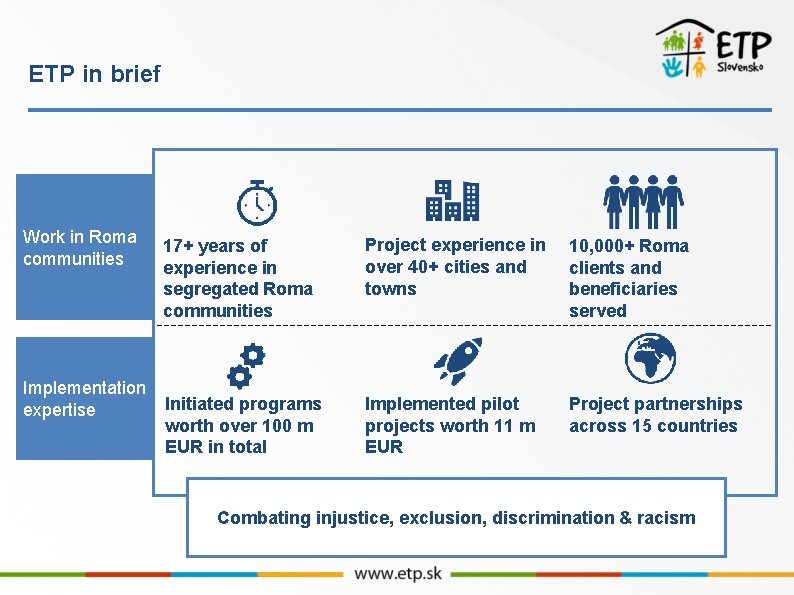
ETP in brief Work in Roma communities Implementation expertise 17+ years of experience in segregated Roma communities Project experience in over 40+ cities and towns 10, 000+ Roma clients and beneficiaries served Initiated programs worth over 100 m EUR in total Implemented pilot projects worth 11 m EUR Project partnerships across 15 countries Combating injustice, exclusion, discrimination & racism
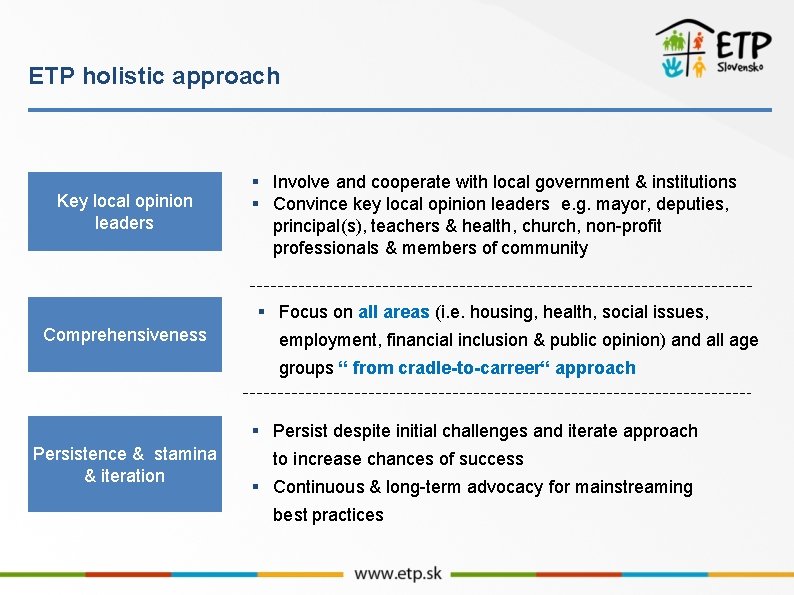
ETP holistic approach Key local opinion leaders § Involve and cooperate with local government & institutions § Convince key local opinion leaders e. g. mayor, deputies, principal(s), teachers & health, church, non-profit professionals & members of community § Focus on all areas (i. e. housing, health, social issues, Comprehensiveness employment, financial inclusion & public opinion) and all age groups “ from cradle-to-carreer“ approach § Persist despite initial challenges and iterate approach Persistence & stamina & iteration to increase chances of success § Continuous & long-term advocacy for mainstreaming best practices
David C. Berliner Growing up in poverty – outside-of-school factors are three to four times more powerful in affecting student achievement than are the inside-the-school factors. . on average, by age 18, children & youth have spent: • about 25% of waking hours in schools • about 75% of waking hours in family & neighborhood. (David C. Berliner: Poverty and Potential, 2009)
Reality of Roma children from ghettos in Slovakia • Usually began schooling without any prior preschool education • Are brought up without appropriate balanced stimuli for development of cognitive skills, nonverbal analytical thinking and command of Slovak language (even their usage of Romani language is poor). • Are raised in different behavioural pattern which is in conflict with optimal social learning and interaction with peers and adults.
„These children have no toys and never received a present. They are full of emotions, but they are unable to articulate them. They don`t dare to dream and to hope for success. They constantly fear that environment won`t accept them, which in fact happens most of the time. “ Mgr. Vladimíra Fortunová, FIE lecturer and afterschool club teacher
The education system in Slovakia 1. Elementary schools in their current form are not well prepared to respond to the needs of children whose personal, social, neurological and cognitive skills are substantially delayed compared to their peers from mainstream society. Average mental age at the start of first grade: 3. 9 years vs 6 years 1 2. Elementary school teachers are not trained or equipped with appropriate tools to teach pupils from ghettos or (socially excluded) segregated communities 2. 1 Páchová et al. Kluby FIE a KK…, 2016, p. 31 ‑ 47 2 Zuzana Réveszová, supervisor of the Criss-Cross method
Challenges faced • • Pupil’s communication skills very poor Pupils don’t understand follow the rules of the class They speak whenever they want, don’t listen when spoken to Use physical power and don’t know how to calm down Are not able to concentrate, lack inner motivation to work Don’t cooperate, don’t share toys or teaching aids Don’t respect diversity of the class and don’t want to make friends Unpatient, distrustful toward the teacher, unable to articulate their needs Before developing cognitive skills, teachers have to focus on socialisation and emotional development. It is necessary to create safe, inspiring and welcoming environment.
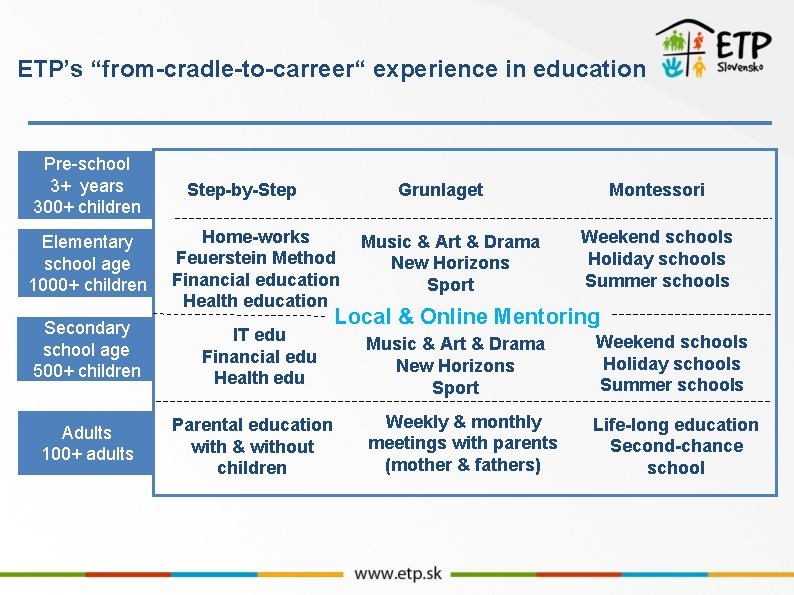
ETP’s “from-cradle-to-carreer“ experience in education Pre-school 3+ years 300+ children Elementary school age 1000+ children Secondary school age 500+ children Adults 100+ adults Step-by-Step Grunlaget Home-works Feuerstein Method Financial education Health education IT edu Financial edu Health edu Parental education with & without children Music & Art & Drama New Horizons Sport Montessori Weekend schools Holiday schools Summer schools Local & Online Mentoring Music & Art & Drama New Horizons Sport Weekend schools Holiday schools Summer schools Weekly & monthly meetings with parents (mother & fathers) Life-long education Second-chance school
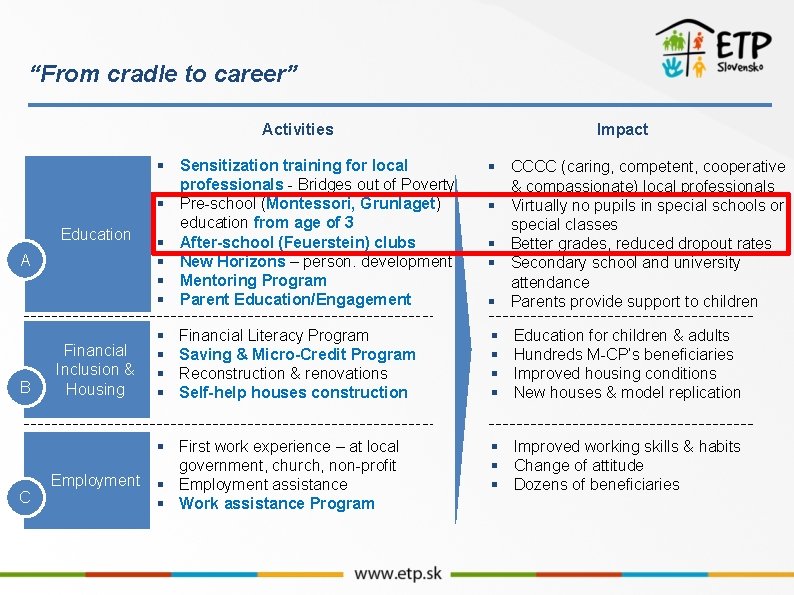
“From cradle to career” Activities Education § Sensitization training for local professionals - Bridges out of Poverty § Pre-school (Montessori, Grunlaget) education from age of 3 § After-school (Feuerstein) clubs § New Horizons – person. development § Mentoring Program § Parent Education/Engagement § CCCC (caring, competent, cooperative & compassionate) local professionals § Virtually no pupils in special schools or special classes § Better grades, reduced dropout rates § Secondary school and university attendance § Parents provide support to children Financial Inclusion & Housing § § § § A B C Impact Employment Financial Literacy Program Saving & Micro-Credit Program Reconstruction & renovations Self-help houses construction § First work experience – at local government, church, non-profit § Employment assistance § Work assistance Program Education for children & adults Hundreds M-CP’s beneficiaries Improved housing conditions New houses & model replication § Improved working skills & habits § Change of attitude § Dozens of beneficiaries
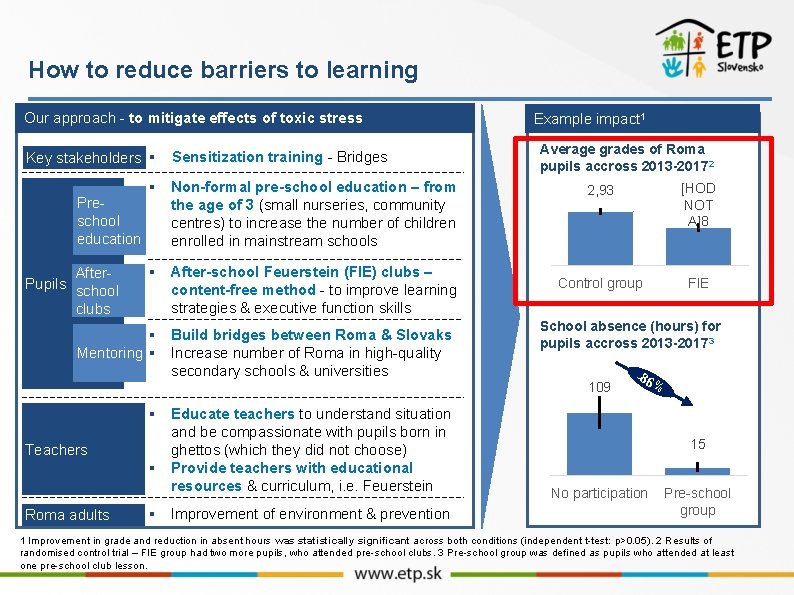
How to reduce barriers to learning Our approach - to mitigate effects of toxic stress arental & religious meetings (SIRONA Key stakeholders § Sensitization training - Bridges § Non-formal pre-school education – from Prethe age of 3 (small nurseries, community school centres) to increase the number of children education enrolled in mainstream schools After. Pupils school clubs § After-school Feuerstein (FIE) clubs – content-free method - to improve learning strategies & executive function skills § Build bridges between Roma & Slovaks Mentoring § Increase number of Roma in high-quality secondary schools & universities Example impact 1 Average grades of Roma pupils accross 2013 -20172 2, 93 [HOD NOT A]8 Control group FIE School absence (hours) for pupils accross 2013 -20173 109 Teachers Roma adults § Educate teachers to understand situation and be compassionate with pupils born in ghettos (which they did not choose) § Provide teachers with educational resources & curriculum, i. e. Feuerstein § Improvement of environment & prevention -86 % 15 No participation Pre-school group 1 Improvement in grade and reduction in absent hours was statistically significant across both conditions (independent t-test: p>0. 05). 2 Results of randomised control trial – FIE group had two more pupils, who attended pre-school clubs. 3 Pre-school group was defined as pupils who attended at least one pre-school club lesson.
What is Feuerstein Instrumental Enrichment? Based on his own experience with children coming from different cultural communities, socially and mentally deprived, Prof. Reuven Feuerstein (a child development psychologist) developed a methodology to stimulate the learning process. They need to learn how to learn. FIE uses mediated learning. There is a difference between instructing the child and mediating the child’s learning process.
How does Feuerstein Instrumental Enrichment work? • FIE develops the potential of each child to help them progress, regardless of their talents, IQ or specific needs • It emphasizes HOW children learn over WHAT they learn • Instruments don’t follow curriculum (they are not based on mathematics, history or other school subjects), they develop cognitive skills and executive functions • A mediator leads learners through complex cognitive tasks and works with them on how to analyze a problem and how to solve it systematically • The “Instruments” are a series of paper and pencil tasks, designed to strengthen learning skills through various cognitive exercises (planning, concentration, spatial orientation, comparison, visual memory etc)
Development of cognitive skills Mediator leads the child through the process of learning: § to absorb new information, § to develop ability to sort information and use it thereafter, § to plan = develop strategy of how to solve a task, § to focus, § to compare, § to verify accuracy, § to search for proofs of own solution, § to prepare answers, § to understand his own emotions, self-control, relationships Bonus – if the mediator is a loving & understanding person. Child experiences success, his self-confidence rises. By enriching a child’s structure of thinking, FIE method makes the child more receptive to stimuli and experience, and increases the child’s ability to cope with new conditions and situations confronting them in life and, of course, in school 1. Center on the Developing Child at Harvard University, 2011, Carlock, 2011
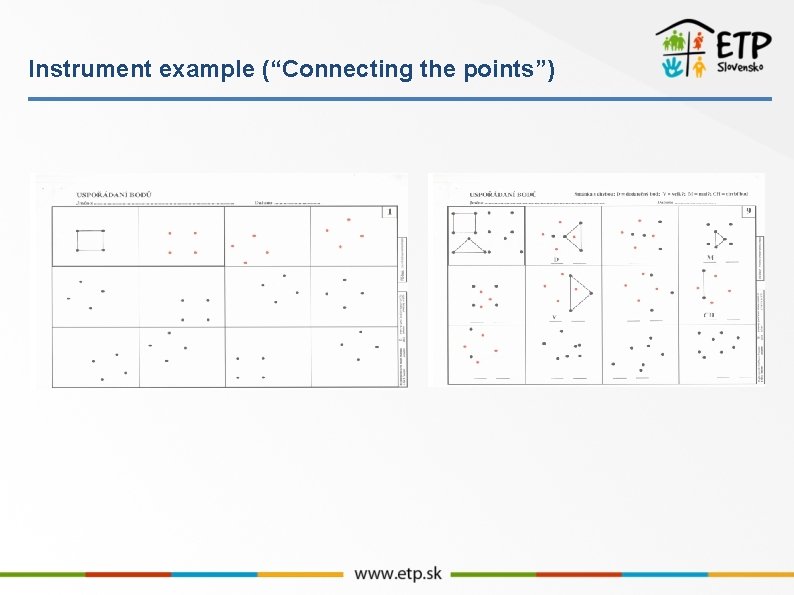
Instrument example (“Connecting the points”)
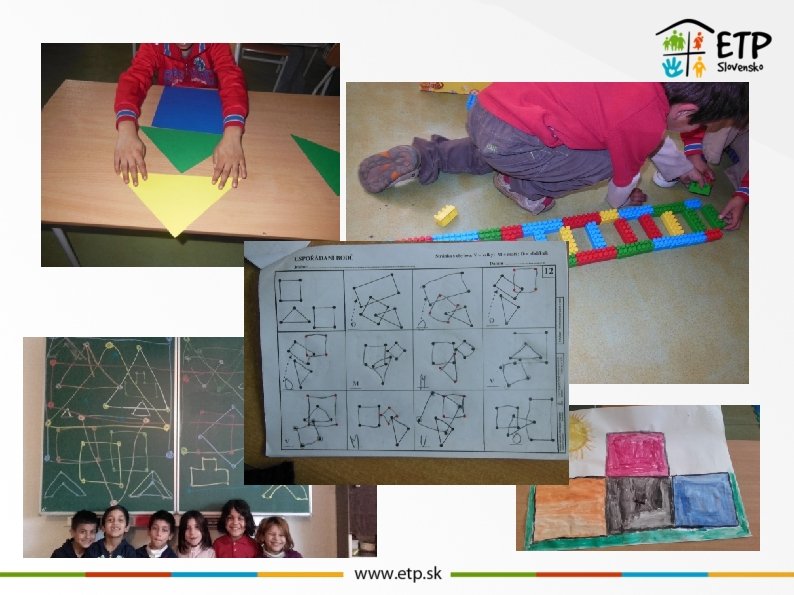
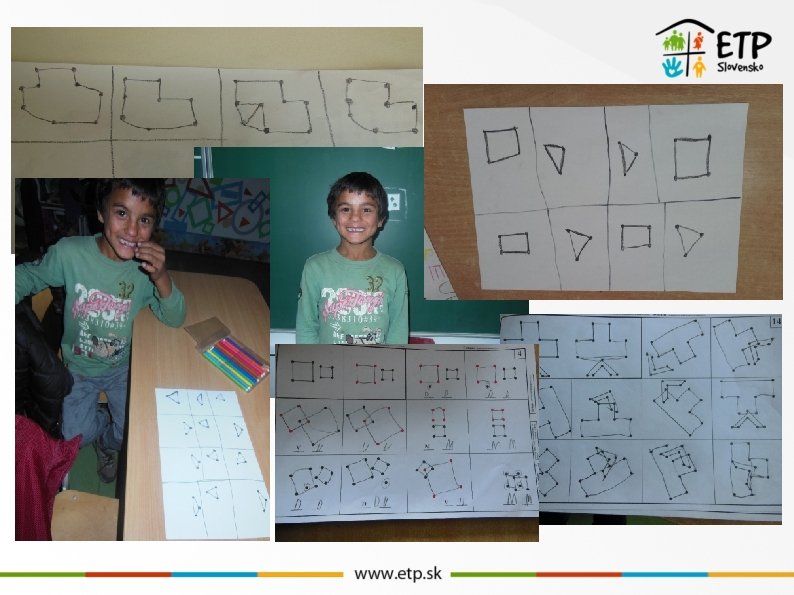
ETP has piloted FIE method since • 2013 – a group of 12 pupils in Veľká Ida – now 4 th graders (afterschool clubs: 4 days/week, 3 hrs/day) • 2013/2014 – a group of 49 preschoolers in 10 community centers (5 days/week, 3 hrs/day) • 2015 – a group of 45 pupils in Rankovce, Stará Ľubovňa, Veľká Ida – now 3 rd graders (afterschool clubs) All relevant information about piloting application of the FIE method, as well as evaluation findings were summarized in ETP publication Let’s Learn to Learn.
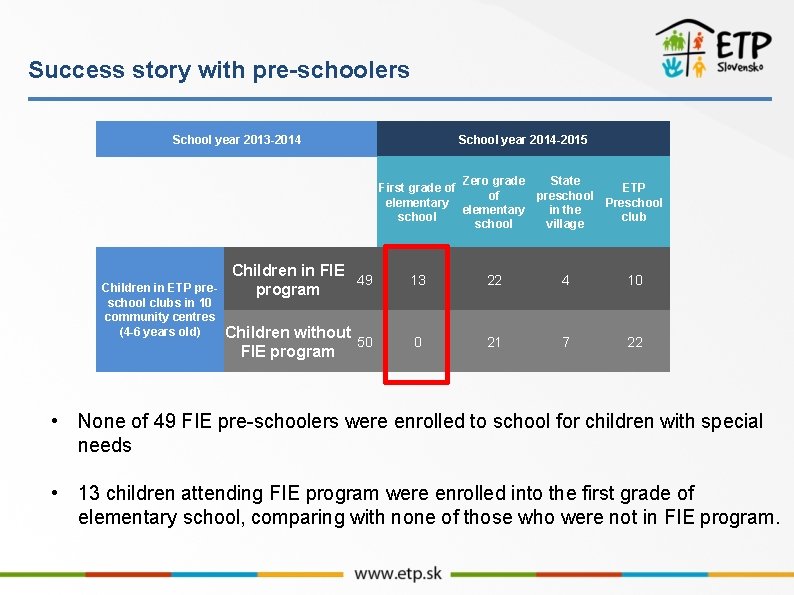
Success story with pre-schoolers School year 2013 -2014 School year 2014 -2015 Zero grade State First grade of ETP of preschool elementary Preschool elementary in the school club school village Children in ETP preschool clubs in 10 community centres (4 -6 years old) Children in FIE 49 program 13 22 4 10 Children without 50 FIE program 0 21 7 22 • None of 49 FIE pre-schoolers were enrolled to school for children with special needs • 13 children attending FIE program were enrolled into the first grade of elementary school, comparing with none of those who were not in FIE program.
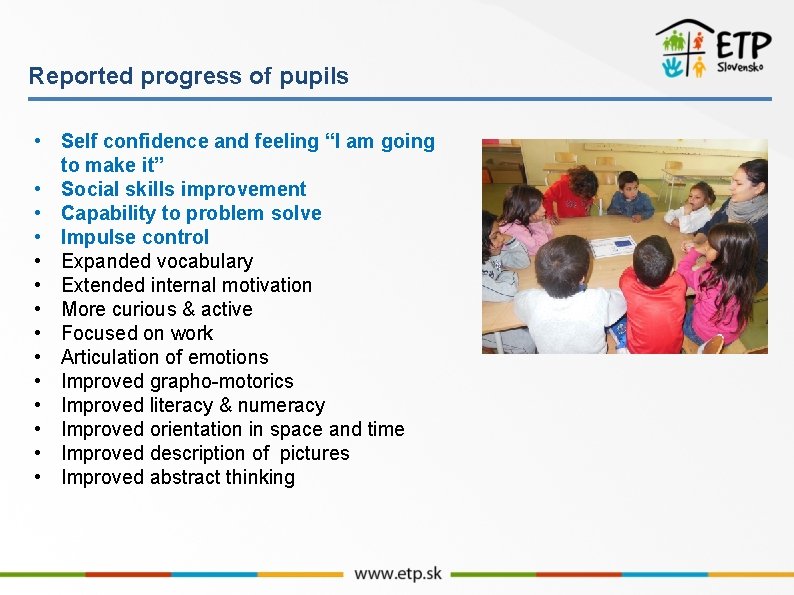
Reported progress of pupils • Self confidence and feeling “I am going to make it” • Social skills improvement • Capability to problem solve • Impulse control • Expanded vocabulary • Extended internal motivation • More curious & active • Focused on work • Articulation of emotions • Improved grapho-motorics • Improved literacy & numeracy • Improved orientation in space and time • Improved description of pictures • Improved abstract thinking
Research in cooperation with the Pedagogical Faculty of the Charles University in Prague 2015/2016: the randomised controlled trial to assess the effectiveness of the FIE method in comparison with standard educational method (Criss-Cross) • three elementary schools (Veľká Ida, Rankovce, Stará Ľubovňa) • 60 children who began to attend elementary school for the first time • In each of three locations: FIE afterschool club was run by a certified FIE lecturer and simultaneously “Criss-Cross” afterschool club was run by a standard teacher. • Both types of the clubs lasted three hours and were operated every day Psychological testing used cognitive static and dynamic tests, nonverbal reasoning, numerical memory and various mathematic tests, active and passive vocabulary and language tests.
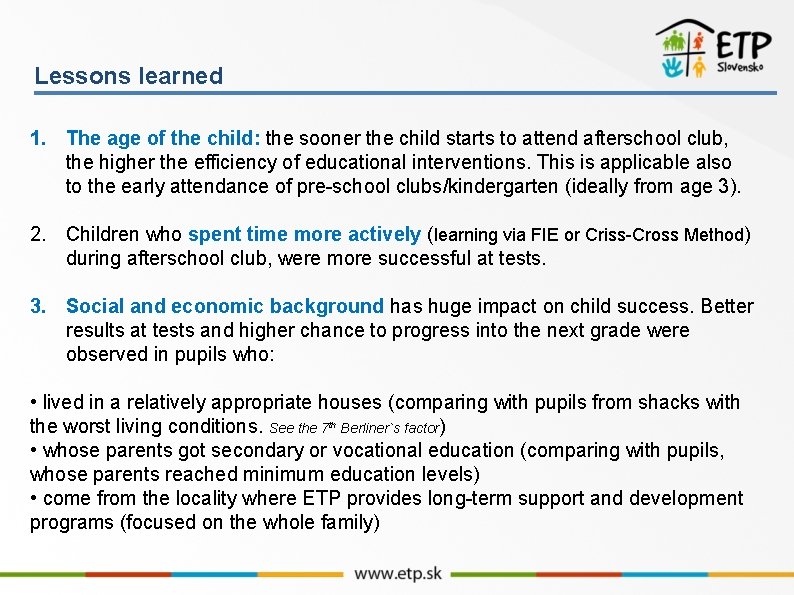
Lessons learned 1. The age of the child: the sooner the child starts to attend afterschool club, the higher the efficiency of educational interventions. This is applicable also to the early attendance of pre-school clubs/kindergarten (ideally from age 3). 2. Children who spent time more actively (learning via FIE or Criss-Cross Method) during afterschool club, were more successful at tests. 3. Social and economic background has huge impact on child success. Better results at tests and higher chance to progress into the next grade were observed in pupils who: • lived in a relatively appropriate houses (comparing with pupils from shacks with the worst living conditions. See the 7 th Berliner`s factor) • whose parents got secondary or vocational education (comparing with pupils, whose parents reached minimum education levels) • come from the locality where ETP provides long-term support and development programs (focused on the whole family)
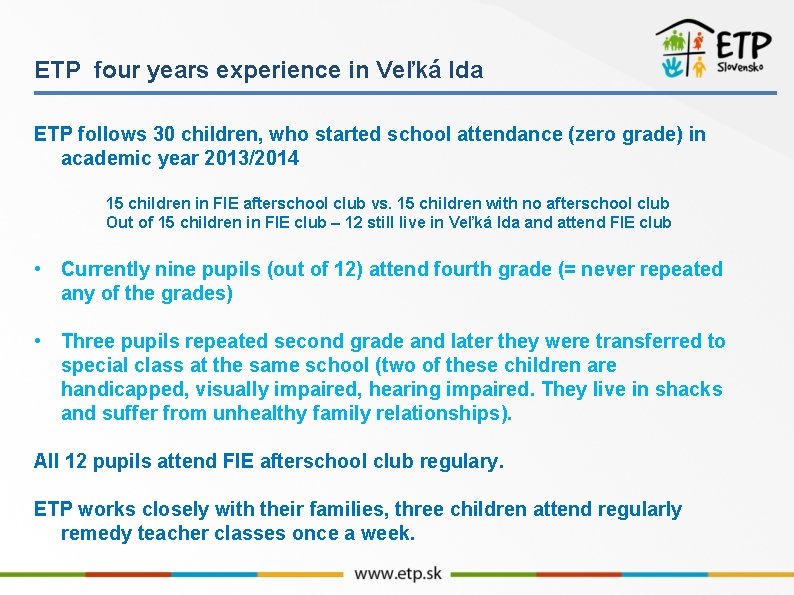
ETP four years experience in Veľká Ida ETP follows 30 children, who started school attendance (zero grade) in academic year 2013/2014 15 children in FIE afterschool club vs. 15 children with no afterschool club Out of 15 children in FIE club – 12 still live in Veľká Ida and attend FIE club • Currently nine pupils (out of 12) attend fourth grade (= never repeated any of the grades) • Three pupils repeated second grade and later they were transferred to special class at the same school (two of these children are handicapped, visually impaired, hearing impaired. They live in shacks and suffer from unhealthy family relationships). All 12 pupils attend FIE afterschool club regulary. ETP works closely with their families, three children attend regularly remedy teacher classes once a week.
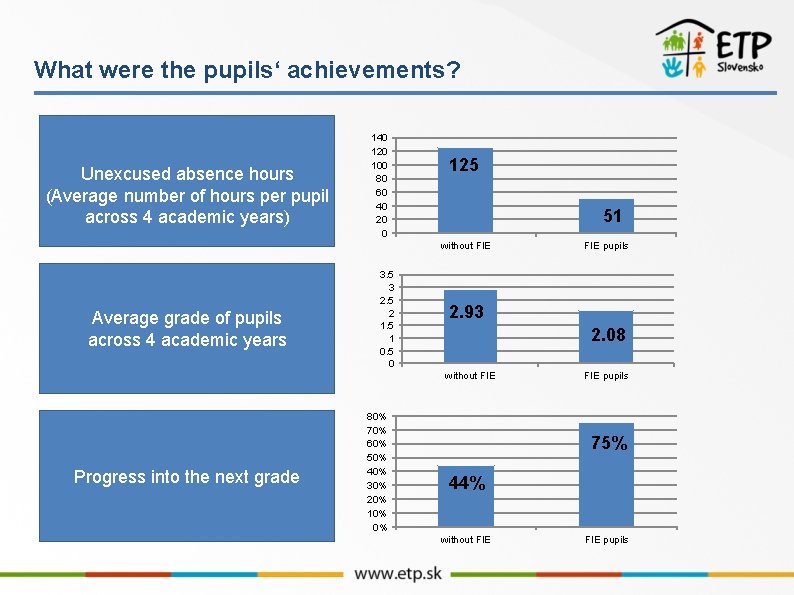
What were the pupils‘ achievements? Unexcused absence hours (Average number of hours per pupil across 4 academic years) 140 120 100 80 60 40 20 0 125 51 without FIE Average grade of pupils across 4 academic years 3. 5 3 2. 5 2 1. 5 1 0. 5 0 2. 93 2. 08 without FIE Progress into the next grade 80% 70% 60% 50% 40% 30% 20% 10% 0% FIE pupils 75% 44% without FIE pupils
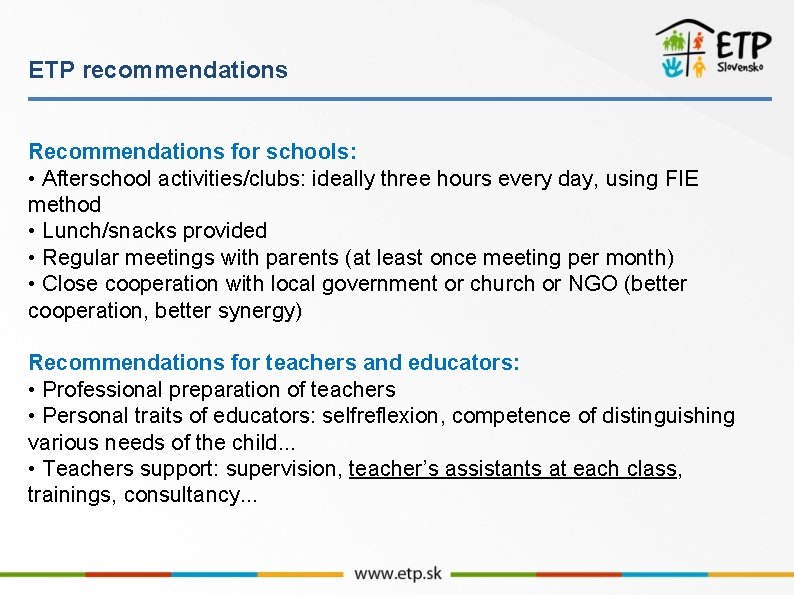
ETP recommendations Recommendations for schools: • Afterschool activities/clubs: ideally three hours every day, using FIE method • Lunch/snacks provided • Regular meetings with parents (at least once meeting per month) • Close cooperation with local government or church or NGO (better cooperation, better synergy) Recommendations for teachers and educators: • Professional preparation of teachers • Personal traits of educators: selfreflexion, competence of distinguishing various needs of the child. . . • Teachers support: supervision, teacher’s assistants at each class, trainings, consultancy. . .
ETP recommendations for EU/Slovakia policy makers: • provide support to families to achieve stability (i. e. housing) • support all family members so that their healh & well-being improves • assist families to achieve financial stability (debt reduction) • assist families to find job and keep it • assist children, youth & adults so that they can benefit from education • support children and youth through their career
Feuerstein clubs mainstreaming? “The Ministry of Education has accepted the publication Learning How to Learn and recommends the use of the FIE method. The Ministry of Education believes that the Feuerstein method presents a comprehensive systemic solution and therefore we recommend schools principals to use the method based on their needs and possibilities. ” Mrs. Eva Koprena, spokeswoman of the Ministry of Education Slovak National TV news, January 15 th, 2017
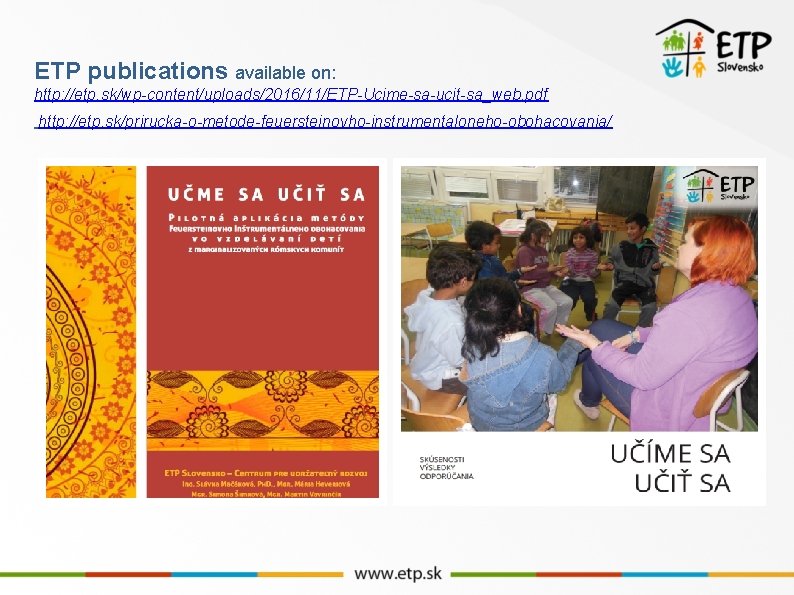
ETP publications available on: http: //etp. sk/wp-content/uploads/2016/11/ETP-Ucime-sa-ucit-sa_web. pdf http: //etp. sk/prirucka-o-metode-feuersteinovho-instrumentaloneho-obohacovania/
“If you are not prepared to look at your pupils’ strengths, don’t touch their weaknesses. “ Professor Reuven Feuerstein Clinical, developmental & cognitive psychologist

THANK YOU FOR YOUR ATTENTION Slávka Mačáková: macakova@ke. etp. sk Lenka Czikková: czikkova@ke. etp. sk www. etp. sk
BACK-UP Researches, experts, theoretical background
Our overall aim Social inclusion – enabling every citizen, especially those disadvantaged, to feel valued and important within a society, to fully participate in the running of the society, including labor market participation. (EU definition) . . . in other words. . . to enable socially excluded people to complete high-quality education, find a job & build a career, live independent & meaningful life and contribute to our society
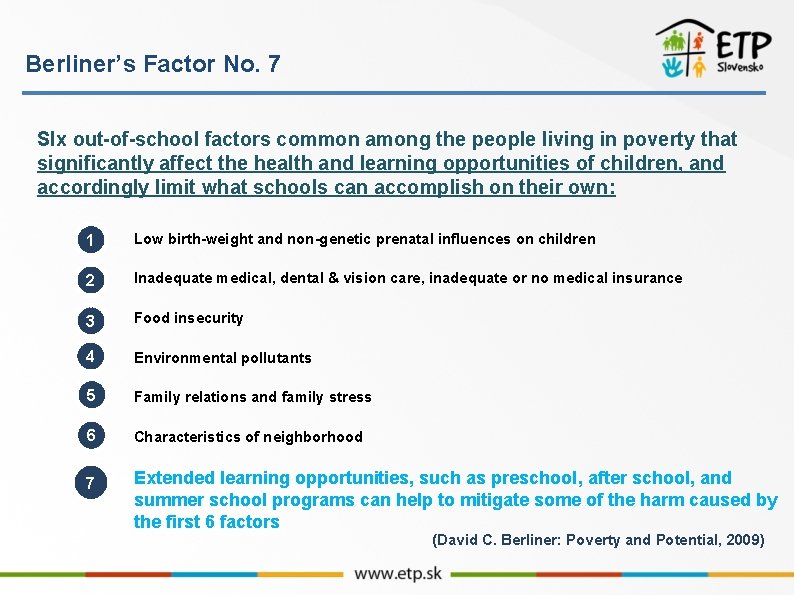
Berliner’s Factor No. 7 SIx out-of-school factors common among the people living in poverty that significantly affect the health and learning opportunities of children, and accordingly limit what schools can accomplish on their own: 1 Low birth-weight and non-genetic prenatal influences on children 2 Inadequate medical, dental & vision care, inadequate or no medical insurance 3 Food insecurity 4 Environmental pollutants 5 Family relations and family stress 6 Characteristics of neighborhood 7 Extended learning opportunities, such as preschool, after school, and summer school programs can help to mitigate some of the harm caused by the first 6 factors (David C. Berliner: Poverty and Potential, 2009)
Effects of chronic stress on executive function skills Growing up in poverty – the toll taken by social bias, stress of persistent poverty, exposure to trauma and violence causes physiological changes in brain development that deeply affect the ways people react to the world around them. Children living in such environment find the world highly unpredictable and lack resources and options for improvement. Center on the Developing Child at Harvard University, Carlock, 2011
Cognitive, behavioral and health challenges associated with poverty-related stress The process of moving out of poverty is complicated, demanding patience, determination, and resilience. Beyond that, it requires personal initiative and agency, a good understanding of ourselves and others, memory, focus, problem-solving and decision-making skills, and the abilities to multitask and juggle competing priorities. The degree to which individuals posses these traits and skills depends on many variables, including, but not limited to: • genetic makeup • the health of the environment • the way they were raised • social rank • history of economic deprivation • the amount of trauma, danger and fear they have experienced Center on the Developing Child at Harvard University, 2011, Carlock, 2011
What Are the Core Capabilities? Research from neuroscience and psychology (Sept 2017) tells us there is a set of underlying core capabilities that adults use to manage life, work, and parenting effectively: planning, focus, selfcontrol, awareness, and flexibility. Chaotic, stressful, and/or threatening situations can derail anyone, yet individuals who experience a pile-up of adversity are often even less able to deploy all of the skills they have to cope with challenging circumstances. Early in life, the experience of severe, frequent stress directs the focus of brain development toward building the capacity for rapid response to threat and away from planning and impulse control. In adulthood, significant and continuous adversity can overload the ability to use existing capacities that are needed the most to overcome challenges. https: //developingchild. harvard. edu/science/deep-dives/adult-capabilities/
Early experience is built into our bodies (for better or for worse). If a person lives in healthy environment, when the experience is positive, he or she builds strong brain architecture. When a person is overwhelmed in adverse environment the brain development can be disrupted. Excessive or prolonged activation to stress response system causes physiological damage to the brain, immune status, metabolic system and cardiovascular functions. . . and it is the root of many social problems Center on the Developing Child at Harvard University, 2011, Carlock, 2011
Primary executive function skills 1) Impulse control – the skills used to filter distractions, override impulses, resist temptation, maintain focus, pause and reflect before taking action, and maintain persistence in the face of worry or despair 2) Working memory – the ability to mentally hold and manipulate information over short periods of time, simultaneously think of multiple things, temporary focus on something while retaining something else in the back of the mind, retain information, follow multi-step instruction, and temporarily stop doing something and return to it later without loss of continuity 3) Mental flexibility (or cognitive flexibility, mental shifting, set shifting) the ability to readily switch gears, multitask, adjust plans, reestablish priorities, apply different rules or social skills in different settings, translate between languages, alter strategies based on feedback, and innovate. Center on the Developing Child at Harvard University, 2011, Carlock, 2011
Primary executive function skills If children are raised in environments that are mentally stimulating with rich caregiver “serve and return“ conversation, if they are allowed to puzzle and explore, if they are encouraged to think about what they would like to do and have many options for achieving their goals, if they experience positive gains they will start from the very earliest age to build neural networks that will grow increasingly powerful, making all the effective function mental processes easier, more efficient, more effective over time. But, if children find the world full of tension and danger and their bodies are often flooded with stress hormones that swamp their prefrontal cortex and hijack their attention, if their environment is highly unpredictable, if the schedules and rules they live by are always changing, if thew have few resources or choices, if they experience limited opportunities for “serve and return“ conversation, then the neural connections for executive functioning will not be as well developed. Center on the Developing Child at Harvard University, 2011, Carlock, 2011
“You can’t touch their brain until you have touched their heart. “ Rita Pierson, lifelong educator A colleague of Rita Pierson: “They don't pay me to like the kids. They pay me to teach a lesson. The kids should learn it. I should teach it, they should learn it. Case closed. “ Rita Pierson: “You know, kids don't learn from people they don't like. “
- Slides: 40