
Social Inclusion by Proactive Design Inclusive By Design

Social Inclusion by Proactive Design Inclusive. By. Design af se tern ss o io on n Kick-off meeting 12 February 2001 Heraklion, Crete, Greece
Meeting agenda (afternoon) Data collection Dissemination Management Next steps 14: 30 – 18: 00 Afternoon session Ø Data collection approach of project phase 1 Ø Expected contributions of partners to the preliminary report Ø Dissemination policy Ø Management issues Ø Consolidation of meeting outcomes and agreement on next steps Ø Preliminary agenda for the 2 nd project meeting 2
Data collection Dissemination Management Next steps Data collection approach of the first project phase 3
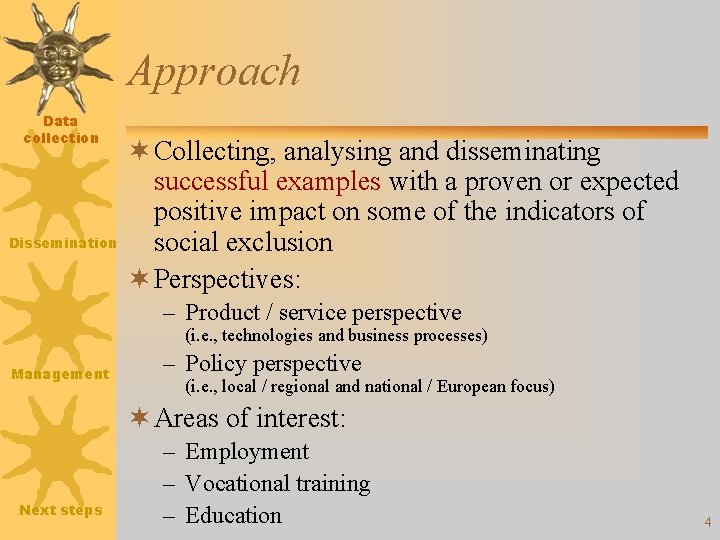
Approach Data collection Dissemination ¬ Collecting, analysing and disseminating successful examples with a proven or expected positive impact on some of the indicators of social exclusion ¬ Perspectives: – Product / service perspective (i. e. , technologies and business processes) Management – Policy perspective (i. e. , local / regional and national / European focus) ¬ Areas of interest: Next steps – Employment – Vocational training – Education 4
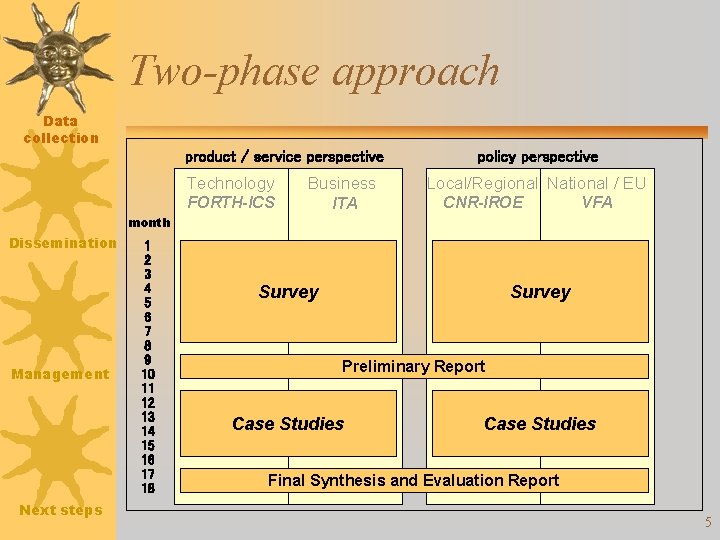
Two-phase approach Data collection product / service perspective Technology Business FORTH-ICS ITA policy perspective Local/Regional National / EU CNR-IROE VFA month Dissemination Management Next steps 1 2 3 4 5 6 7 8 9 10 11 12 13 14 15 16 17 18 Survey Preliminary Report Case Studies Final Synthesis and Evaluation Report 5
Sources for the sample (I) Data collection ¬ Product / service perspective Dissemination Management Next steps – IST projects (e. g. , The School of Tomorrow) – European Agency for Development in Special Needs Education – High-tech enterprises with an open commitment to accessibility – Literature and web review – Conference participants with relevant focus – “Known” (to FORTH-ICS) candidates – Other 6
Sources for the sample (II) Data collection Dissemination Management Next steps ¬ Policy perspective – – – European employment strategy Strategies for jobs in the information society Structural funds (e. g. , objectives of EQUAL) Forthcoming initiatives on social protection National initiatives to combat exclusion Key players in the field of • employment (e. g. , labour offices, huge employers) • vocational training (e. g. , training centres, ministries) • education (e. g. , distance education providers) – “Known” (to VFA and CNR-IROE) candidates – Others 7
Survey Data collection Dissemination Management Next steps ¬ questionnaires vs. interviews ¬ sample size ¬ length, language, level, scope ¬ paper-based vs. web-based ¬ timing ¬ minimum feedback rate & reminders to increase feedback ¬ synergies (e. g. , combined questionnaires) 8
Data analysis Data collection Dissemination Management Next steps ¬quantitative data ¬qualitative data ¬ranking (? ) ¬selection process ¬documentation 9
Link between the outcomes Data collection Dissemination Management Next steps If successful policy measures can be identified which facilitate inclusion / prevent exclusion of some societal groups, it is likely that – if these policy measures are modified towards the use of universally accessible IST-based technologies – they would unfold an even more powerful inclusion potential towards all citizens. 10
Data collection Dissemination Management Next steps 11
Dissemination Data collection Dissemination Management Next steps ¬Project web site (February 2001) ¬Preliminary report on trends and practices (due August 2001) ¬Final project report (due May 2002) ¬Other potential dissemination channels: – Conferences – Discussion groups – Supporting organisations 12
Web site Data collection Dissemination Management Next steps ¬Address: http: // ibd. ics. forth. gr (? ) ¬Fulfils accessibility criteria (W 3 C-WAI) ¬Contents – Project description – Participants – Timetable (? ) – Results – Participants-only area (? ) 13
Preliminary report Data collection Key elements: ¬Introduction Dissemination ¬Explanation of project approach ¬(Preliminary) results of the broad surveys Management ¬Synthesis ¬Preliminary conclusions Next steps 14
Final report Data collection Key elements: ¬Introduction Dissemination ¬Summary of the outcomes of the preliminary report ¬Explanation of the case-study approach Management ¬Case study outcomes ¬Synthesis and policy recommendations ¬Evaluation report Next steps 15
Supporting organisations Data collection Dissemination Management Next steps How to involve the supporting organisations? § Institute of training and development "DIMITRA" (Greece) § Association of the sheltered workshops for people with disabilities in the federal state of Rhineland-Palatinate (Germany) § University of Crete (Greece) § European Agency for Development in Special Needs Education (Europe) § Europliroforissi - Vocational Training Centre (Greece) § Publishers Association of Regional Hellenic Daily Press (Greece) § National Institute of Labour (Greece) § Trade Union, Department of Heraklion / Crete (Greece) § Non Profit Association of Parents Guardians & Friends of Persons with Special Needs (Greece) § Federal State’s Ministry of Labour, Social Affairs and Health Rhineland-Palatinate (Germany) 16
Data collection Dissemination Management issues Management Next steps 17
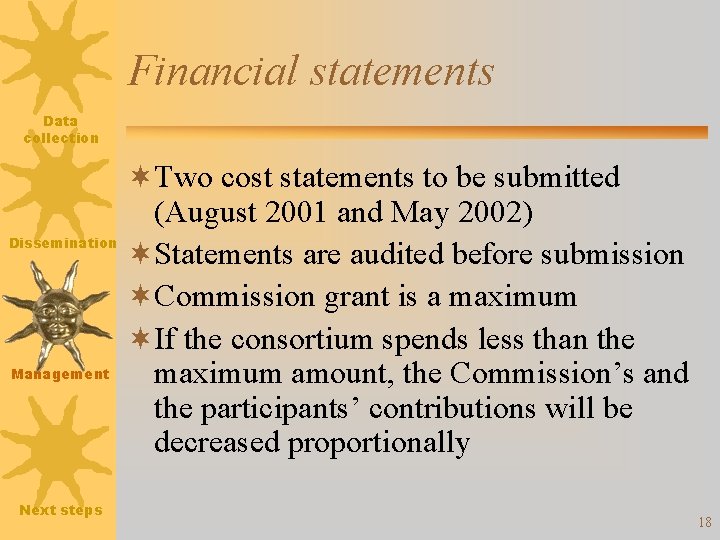
Financial statements Data collection Dissemination Management Next steps ¬Two cost statements to be submitted (August 2001 and May 2002) ¬Statements are audited before submission ¬Commission grant is a maximum ¬If the consortium spends less than the maximum amount, the Commission’s and the participants’ contributions will be decreased proportionally 18
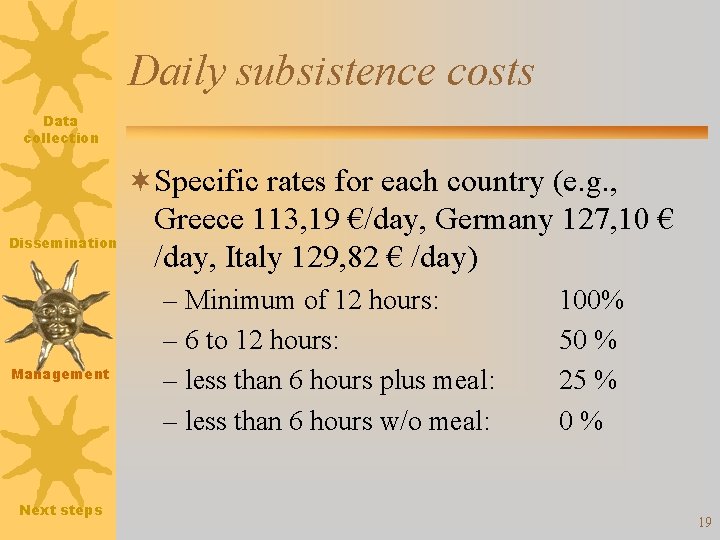
Daily subsistence costs Data collection Dissemination Management Next steps ¬Specific rates for each country (e. g. , Greece 113, 19 €/day, Germany 127, 10 € /day, Italy 129, 82 € /day) – Minimum of 12 hours: – 6 to 12 hours: – less than 6 hours plus meal: – less than 6 hours w/o meal: 100% 50 % 25 % 0% 19
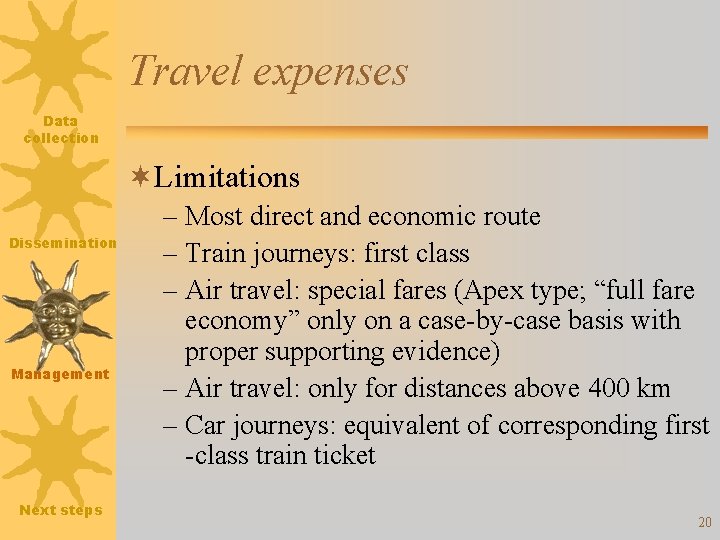
Travel expenses Data collection ¬Limitations Dissemination Management Next steps – Most direct and economic route – Train journeys: first class – Air travel: special fares (Apex type; “full fare economy” only on a case-by-case basis with proper supporting evidence) – Air travel: only for distances above 400 km – Car journeys: equivalent of corresponding first -class train ticket 20
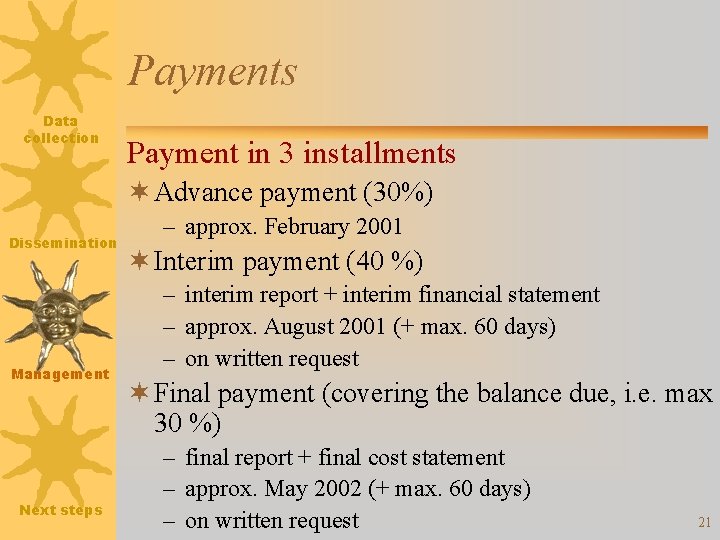
Payments Data collection Payment in 3 installments ¬ Advance payment (30%) Dissemination Management Next steps – approx. February 2001 ¬ Interim payment (40 %) – interim report + interim financial statement – approx. August 2001 (+ max. 60 days) – on written request ¬ Final payment (covering the balance due, i. e. max 30 %) – final report + final cost statement – approx. May 2002 (+ max. 60 days) – on written request 21
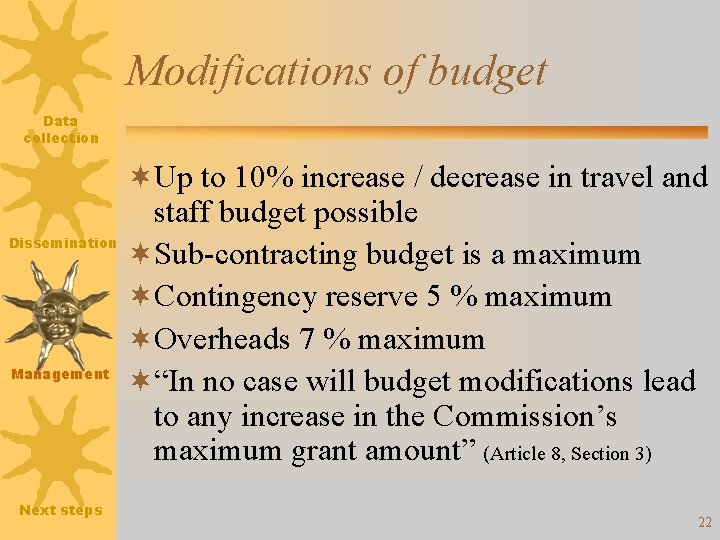
Modifications of budget Data collection Dissemination Management Next steps ¬Up to 10% increase / decrease in travel and staff budget possible ¬Sub-contracting budget is a maximum ¬Contingency reserve 5 % maximum ¬Overheads 7 % maximum ¬“In no case will budget modifications lead to any increase in the Commission’s maximum grant amount” (Article 8, Section 3) 22
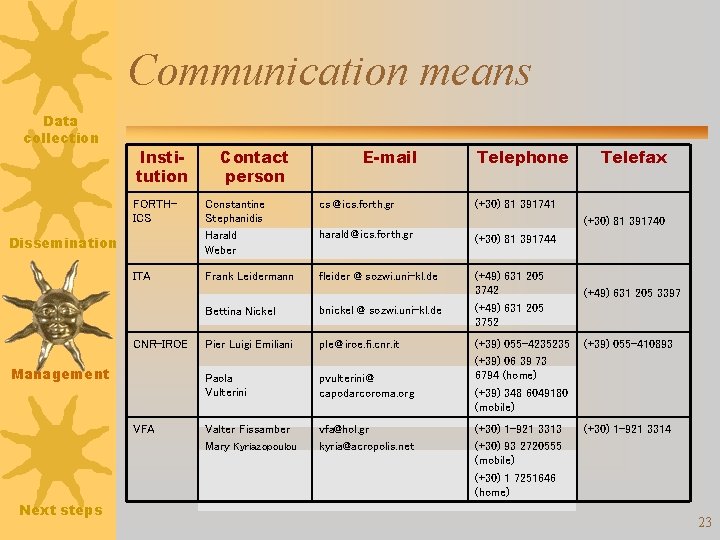
Communication means Data collection Institution FORTHICS Dissemination ITA CNR-IROE Management VFA Next steps Contact person E-mail Telephone Constantine Stephanidis Harald Weber cs @ ics. forth. gr harald @ ics. forth. gr (+30) 81 391744 Frank Leidermann fleider @ sozwi. uni-kl. de (+49) 631 205 3742 (+49) 631 205 3752 Telefax (+30) 81 391741 (+30) 81 391740 Bettina Nickel bnickel @ sozwi. uni-kl. de Pier Luigi Emiliani ple @ iroe. fi. cnr. it Paola Vulterini pvulterini @ capodarcoroma. org Valter Fissamber Mary Kyriazopoulou vfa@hol. gr kyria@acropolis. net (+49) 631 205 3397 (+39) 055 -4235235 (+39) 06 39 73 6794 (home) (+39) 348 6049180 (mobile) (+39) 055 -410893 (+30) 1 -921 3313 (+30) 93 2720555 (mobile) (+30) 1 7251646 (home) (+30) 1 -921 3314 23
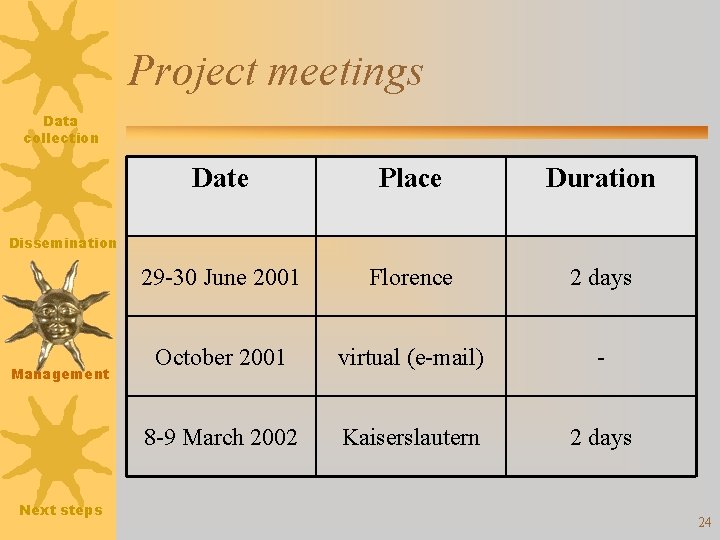
Project meetings Data collection Date Place Duration 29 -30 June 2001 Florence 2 days October 2001 virtual (e-mail) - 8 -9 March 2002 Kaiserslautern 2 days Dissemination Management Next steps 24
Data collection Dissemination Next steps Management Next steps 25
![Timetable [Project] month Data collection Dissemination Management Dec 2000 Activity [1] Jan 2001 [2]](http://slidetodoc.com/presentation_image_h2/8011885dd3803aff3d3ce4fbf57ab201/image-26.jpg "Timetable [Project] month Data collection Dissemination Management Dec 2000 Activity [1] Jan 2001 [2]")
Timetable [Project] month Data collection Dissemination Management Dec 2000 Activity [1] Jan 2001 [2] Feb 2001 [3] Mar 2001 [4] Questionnaires; Pretest Apr 2001 [5] Send out; Reminders; Coding May 2001 [6] Jun 2001 [7] Jul 2001 [8] Aug 2001 [9] Kick-off meeting; launch of project web site 2 nd project meeting (29. -30. 06. Florence) Case studies, survey & synthesis Internal project evaluation Oct 2001 [11] Virtual meeting Nov 2001 [12] Project progress and evaluation report Dec 2001 [13] Jan 2002 [14] Feb 2002 [15] [17] May 2002 [18] Data analysis Preliminary report [10] Apr 2002 Indicators and Definitions Presentation / Documentation Sep 2001 Mar 2002 [16] Next steps Event 3 rd project meeting (8. -9. 3. Kaiserslautern) Report preparation Final synthesis, evaluation & project report Dissemination 26
- Slides: 26