
Social Impact of WW 2 Learning Intentions Describe
Social Impact of WW 2
Learning Intentions • Describe what is meant by bombing, rationing and evacuation • Explain how wartime experiences such as bombing, rationing and evacuation had an effect on poverty • Describe how the Beveridge Report helped to make clear what the main social problems in Britain were.
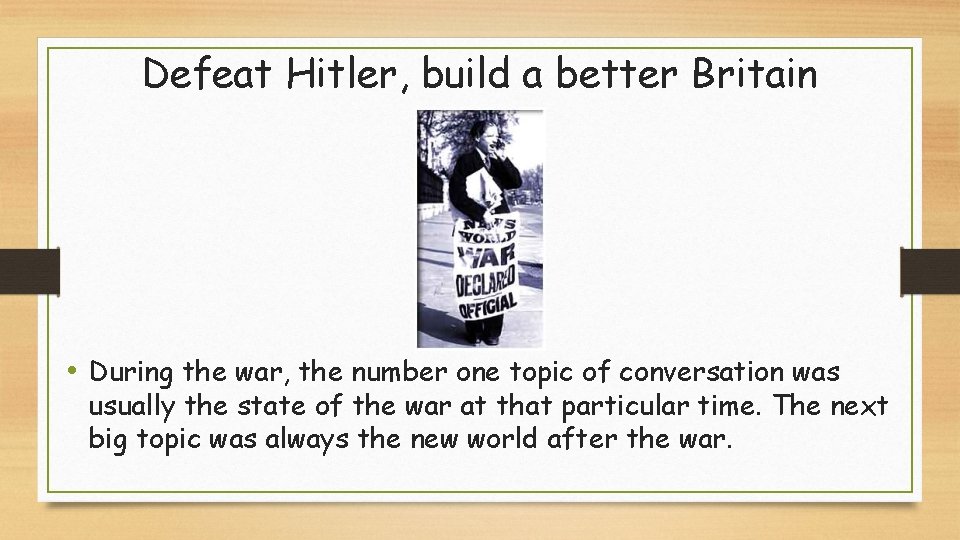
Defeat Hitler, build a better Britain • During the war, the number one topic of conversation was usually the state of the war at that particular time. The next big topic was always the new world after the war.
Total War • Total war involved sacrifices and contributions by everyone. • The government took control over the economy and people’s lives in a way never thought possible before. • War created a powerful unity of purpose and the question arose if it was possible to distribute resources equally in war time why not in peace time?
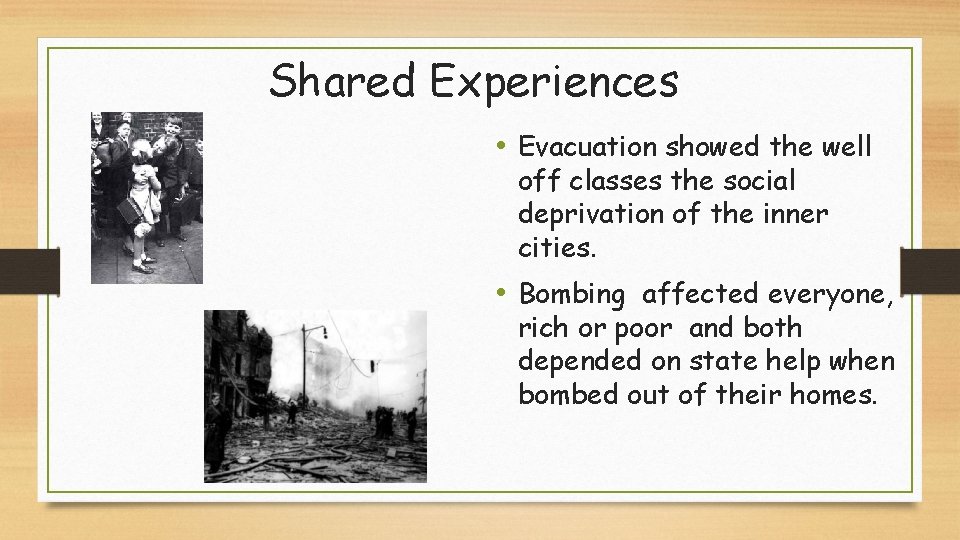
Shared Experiences • Evacuation showed the well off classes the social deprivation of the inner cities. • Bombing affected everyone, rich or poor and both depended on state help when bombed out of their homes.
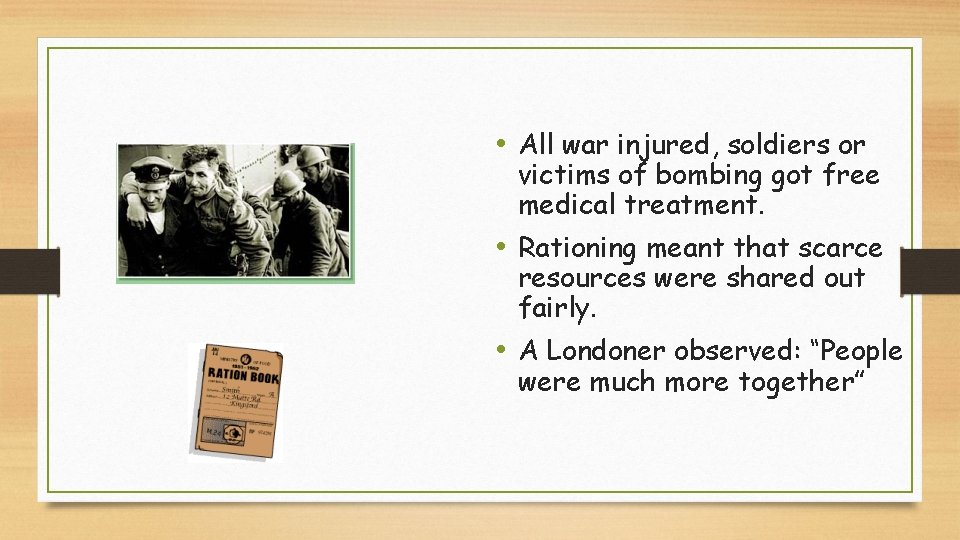
• All war injured, soldiers or victims of bombing got free medical treatment. • Rationing meant that scarce resources were shared out fairly. • A Londoner observed: “People were much more together”
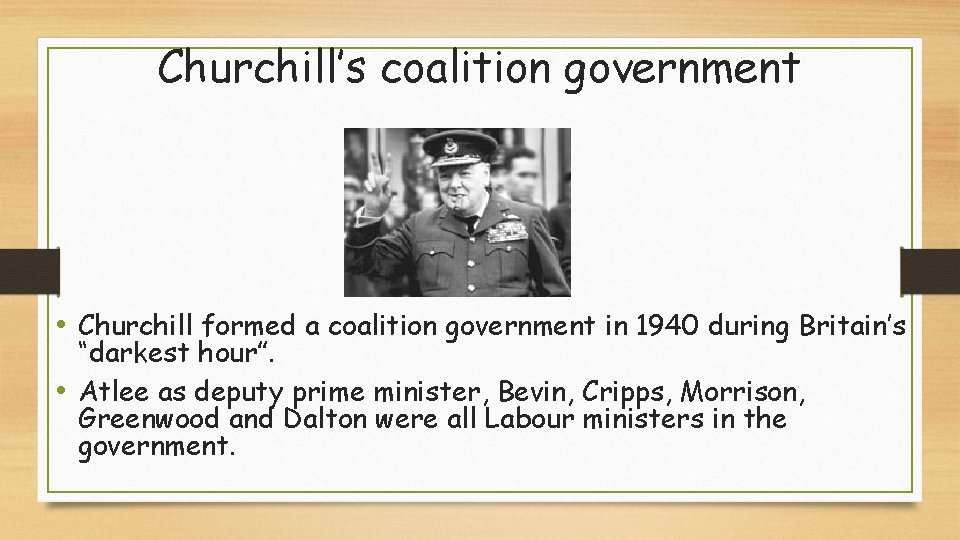
Churchill’s coalition government • Churchill formed a coalition government in 1940 during Britain’s “darkest hour”. • Atlee as deputy prime minister, Bevin, Cripps, Morrison, Greenwood and Dalton were all Labour ministers in the government.
Government Action 1940 - 42 The Government began to introduce a number of reforms during the war • • • National Milk scheme Provision of school meals and milk Immunisation State nurseries Old age and widows’ pension Act Determination of needs act
• These measures were moving the social security system from selective to universal benefits. It could be argued that the war was laying the foundations of the modern welfare state and that the Labour government completed it.
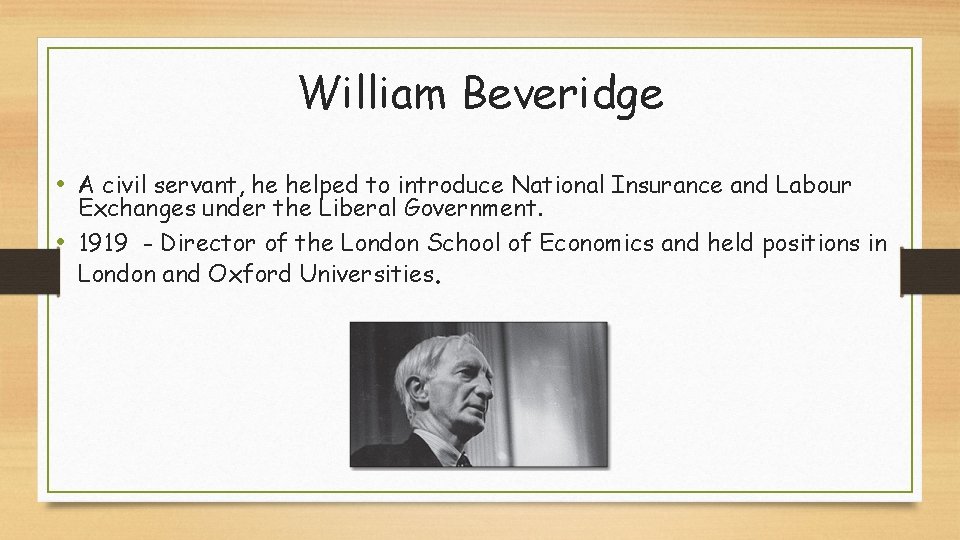
William Beveridge • A civil servant, he helped to introduce National Insurance and Labour Exchanges under the Liberal Government. • 1919 - Director of the London School of Economics and held positions in London and Oxford Universities.
William Beveridge • Involved in the planning of rationing which was introduced in 1940. • In 1941 he was asked by the coalition government to investigate how improvements could be made to the system of providing sickness and unemployment insurance.
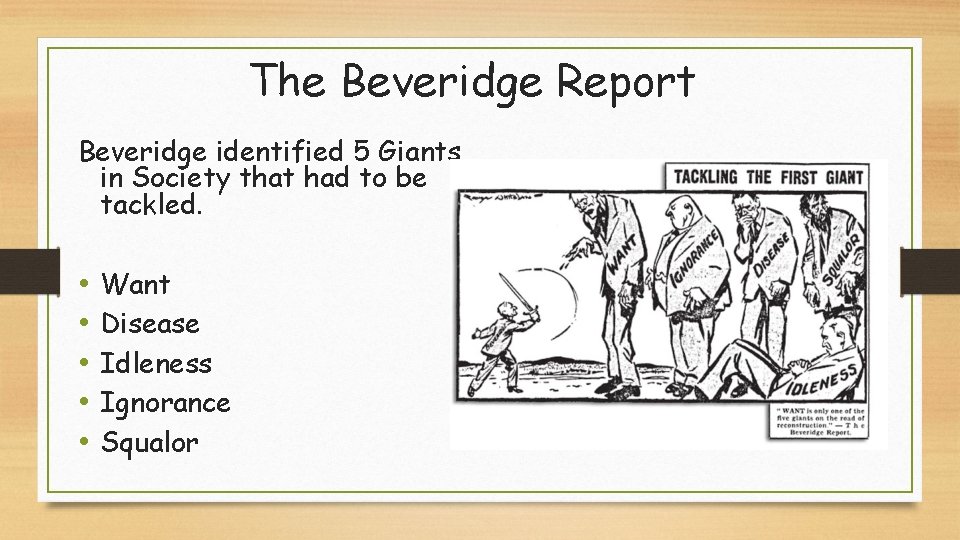
The Beveridge Report Beveridge identified 5 Giants in Society that had to be tackled. • • • Want Disease Idleness Ignorance Squalor
How to tackle the 5 Giants? • Want - establish a comprehensive social security system • Disease - establish a new health service • Idleness - the state should aim to provide full employment • Ignorance - reform the education system • Squalor - clear slums and build new houses.
Principles behind the Proposals The System was to be: • Comprehensive • Universal • Insurance Based • Compulsory • Flat rate • Provide subsistence • Non-means tested
The Beveridge Report • Beveridge proposed a new social security system funded from national insurance that would meet peoples’ needs from the ‘cradle to the grave’. • The Beveridge Report became a bestseller , 635, 000 copies were sold. • Not everyone was enthusiastic about the proposals, how could Britain afford it?
The Beveridge Report “The purpose of victory is to live in a better world than the old world; each individual citizen is more likely to concentrate upon his war effort if he feels his government will be ready in time with plans for that better world” Extract from the Beveridge Report
- Slides: 16