
Social Identity and Categorization Theory Henri Tajfel 3

![Tajfel study (1970) [Aim] To test the Social Identity Theory. • 48 boys were](https://slidetodoc.com/presentation_image_h2/c633dc0f94b9daaf703a61ff09270e98/image-6.jpg "Tajfel study (1970) [Aim] To test the Social Identity Theory. • 48 boys were")
![Cialdini (1976) Demonstrate social comparison with college football [A] supporters. • Observed what college](https://slidetodoc.com/presentation_image_h2/c633dc0f94b9daaf703a61ff09270e98/image-8.jpg "Cialdini (1976) Demonstrate social comparison with college football [A] supporters. • Observed what college")
![Nass, Fogg, Moon Study (1995) [A] • Social Identity will form w/randomly assigned team](https://slidetodoc.com/presentation_image_h2/c633dc0f94b9daaf703a61ff09270e98/image-10.jpg "Nass, Fogg, Moon Study (1995) [A] • Social Identity will form w/randomly assigned team")




- Slides: 23
Social Identity (and Categorization) Theory Henri Tajfel 3 biii – Evaluate Social Identity Theory, making reference to relevant studies
Social Identity Theory - Henri Tajfel • Assumes people try to improve selfimage/esteem thru personal accomplishment & their social identity • Small groups are formed in society according to common interests • Individuals will then identify with those small groups on a personal level – source of pride • People belong to many groups and each varies in importance to one’s self-concept
SIT cont’d • Group schemas tell us what to think, feel, and do in particular contexts • Once identified these behaviors become stereotypes of in-group normative behavior • Distinctions are made between in-group and out-group based solely on group membership • Creates “us vs. them” distinctions between inand out-groups • In-groups are always favored
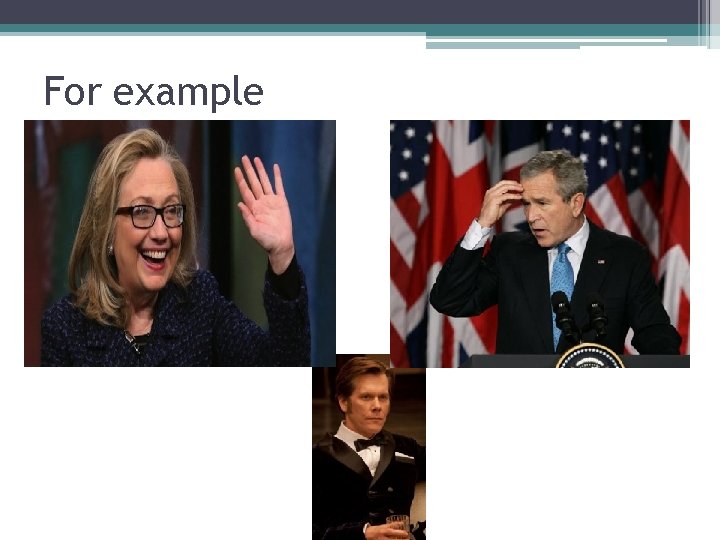
For example
• How many of you have criticized a parent this week? • How would you react if someone else, not a relative criticized your parents? • How many of you whine and complain about UAIS? • How do you react when people who don’t go here criticize this program?
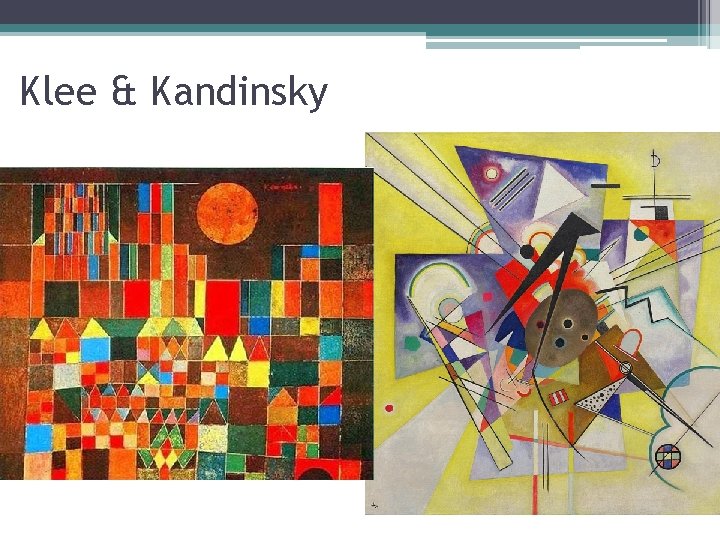
Tajfel study (1970) [Aim] To test the Social Identity Theory. • 48 boys were assigned at random to 2 groups based on their preference between Klee or Kandinsky’s art work. [Proc. ] • Asked to rate in-group and out-group based on traits e. g. likeability. • Tajfel found that the out-group was rated less likeable, but never [Find. ] actually disliked. • There seems to be a preference of the in-group over out-group, however it is not clear that they make social comparisons to enhance either self-esteem. [Concl. ] • Later research – Social identity does not account for intergroup conflict. In the absence of competition, social comparison can be positive. • Supports Social Identity Theory. • Showed the formation and the features of SIT. [Eval. ] • Ecological validity: Low, lab conditions. • Meaningless groups. • Controlled environment removed confounding variables.
Klee & Kandinsky
Cialdini (1976) Demonstrate social comparison with college football [A] supporters. • Observed what college students wear to school the next [P] day after their football game. • Students wore apparel with the representative colour [F] of their school the day after the football game if the school won. • Result of positive self-concept results in a bias intergroup comparison. [C] • Having a positive representation of your social group (Positive distinctiveness).
C’mon I had to…
Nass, Fogg, Moon Study (1995) [A] • Social Identity will form w/randomly assigned team • 28 students (equal men &women) initiated into the Blue Group. Then randomly assigned to answer [P] questions on blue or green computers. Blue-blue was “blue team” vs. blue indivs. working on green computer • Blue team changed their answers to match the team [F] computer answers more often than individuals • Suggests a SI has formed between blue members and blue computer [C] • Suggests that even in absence of other people, SIs can still form
Zimbardo – Stanford Prison Study Coming Soon to Psych Class Near You!
And Now…This https: //www. youtube. com/watch? v=AJKfs 4 Znb. NE https: //edpuzzle. com/classes/56 a 044379 d 0 f 10424175 f 6 c 5
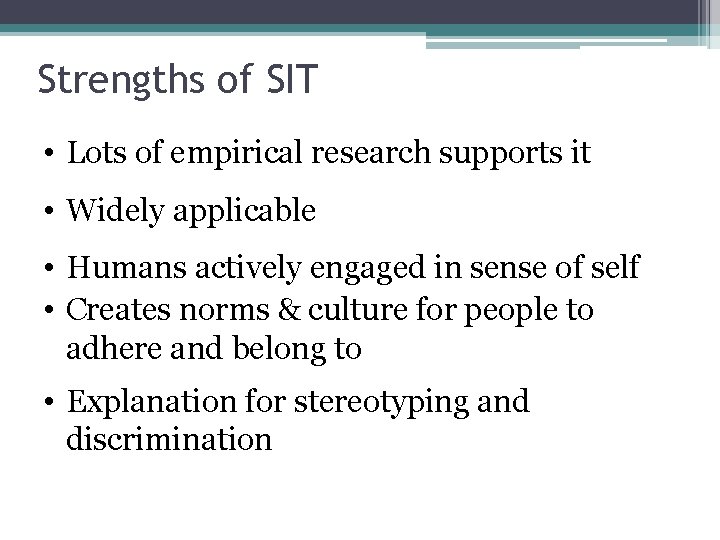
Strengths of SIT • Lots of empirical research supports it • Widely applicable • Humans actively engaged in sense of self • Creates norms & culture for people to adhere and belong to • Explanation for stereotyping and discrimination
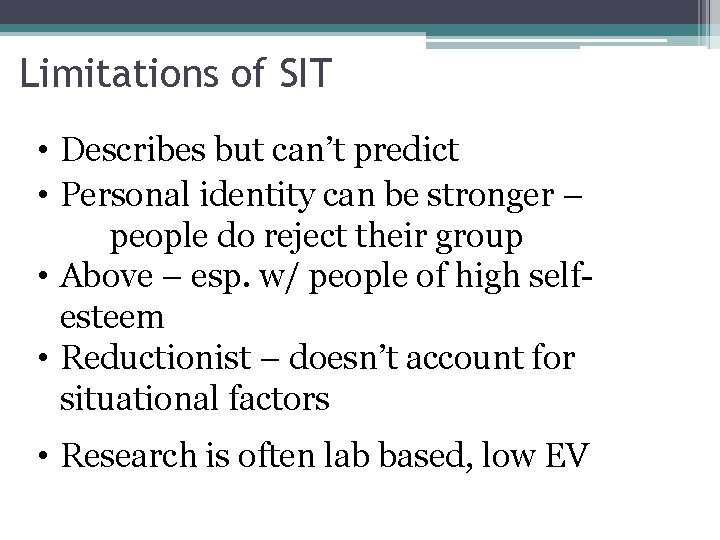
Limitations of SIT • Describes but can’t predict • Personal identity can be stronger – people do reject their group • Above – esp. w/ people of high selfesteem • Reductionist – doesn’t account for situational factors • Research is often lab based, low EV
Hey, we were talking about art earlier, so that’s my excuse to show you this… http: //distractify. com/trending/2016/02/01/mark-hairstylist-work-of-art
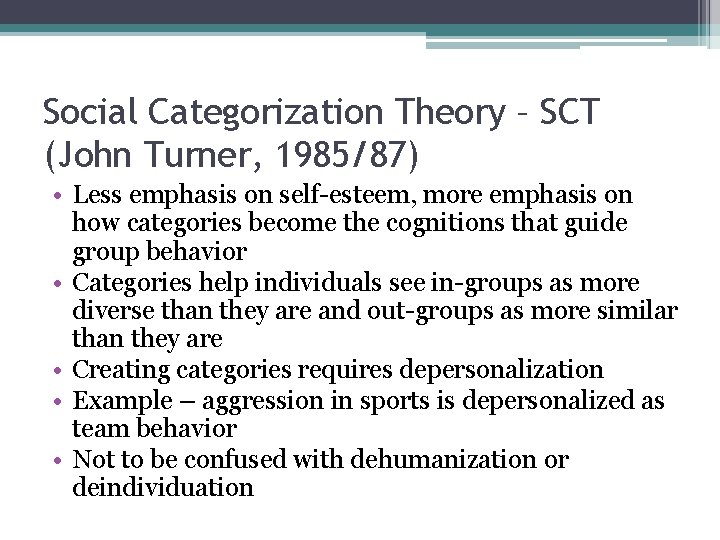
Social Categorization Theory – SCT (John Turner, 1985/87) • Less emphasis on self-esteem, more emphasis on how categories become the cognitions that guide group behavior • Categories help individuals see in-groups as more diverse than they are and out-groups as more similar than they are • Creating categories requires depersonalization • Example – aggression in sports is depersonalized as team behavior • Not to be confused with dehumanization or deindividuation
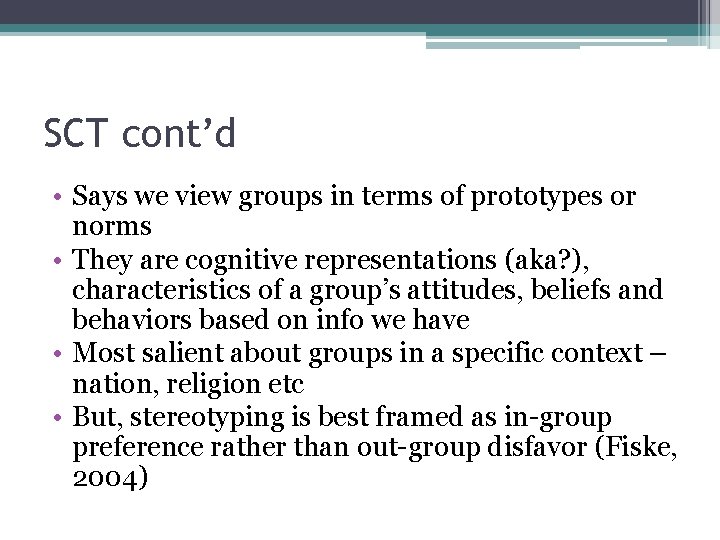
SCT cont’d • Says we view groups in terms of prototypes or norms • They are cognitive representations (aka? ), characteristics of a group’s attitudes, beliefs and behaviors based on info we have • Most salient about groups in a specific context – nation, religion etc • But, stereotyping is best framed as in-group preference rather than out-group disfavor (Fiske, 2004)
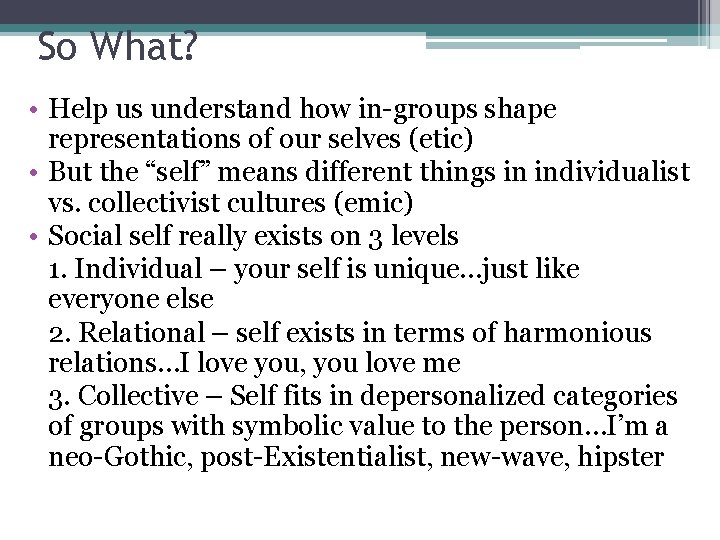
So What? • Help us understand how in-groups shape representations of our selves (etic) • But the “self” means different things in individualist vs. collectivist cultures (emic) • Social self really exists on 3 levels 1. Individual – your self is unique…just like everyone else 2. Relational – self exists in terms of harmonious relations…I love you, you love me 3. Collective – Self fits in depersonalized categories of groups with symbolic value to the person…I’m a neo-Gothic, post-Existentialist, new-wave, hipster
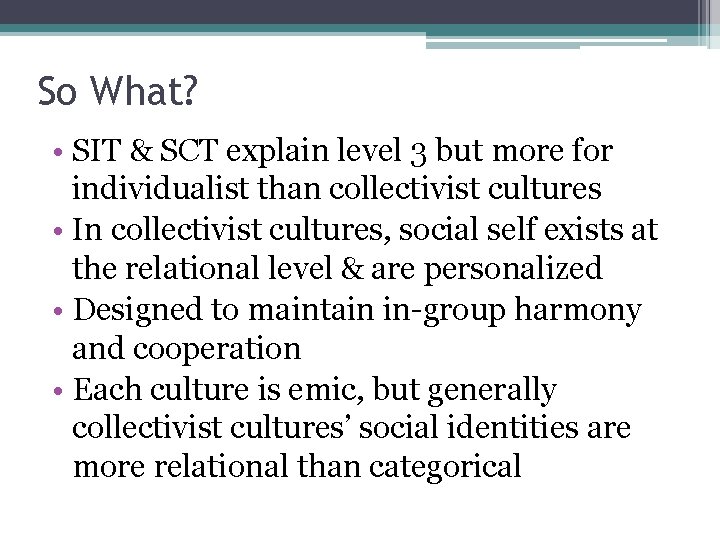
So What? • SIT & SCT explain level 3 but more for individualist than collectivist cultures • In collectivist cultures, social self exists at the relational level & are personalized • Designed to maintain in-group harmony and cooperation • Each culture is emic, but generally collectivist cultures’ social identities are more relational than categorical
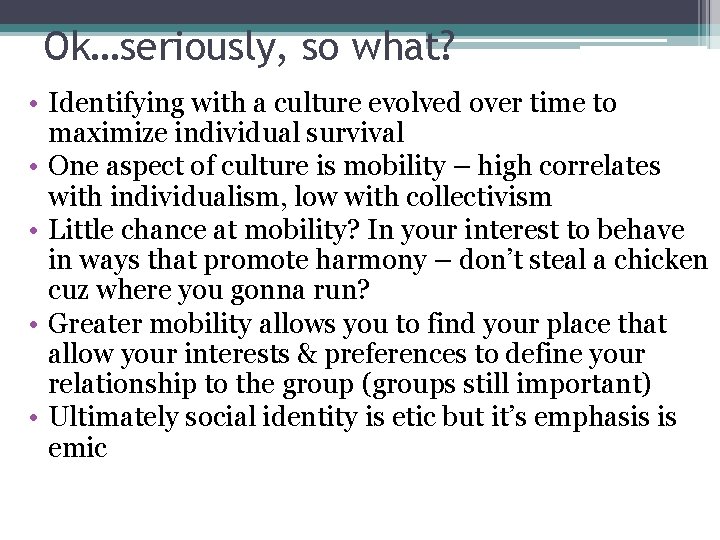
Ok…seriously, so what? • Identifying with a culture evolved over time to maximize individual survival • One aspect of culture is mobility – high correlates with individualism, low with collectivism • Little chance at mobility? In your interest to behave in ways that promote harmony – don’t steal a chicken cuz where you gonna run? • Greater mobility allows you to find your place that allow your interests & preferences to define your relationship to the group (groups still important) • Ultimately social identity is etic but it’s emphasis is emic