
Social Humans System are part of the ecosystem
- Slides: 21
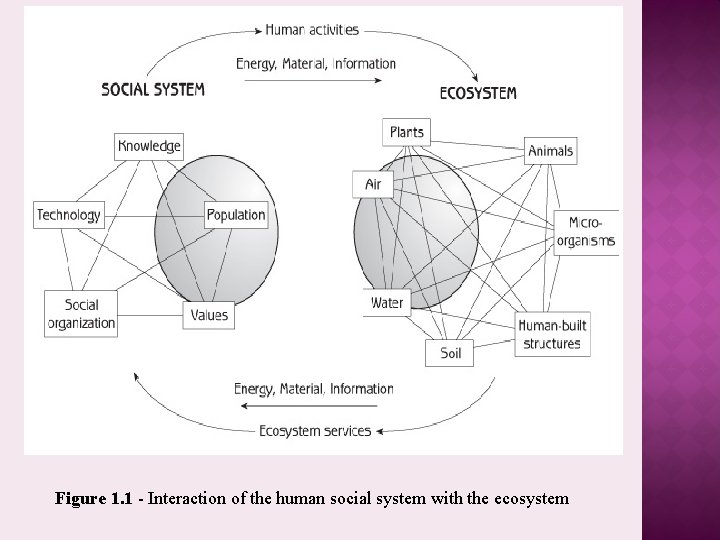
�Social � Humans System are part of the ecosystem; it is useful to think of human - environment interaction as interaction between the human social system and the rest of the ecosystem (see Figure 1. 1). � The social system is everything about people, their population and the psychology and social organization that shape their behavior. � The social system is a central concept in human ecology because human activities that impact on ecosystems are strongly influenced by the society in which people live.
� Values and knowledge which together form our worldview as individuals and as a society shape the way that we process and interpret information and translate it into action. � Technology defines our repertoire of possible actions. � Social organization, and the social institutions that specify socially acceptable behavior, shape the possibilities into what we actually do. � Like ecosystems, social systems can be on any scale - from a family to the entire human population of the planet.
Figure 1. 1 - Interaction of the human social system with the ecosystem
� The ecosystem provides services to the social system by moving materials, energy and information to the social system to meet people’s needs. � These ecosystem services include water, fuel, food, materials for clothing, construction materials and recreation. Movements of materials are obvious; energy and information are less so. Every material object contains energy, most conspicuous in foods and fuels, and every object contains information in the way it is structured or organized.
�Information can move from ecosystems to social systems independent of materials. A hunter’s discovery of his prey, a farmer’s observation of his field, a city dweller’s assessment of traffic when crossing the street, and a refreshing walk in the woods are all transfers of information from ecosystem to social system. �
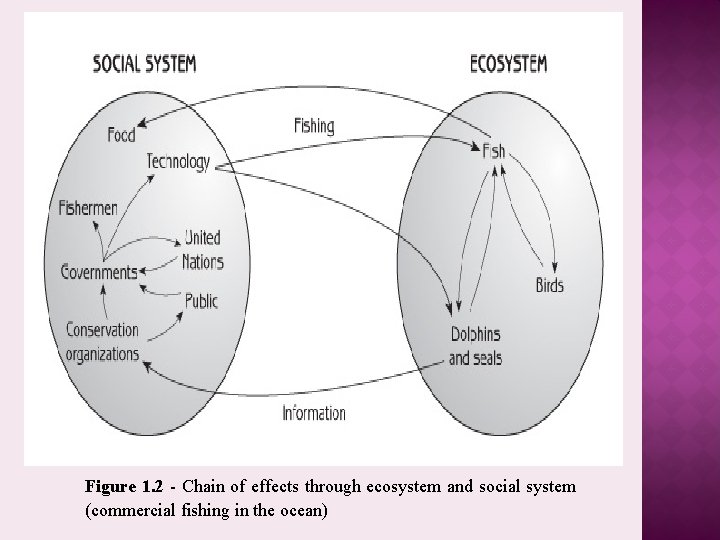
� Human ecology analyses the consequences of human activities as a chain of effects through the ecosystem and human social system. � The following story is about fishing. Fishing is directed toward one part of the marine ecosystem, namely fish, but fishing has unintended effects on other parts of the ecosystem. Those effects set in motion a series of additional effects that go back and forth between ecosystem and social system (see Figure 1. 2).
Figure 1. 2 - Chain of effects through ecosystem and social system (commercial fishing in the ocean)
� Drift nets are nylon nets that are invisible in the water. Fish become tangled in drift nets when they try to swim through them. � During the 1980 s, fishermen used thousands of kilometers of drift nets to catch fish in oceans around the world. In the mid-1980 s, it was discovered that drift nets were killing large numbers of dolphins, seals, turtles and other marine animals that drowned after becoming entangled in the nets - a transfer of information from ecosystem to social system, as depicted in Figure 1. 2
� When conservation organizations realized what the nets were doing to marine animals, they campaigned against drift nets, mobilizing public opinion to pressure governments to make their fishermen stop using the nets. � The governments of some nations did not respond, but other nations took the problem to the United Nations, which passed a resolution that all nations should stop using drift nets. At first, many fishermen did not want to stop using drift nets, but their governments forced them to change.
�Within a few years the fishermen switched from drift nets to long lines and other fishing methods. �Long lines, which feature baited hooks hanging from a main line often kilometers in length, have been a common method of fishing for many years. The long lines that fishermen now use put a total of several hundred million hooks in the oceans around the world.
� The drift net story shows how human activities can generate a chain of effects that passes back and forth between social system and ecosystem. � Fishing affected the ecosystem (by killing dolphins and seals), which in turn led to a change in the social system (fishing technology). And the story continues today. � About six years ago it was discovered that long lines are killing large numbers of sea birds, most notably albatross, when the lines are put into the water from fishing boats. Immediately after the hooks are reeled from the back of a boat into the water, birds fly down to eat the bait on hooks floating behind the boat near the surface of the water.
� The birds are caught on the hooks, dragged down into the water and drown. Because some species of birds could be driven to local extinction if the killing is not stopped, governments and fishermen are investigating modifications to long lines that will protect the birds. � Some fishermen are using a cover at the back of their boat to prevent birds from reaching the hooks, and others are adding weights to the hooks to sink them beyond the reach of birds before the birds can get to them. It has also been discovered that birds do not go after bait that is dyed blue. �
� The application of ecological concepts to epidemiology has similar roots to those of other disciplinary applications, with Carl Linnaeus having played a seminal role. � However, the term appears to have come into common use in the medical and public health literature in the mid-twentieth century. This was strengthened in 1971 by the publication of Epidemiology as Medical Ecology, and again in 1987 by the publication of a textbook on Public Health and Human Ecology.
� An “ecosystem health” perspective has emerged as a thematic movement, integrating research and practice from such fields as environmental management, public health, biodiversity, and economic development. Drawing in turn from the application of concepts such as the social-ecological model of health, human ecology has converged with the mainstream of global public health literature. �
�In addition to its links to other disciplines, human ecology has a strong historical linkage to the field of home economics through the work of Ellen Swallow Richards, among others. However, as early as the 1960 s, a number of universities began to rename "home economics" departments, schools, and colleges as "human ecology" programs.
�In part, this name change was a response to perceived difficulties with the term "home economics" in a modernizing society, and reflects recognition of "human ecology" as one of the initial choices for the discipline which was to become "home economics".
� Human ecology and home economics both look at how people live day-to-day and try to solve problems that affect people's daily lives. The difference between human ecology and home economics is one of scope. � For example, let's say you're looking for ways to save money on gas. As a home economist, you'd schedule all your weekly errands for the same day, look for places to shop closer to your house and possibly begin researching a more fuel-efficient car. � As a human ecologist, you would work as part of the development team designing more fuel-efficient cars. These differences show up in all areas of household management.
A home economist does meal planning and preparation. He might research recipes, prepare shopping lists, read books on nutrition and health and search for ways to help his family eat well within a reasonable budget. In some cases, he might pursue food preservation hobbies like canning or drying. �A human ecologist will do formal research into the effects of nutrition on the human body and the importance of food culture to a community. He'll use his research to come up with information and recommendations that may help the home economist succeed with his food and nutrition goals.
The home economist will shop for clothing and linens for her family. She'll set budgets, follow fashions and help determine what items of clothing different individuals in the family need. She may also know how to sew and take on the responsibility of doing basic repairs to damaged clothing or linen items. � The human ecologist will study and design fibers and fashions in hopes of helping people fulfill their basic need for clothing.
The home economist will work within his household to create a clean and safe environment. He'll choose cleaning supplies, assign chores to other members of the household and labor to keep things orderly and in good repair. � The human ecologist will study, research and develop cleaning supplies that support the goals of maintaining a clean and healthy home environment.
The home economist may set her mind to keeping items in the household organized and easy to access. She'll also work to create an environment that suits her taste and the taste of her family. She wants her home to be a place her family enjoys spending time in. � The human ecologist studies how home design, organization and planning affect family interactions. She uses what she learns to develop new organizational ideas and products that can help the home economist do more to create the home environment she wants.