
Social Housing Bill 29 of 2007 Preliminary response
Social Housing Bill 29 of 2007 Preliminary response Odette Crofton Acting Chief Director Social / Rental housing & PHP 12 September 2007
Outline • Context • Social housing policy • Social housing Bill Chapters – Chapter 1 – Chapter 2 – Chapter 3 – Chapter 4 – Chapter 5
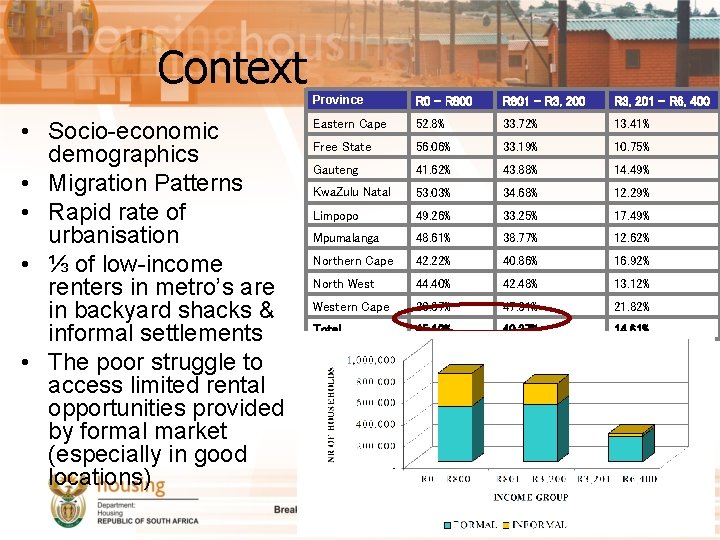
Context • Socio-economic demographics • Migration Patterns • Rapid rate of urbanisation • ⅓ of low-income renters in metro’s are in backyard shacks & informal settlements • The poor struggle to access limited rental opportunities provided by formal market (especially in good locations) Province R 0 – R 800 R 801 – R 3, 200 R 3, 201 – R 6, 400 Eastern Cape 52. 8% 33. 72% 13. 41% Free State 56. 06% 33. 19% 10. 75% Gauteng 41. 62% 43. 88% 14. 49% Kwa. Zulu Natal 53. 03% 34. 68% 12. 29% Limpopo 49. 26% 33. 25% 17. 49% Mpumalanga 48. 61% 38. 77% 12. 62% Northern Cape 42. 22% 40. 86% 16. 92% North West 44. 40% 42. 48% 13. 12% Western Cape 30. 87% 47. 31% 21. 82% Total 45. 12% 40. 27% 14. 61%
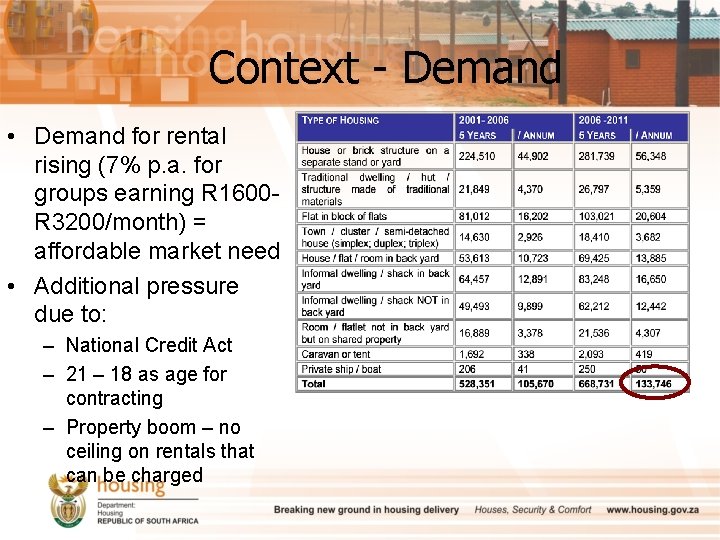
Context - Demand • Demand for rental rising (7% p. a. for groups earning R 1600 R 3200/month) = affordable market need • Additional pressure due to: – National Credit Act – 21 – 18 as age for contracting – Property boom – no ceiling on rentals that can be charged

Context • Basic Rental Formula Tenant pays Rent Common Denominator to occupy a Unit Definition: An agreement between a landlord and a tenant that gives the tenant the right to use and occupy rental property for a period of time
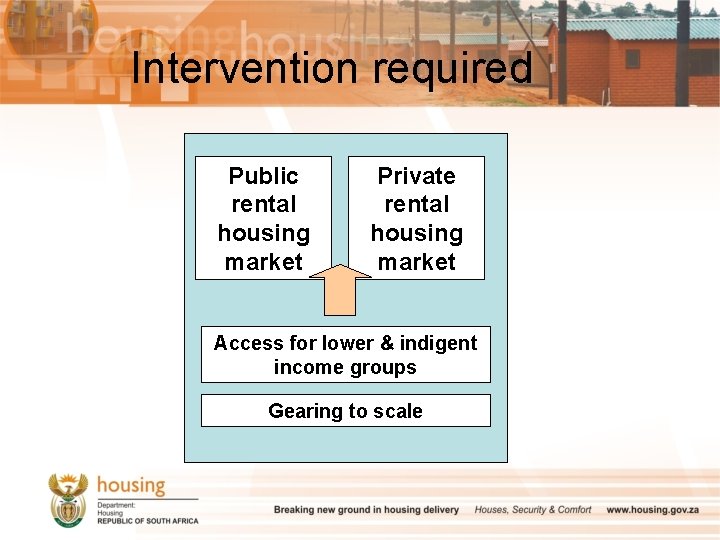
Intervention required Public rental housing market Private rental housing market Access for lower & indigent income groups Gearing to scale
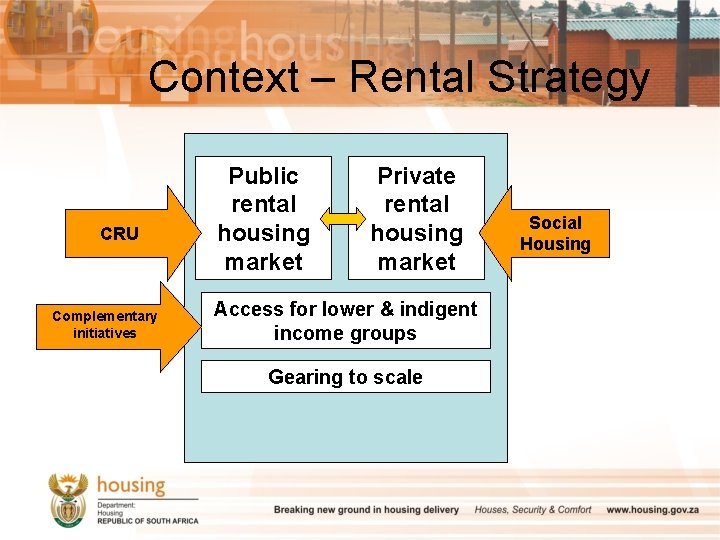
Context – Rental Strategy CRU Complementary initiatives Public rental housing market Private rental housing market Access for lower & indigent income groups Gearing to scale Social Housing
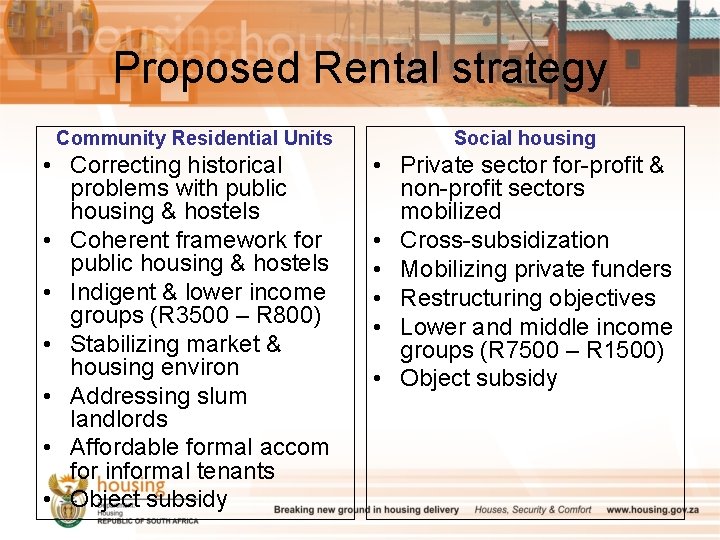
Proposed Rental strategy Community Residential Units • Correcting historical problems with public housing & hostels • Coherent framework for public housing & hostels • Indigent & lower income groups (R 3500 – R 800) • Stabilizing market & housing environ • Addressing slum landlords • Affordable formal accom for informal tenants • Object subsidy Social housing • Private sector for-profit & non-profit sectors mobilized • Cross-subsidization • Mobilizing private funders • Restructuring objectives • Lower and middle income groups (R 7500 – R 1500) • Object subsidy

Social housing policy • SH programme involves a mixture of gov grants, private sector funding and equity • Focus on involvement of private sector • Allowing for maximum cross subsidisation from higher/middle income to support lower income • Targeted & focused programme, not mass delivery • Restructuring objectives
Definition of social housing • A rental or co-operative housing option for to low income persons at a level of scale and built form which requires institutionalised management and which is provided by accredited social housing institutions or in accredited social housing projects in designated restructuring zones
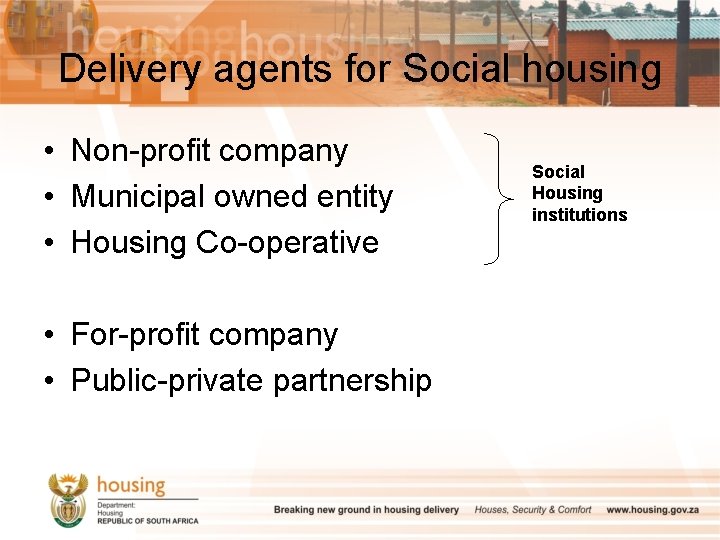
Delivery agents for Social housing • Non-profit company • Municipal owned entity • Housing Co-operative • For-profit company • Public-private partnership Social Housing institutions
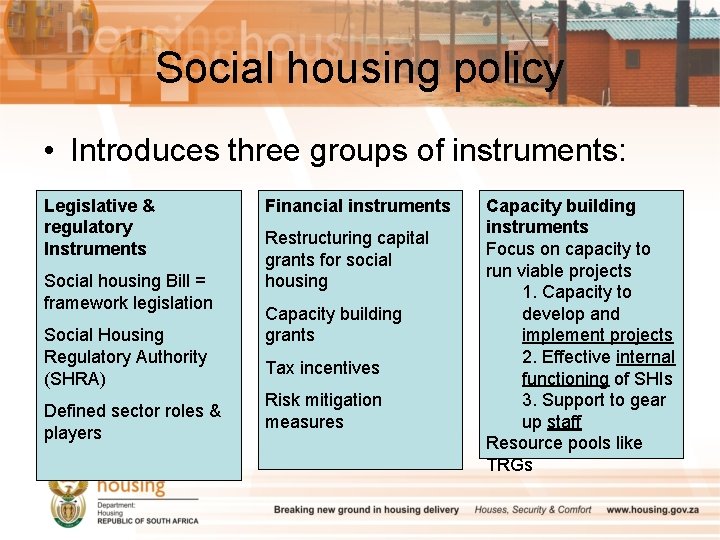
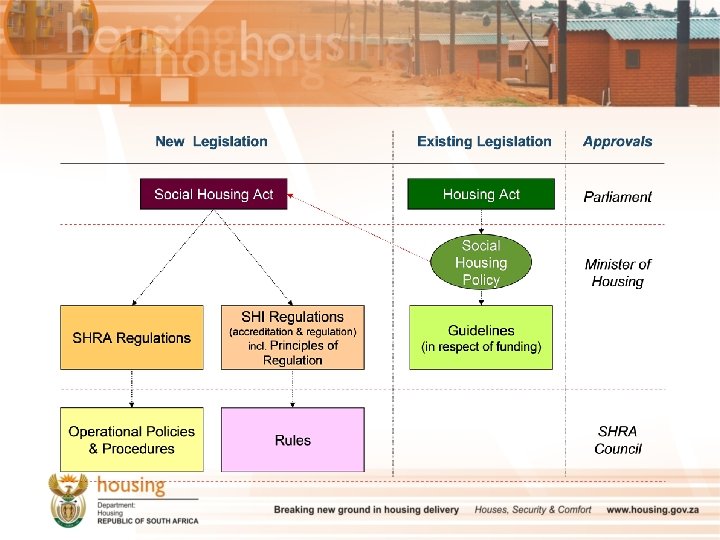
Social housing policy • Introduces three groups of instruments: Legislative & regulatory Instruments Social housing Bill = framework legislation Social Housing Regulatory Authority (SHRA) Defined sector roles & players Financial instruments Restructuring capital grants for social housing Capacity building grants Tax incentives Risk mitigation measures Capacity building instruments Focus on capacity to run viable projects 1. Capacity to develop and implement projects 2. Effective internal functioning of SHIs 3. Support to gear up staff Resource pools like TRGs

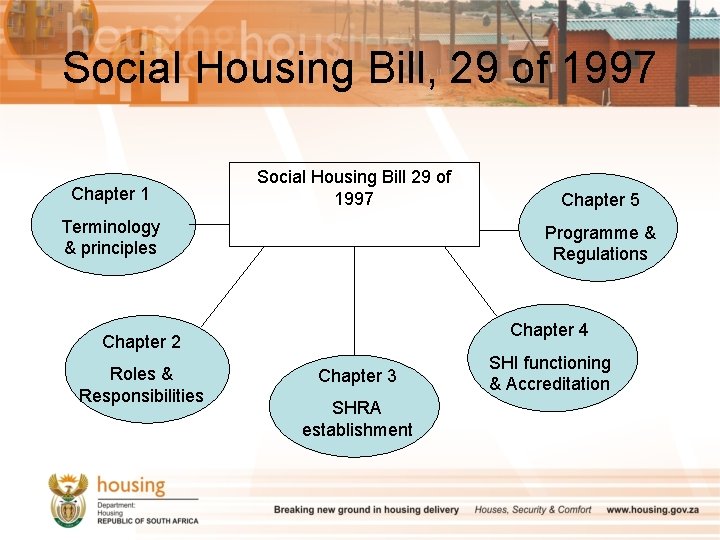
Social Housing Bill, 29 of 1997 Chapter 1 Social Housing Bill 29 of 1997 Terminology & principles Programme & Regulations Chapter 4 Chapter 2 Roles & Responsibilities Chapter 5 Chapter 3 SHRA establishment SHI functioning & Accreditation
Chapter 1 Terminology & definitions ambiguity: • Approved projects vs accredited projects • Low & medium income groups • Lease agreements • Maladministration • Social housing – not include rent-to-buy • Principles – specific to SH, rather than all from housing act and SH policy
Chapter 2 • Roles & responsibilities not duplicate roles & responsibilities in Housing Act • Co-ordination & alignment as part of the process • MFMA, PFMA alignment
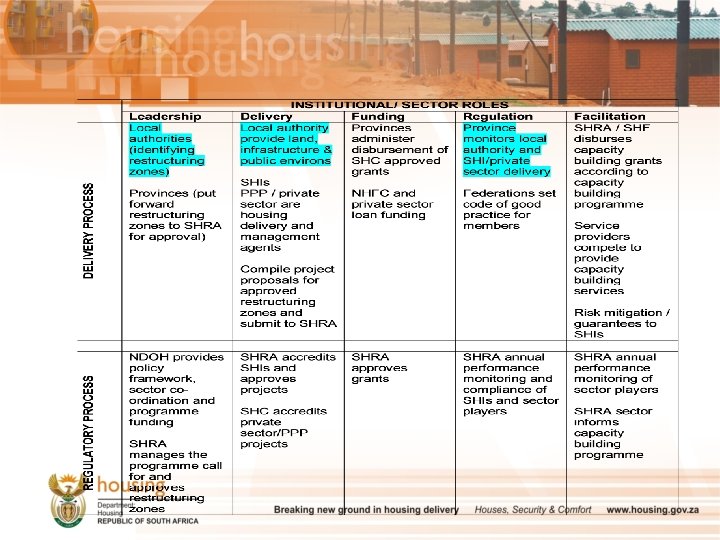
Chapter 3 • Council member appointment vs independence of the council • “fit” & proper members on the council • All delivery agents are monitored, but in different ways – SHIs (non-profits) vs Forprofits • Inspections & intervention
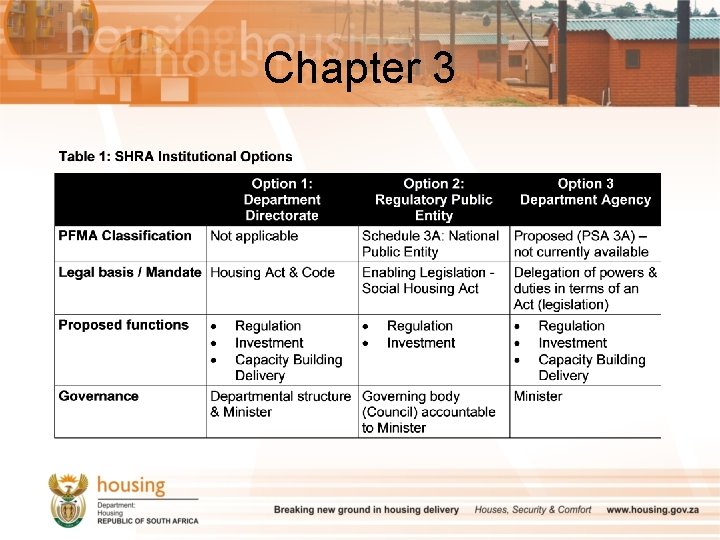
Chapter 3
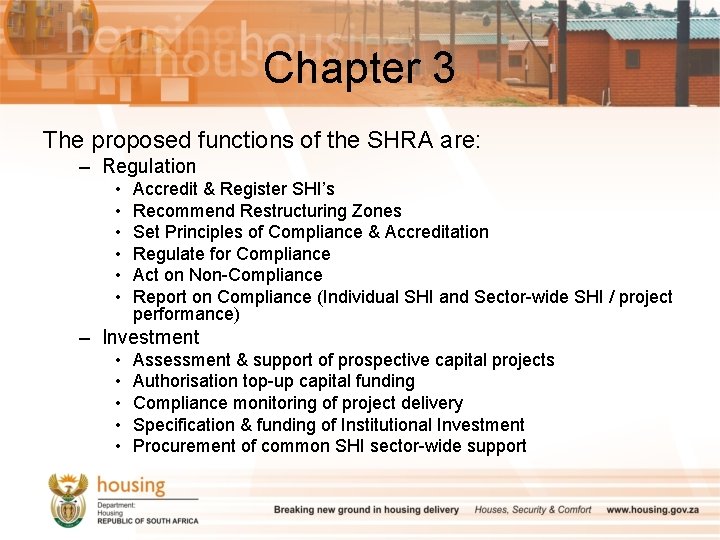
Chapter 3 The proposed functions of the SHRA are: – Regulation • • • Accredit & Register SHI’s Recommend Restructuring Zones Set Principles of Compliance & Accreditation Regulate for Compliance Act on Non-Compliance Report on Compliance (Individual SHI and Sector-wide SHI / project performance) – Investment • • • Assessment & support of prospective capital projects Authorisation top-up capital funding Compliance monitoring of project delivery Specification & funding of Institutional Investment Procurement of common SHI sector-wide support
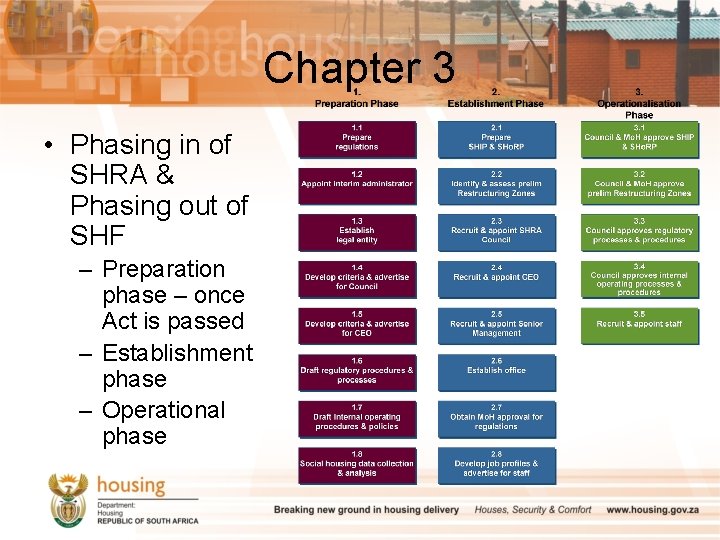
Chapter 3 • Phasing in of SHRA & Phasing out of SHF – Preparation phase – once Act is passed – Establishment phase – Operational phase
Chapter 4 • Dealing with existing institutions – turnaround programme • Data and information on the SHIs
Chapter 5 • Regulations to the bill – Code of conduct – Investment criteria & qualifying criteria – SHRA & other delivery agents – SHRA & provinces – SHRA & NHFC – Administrative matter
Chapter 5 - Funding SH Sources of funding: • Share capital • Shareholders loan • Senior bank debt • NHFC debt • Other debt • SH Restructuring grant • Staff gear-up grant • Provincial top-up (inst subsidy) Application of funding: • Project Costs – CAPEX – Overheads – Vat • Financing costs – Interest during construction – Commitment fees – Underwriting fees
Financial model for SH Key project variables measured to ensure a viable project • Project IRR pre-tax, post-grant (excludes residual value) • Maximum Weighted Average Cost of Capital • Initial yield on total capital cost • Initial yield on capital cost less grant • Initial yield on equity • Return on equity (Ro. E) • Minimum debt service cover ratio • Maximum cost to income ratio • Loan to value
Concluding comments • Process of dealing with public comments • Budget for social housing • Dealing with Housing delivery process blockages (land, land release, EIA, township establishment, etc)
• Urgency of the Bill – Stability, clarity and direction in the sector – Growth in the Industry – Harness bigger and more institutions into the sector – Entice and provide comfort for funders (local & international
- Slides: 29