
Social Genomics II Air Pollution and the Brain
Social Genomics II: “Air Pollution and the Brain” Anita Webb, Ph. D JPS Health Network Fort Worth, Texas
Key Points • • • Known: Air pollution can harm lungs Newer: Air pollution can harm brains May damage child’s cognitive abilities Increase risk of adult cognitive decline Possibly increase risk of depression
Review: “Social Genomics I” * • Environmental factors can affect gene expression. • The environment, including social factors, can ultimately determine genetic profiles. • New explanations are emerging for chronic medical problems. • *[See Power. Point at: www. fmdrl. org]
Example: Air Pollution • Known: • Pollution can harm the body – Cardiovascular health – Respiratory health • Newer research – Effects on the brain?
Impact on the Brain? • • Especially, How does air pollution impact: Children’s brain development? Brain function in older adults?
KNOWN: • Air pollution is harmful to overall health • Also specifically affects the brain – Adult cognitive decline – Possibly depression – P. Mohai – (multiple studies 1992 -2011+)
“Particulate Matter” • Two types in air pollution – “Fine” – “Coarse” • Fine particulate matter – Can more easily pass into blood stream – And then into the brain – Causing cognitive decline
![[Newer Finding] • Coarse particulate matter • Is also associated with • Cognitive decline.](http://slidetodoc.com/presentation_image_h2/dbba7c0018b879ad9ea437f37ff00818/image-8.jpg "[Newer Finding] • Coarse particulate matter • Is also associated with • Cognitive decline.")
[Newer Finding] • Coarse particulate matter • Is also associated with • Cognitive decline. • J. Weuve. Arch Int Med (2012)

“Fine Particulate Matter” • Pollution from – Power plants, factories, motor vehicles – “ 1/30 th width of human hair” • One of six principal pollutants monitored by the Environmental Protection Agency • Research evidence suggests – Harmful cardiovascular effects
“Fine Particulate” • • More dangerous than “course matter” Example: diesel exhaust Black carbon: “Essentially soot” Boston Studies – Children – Adults
Boston: Children • Birth to mean age 10: N = 200+ • High levels of factory “black carbon” pollution in their environment • Research results – Decreased scores on cognitive tests – Memory, verbal IQ and nonverbal IQ • (Am J. Epidemiology 2008)
Boston: Adults • Older men, N=680 • Decreased scores on cognitive tests – Equal to two years of aging • Conclusion: Decline was due to air pollution – Potential Confounds: Traffic noise and gases • At risk for cognitive impairment, dementia – (Environ. Health Perspectives 2011)
New York City Children • New York City: Fossil fuel exposure • (Polycyclic aromatic hydrocarbons) • Measured exposure in utero to age 6/7 • At age 6/7, fossil fuel exposure correlated with • Impaired attention • Increased anxiety and depression • Perera. Env. Health Perspectives, 2012.
Industrial Pollution • Public school children in Michigan • In highest industrial pollution areas • Correlations: – Lowest attendance rates – Highest failure rates on state testing – Controlling for confounds • Including socioeconomic status • (P. Mohai et al, 2011)
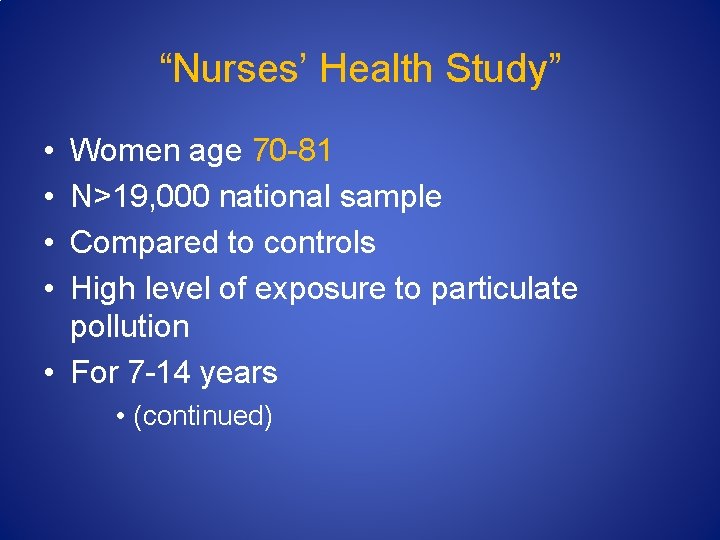
“Nurses’ Health Study” • • Women age 70 -81 N>19, 000 national sample Compared to controls High level of exposure to particulate pollution • For 7 -14 years • (continued)
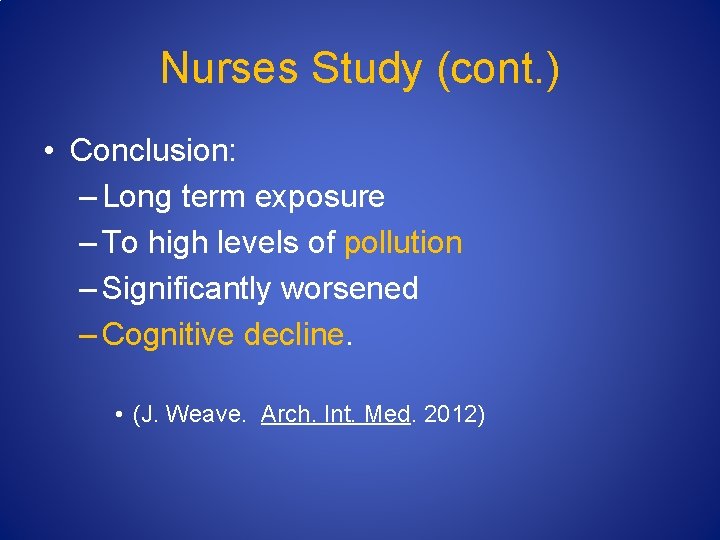
Nurses Study (cont. ) • Conclusion: – Long term exposure – To high levels of pollution – Significantly worsened – Cognitive decline. • (J. Weave. Arch. Int. Med. 2012)

Hypothesis • • • The cumulative results of these studies Suggest that particulate air pollution Deserves closer scrutiny As a risk factor For cognitive impairment And perhaps dementia. – (Weir 2012)
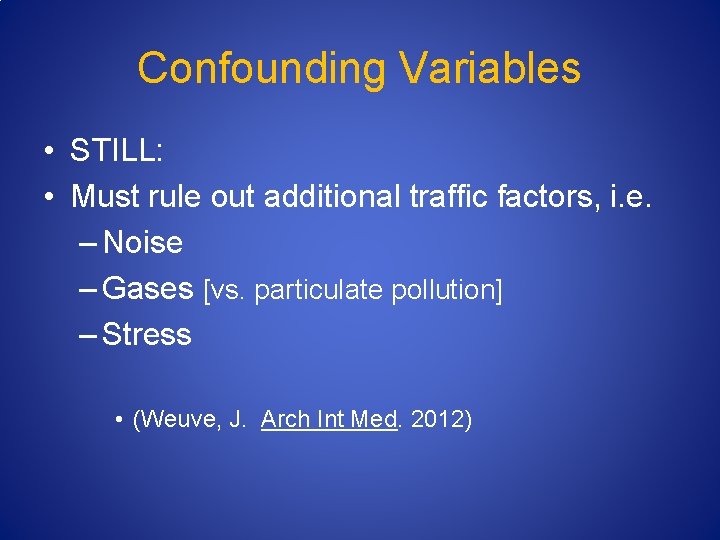
Confounding Variables • STILL: • Must rule out additional traffic factors, i. e. – Noise – Gases [vs. particulate pollution] – Stress • (Weuve, J. Arch Int Med. 2012)
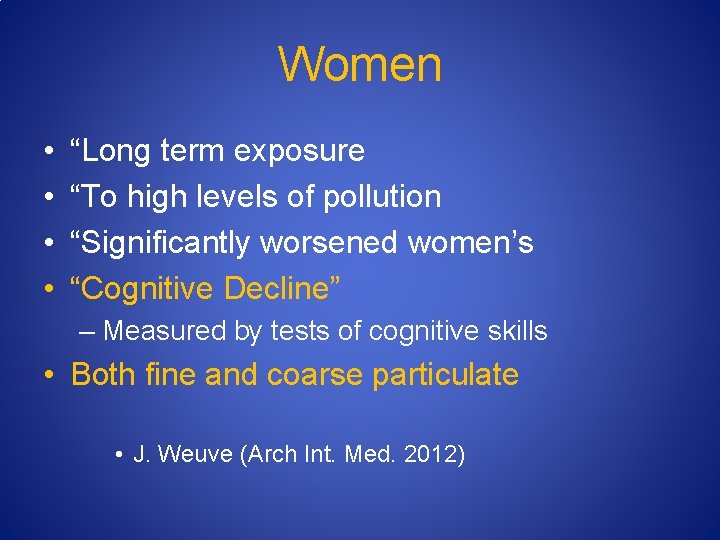
Women • • “Long term exposure “To high levels of pollution “Significantly worsened women’s “Cognitive Decline” – Measured by tests of cognitive skills • Both fine and coarse particulate • J. Weuve (Arch Int. Med. 2012)
Animal Study • Mice exposed to high levels of – Particulate air pollution – 8 hours/day, 5 days/week, x 10 months • Brain autopsies found: – Inflammation – Structural changes in hippocampus • Decreased dendritic complexity • (Correlates with poorer memory)
Mice (continued) • Impaired behavior – Decreased performance on maze task – Failure in swim test – Suggestive of “depression” • Responded to antidepressant medication • Improved performance • (Nelson 2011, Molecular Psychiatry)
Mexico City: Dogs • Well known air pollution problems • Results of autopsies on dog brains – Inflammation and pathology – Amyloid plaques – Neurofibrillary tangles • [i. e. Primary markers for Alzheimer’s Disease] – Calderon-Garciduenas – Toxicol. Path. 2003
Mexico City: Children • Comparison: – N= 55 children in Mexico City – N=18 children in Mexican town with cleaner air • MRI results: Children in Mexico City – “Significantly more likely” to have • Brain inflammation • Damage in prefrontal cortex – (continued)
Results (continued) • Mexico City children test results – Compared to control group • Lower Test Scores – Memory, cognitive function and I. Q. • Measurable anatomical differences • Conclusion: – Pollution can negatively affect the brain
Mechanism of Damage • Neuro-inflammation – Disrupts the blood-brain barrier • A key factor in many central nervous system disorders, e. g. – Alzheimer’s Disease – Parkinson’s Disease • (Brain and Cognition, 2008)
Key Points • • • Known: Air pollution can harm lungs Newer: Air pollution can harm brains May damage child’s cognitive abilities Increase risk of adult cognitive decline Possibly increase risk of depression
Primary Reference • • Weir, Kirsten “Smog in Our Brains” Monitor on Psychology July/August 2012, 43, (7): 33 -37.
- Slides: 27