
Social Enterprise Development How to create a sustainable
Social Enterprise Development How to create a sustainable bio-economy business that has an environmental or social mission
Social Enterprise Development Key Learning Outcomes • Get an overview of the social enterprise concept • Learn about the challenges for social enterprises • Lean about models for scaling up and practices in a social enterprise • An understanding on policy considerations around sustainable enterprises including push and pull measures and public procurement
Overview of social enterprise What is a Social Enterprise? A business that trades for a social purpose There is no universally accepted definition of a social enterprise but they always have 2 goals: 1. To achieve social, cultural, community and/or environmental outcomes 2. To earn revenue Social Enterprise tend to: • • • Be commercially focused business with a clear social and/or environmental mission Earn the majority of income from trading Primarily re-invest profit in the business and social/environmental objectives Commitment to the social and/or environmental goals are as core to success as profit. Have various legal structures including mutual organisations, community interest company, social business, & co-operatives and this can vary in different countries.
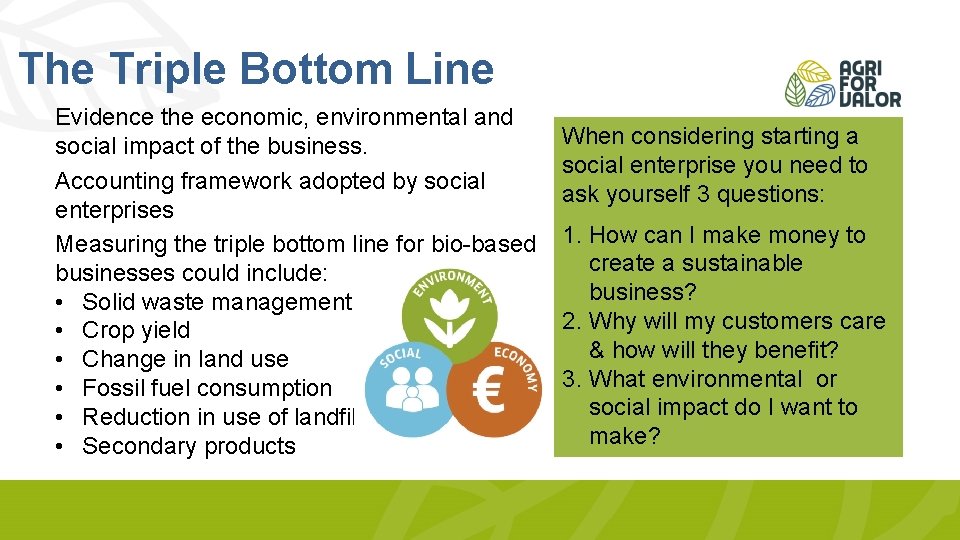
The Triple Bottom Line Evidence the economic, environmental and social impact of the business. Accounting framework adopted by social enterprises Measuring the triple bottom line for bio-based businesses could include: • Solid waste management • Crop yield • Change in land use • Fossil fuel consumption • Reduction in use of landfill • Secondary products When considering starting a social enterprise you need to ask yourself 3 questions: 1. How can I make money to create a sustainable business? 2. Why will my customers care & how will they benefit? 3. What environmental or social impact do I want to make?
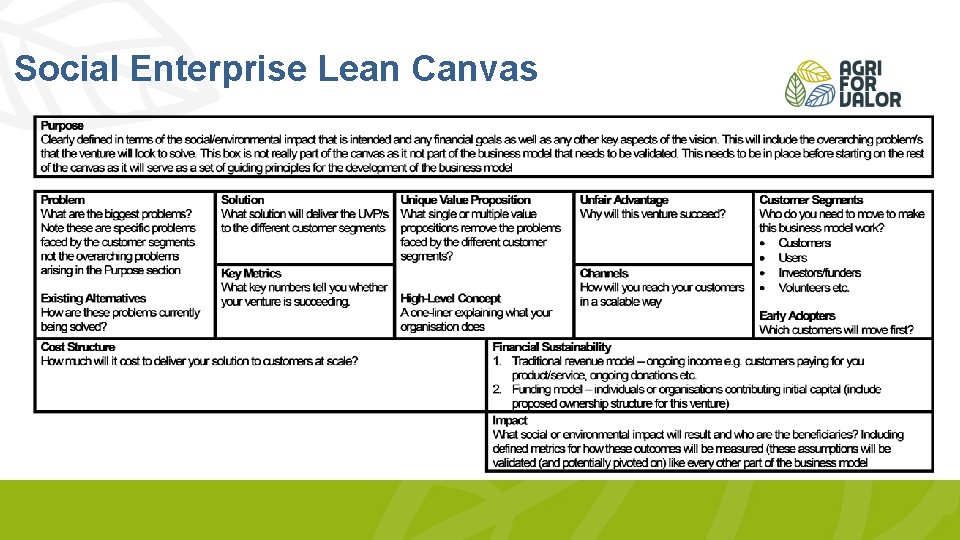
Social Enterprise Lean Canvas
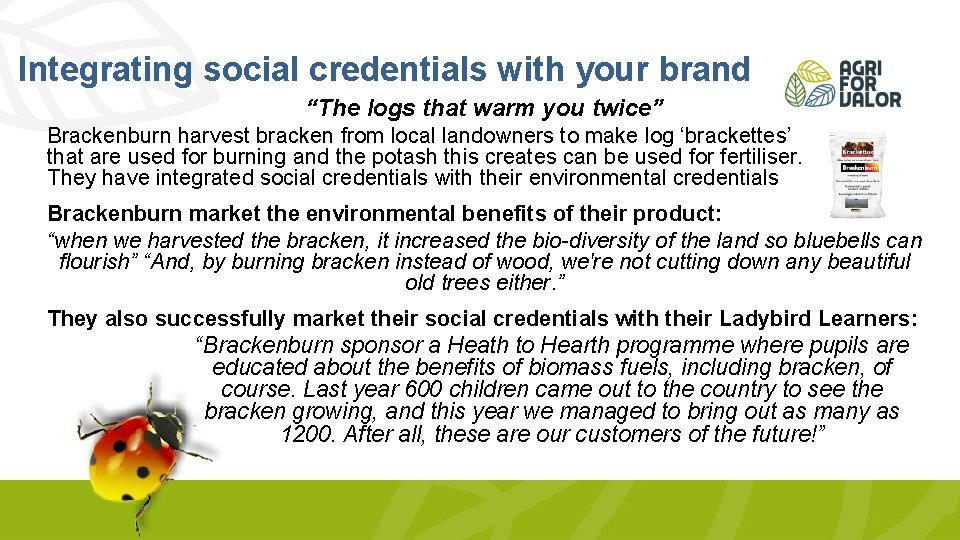
Integrating social credentials with your brand “The logs that warm you twice” Brackenburn harvest bracken from local landowners to make log ‘brackettes’ that are used for burning and the potash this creates can be used for fertiliser. They have integrated social credentials with their environmental credentials Brackenburn market the environmental benefits of their product: “when we harvested the bracken, it increased the bio-diversity of the land so bluebells can flourish” “And, by burning bracken instead of wood, we're not cutting down any beautiful old trees either. ” They also successfully market their social credentials with their Ladybird Learners: “Brackenburn sponsor a Heath to Hearth programme where pupils are educated about the benefits of biomass fuels, including bracken, of course. Last year 600 children came out to the country to see the bracken growing, and this year we managed to bring out as many as 1200. After all, these are our customers of the future!”
Challenges for bio-based social enterprises • Competing: Up against much larger companies or local councils. • Accessing Finance: Can be a struggle to access mainstream finance. • Over-reliance on financial support: Political or economic changes can cause difficulties • Accessing Support: Increasing number of support agencies throughout Europe. • Unfamiliarity: Lack of a fixed definition of social enterprise can lead to confusion • Finding a business model: Need to create a number of revenue streams. • Clarity of purpose: Strike the balance between diversifying & core mission. • Partnering: Ensuring values align with your partner or collaborator • Scaling: It can be difficult to create a scalable business model.
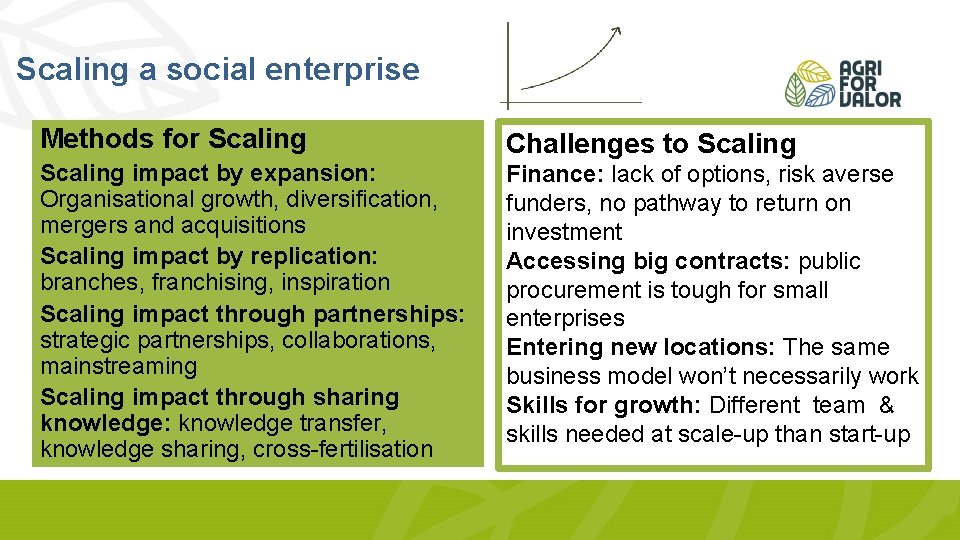
Scaling a social enterprise Methods for Scaling Challenges to Scaling impact by expansion: Organisational growth, diversification, mergers and acquisitions Scaling impact by replication: branches, franchising, inspiration Scaling impact through partnerships: strategic partnerships, collaborations, mainstreaming Scaling impact through sharing knowledge: knowledge transfer, knowledge sharing, cross-fertilisation Finance: lack of options, risk averse funders, no pathway to return on investment Accessing big contracts: public procurement is tough for small enterprises Entering new locations: The same business model won’t necessarily work Skills for growth: Different team & skills needed at scale-up than start-up
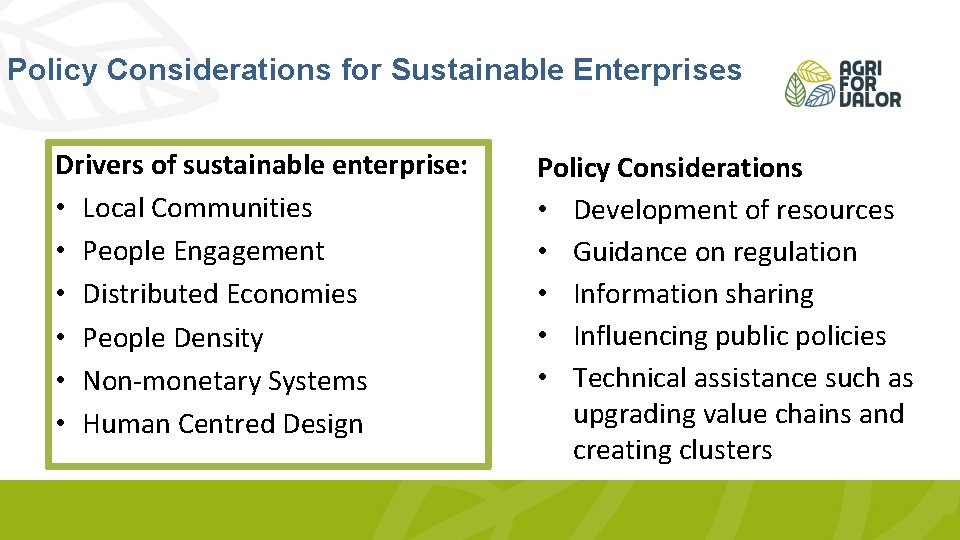
Policy Considerations for Sustainable Enterprises Drivers of sustainable enterprise: • Local Communities • People Engagement • Distributed Economies • People Density • Non-monetary Systems • Human Centred Design Policy Considerations • Development of resources • Guidance on regulation • Information sharing • Influencing public policies • Technical assistance such as upgrading value chains and creating clusters
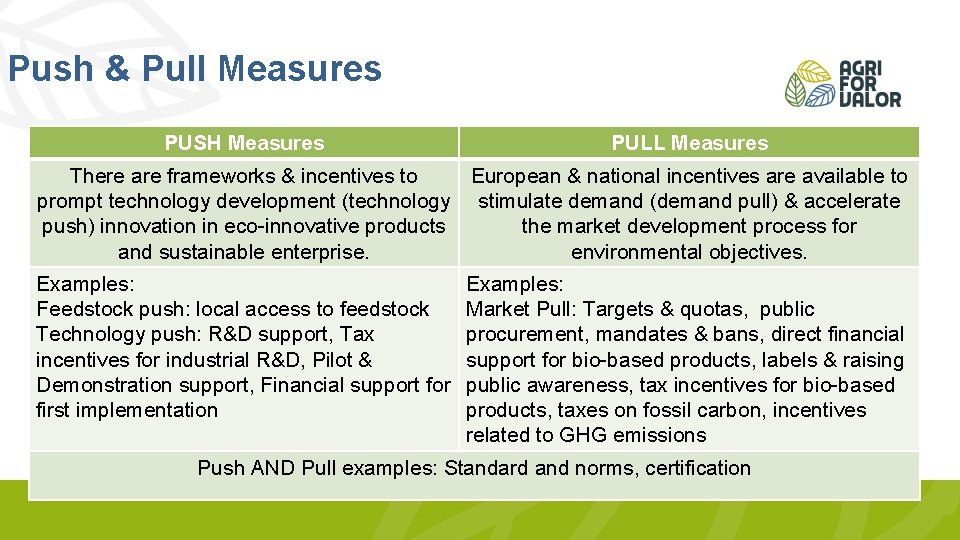
Push & Pull Measures PUSH Measures PULL Measures There are frameworks & incentives to European & national incentives are available to prompt technology development (technology stimulate demand (demand pull) & accelerate push) innovation in eco-innovative products the market development process for and sustainable enterprise. environmental objectives. Examples: Feedstock push: local access to feedstock Technology push: R&D support, Tax incentives for industrial R&D, Pilot & Demonstration support, Financial support for first implementation Examples: Market Pull: Targets & quotas, public procurement, mandates & bans, direct financial support for bio-based products, labels & raising public awareness, tax incentives for bio-based products, taxes on fossil carbon, incentives related to GHG emissions Push AND Pull examples: Standard and norms, certification
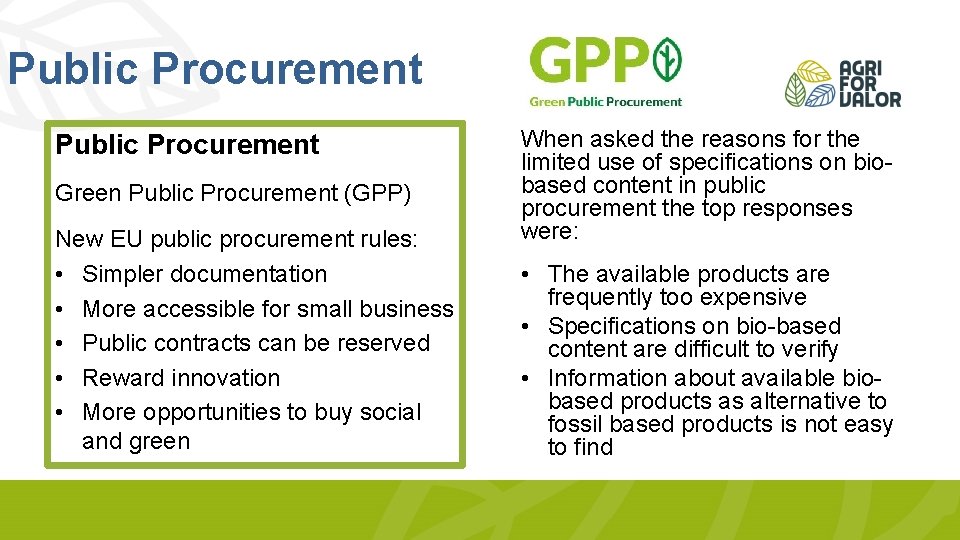
Public Procurement Green Public Procurement (GPP) New EU public procurement rules: • Simpler documentation • More accessible for small business • Public contracts can be reserved • Reward innovation • More opportunities to buy social and green When asked the reasons for the limited use of specifications on biobased content in public procurement the top responses were: • The available products are frequently too expensive • Specifications on bio-based content are difficult to verify • Information about available biobased products as alternative to fossil based products is not easy to find
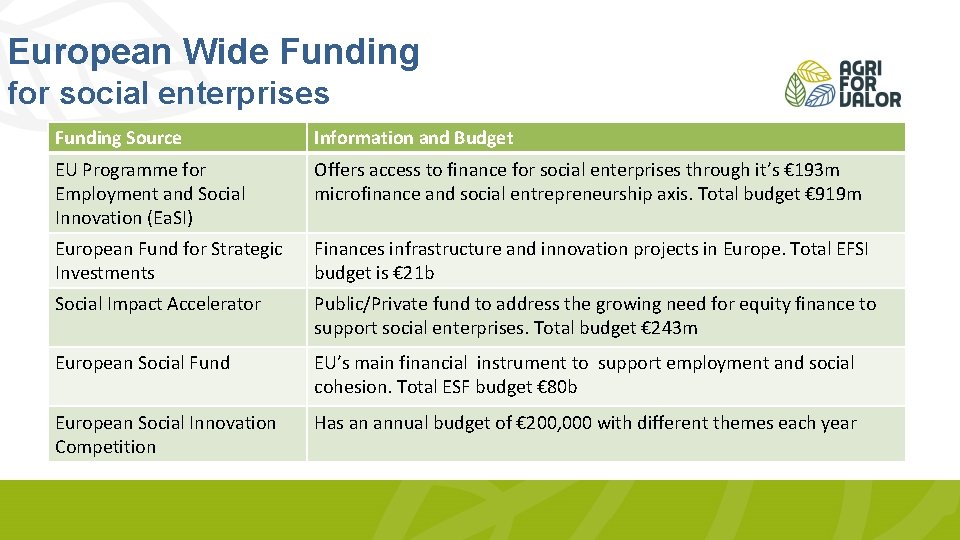
European Wide Funding for social enterprises Funding Source Information and Budget EU Programme for Employment and Social Innovation (Ea. SI) Offers access to finance for social enterprises through it’s € 193 m microfinance and social entrepreneurship axis. Total budget € 919 m European Fund for Strategic Investments Finances infrastructure and innovation projects in Europe. Total EFSI budget is € 21 b Social Impact Accelerator Public/Private fund to address the growing need for equity finance to support social enterprises. Total budget € 243 m European Social Fund EU’s main financial instrument to support employment and social cohesion. Total ESF budget € 80 b European Social Innovation Competition Has an annual budget of € 200, 000 with different themes each year
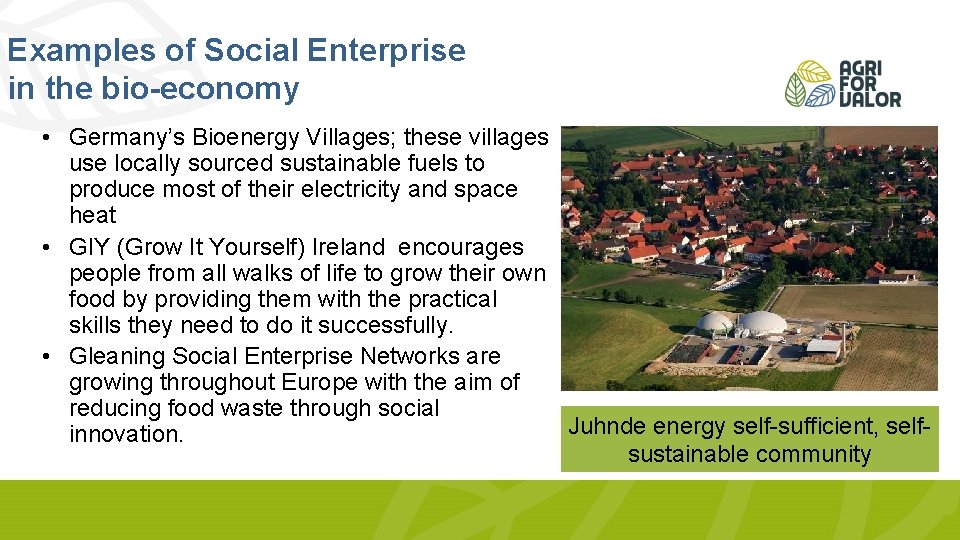
Examples of Social Enterprise in the bio-economy • Germany’s Bioenergy Villages; these villages use locally sourced sustainable fuels to produce most of their electricity and space heat • GIY (Grow It Yourself) Ireland encourages people from all walks of life to grow their own food by providing them with the practical skills they need to do it successfully. • Gleaning Social Enterprise Networks are growing throughout Europe with the aim of reducing food waste through social Juhnde energy self-sufficient, selfinnovation. sustainable community
Further Information & Resources • • • The Social Lean Canvas and the Social Business Model Canvas European Commission on Green Public Procurement and Social Enterprises European Federation of Renewable Energy Cooperatives Policy Brief on Scaling the Impact of Social Enterprises Social Enterprise in Europe Developing Legal Systems that Support Social Enterprise Growth Social Enterprising Europe (SEE) Project Irish Social Enterprise Network NESs. T Hungary Social Enterprises Spanish and Latin American Social Enterprises European Venture Philanthropy Association overview of EU funding for social entrepreneurship Options for Designing a New Political Framework of the European Bio-based Economy with information on technology push and market pull
Now you can: • Decide whether a social enterprise is the right approach for your business • Work towards a sustainable triple bottom line • Develop your own social business model using the social enterprise lean canvas • Scale your social enterprise using different methods • Use push and pull measures to market • Access public procurement to sell your products or services
- Slides: 15