
SOCIAL EMOTIONAL Development of Highly Gifted Students Dabrowskis
SOCIAL EMOTIONAL Development of Highly Gifted Students Dabrowski’s Theories
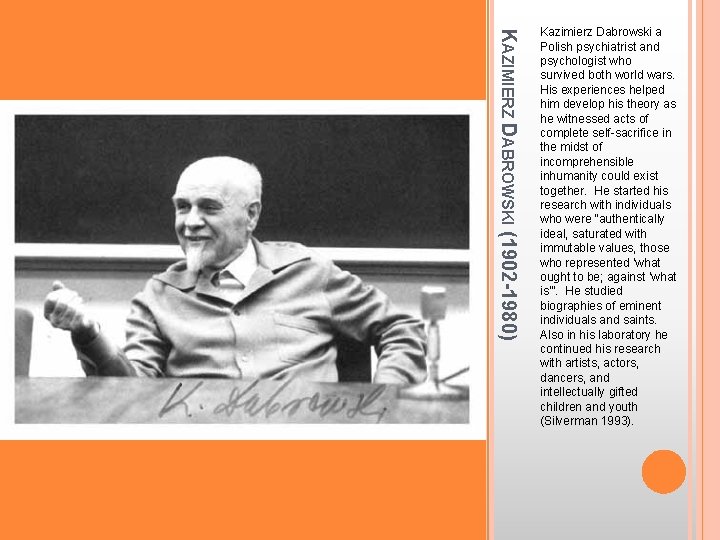
KAZIMIERZ DABROWSKI (1902 -1980) Kazimierz Dabrowski a Polish psychiatrist and psychologist who survived both world wars. His experiences helped him develop his theory as he witnessed acts of complete self-sacrifice in the midst of incomprehensible inhumanity could exist together. He started his research with individuals who were “authentically ideal, saturated with immutable values, those who represented ‘what ought to be; against ‘what is’”. He studied biographies of eminent individuals and saints. Also in his laboratory he continued his research with artists, actors, dancers, and intellectually gifted children and youth (Silverman 1993).
THE OVEREXCITABILITIES Type Characteristic Psychomotor Sensual Imaginational Intellectual Emotional Endless Energy Unusual capacity to care Vivid imagination Love of learning Emotional energy
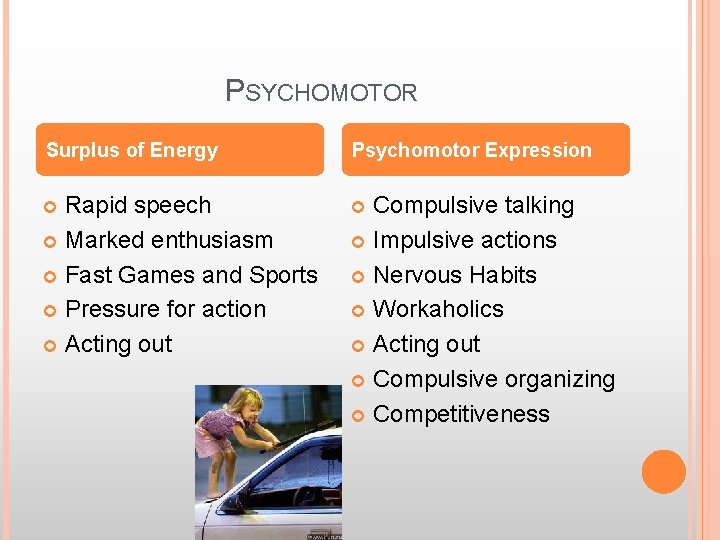
PSYCHOMOTOR Surplus of Energy Psychomotor Expression Rapid speech Marked enthusiasm Fast Games and Sports Pressure for action Acting out Compulsive talking Impulsive actions Nervous Habits Workaholics Acting out Compulsive organizing Competitiveness

SENSUAL Sensory Pleasure Seeing-appreciation of aesthetic and beautiful objects. Smelling-very sensitive to smells and aromas. Tasting-cherishes memories of particular food. Touching-loves textures Hearing-enjoys sounds of nature and music. Sensual Expression Overeating Sexual Overindulgence Buying Sprees Wanting to be in the limelight Sensitive to touch and fit of clothes Negative reaction to noise Constantly bombarded by stimuli Notice a great deal in their environment

INTELLECTUAL Probing questions, Problem Solving and Learning Curiosity Concentration Capacity of sustained intellectual effort Avid Reading Detailed Planning Theoretical Thinking about thinking Analytical thinking Introspection Love of theory and analysis Moral thinking Conceptual and intuitive integration
IMAGINATIONAL Free Play of the Imagination Frequent use of image and metaphor Facility for invention and fantasy Facility for detailed visualizing Poetic and dramatic perception Animistic and magical thinking Spontaneous Imagery as an expression of emotional tension Animistic imagery Mixing truth and fiction Elaborate dreams Illusions Detailed visual recall Fears of the unknown Tendency to dramatize
EMOTIONAL Intensity of Feeling Relationship feelings Positive and Negative feelings Extremes of emotions Identification with others’ feelings Emotional ties and attachments Concern for others Sensitivity in relationships Attachment to animals Difficulty adjusting to new environments
EMOTIONAL CONTINUED… Somatic Expression Inhibition Tense stomach Sinking heart Blushing and Flushing Timidity Shyness Emotional Concerns Feelings Towards Self o. Self-Evaluation o. Self-Judgment o. Feelings of inadequacy o. Feelings of inferiority o. Anxieties o. Feelings of Guilt o. Death o. Depressive o. Suicidal Moods
OVEREXCITABILITIES AND ADULT DEVELOPMENT The second theory of Dabrowski’s involves five levels of adult development. “The Overexcitabilities of gifted children are the seeds of their selfdevelopment, The sands in the oysters that create the pearls through irritation. (Silverman, 1993). ”
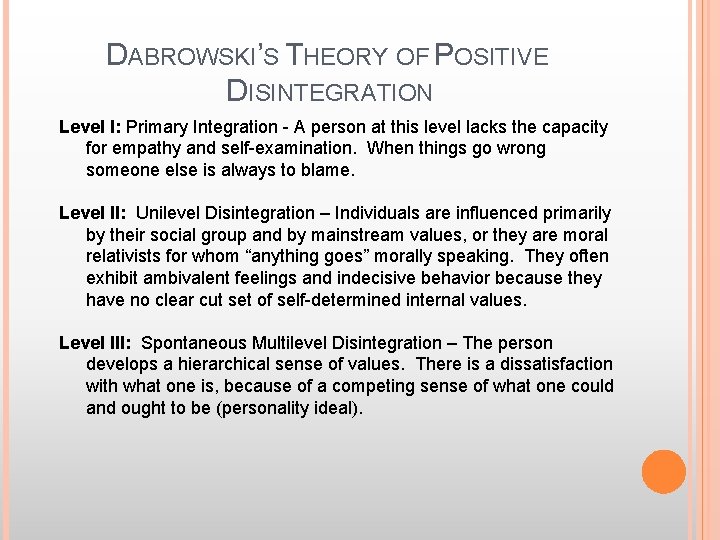
DABROWSKI’S THEORY OF POSITIVE DISINTEGRATION Level I: Primary Integration - A person at this level lacks the capacity for empathy and self-examination. When things go wrong someone else is always to blame. Level II: Unilevel Disintegration – Individuals are influenced primarily by their social group and by mainstream values, or they are moral relativists for whom “anything goes” morally speaking. They often exhibit ambivalent feelings and indecisive behavior because they have no clear cut set of self-determined internal values. Level III: Spontaneous Multilevel Disintegration – The person develops a hierarchical sense of values. There is a dissatisfaction with what one is, because of a competing sense of what one could and ought to be (personality ideal).
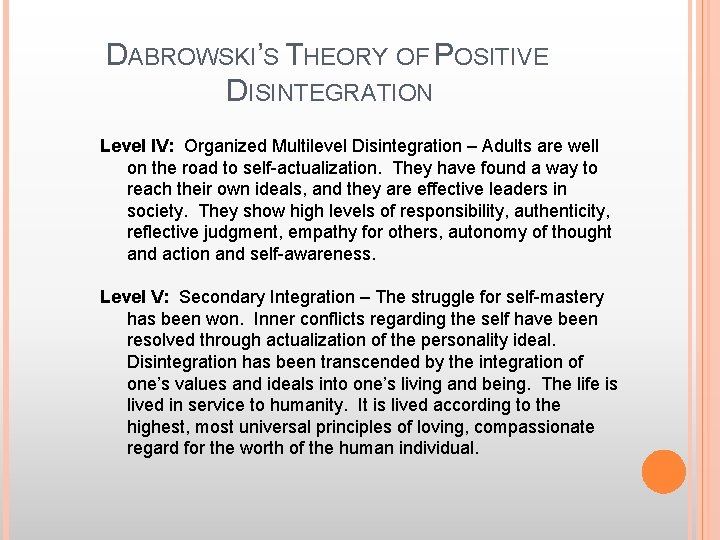
DABROWSKI’S THEORY OF POSITIVE DISINTEGRATION Level IV: Organized Multilevel Disintegration – Adults are well on the road to self-actualization. They have found a way to reach their own ideals, and they are effective leaders in society. They show high levels of responsibility, authenticity, reflective judgment, empathy for others, autonomy of thought and action and self-awareness. Level V: Secondary Integration – The struggle for self-mastery has been won. Inner conflicts regarding the self have been resolved through actualization of the personality ideal. Disintegration has been transcended by the integration of one’s values and ideals into one’s living and being. The life is lived in service to humanity. It is lived according to the highest, most universal principles of loving, compassionate regard for the worth of the human individual.
REFERENCES Davis, G. , Rimm, S. , & Siegle, D. (2011). Education of the gifted and talented 6 th edition. Pearson Education, Inc. , New Jersey: Upper Saddle River. Lind, Sharon. (2001). Supporting the emotional needs of the gifted. Overexcitability and the gifted. 1 (1) 3 -6. www. sengifted. org Neihart, M. , Reis, S. M. , Robinson, N. M. & Moon, S. M. (2002). The social and emotional development of gifted children: What do we know? . Purfrock Press, Inc. , DC: Washington. Silverman, L. S. (2000). Counseling the gifted & talented. Love Publishing Company. Colorado: Denver.
- Slides: 13