
Social Dynamics of Economic Performance Innovation and Creativity

- Slides: 18
Social Dynamics of Economic Performance: Innovation and Creativity in City-Regions Meric S. Gertler University of Toronto ISRN Eighth Annual Meeting Kingbridge Centre King City May 4, 2006 Innovation Systems Research Network
From Clusters to City-Regions: Primary Research Question How do local social characteristics and processes in city-regions shape their economic vitality and dynamism as centres of innovation and creativity? Innovation Systems Research Network
3 Dimensions • Social learning dynamics & knowledge flows between economic actors • Social dimensions of talent attraction and retention (quality of place, including diversity, openness, inclusion) • Social nature of civic engagement and governance processes Innovation Systems Research Network
Theme I: Social Dynamics of Innovation • Primary H: the economic and creativity performance (ECP) of city-regions depends on – Strength of local knowledge circulation within clusters – Strength of local knowledge circulation between clusters (local knowledge diversity) – Strength of knowledge-based linkages between local and non-local actors (geographical knowledge diversity) Innovation Systems Research Network
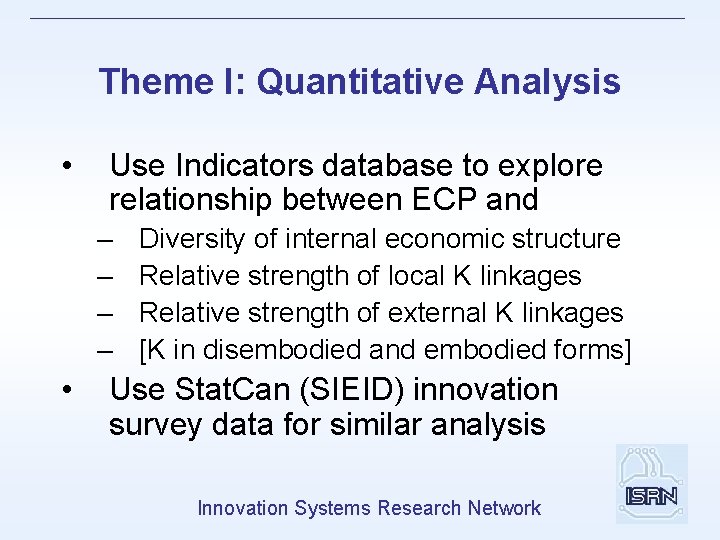
Theme I: Quantitative Analysis • Use Indicators database to explore relationship between ECP and – – • Diversity of internal economic structure Relative strength of local K linkages Relative strength of external K linkages [K in disembodied and embodied forms] Use Stat. Can (SIEID) innovation survey data for similar analysis Innovation Systems Research Network
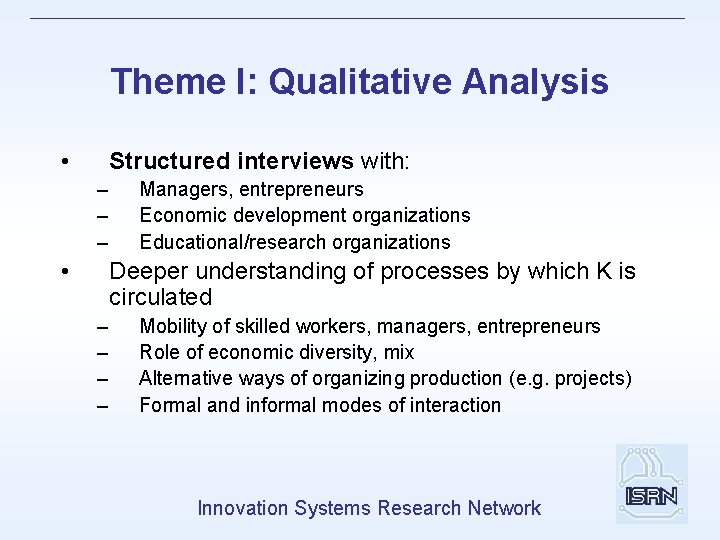
Theme I: Qualitative Analysis • Structured interviews with: – – – • Managers, entrepreneurs Economic development organizations Educational/research organizations Deeper understanding of processes by which K is circulated – – Mobility of skilled workers, managers, entrepreneurs Role of economic diversity, mix Alternative ways of organizing production (e. g. projects) Formal and informal modes of interaction Innovation Systems Research Network
Theme I: Network Analysis? • H: ECP of city-regions depends on structure (density, diversity) of local networks (strong/weak ties; local/non-local ties; heterogeneity/diversity of actors belonging to networks) Objectives: • – – • Compare strength, structure of social network ties w/in and b/w local industry clusters Identify key actors who link multiple clusters within the city-region Identify, understand role played by key intermediary organizations: local tech associations, research alliances, chamber of commerce, social service agencies, unions Link network structure, diversity to ECP? Challenge: – – how to characterize social networks in LARGE cities? qualitative alternatives to quantitative (SNA) approach? Innovation Systems Research Network
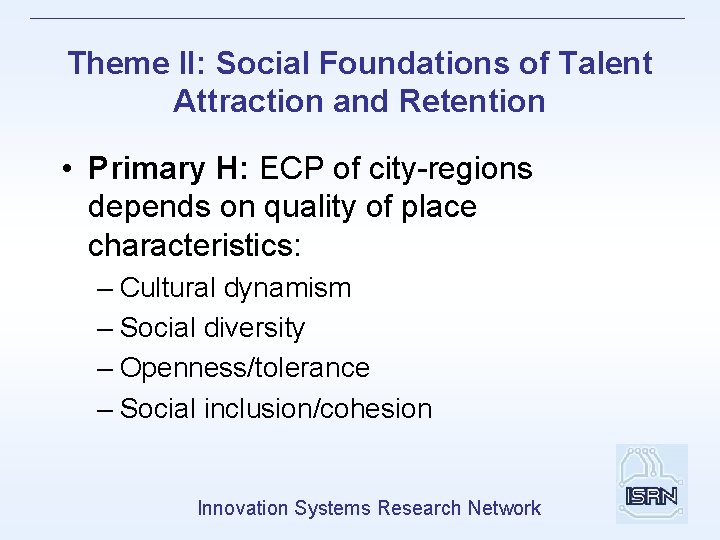
Theme II: Social Foundations of Talent Attraction and Retention • Primary H: ECP of city-regions depends on quality of place characteristics: – Cultural dynamism – Social diversity – Openness/tolerance – Social inclusion/cohesion Innovation Systems Research Network
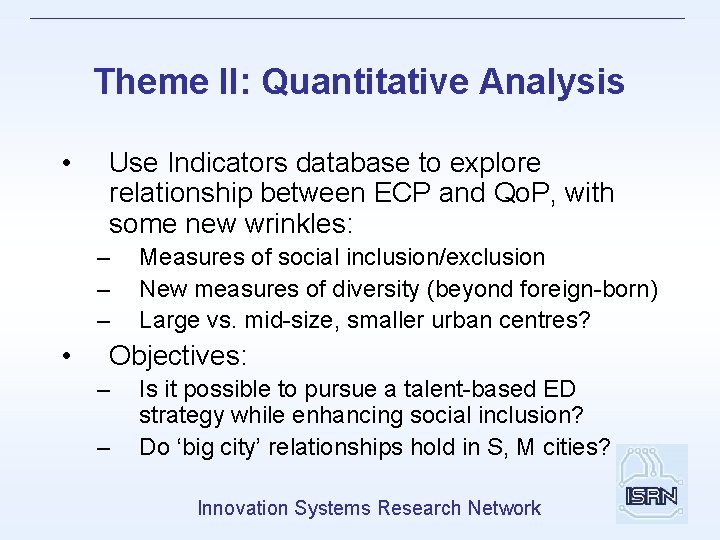
Theme II: Quantitative Analysis • Use Indicators database to explore relationship between ECP and Qo. P, with some new wrinkles: – – – • Measures of social inclusion/exclusion New measures of diversity (beyond foreign-born) Large vs. mid-size, smaller urban centres? Objectives: – – Is it possible to pursue a talent-based ED strategy while enhancing social inclusion? Do ‘big city’ relationships hold in S, M cities? Innovation Systems Research Network
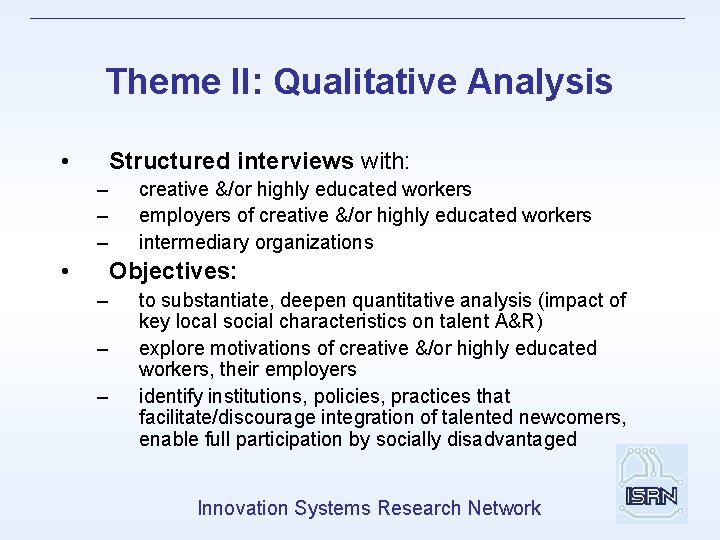
Theme II: Qualitative Analysis • Structured interviews with: – – – • creative &/or highly educated workers employers of creative &/or highly educated workers intermediary organizations Objectives: – – – to substantiate, deepen quantitative analysis (impact of key local social characteristics on talent A&R) explore motivations of creative &/or highly educated workers, their employers identify institutions, policies, practices that facilitate/discourage integration of talented newcomers, enable full participation by socially disadvantaged Innovation Systems Research Network
Theme III: Inclusive Communities and Civic Engagement • Primary H: ECP of city-regions depends on: – Their ability to generate effective new forms of associative governance, collaborative leadership – Social inclusiveness of new governance forms Innovation Systems Research Network
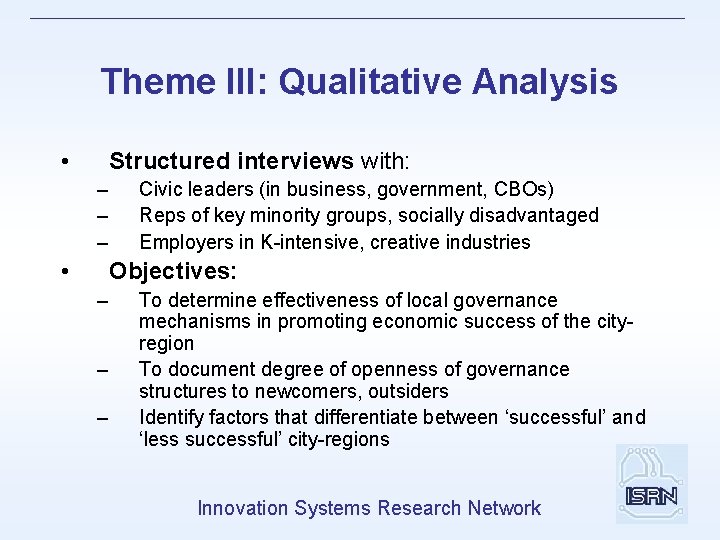
Theme III: Qualitative Analysis • Structured interviews with: – – – • Civic leaders (in business, government, CBOs) Reps of key minority groups, socially disadvantaged Employers in K-intensive, creative industries Objectives: – – – To determine effectiveness of local governance mechanisms in promoting economic success of the cityregion To document degree of openness of governance structures to newcomers, outsiders Identify factors that differentiate between ‘successful’ and ‘less successful’ city-regions Innovation Systems Research Network
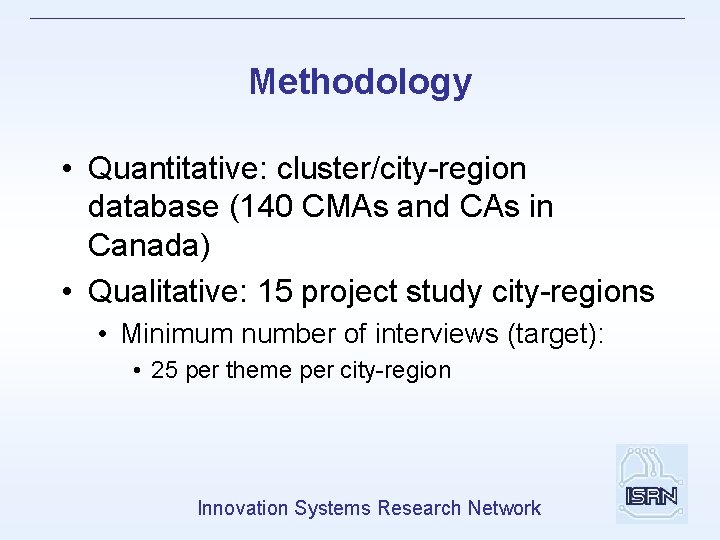
Methodology • Quantitative: cluster/city-region database (140 CMAs and CAs in Canada) • Qualitative: 15 project study city-regions • Minimum number of interviews (target): • 25 per theme per city-region Innovation Systems Research Network
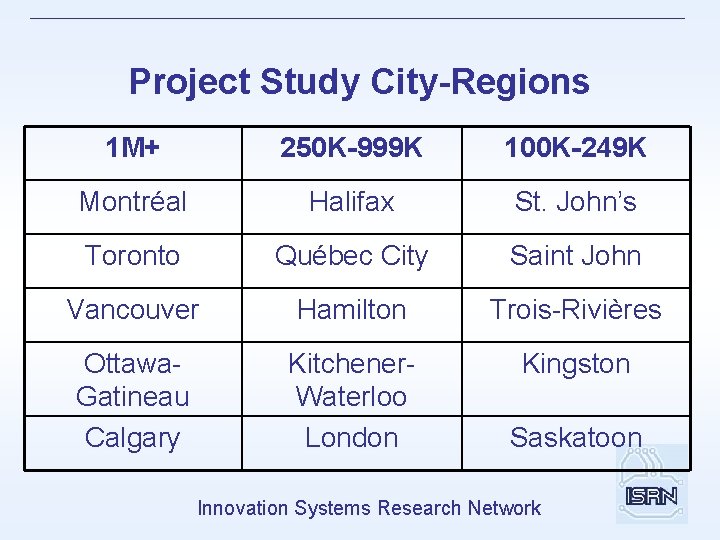
Project Study City-Regions 1 M+ 250 K-999 K 100 K-249 K Montréal Halifax St. John’s Toronto Québec City Saint John Vancouver Hamilton Trois-Rivières Ottawa. Gatineau Calgary Kitchener. Waterloo London Kingston Saskatoon Innovation Systems Research Network
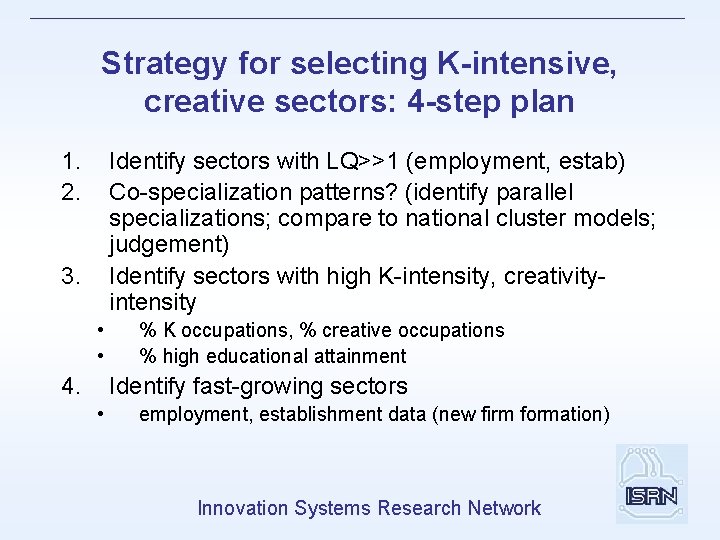
Strategy for selecting K-intensive, creative sectors: 4 -step plan 1. 2. Identify sectors with LQ>>1 (employment, estab) Co-specialization patterns? (identify parallel specializations; compare to national cluster models; judgement) Identify sectors with high K-intensity, creativityintensity 3. • • 4. % K occupations, % creative occupations % high educational attainment Identify fast-growing sectors • employment, establishment data (new firm formation) Innovation Systems Research Network
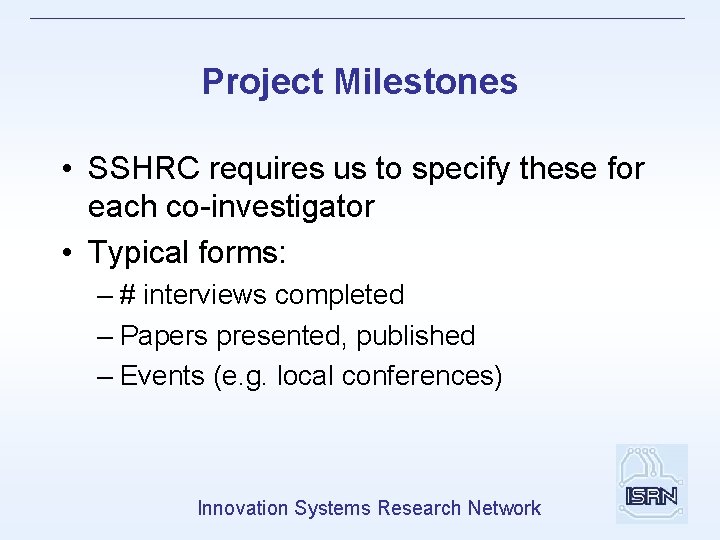
Project Milestones • SSHRC requires us to specify these for each co-investigator • Typical forms: – # interviews completed – Papers presented, published – Events (e. g. local conferences) Innovation Systems Research Network
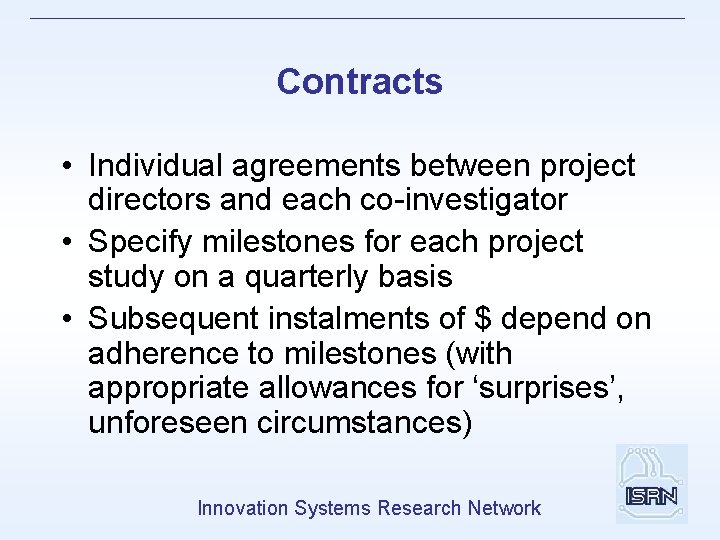
Contracts • Individual agreements between project directors and each co-investigator • Specify milestones for each project study on a quarterly basis • Subsequent instalments of $ depend on adherence to milestones (with appropriate allowances for ‘surprises’, unforeseen circumstances) Innovation Systems Research Network
Questions? Innovation Systems Research Network