
Social Development Social Development Harlows Surrogate Mother Experiments




- Slides: 37
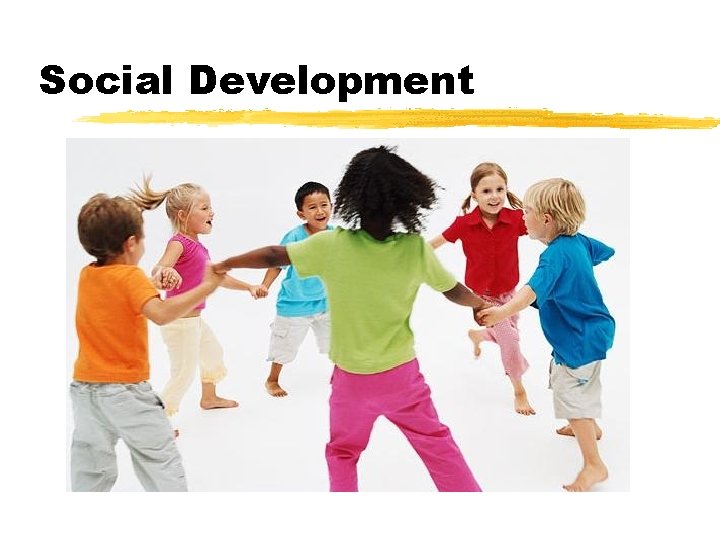
Social Development
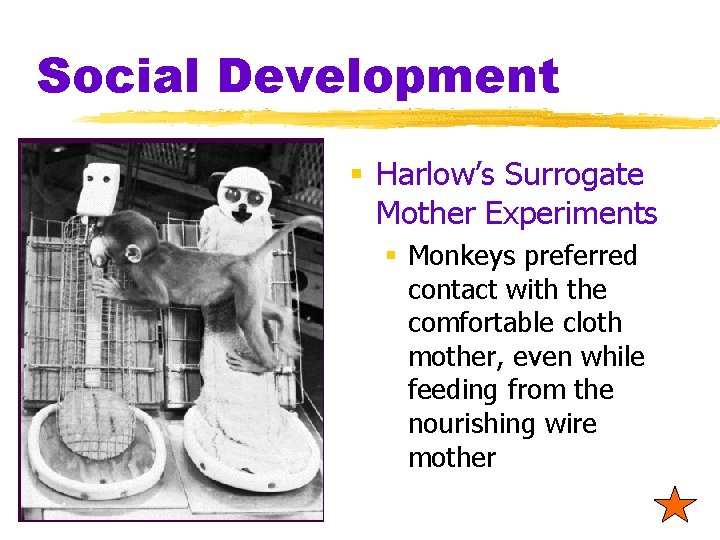
Social Development § Harlow’s Surrogate Mother Experiments § Monkeys preferred contact with the comfortable cloth mother, even while feeding from the nourishing wire mother
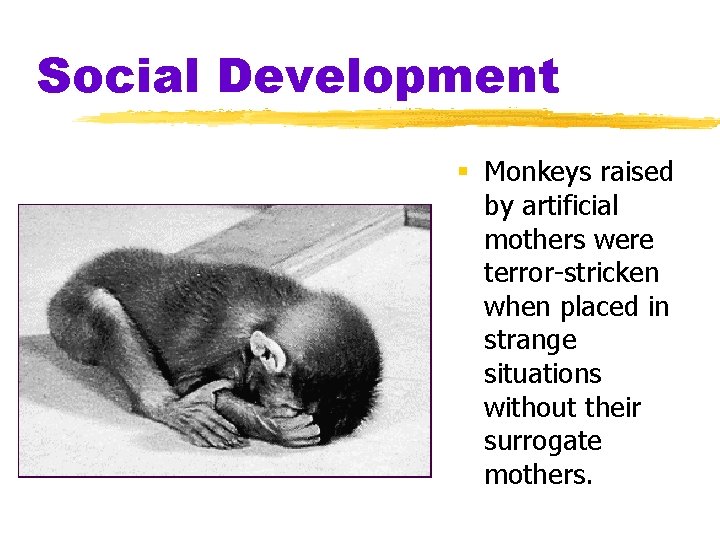
Social Development § Monkeys raised by artificial mothers were terror-stricken when placed in strange situations without their surrogate mothers.
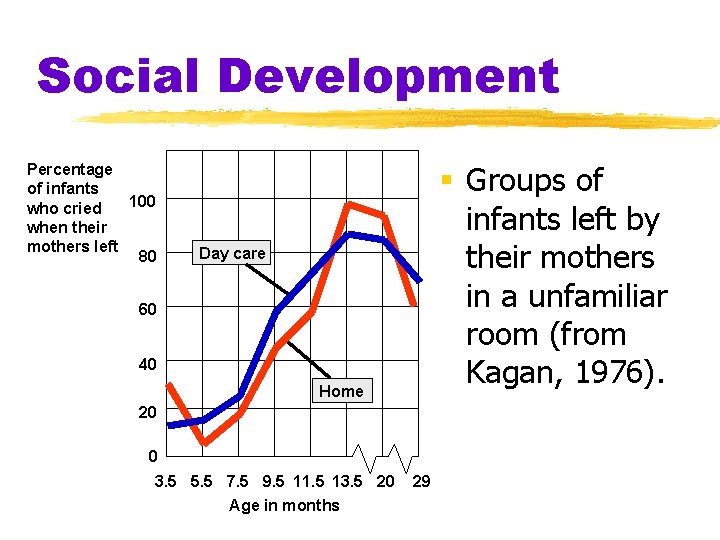
Social Development § Stranger Anxiety § fear of strangers that infants commonly display § beginning by about 8 months of age § Attachment § an emotional tie with another person § shown in young children by their seeking closeness to the caregiver and displaying distress on separation
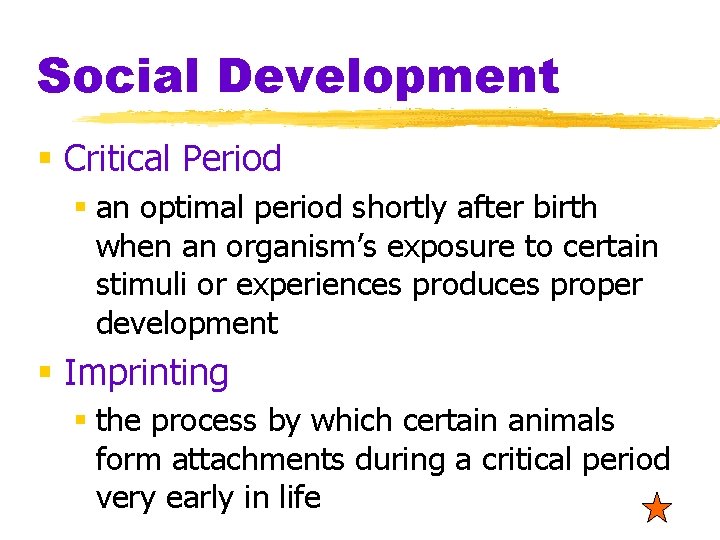
Social Development § Critical Period § an optimal period shortly after birth when an organism’s exposure to certain stimuli or experiences produces proper development § Imprinting § the process by which certain animals form attachments during a critical period very early in life
Social Development Percentage of infants 100 who cried when their mothers left 80 § Groups of infants left by their mothers in a unfamiliar room (from Kagan, 1976). Day care 60 40 Home 20 0 3. 5 5. 5 7. 5 9. 5 11. 5 13. 5 20 Age in months 29
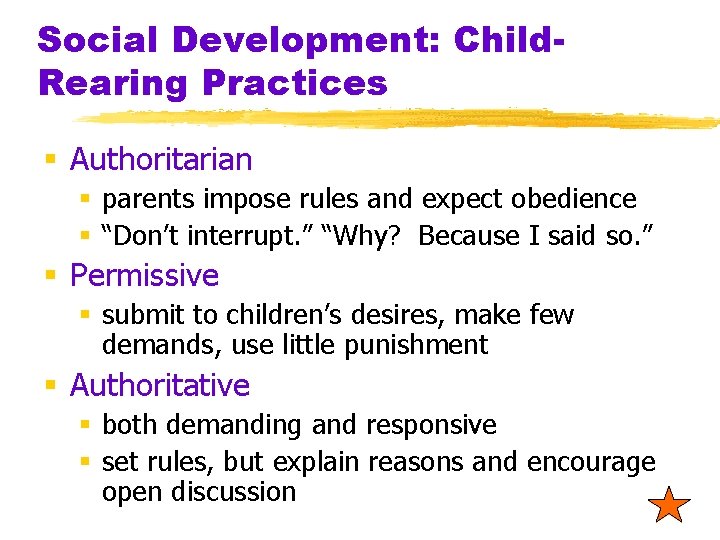
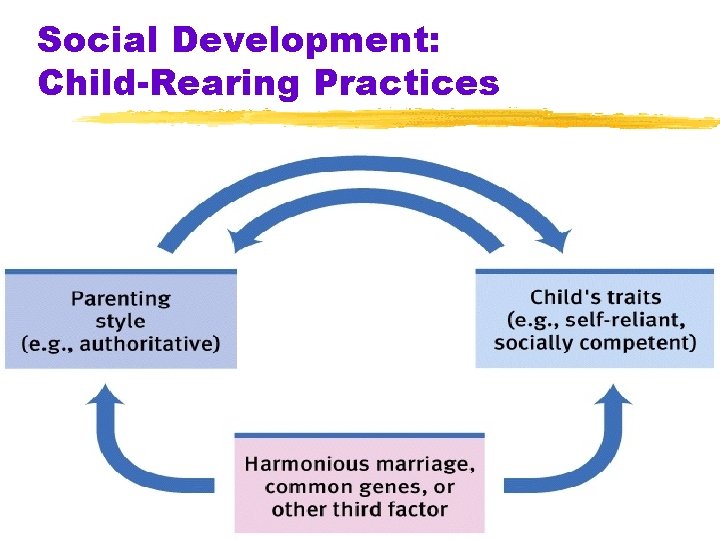
Social Development: Child. Rearing Practices § Authoritarian § parents impose rules and expect obedience § “Don’t interrupt. ” “Why? Because I said so. ” § Permissive § submit to children’s desires, make few demands, use little punishment § Authoritative § both demanding and responsive § set rules, but explain reasons and encourage open discussion
Social Development: Child-Rearing Practices
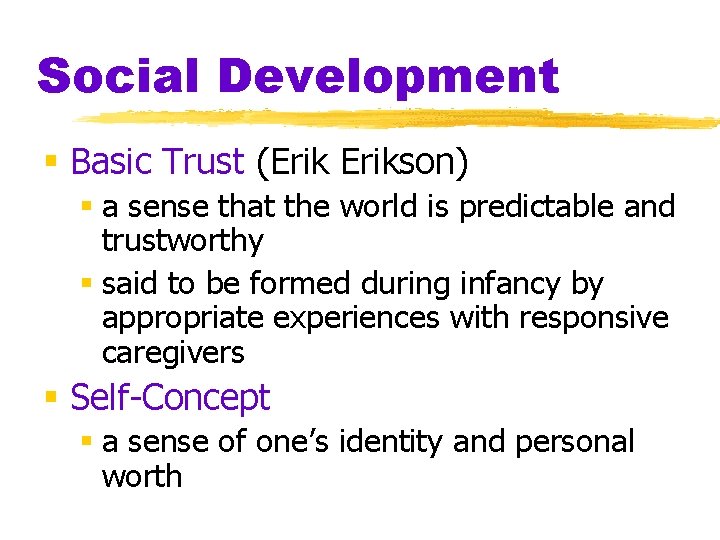
Social Development § Basic Trust (Erikson) § a sense that the world is predictable and trustworthy § said to be formed during infancy by appropriate experiences with responsive caregivers § Self-Concept § a sense of one’s identity and personal worth
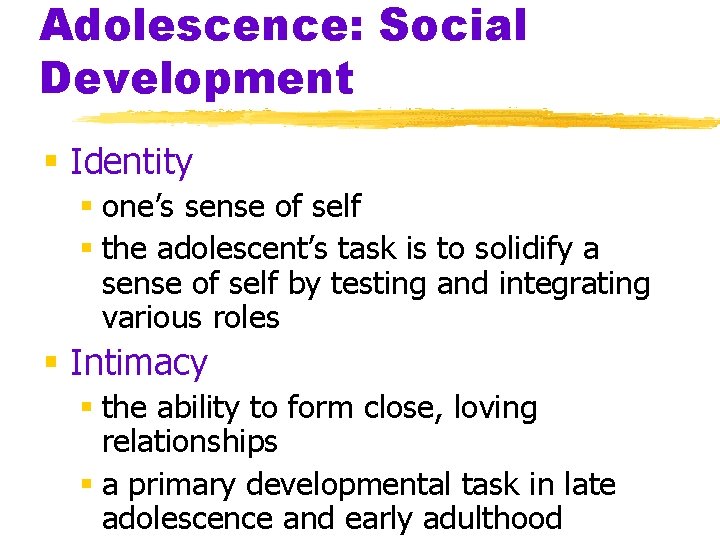
Adolescence: Social Development § Identity § one’s sense of self § the adolescent’s task is to solidify a sense of self by testing and integrating various roles § Intimacy § the ability to form close, loving relationships § a primary developmental task in late adolescence and early adulthood
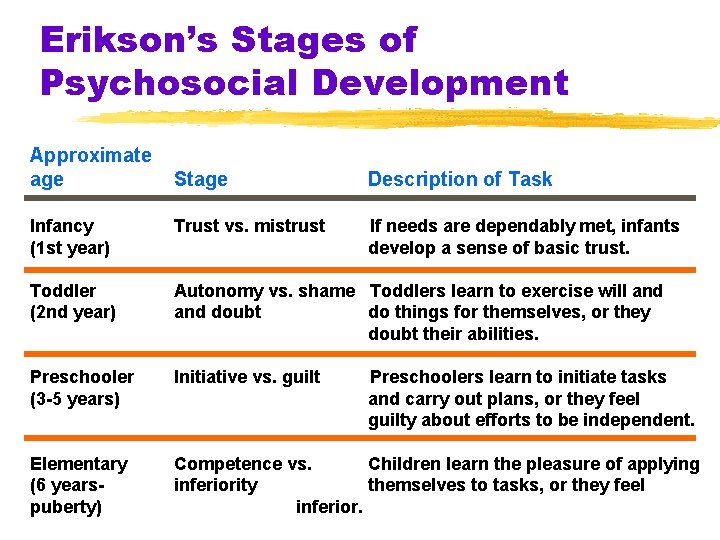
Erikson’s Stages of Psychosocial Development Approximate age Stage Description of Task Infancy (1 st year) Trust vs. mistrust If needs are dependably met, infants develop a sense of basic trust. Toddler (2 nd year) Autonomy vs. shame Toddlers learn to exercise will and doubt do things for themselves, or they doubt their abilities. Preschooler (3 -5 years) Initiative vs. guilt Elementary (6 yearspuberty) Competence vs. Children learn the pleasure of applying inferiority themselves to tasks, or they feel inferior. Preschoolers learn to initiate tasks and carry out plans, or they feel guilty about efforts to be independent.
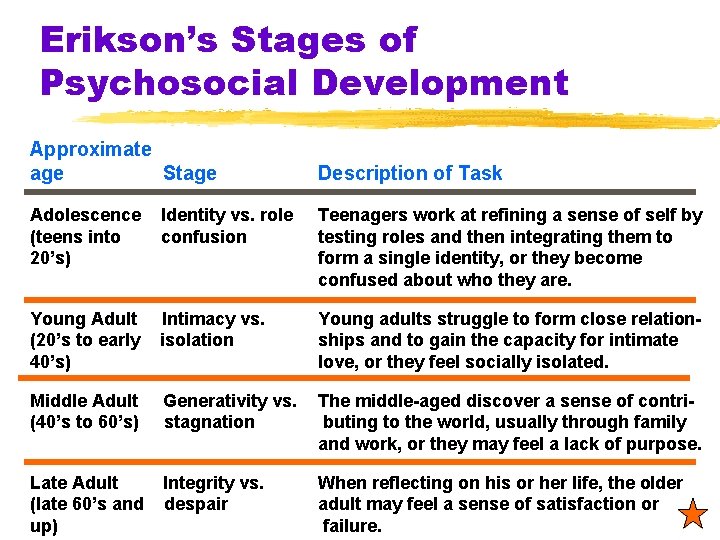
Erikson’s Stages of Psychosocial Development Approximate age Stage Description of Task Adolescence (teens into 20’s) Identity vs. role confusion Teenagers work at refining a sense of self by testing roles and then integrating them to form a single identity, or they become confused about who they are. Young Adult (20’s to early 40’s) Intimacy vs. isolation Young adults struggle to form close relationships and to gain the capacity for intimate love, or they feel socially isolated. Middle Adult (40’s to 60’s) Generativity vs. stagnation The middle-aged discover a sense of contributing to the world, usually through family and work, or they may feel a lack of purpose. Late Adult (late 60’s and up) Integrity vs. despair When reflecting on his or her life, the older adult may feel a sense of satisfaction or failure.
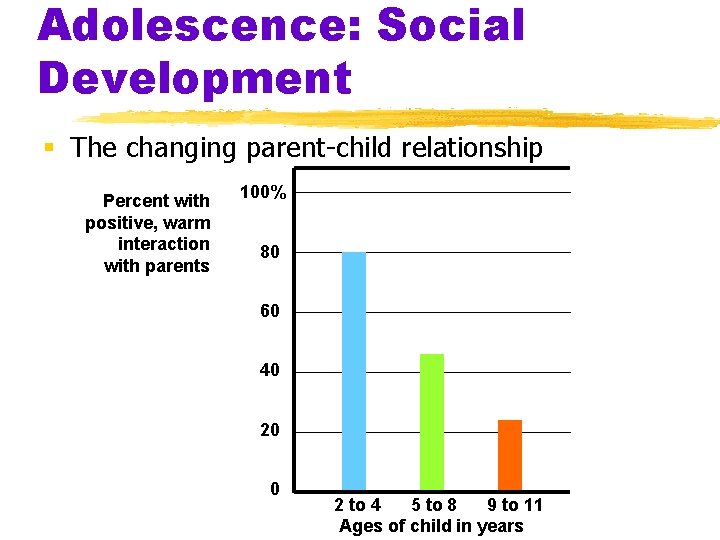
Adolescence: Social Development § The changing parent-child relationship Percent with positive, warm interaction with parents 100% 80 60 40 20 0 2 to 4 5 to 8 9 to 11 Ages of child in years
Review of Freud’s Stages of Development z. Psychosexual Development: y. Freud's theory of psychosexual development is one of the best known, but also one of the most controversial. y. Freud believed that personality develops through a series of childhood stages during which the pleasure-seeking energies of the id become focused on certain erogenous areas. This psychosexual energy, or libido, was described as the driving force behind behavior.
Stage 1: Oral Stage (Birth to 18 months) z. During the oral stage, the child if focused on oral pleasures (sucking). z. Too much or too little gratification can result in an Oral Fixation or Oral Personality which is evidenced by a preoccupation with oral activities. z. This type of personality may have a stronger tendency to smoke, drink alcohol, over eat, or bite his or her nails.
Stage 2: Anal Stage (18 months to three years) z. The child’s focus of pleasure in this stage is on eliminating and retaining feces. z. Through society’s pressure, mainly via parents, the child has to learn to control anal stimulation. z. In terms of personality, after effects of an anal fixation during this stage can result in an obsession with cleanliness, perfection, and control (anal retentive).
Stage 3: Phallic Stage (ages three to six) z The pleasure zone switches to the genitals z Freud believed that during this stage boy develop unconscious sexual desires for their mother: Oedipus Complex z Later it was added that girls go through a similar situation, developing unconscious sexual attraction to their father. Although Freud Strongly disagreed with this, it has been termed the Electra Complex by more recent psychoanalysts.
Stage 3: Continued z. According to Freud, out of fear of castration and due to the strong competition of his father, boys eventually decide to identify with him rather than fight him z. By identifying with his father, the boy develops masculine characteristics and identifies himself as a male, and represses his sexual feelings toward his mother.
Stage 4: Latency Stage (age six to puberty) z. It’s during this stage that sexual urges remain repressed and children interact and play mostly with same sex peers.
Stage 5: Genital Stage (puberty on) z. The final stage of psychosexual development begins at the start of puberty when sexual urges are once again awakened. z. Through the lessons learned during the previous stages, adolescents direct their sexual urges onto opposite sex peers, with the primary focus of pleasure is the genitals.
Moral Development
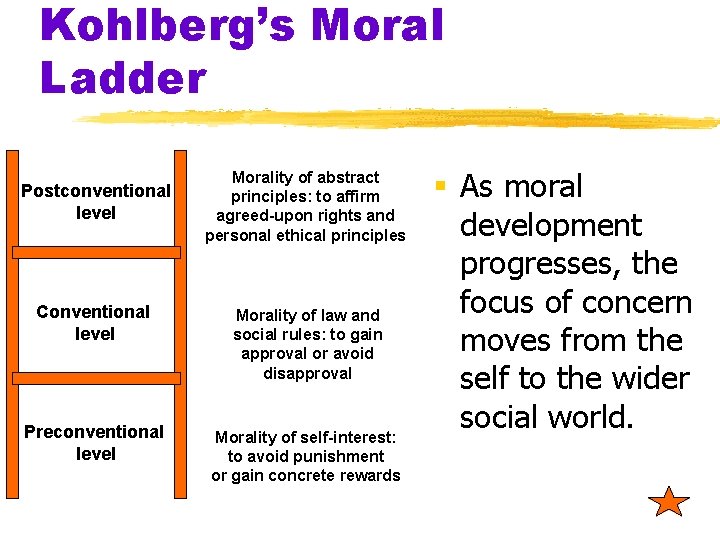
Kohlberg’s Moral Ladder Postconventional level Morality of abstract principles: to affirm agreed-upon rights and personal ethical principles Conventional level Morality of law and social rules: to gain approval or avoid disapproval Preconventional level Morality of self-interest: to avoid punishment or gain concrete rewards § As moral development progresses, the focus of concern moves from the self to the wider social world.
Adulthood: Physical Development § Menopause § the time of natural cessation of menstruation § also refers to the biological changes a woman experiences as her ability to reproduce declines § Alzheimer’s Disease § a progressive and irreversible brain disorder § characterized by a gradual deterioration of memory, reasoning, language, and finally, physical functioning
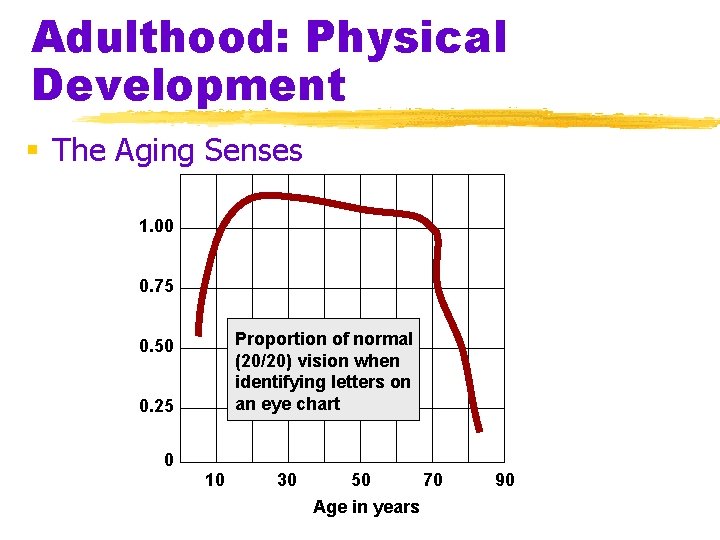
Adulthood: Physical Development § The Aging Senses 1. 00 0. 75 Proportion of normal (20/20) vision when identifying letters on an eye chart 0. 50 0. 25 0 10 30 50 Age in years 70 90
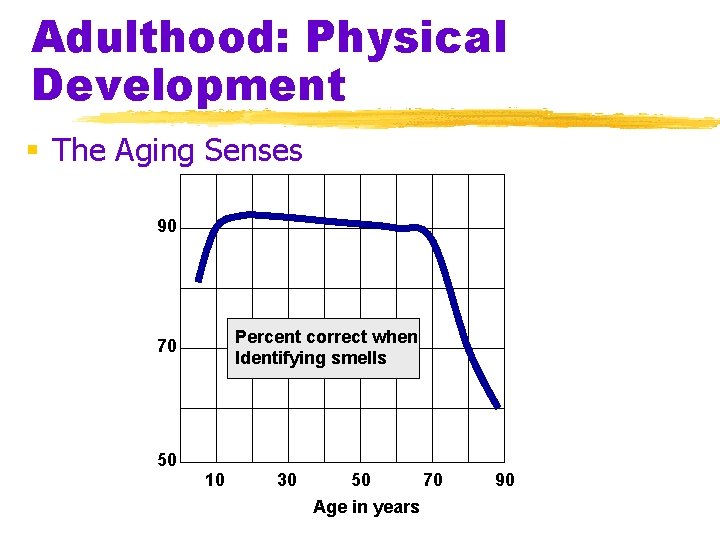
Adulthood: Physical Development § The Aging Senses 90 Percent correct when Identifying smells 70 50 10 30 50 Age in years 70 90
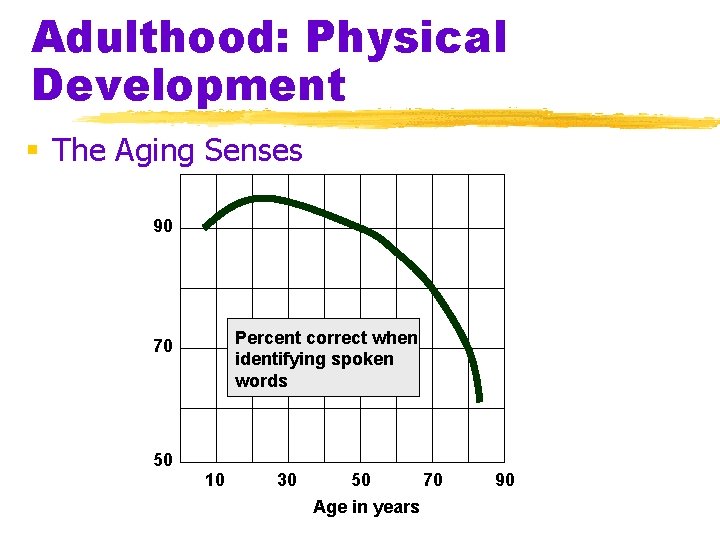
Adulthood: Physical Development § The Aging Senses 90 Percent correct when identifying spoken words 70 50 10 30 50 Age in years 70 90
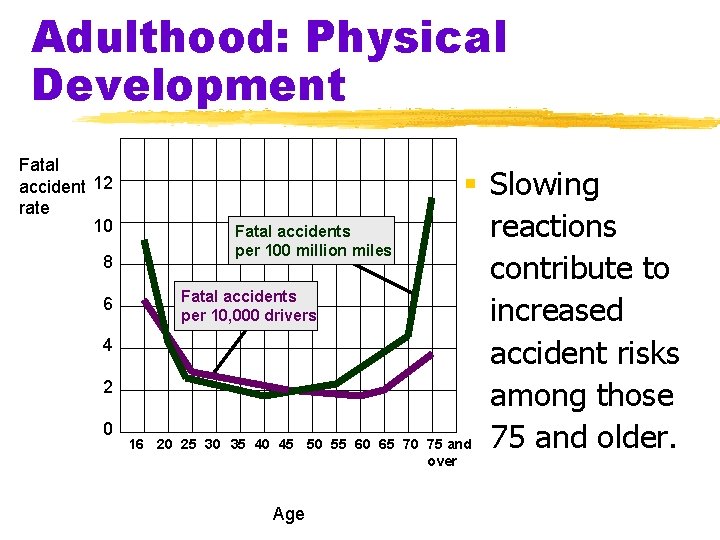
Adulthood: Physical Development Fatal accident 12 rate 10 8 6 4 2 0 16 § Slowing Fatal accidents reactions per 100 million miles contribute to Fatal accidents increased per 10, 000 drivers accident risks among those 20 25 30 35 40 45 50 55 60 65 70 75 and older. over Age
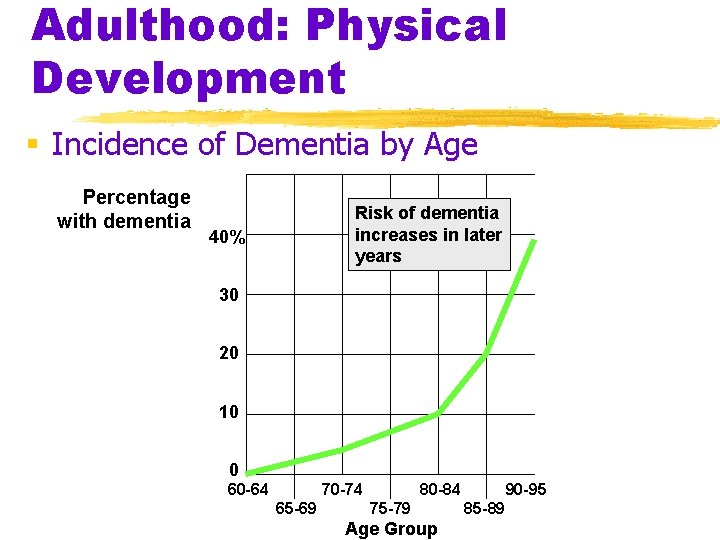
Adulthood: Physical Development § Incidence of Dementia by Age Percentage with dementia Risk of dementia increases in later years 40% 30 20 10 0 60 -64 70 -74 65 -69 80 -84 75 -79 Age Group 90 -95 85 -89
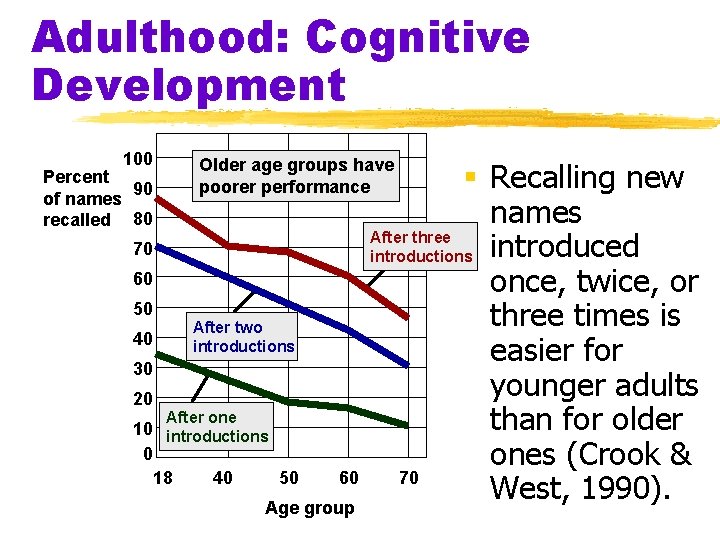
Adulthood: Cognitive Development 100 Percent 90 of names recalled 80 Older age groups have poorer performance 70 60 50 40 After two introductions 30 20 After one 10 introductions 0 18 40 50 60 Age group § Recalling new names After three introductions introduced once, twice, or three times is easier for younger adults than for older ones (Crook & 70 West, 1990).
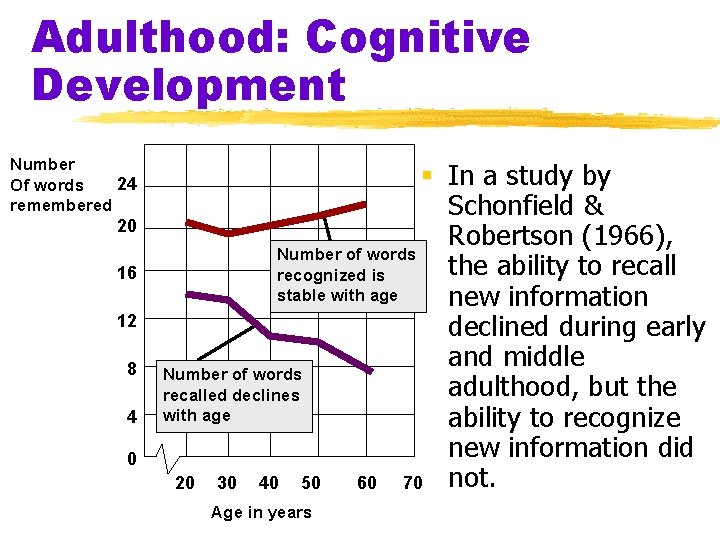
Adulthood: Cognitive Development Number 24 Of words remembered 20 16 12 8 4 0 § In a study by Schonfield & Robertson (1966), Number of words the ability to recall recognized is stable with age new information declined during early and middle Number of words adulthood, but the recalled declines with age ability to recognize new information did 20 30 40 50 60 70 not. Age in years
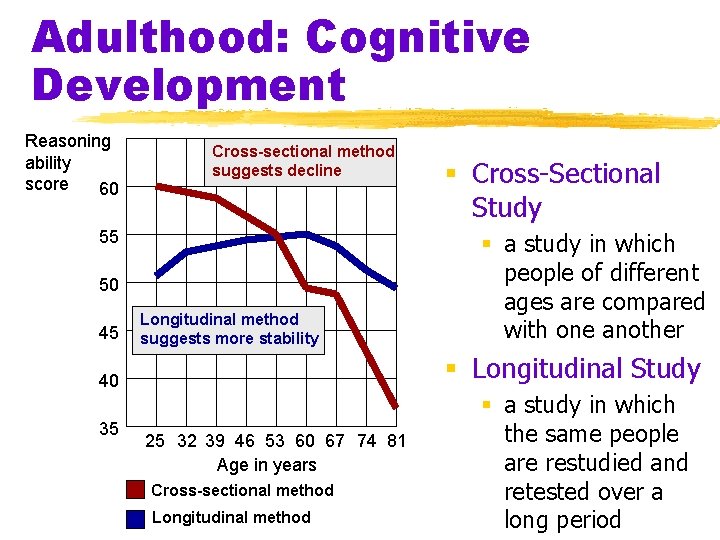
Adulthood: Cognitive Development Reasoning ability score 60 Cross-sectional method suggests decline 55 50 45 Longitudinal method suggests more stability § a study in which people of different ages are compared with one another § Longitudinal Study 40 35 § Cross-Sectional Study 25 32 39 46 53 60 67 74 81 Age in years Cross-sectional method Longitudinal method § a study in which the same people are restudied and retested over a long period
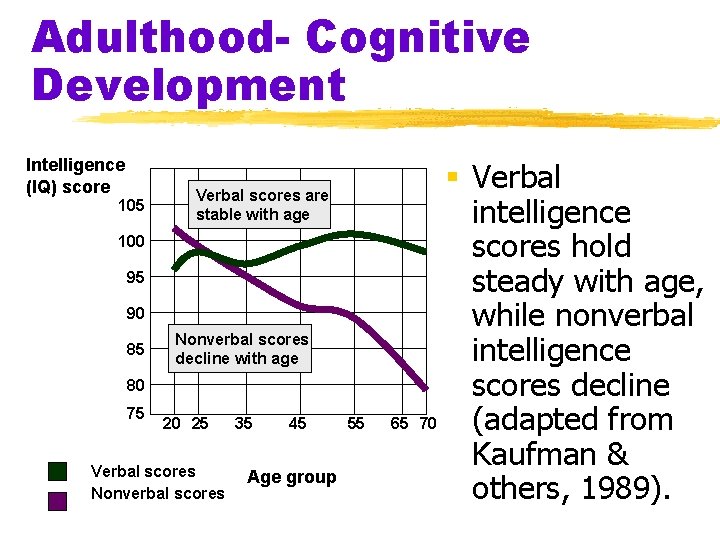
Adulthood- Cognitive Development Intelligence (IQ) score 105 Verbal scores are stable with age 100 95 90 85 Nonverbal scores decline with age 80 75 20 25 Verbal scores Nonverbal scores 35 45 Age group 55 65 § Verbal intelligence scores hold steady with age, while nonverbal intelligence scores decline 70 (adapted from Kaufman & others, 1989).
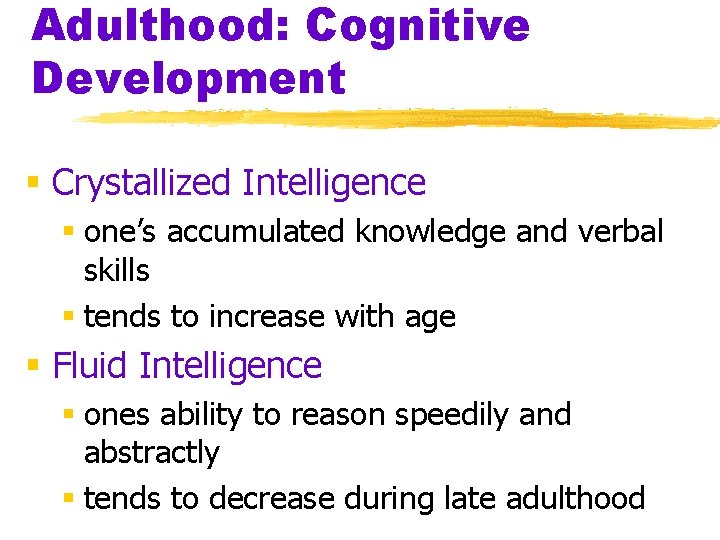
Adulthood: Cognitive Development § Crystallized Intelligence § one’s accumulated knowledge and verbal skills § tends to increase with age § Fluid Intelligence § ones ability to reason speedily and abstractly § tends to decrease during late adulthood
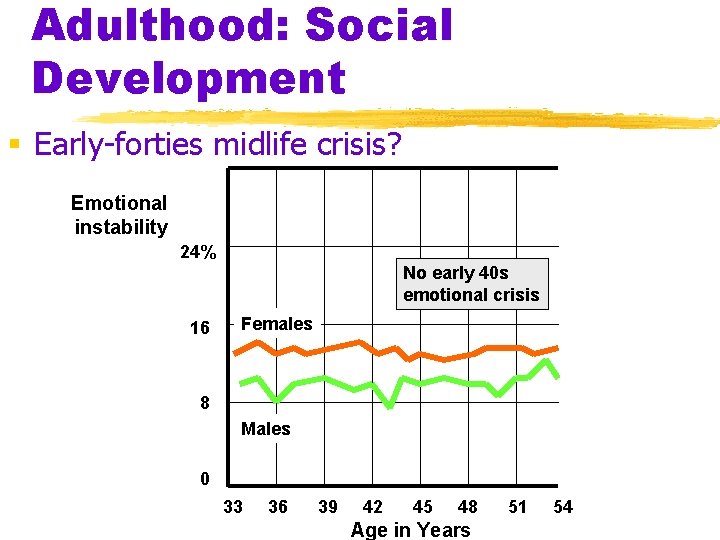
Adulthood: Social Development § Early-forties midlife crisis? Emotional instability 24% No early 40 s emotional crisis 16 Females 8 Males 0 33 36 39 42 45 48 Age in Years 51 54
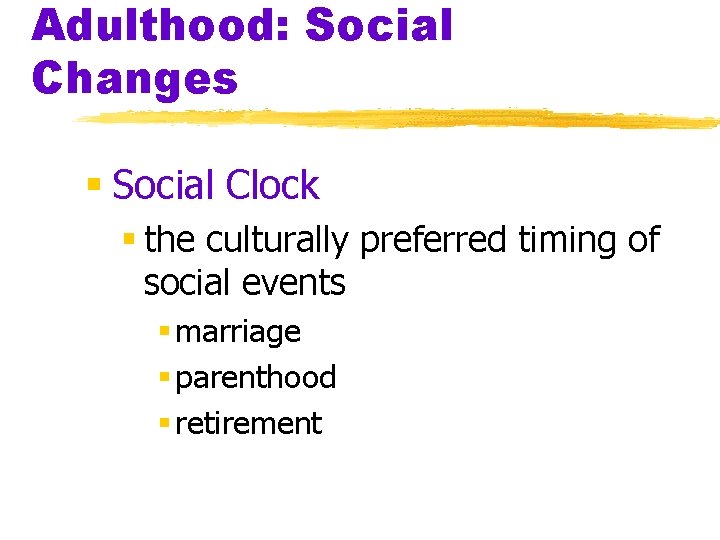
Adulthood: Social Changes § Social Clock § the culturally preferred timing of social events § marriage § parenthood § retirement
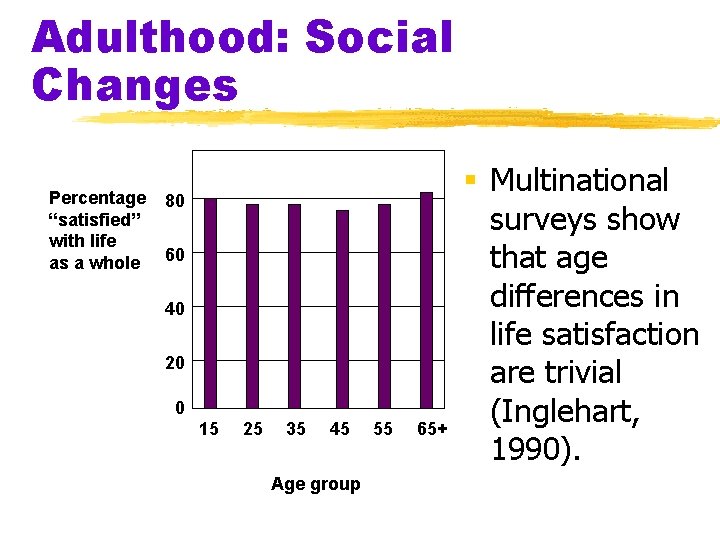
Adulthood: Social Changes Percentage “satisfied” with life as a whole 80 60 40 20 0 15 25 35 45 Age group 55 65+ § Multinational surveys show that age differences in life satisfaction are trivial (Inglehart, 1990).
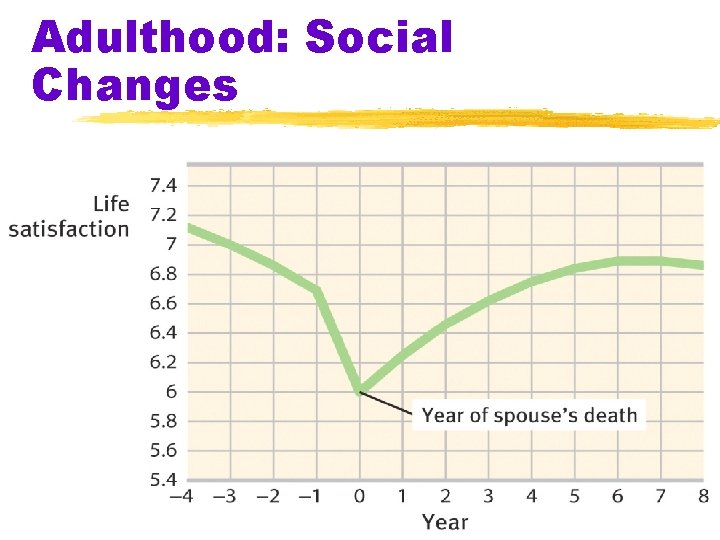
Adulthood: Social Changes