
Social Development Chapter 7 Child Development for Students


- Slides: 54
Social Development Chapter 7 Child Development for Students in Ireland 2 nd Edition © Eilis Flood 2013
Chapter Outline What is social development? Developing an ability to interact effectively with others Bullying (Level 6) Understanding the norms of society Moral development Pro-social and antisocial behaviour in children Effective management of children’s behaviour How Aistear promotes social development Revision questions Child Development for Students in Ireland 2 nd Edition © Eilis Flood 2013
What is Social Development? Social development can be defined as: 1. The development of an ability to interact effectively with others 2. The development of an understanding of the norms (ways) of the society in which you live 3. The development of a sense of right and wrong (moral development). Child Development for Students in Ireland 2 nd Edition © Eilis Flood 2013
Developing an Ability to Interact Effectively with Others - Infancy From birth babies are predisposed to be social. Babies cry for attention from birth. The reflexive smile – this occurs during the first month after birth, usually during sleep, and is caused by some internal stimuli, e. g. wind, and not by the child’s external environment. The social smile, which occurs as early as 4 -6 weeks, becomes more frequent as the baby gets older and is a response to their carer’s voice and smiles. After six months, smiles are accompanied by the Duchenne marker (constricting or crinkling of the eyes). Child Development for Students in Ireland 2 nd Edition © Eilis Flood 2013
Developing an Ability to Interact Effectively with Others - Early Childhood While infants as young as six months take notice and sometimes show an interest in other babies, it is not until approximately 18 months to 2 years that toddlers begin interacting with peers. Even so, parallel play still predominates whereby the toddler will play happily alongside peers but not with them. By 2½ toddlers engage in sustained role play, and after watching other children at play with interest may join in for a few minutes. By three years the toddler understands what it is to share and joins in make believe play with other children. Child Development for Students in Ireland 2 nd Edition © Eilis Flood 2013
Developing an Ability to Interact Effectively with Others - Early Childhood By four years the child will understand turn taking as well as sharing and will co-operate with peers. By this year the child seeks out the companionship of others and will alternate between playing and fighting with peers. By four the child understands that arguments, e. g. over a toy, need to be sorted out verbally and not by physically fighting. By five years children understand the need for rules and fair play, and they begin to choose their own friends. Child Development for Students in Ireland 2 nd Edition © Eilis Flood 2013
Middle to Late Childhood (Level 6) As children get older (beyond age six), they begin to notice difference and begin to compare themselves to others. They begin to seek out friendships and friendship groups. Co-operative play predominates. Peer statuses begin to emerge – leaders and followers. It is at this time that some children unfortunately start to become isolated or rejected by their peers. It is also a tie when bullying begins to occur. Child Development for Students in Ireland 2 nd Edition © Eilis Flood 2013
Bullying (Level 6) A nationwide study in Irish schools indicated that 31% of primary and 16% of secondary school children have been bullied at some stage - 200, 000 students (O’Moore, 1997). Children who are bullied experience fear, humiliation, social isolation and loss of selfesteem. Bullying causes school avoidance, drop in quality of school work, illness, personality change and, unfortunately, sometimes suicide. Child Development for Students in Ireland 2 nd Edition © Eilis Flood 2013
Types of Bullying Behaviour Verbal bullying: Occurs when children are called names or verbally insulted or made fun of. Sometimes a child’s family, culture, race or religion is insulted. Spreading of malicious rumours is a particularly hurtful form of verbal bullying. Physical bullying: Occurs when children are physically pushed, punched, pinched, kicked or hurt in other ways – more common with boys. Gesture bullying: Occurs when children use gestures, e. g. staring to intimidate another child. Exclusion bullying: Occurs when a child is deliberately excluded from a group. This form of bullying causes tremendous damage to a child’s self-esteem as it causes them to feel as if nobody likes them. Extortion bullying: Occurs when children are threatened and demands are made to hand over items such as money or possessions. E-bullying: Occurs when the bully uses technology to bully and intimidate. Social networking sites, texts and emails can all be used to spread vicious rumours, abuse and intimidate. This form of bullying is particularly difficult for the victim to deal with as it can be difficult to escape from, e. g. even at home the bully can make contact. Child Development for Students in Ireland 2 nd Edition © Eilis Flood 2013
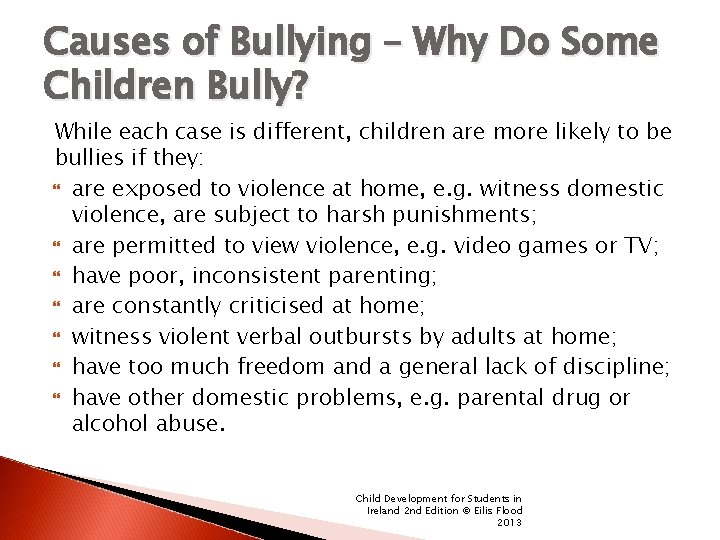
Causes of Bullying – Why Do Some Children Bully? While each case is different, children are more likely to be bullies if they: are exposed to violence at home, e. g. witness domestic violence, are subject to harsh punishments; are permitted to view violence, e. g. video games or TV; have poor, inconsistent parenting; are constantly criticised at home; witness violent verbal outbursts by adults at home; have too much freedom and a general lack of discipline; have other domestic problems, e. g. parental drug or alcohol abuse. Child Development for Students in Ireland 2 nd Edition © Eilis Flood 2013
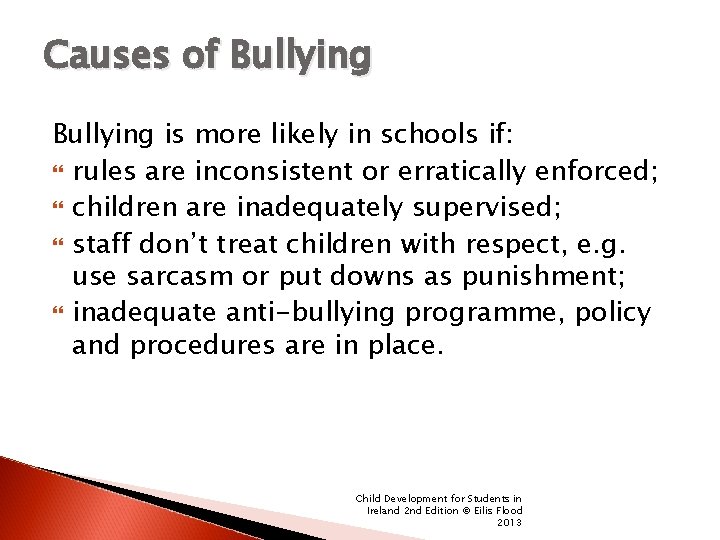
Causes of Bullying is more likely in schools if: rules are inconsistent or erratically enforced; children are inadequately supervised; staff don’t treat children with respect, e. g. use sarcasm or put downs as punishment; inadequate anti-bullying programme, policy and procedures are in place. Child Development for Students in Ireland 2 nd Edition © Eilis Flood 2013
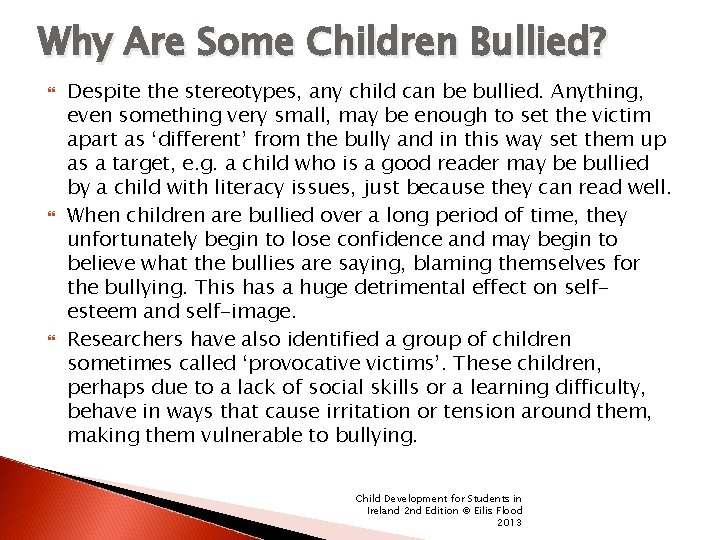
Why Are Some Children Bullied? Despite the stereotypes, any child can be bullied. Anything, even something very small, may be enough to set the victim apart as ‘different’ from the bully and in this way set them up as a target, e. g. a child who is a good reader may be bullied by a child with literacy issues, just because they can read well. When children are bullied over a long period of time, they unfortunately begin to lose confidence and may begin to believe what the bullies are saying, blaming themselves for the bullying. This has a huge detrimental effect on selfesteem and self-image. Researchers have also identified a group of children sometimes called ‘provocative victims’. These children, perhaps due to a lack of social skills or a learning difficulty, behave in ways that cause irritation or tension around them, making them vulnerable to bullying. Child Development for Students in Ireland 2 nd Edition © Eilis Flood 2013
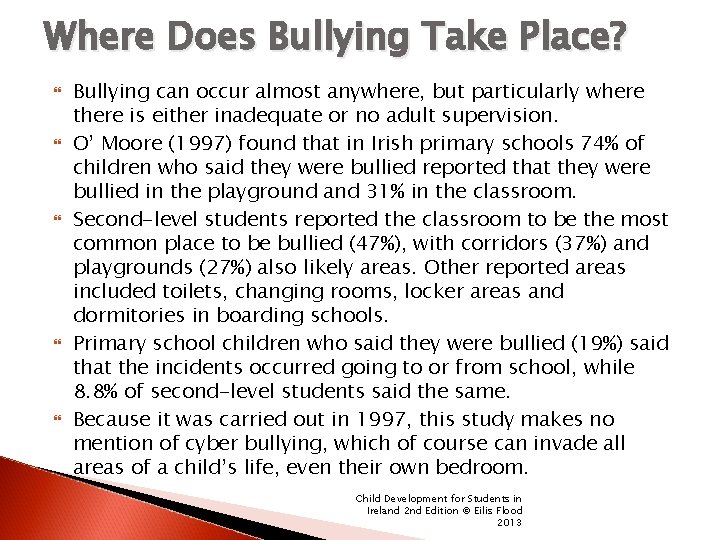
Where Does Bullying Take Place? Bullying can occur almost anywhere, but particularly where there is either inadequate or no adult supervision. O’ Moore (1997) found that in Irish primary schools 74% of children who said they were bullied reported that they were bullied in the playground and 31% in the classroom. Second-level students reported the classroom to be the most common place to be bullied (47%), with corridors (37%) and playgrounds (27%) also likely areas. Other reported areas included toilets, changing rooms, locker areas and dormitories in boarding schools. Primary school children who said they were bullied (19%) said that the incidents occurred going to or from school, while 8. 8% of second-level students said the same. Because it was carried out in 1997, this study makes no mention of cyber bullying, which of course can invade all areas of a child’s life, even their own bedroom. Child Development for Students in Ireland 2 nd Edition © Eilis Flood 2013
Signs That a Child May Be Being Bullied Unexplained bruising, cuts or damage to clothing. Child shows signs of anxiety or distress - refusal to say what is wrong. Unexplained mood swings or behaviour. Withdrawn, clingy, attention seeking. Aggressive behaviour. Out-of-character behaviour in class. Deterioration in educational attainments. Loss of concentration and interest in school. Skipping school or complaining of illness to avoid school. Lingering behind at school after classes are over. Increased requests for pocket money or stealing money. Loss of or damage to personal possessions or equipment Artwork expressing inner turmoil. Child Development for Students in Ireland 2 nd Edition © Eilis Flood 2013
What Can Parents Do? Discuss the issue of bullying with your children. Challenge every incident of bullying you witness or hear about, e. g. if your child tells you about another child that was treated badly that day. Encourage your child to report incidents. Be aware of your own behaviour. Support your child’s school in their efforts to combat bullying. Give children advice about what to do if they are being bullied. Child Development for Students in Ireland 2 nd Edition © Eilis Flood 2013
What Can Schools Do? Raise awareness of bullying, e. g. through anti-bullying workshops, etc. Have a clear anti-bullying policy. Implement preventative measures, e. g. proper supervision at lunchtime, challenge ‘slagging’ and other potential bullying behaviours. Teach children how to deal effectively with conflict. Be vigilant. Advise parents of children being subjected to cyber bullying to print material and report it to the school immediately. Parents may be advised to report cyber bullying to the Gardaí Child Development for Students in Ireland 2 nd Edition © Eilis Flood 2013
Helping Children to Combat Bullying Advise children to do the following: Tell someone they trust - their parents, teachers, friends; telling will not make the situation worse. Act as confidently as they can, make eye contact and clearly tell the bully to stop, move away. Don’t hit out – tell the child that they may get hurt or the bully may claim that they are the victim. If children are being called names, tell them to try not to show that they are annoyed - bullies look for this reaction. Reassure the child that it is the bully that has the problem, not them. Tell them not to believe anything the bully says, it is not true. Child Development for Students in Ireland 2 nd Edition © Eilis Flood 2013
Sibling Relationships Over 80% of children born in Ireland have one or more sibling. Sibling relationships can be very important in developing social skills such as helping, sharing, teaching and conflict resolution. Judy Dunn (2007) found that sibling relationships showed three main characteristics: ◦ Expression of intensive positive and negative emotions ◦ Siblings tended to alternate between being highly supportive of each other and teasing/undermining each other ◦ Siblings tended to describe each other in either warm and affectionate ways or as being irritating and mean. Child Development for Students in Ireland 2 nd Edition © Eilis Flood 2013
Sibling Relationships When siblings fight, parents tend to deal with it in one of three ways: ◦ Intervene and help siblings sort out differences ◦ Give out and threaten ◦ Do nothing and let them sort it out themselves. In terms of learning social skills, the first strategy is considered best as it allows children to practise skills needed to effectively resolve conflict situations in a calm and respectful manner (Kramer, L. , and Radley, C. , 1997). Child Development for Students in Ireland 2 nd Edition © Eilis Flood 2013
Only Children Contrary to popular belief, only children do not turn out self-centred and spoilt. Instead, they tend to be achievement orientated and display many positive personality traits. When only children first attend pre-school or school they frequently have a lot of ground to make up in terms of social development. Most manage to do so and there is no research to show that only children are less socially able than children with siblings. Child Development for Students in Ireland 2 nd Edition © Eilis Flood 2013
Peer Relationships Three social skills are particularly important in the forming of successful peer relations: ◦ Perspective taking ◦ Socio-information processing – interpreting situations effectively ◦ Emotional regulation – ie temper fear etc These three factors are seen to be important in determining a child’s peer status. Child Development for Students in Ireland 2 nd Edition © Eilis Flood 2013
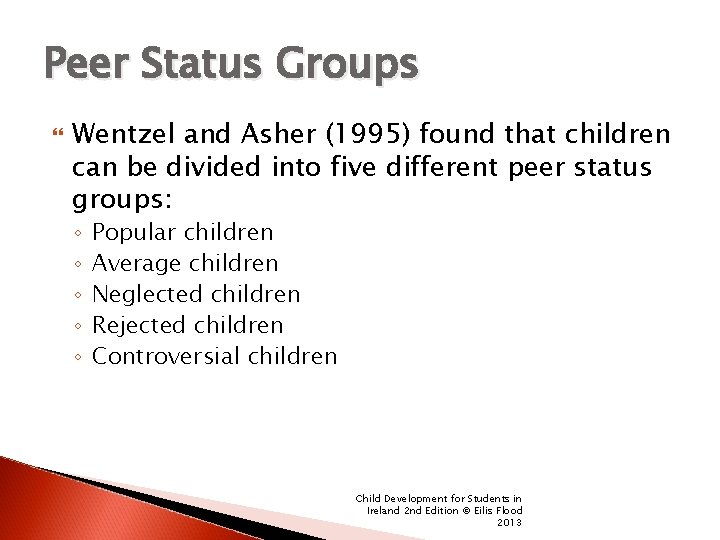
Peer Status Groups Wentzel and Asher (1995) found that children can be divided into five different peer status groups: ◦ ◦ ◦ Popular children Average children Neglected children Rejected children Controversial children Child Development for Students in Ireland 2 nd Edition © Eilis Flood 2013
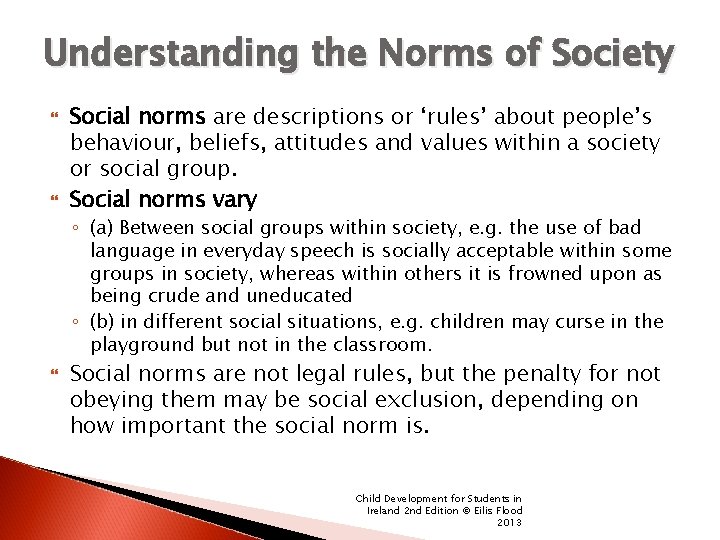
Understanding the Norms of Society Social norms are descriptions or ‘rules’ about people’s behaviour, beliefs, attitudes and values within a society or social group. Social norms vary ◦ (a) Between social groups within society, e. g. the use of bad language in everyday speech is socially acceptable within some groups in society, whereas within others it is frowned upon as being crude and uneducated ◦ (b) in different social situations, e. g. children may curse in the playground but not in the classroom. Social norms are not legal rules, but the penalty for not obeying them may be social exclusion, depending on how important the social norm is. Child Development for Students in Ireland 2 nd Edition © Eilis Flood 2013
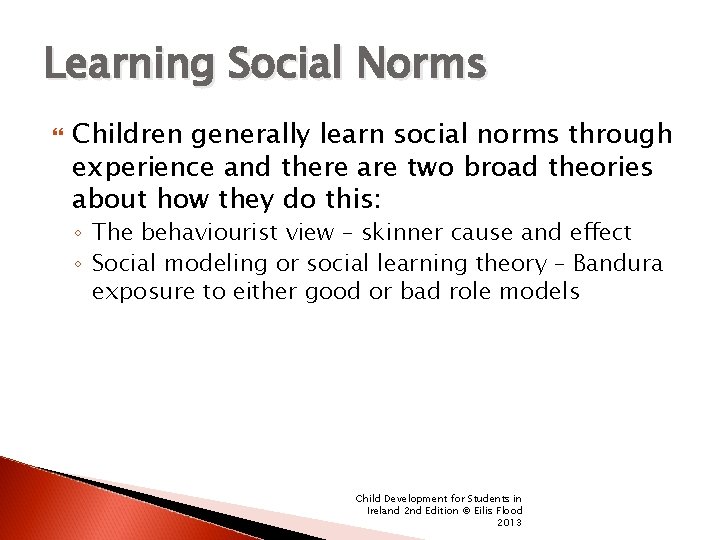
Learning Social Norms Children generally learn social norms through experience and there are two broad theories about how they do this: ◦ The behaviourist view – skinner cause and effect ◦ Social modeling or social learning theory – Bandura exposure to either good or bad role models Child Development for Students in Ireland 2 nd Edition © Eilis Flood 2013
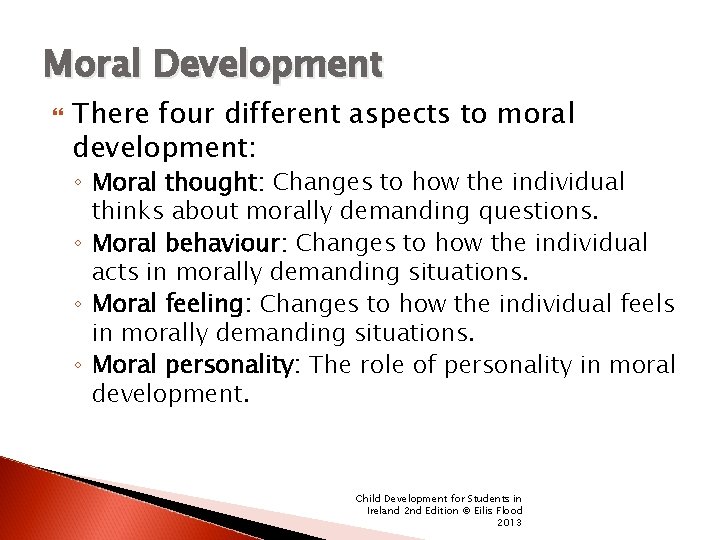
Moral Development There four different aspects to moral development: ◦ Moral thought: Changes to how the individual thinks about morally demanding questions. ◦ Moral behaviour: Changes to how the individual acts in morally demanding situations. ◦ Moral feeling: Changes to how the individual feels in morally demanding situations. ◦ Moral personality: The role of personality in moral development. Child Development for Students in Ireland 2 nd Edition © Eilis Flood 2013
(1) Development of Moral Thought Both Jean Piaget (1932) and Lawrence Kohlberg (1958) believed that moral development occurs in a series of stages. Child Development for Students in Ireland 2 nd Edition © Eilis Flood 2013
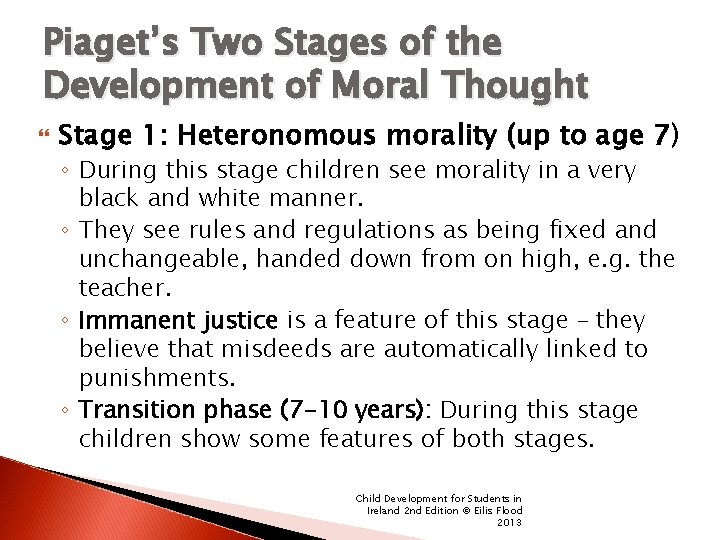
Piaget’s Two Stages of the Development of Moral Thought Stage 1: Heteronomous morality (up to age 7) ◦ During this stage children see morality in a very black and white manner. ◦ They see rules and regulations as being fixed and unchangeable, handed down from on high, e. g. the teacher. ◦ Immanent justice is a feature of this stage – they believe that misdeeds are automatically linked to punishments. ◦ Transition phase (7 -10 years): During this stage children show some features of both stages. Child Development for Students in Ireland 2 nd Edition © Eilis Flood 2013
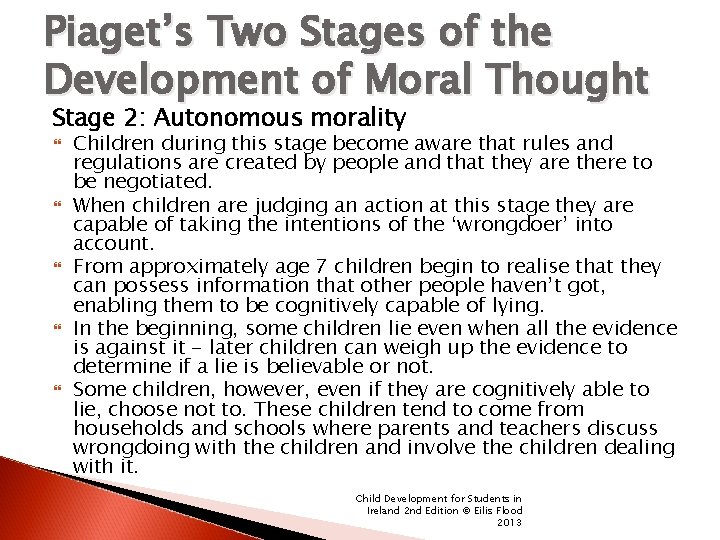
Piaget’s Two Stages of the Development of Moral Thought Stage 2: Autonomous morality Children during this stage become aware that rules and regulations are created by people and that they are there to be negotiated. When children are judging an action at this stage they are capable of taking the intentions of the ‘wrongdoer’ into account. From approximately age 7 children begin to realise that they can possess information that other people haven’t got, enabling them to be cognitively capable of lying. In the beginning, some children lie even when all the evidence is against it - later children can weigh up the evidence to determine if a lie is believable or not. Some children, however, even if they are cognitively able to lie, choose not to. These children tend to come from households and schools where parents and teachers discuss wrongdoing with the children and involve the children dealing with it. Child Development for Students in Ireland 2 nd Edition © Eilis Flood 2013
Kohlberg’s Stages of Moral Development Kohlberg believed there were three distinct levels, each of which had two sub-stages. Kohlberg gathered the data for his stage theory by presenting children of different ages with moral dilemmas followed by a series of questions. Kohlberg then categorised the children’s answers. For an example of one of Kohlberg’s dilemmas, see p. 154. Child Development for Students in Ireland 2 nd Edition © Eilis Flood 2013
(2) Development of Moral Behaviour Moral behaviour is how an individual acts in morally challenging situations. As with the learning of social norms, children learn their moral behaviour in two main ways: ◦ Conditioning ◦ Social modelling Child Development for Students in Ireland 2 nd Edition © Eilis Flood 2013
Conditioning At its simplest, when individuals are rewarded for moral behaviour they are encouraged to repeat it. Whereas when they are punished for behaviour that is morally wrong they are encouraged not to repeat it. Punishment is not a very effective tool. Skinner found that for punishment to be effective it had to be severe enough to stop the undesirable behaviour and had to follow the undesirable behaviour straight afterwards. Severe immediate punishments are usually not possible or, indeed, desirable, so encouragement of moral behaviour is much more effective. Child Development for Students in Ireland 2 nd Edition © Eilis Flood 2013
Social Modelling Bandura’s social modelling theory: children who witness moral behaviour at home, in their communities and at school are much more likely to develop high moral standards themselves. Children need to be taught by example. Child Development for Students in Ireland 2 nd Edition © Eilis Flood 2013
3. Moral Feeling Moral feeling is how you react emotionally to moral decisions. Do you feel guilt when you do something morally suspect? Are you happy when you do something morally good? Does whether or not you are going to get found out have any bearing on your feelings? Child Development for Students in Ireland 2 nd Edition © Eilis Flood 2013
Psychoanalytic Theory of Moral Development The famous psychoanalyst Sigmund Freud (1856 -1939) spent many years exploring this aspect of personality. He believed that the personality was composed of three parts: ◦ Id ◦ Ego ◦ Superego Each has a bearing on moral decisions and how the individual feels about them. Finding a purse full of money Child Development for Students in Ireland 2 nd Edition © Eilis Flood 2013
Development of Empathy is another aspect of moral feeling. Damon (1988) proposes three stages in the development of empathy: ◦ Global empathy is characteristic of babies and toddlers (0 -2 years) ◦ During early childhood (2 -10) children do empathise, but only if the person is present ◦ From approximately 10 -12 years children become capable of empathising with others even if they are not present, e. g. people living in poverty. Child Development for Students in Ireland 2 nd Edition © Eilis Flood 2013
4. Moral Personality There is debate around how much of our moral personality is innate and how much is due to environment. Freud would contend that both are involved – the id being present from birth with the ego and superego strongly influenced by environmental factors. There are individuals, however, who are reared in morally corrupt environments yet emerge from these environments morally strong. These cases lend weight to the nature argument, that moral personality is largely innate. Child Development for Students in Ireland 2 nd Edition © Eilis Flood 2013
Influences on Moral Development – Parents Research indicates how much influence parents have largely depends on three factors: 1. 2. ◦ ◦ ◦ 1. The quality of the adult/child relationship The form of discipline used (Hoffman, 1970) Love withdrawal Power assertion induction Whether or not the parent is proactive Both Piaget and Kohlberg emphasise the importance of the peer group in moral development. Child Development for Students in Ireland 2 nd Edition © Eilis Flood 2013
Influences on Moral Development – Pre-schools and Schools Within any school or pre-school, both the explicit and the hidden curriculum exist. In terms of moral development, the hidden curriculum can be just as important as the explicit. Schools and their staff need to lead by example. Pre-schools and schools must advocate a care perspective for the promotion of moral development, e. g. Teach children to always consider the feelings of others. Child Development for Students in Ireland 2 nd Edition © Eilis Flood 2013
Development of Pro-social Behaviour – Sharing Learning to share with others is one of the earliest forms of pro-social behaviour that children demonstrate. Up until about the age of three, children share because it is something they have been taught they must do, not for empathic reasons (Damon, 1988). From approximately four years, children begin to share because they feel empathy for the other child, but will generally only share if they have more than enough for themselves and what they are sharing is not too coveted. The important thing about sharing in terms of social development is that the child understands that sharing is an important part of forming and maintaining social relationships and that it is morally right to share. Child Development for Students in Ireland 2 nd Edition © Eilis Flood 2013
Pro-social Behaviour - Developing a Sense of Fairness is usually defined in terms of: ◦ equality –that everyone is treated equally; ◦ merit – extra rewards come to those who work hard for them; ◦ benevolence – special consideration should be given to those who need something most. Up until about eight years of age, children think of fairness in terms of equality only. From about eight years on they also begin to think of it in terms of merit and benevolence. Child Development for Students in Ireland 2 nd Edition © Eilis Flood 2013
Special Needs Affecting Social Development – Autistic Spectrum Disorders Autistic spectrum disorder is the term used to describe a collection of developmental disorders primarily affecting the child’s ability to communicate and form social relationships. If a child is described as having autism they will have a significant number of the developmental disorders listed on the autistic spectrum. If a child is described as having Asperger syndrome they will have some of the developmental disorders listed but not all. Child Development for Students in Ireland 2 nd Edition © Eilis Flood 2013
Autism Prevalence: 1 in 110 (Irish Autism Action 2012) Cause: not fully understood although genetic factors play a part. Symptoms: (a) language delay, some remain non-verbal, (b) difficulty with social relationships, (c) repetitive activities and routines and (d) often have a narrow range of interests – can be obsessive about them. Children with autism benefit from early interventions, e. g. ABA programmes. Child Development for Students in Ireland 2 nd Edition © Eilis Flood 2013
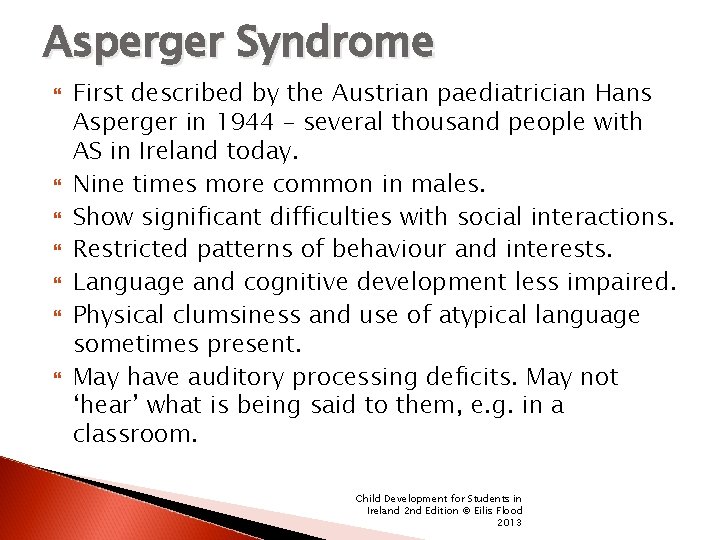
Asperger Syndrome First described by the Austrian paediatrician Hans Asperger in 1944 – several thousand people with AS in Ireland today. Nine times more common in males. Show significant difficulties with social interactions. Restricted patterns of behaviour and interests. Language and cognitive development less impaired. Physical clumsiness and use of atypical language sometimes present. May have auditory processing deficits. May not ‘hear’ what is being said to them, e. g. in a classroom. Child Development for Students in Ireland 2 nd Edition © Eilis Flood 2013
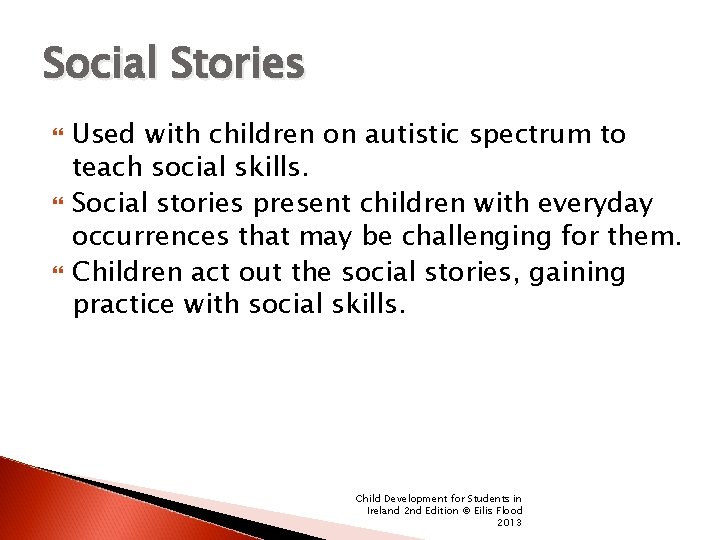
Social Stories Used with children on autistic spectrum to teach social skills. Social stories present children with everyday occurrences that may be challenging for them. Children act out the social stories, gaining practice with social skills. Child Development for Students in Ireland 2 nd Edition © Eilis Flood 2013
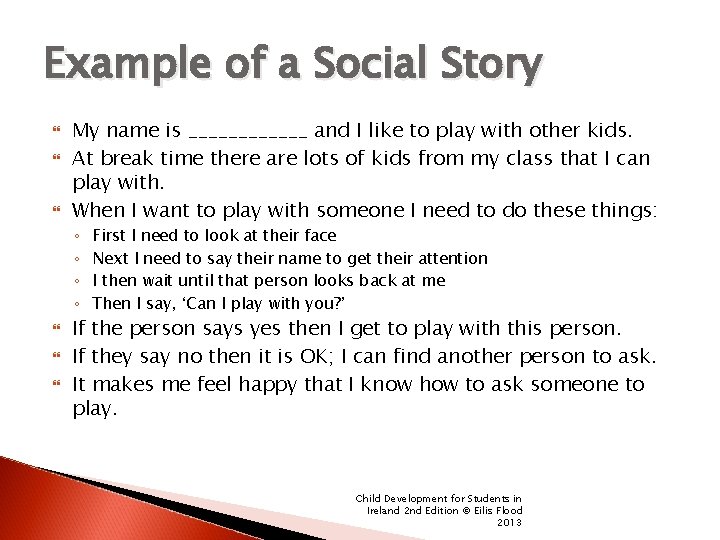
Example of a Social Story My name is ______ and I like to play with other kids. At break time there are lots of kids from my class that I can play with. When I want to play with someone I need to do these things: ◦ ◦ First I need to look at their face Next I need to say their name to get their attention I then wait until that person looks back at me Then I say, ‘Can I play with you? ’ If the person says yes then I get to play with this person. If they say no then it is OK; I can find another person to ask. It makes me feel happy that I know how to ask someone to play. Child Development for Students in Ireland 2 nd Edition © Eilis Flood 2013
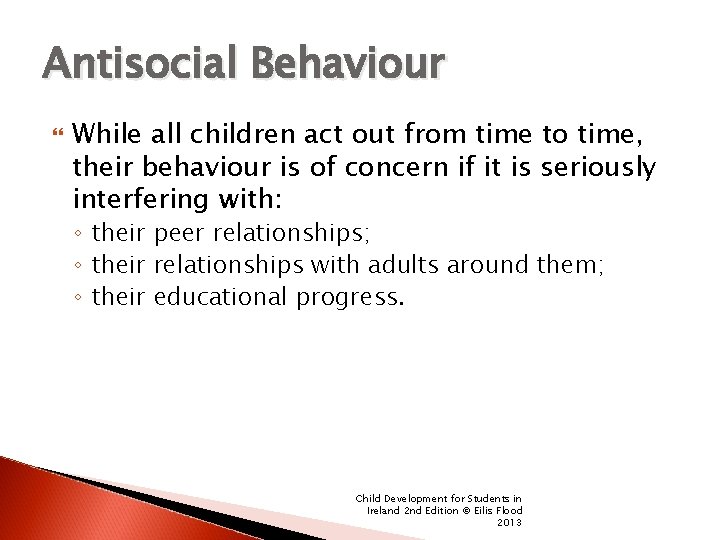
Antisocial Behaviour While all children act out from time to time, their behaviour is of concern if it is seriously interfering with: ◦ their peer relationships; ◦ their relationships with adults around them; ◦ their educational progress. Child Development for Students in Ireland 2 nd Edition © Eilis Flood 2013
Special Needs Affecting Behaviour Opposition Defiant Disorder (ODD): The child shows a recurrent and unusual pattern of negative, defiant, disobedient and hostile behaviour towards adults, particularly authority figures. Conduct Disorder is more serious than OD. Behaviours are much more destructive and extreme. A child with conduct disorder will not appear to be able to consider the feelings of others and will frequently hurt or injure others, showing no empathy or remorse. Child Development for Students in Ireland 2 nd Edition © Eilis Flood 2013
Effective Management of Children’s Behaviour Adults should intervene and help peers and siblings to sort out differences in a calm and fair manner. If one child hurts another, always encourage the offending child to think about how the other one feels. Encourage children to manage their anger, e. g. count to ten. Reinforce social norms with praise and encouragement, e. g. ‘Yes, good boy, we always wash our hands after going to the toilet’. Always seek to encourage good behaviour rather than punish bad behaviour. Child Development for Students in Ireland 2 nd Edition © Eilis Flood 2013
Effective Management of children’s Behaviour Set clear yet fair rules and boundaries for children to follow. Practise what you preach, e. g. if a parent asks a child not to hit others, they should not slap the child. Use induction as a discipline technique – reason with the child, discuss the consequences of their actions. Advocate a care perspective. Educate about the importance of considering others’ feelings, being sensitive to the needs of others and helping each other. Child Development for Students in Ireland 2 nd Edition © Eilis Flood 2013
How Aistear Promotes Social Development One of Aistear’s main pedagogical principles is that children learn through positive interactions with others. Aistear’s guidelines for good practice state: Aistear recognises that relationships are at the very centre of early learning and development. The good practice guidelines identify a range of interaction strategies and methods the adult can use to enhance children’s learning and development. Effective interactions between adults and children need to be ‘respectful, playful, enjoyable, enabling, and rewarding’. (NCCA, 2009, P. 27). In addition, all of Aistear’s four themes have elements of social development. See pp. 166– 167 for themes and learning goals related to social development. See also sample social development observation on pp. 168– 172. Child Development for Students in Ireland 2 nd Edition © Eilis Flood 2013
Revision Questions 1. 2. 3. 4. 5. 6. 7. 8. 9. What is social development? What is meant by parallel play? Describe how children’s ability to interact effectively with others develops from birth to six years. Describe how children’s ability to interact effectively with others develops 6 -12 years. (Level 6) Describe the types of bullying children may be subjected to. (Level 6) What factors make a child more likely to engage in bullying behaviour? (Level 6) What signs could indicate a child is being bullied? (Level 6) What can schools do to help prevent bullying? (Level 6) What advice can parents and schools give children who are being bullied? (Level 6) Child Development for Students in Ireland 2 nd Edition © Eilis Flood 2013
Revision Questions 10. 11. 12. 13. 14. 15. 16. 17. According to Judy Dunn (2007), what are three main characteristics of sibling relationships? Should parents intervene in sibling fights? Which three skills are necessary for successful peer relations? How do Wentzel and Asher classify children’s peer status? What are social norms? Describe the behaviourist view of how children learn social norms. What is meant by social modelling? Name the four different aspects of moral development. Child Development for Students in Ireland 2 nd Edition © Eilis Flood 2013
Revision Questions 18. 19. 20. 21. 22. 23. 24. Describe Piaget’s theory of moral development. Describe Kohlberg’s theory of moral development. Describe Freud’s psychoanalytic theory of moral development. What is empathy? Describe Damon’s three stages in the development of empathy. Describe how parents can influence their child’s moral development. In schools and pre-schools, what is the difference between the explicit and hidden curriculum? Child Development for Students in Ireland 2 nd Edition © Eilis Flood 2013
Revision Questions 25. 26. 27. 28. 29. 30. How can schools and pre-schools promote moral development? Define both pro-social and anti-social behaviour. Describe one special need that affects social development. What is oppositional defiant disorder? What is conduct disorder? How can pre-schools and schools deal effectively with children’s challenging behaviour? Child Development for Students in Ireland 2 nd Edition © Eilis Flood 2013