
Social Development Chapter 3 Biological Foundations Roots in
Social Development Chapter 3 Biological Foundations: Roots in Neurons and Genes
Today’s Outline: Biological Foundations of Social Interaction n Biological “preparedness” for social interaction n Neurological foundations n Genetics n Differences in temperament
Biological “Preparedness” for Social Interaction: Why are babies prepared? n Evolutionary Theory q q q Preparedness is adaptive and useful for ensuring the survival of the human infant and more generally, the species Infants are biologically “programmed” for social interactions that ensure that their needs are met Interactions with environment and people help to develop brain and neuron networks, crucial to later development
Biological “Preparedness” for Social Interaction: How are babies prepared? n Parent-child synchrony n Visual Preparedness n Auditory Preparedness n Smell, Taste, and Touch Preparedness

What is synchrony? n a process that coordinates the ongoing exchanges b/w parent and child during social interactions n Includes sensory, hormonal, and physiological stimuli n Occurs from gestation through infancy n Video

Synchrony n Newborns: q n Newborns’ alert-scanning behavior → Maternal behaviors → infant-mother and infant-father synchrony at 3 months 3 Months: q q q Begin to respond to social cues Dyadic example Triadic example
Underlying Causes of Synchrony n Infant’s Biological Rhythms q q Biological Clock Cardiac Rhythms n Mother’s Level of Oxytocin n Parents’ activation in brain areas linked to parenting, empathy, and emotion regulation
Long-Term Effects of Synchrony on Development n Mother-infant synchrony at 3 and 9 mos q q q n Self-regulation behaviors at 2, 4, and 6 years old IQ at 2 and 4 years old Ability to use words that reflect internal states Synchrony with both parents at 3 mos q q q Secure attachment at 1 year Fewer behavior problems at age 2 Greater empathy at age 13
Who’s at risk for low synchrony? n Prematurely born infants n Triplets n Infants of clinically depressed mothers n Infants of clinically anxious mothers
Interventions n Kangaroo Care (KC) – Skin-to-Skin Contact q q q 3 -month old preterm infants and parents ½ received KC; coded for touch, proximity KC families (Feldman et al. , 2003) n n Parents were more sensitive, less intrusive Infants showed less negative emotion Greater touch and closer proximity among triad Massage (Field, 2001) q Greater weight gain, fewer time spent in hospital
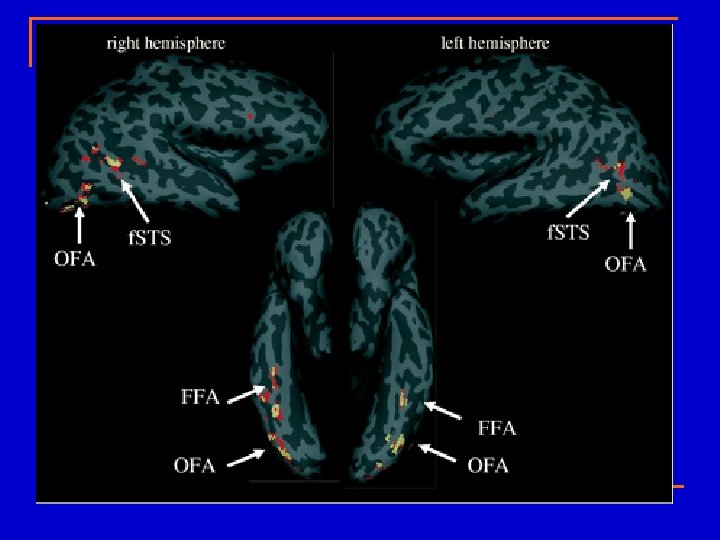
Visual preparation for social interaction n Fusiform Face Area (FFA; Kanwisher’s work) q Domain-Specific vs. Domain General
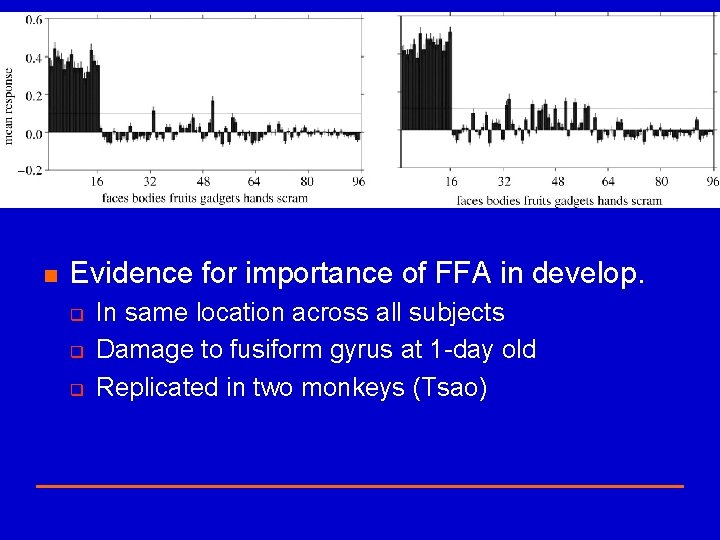
Visual preparation for social interaction n Fusiform Face Area (FFA; Kanwisher’s work) q n Domain-Specific vs. Domain General Evidence for importance of FFA in develop. q q q In same location across all subjects Damage to fusiform gyrus at 1 -day old Replicated in two monkeys (Tsao)
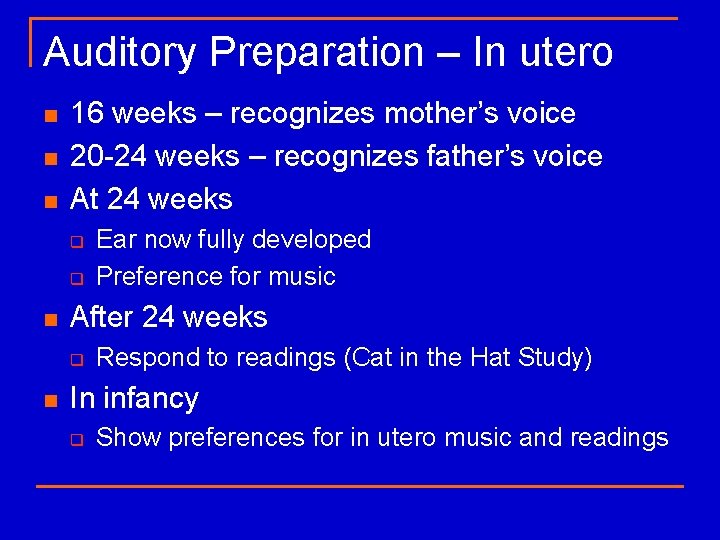
Auditory Preparation – In utero n n n 16 weeks – recognizes mother’s voice 20 -24 weeks – recognizes father’s voice At 24 weeks q q n After 24 weeks q n Ear now fully developed Preference for music Respond to readings (Cat in the Hat Study) In infancy q Show preferences for in utero music and readings
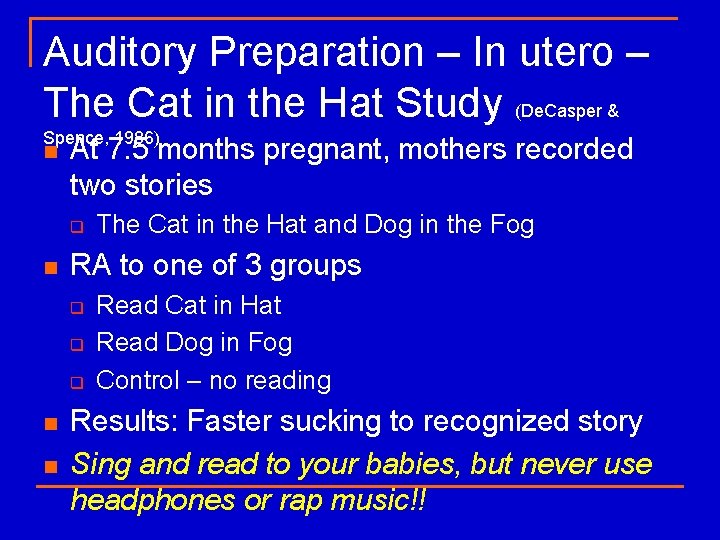
Auditory Preparation – In utero – The Cat in the Hat Study (De. Casper & Spence, 1986) n At 7. 5 months pregnant, mothers recorded two stories q n RA to one of 3 groups q q q n n The Cat in the Hat and Dog in the Fog Read Cat in Hat Read Dog in Fog Control – no reading Results: Faster sucking to recognized story Sing and read to your babies, but never use headphones or rap music!!
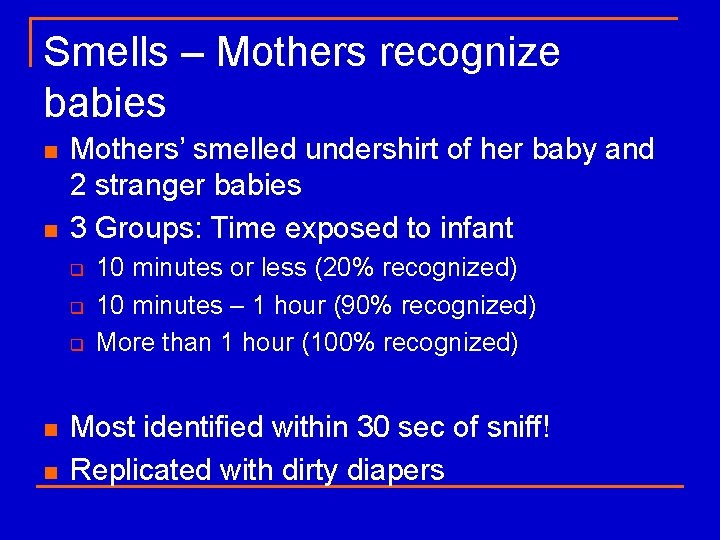
Smells – Mothers recognize babies n n Mothers’ smelled undershirt of her baby and 2 stranger babies 3 Groups: Time exposed to infant q q q n n 10 minutes or less (20% recognized) 10 minutes – 1 hour (90% recognized) More than 1 hour (100% recognized) Most identified within 30 sec of sniff! Replicated with dirty diapers
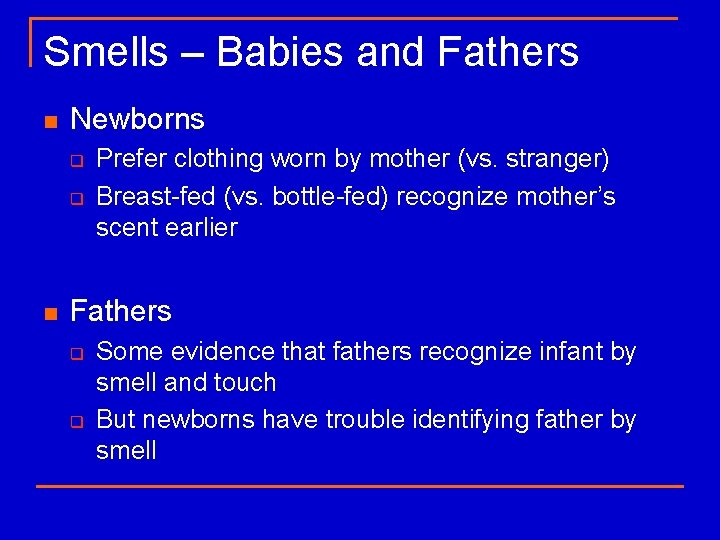
Smells – Babies and Fathers n Newborns q q n Prefer clothing worn by mother (vs. stranger) Breast-fed (vs. bottle-fed) recognize mother’s scent earlier Fathers q q Some evidence that fathers recognize infant by smell and touch But newborns have trouble identifying father by smell
- Slides: 16