
Social Development Chapter 13 Second Lecture Outline Psychosexual

- Slides: 11
Social Development (Chapter 13) Second Lecture Outline: Psychosexual Development Attachment Theory and Parenting Moral Development
Freud’s Psychosexual Theory w Oral stage (birth to two years) • Pleasure from sucking and oral activity w Anal stage (two to four years) • Urination and defecation w Phallic stage (4 to middle childhood) • Oedipal (male) and Electra (female) conflict: Desire opposite sex parent, fear wrath of same sex parent, identify with same sex parent w Latency and Genital (adolescent) phases
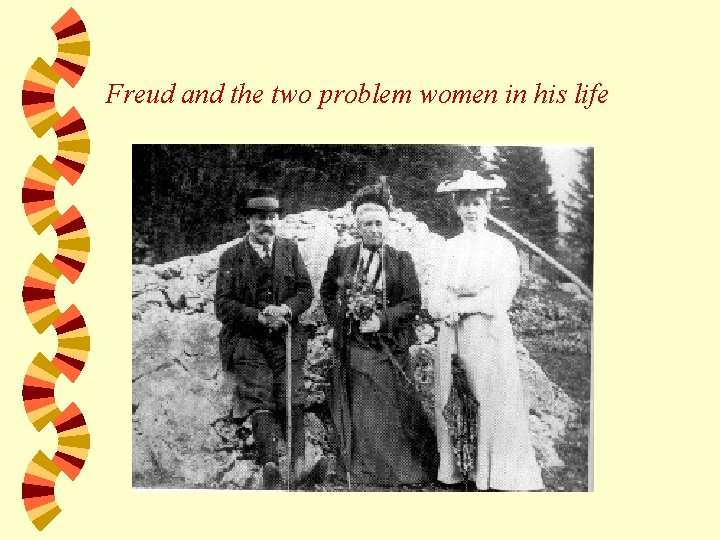
Freud and the two problem women in his life
Attachment theory Emotional bonds between people have adaptive significance, develop through an interactional history, and influence personality development w History: Spitz and WWII orphans; Harry Harlow and rhesus monkeys; Lorenz and his ducks; Genie and deprivation; sabretooth tigers w Bowlby: Attachment, Separation, and Loss w
Maasi in africa: Attachment theory is cross-cultural
Patterns in Infancy: Ainsworth’s Strange Situation Three patterns which differ on proximityseeking and distress resolution w Avoidant (A): No distress or proximityseeking, no distinction between mother and stranger w Secure (B): Distress resolved, proximityseeking w Resistant (C): Distress not resolved, ambivalent proximity-seeking w
Attachment in context Parental work status does not predict attachment w Emotional adjustment of the parent (e. g. , family stress and conflict) is important w Quality of non-parental care is important w Relationship quality becomes internalizes and influences later adult and romantic relationships w • AAI: Dismissing, Autonomous, Preoccupied
Parental Styles w Authoritarian: Firm, punitive, unsympathetic, and negative • Children can learn to be sneaky and externally controlled with low self-esteem w Permissive: Freedom, no rules or discipline • Children can learn to be impulsive, get in trouble w Authoritative: Firm but understanding • Children help make the rules, high self-esteem
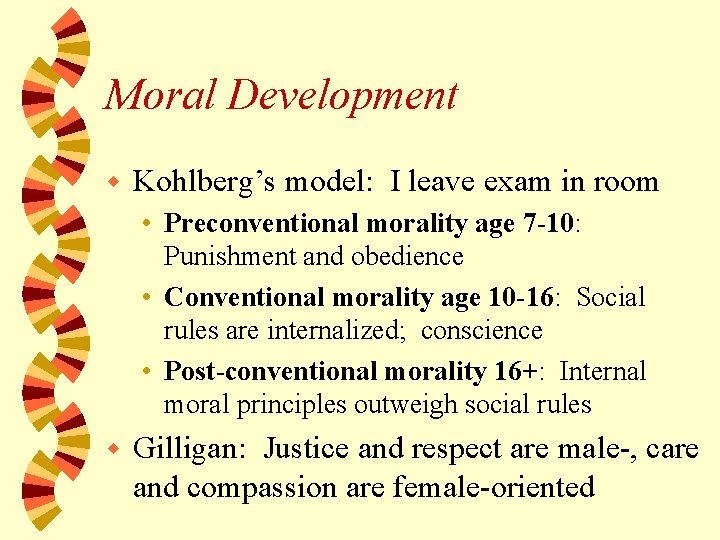
Moral Development w Kohlberg’s model: I leave exam in room • Preconventional morality age 7 -10: Punishment and obedience • Conventional morality age 10 -16: Social rules are internalized; conscience • Post-conventional morality 16+: Internal moral principles outweigh social rules w Gilligan: Justice and respect are male-, care and compassion are female-oriented
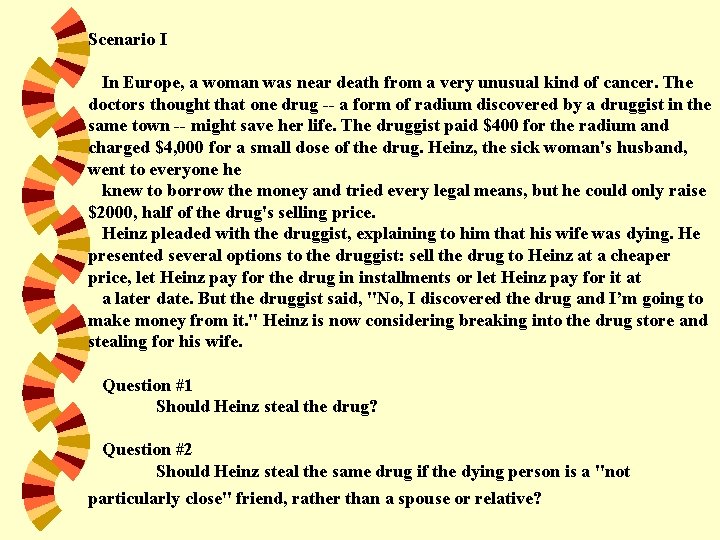
Scenario I In Europe, a woman was near death from a very unusual kind of cancer. The doctors thought that one drug -- a form of radium discovered by a druggist in the same town -- might save her life. The druggist paid $400 for the radium and charged $4, 000 for a small dose of the drug. Heinz, the sick woman's husband, went to everyone he knew to borrow the money and tried every legal means, but he could only raise $2000, half of the drug's selling price. Heinz pleaded with the druggist, explaining to him that his wife was dying. He presented several options to the druggist: sell the drug to Heinz at a cheaper price, let Heinz pay for the drug in installments or let Heinz pay for it at a later date. But the druggist said, "No, I discovered the drug and I’m going to make money from it. " Heinz is now considering breaking into the drug store and stealing for his wife. Question #1 Should Heinz steal the drug? Question #2 Should Heinz steal the same drug if the dying person is a "not particularly close" friend, rather than a spouse or relative?