
Social Cost Benefit Analysis SCBA Project Management Commercial
Social Cost Benefit Analysis (SCBA) Project Management
Commercial Cost Benefit Analysis (CBA) • Here Cost represents total cost incurred in a project • Here Benefit represents profitability of the project • Therefore a project is feasible if Cost > Benefits • But what will be the costs and/or the benefits that a society may have to bear and/or get from the proposed project are not considered here.
Social Cost Benefit Analysis (SCBA) • SCBA takes in to account the impact of a project on to the society. • Social impact can be positive or negative • If impact is negative then project could be a costlier affair for the society. • If impact is positive the project is a beneficial affair for the society. • Thus , when we evaluate a project from the view point of the society (or economy) as a whole, it is called Social Cost Benefit Analysis (SCBA)/Economic Analysis.
Scope of SCBA • SCBA can be applied to both Public & private investments – ▫ Public Investment: SCBA is important specially for the developing countries where govt. plays a significant role in the economic development. ▫ Private Investment: Here, SCBA is also important as the private investments are to be approved by various governmental & quasigovernmental agencies.
Objectives of SCBA The main focus of Social Cost Benefit Analysis is to determine: 1. Economic benefits of the project in terms of shadow prices; 2 The impact of the project on the level of savings and investments in the society; 3. The impact of the project on the distribution of income in the society; 4. The contribution of the project towards the fulfillment of certain merit wants (self- sufficiency, employment etc).
Significances of SCBA • CBA is unable to reflect social values. Hence SCBA has been emerged with some interesting significances. These significances also make the SCBA different from the CBA. Market Imperfections Externalities Taxes & Subsidies Concern for Savings Concern for Redistribution Merit Wants
Approaches to SCBA • There are two principal approaches for Social Cost Benefit Analysis. A. UNIDO Approach, and B. L-M Approach. A. UNIDO Approach: This approach is mainly based on the publication of UNIDO (United Nation Industrial Development Organization) named Guide to Practical Project Appraisal in 1978. B. L-M Approach: I. M. D Little & J. A. Mirlees have developed this approach for analysis of Social Cost-Benefit in Manual of Industrial Project Analysis in Developing Countries and Project Appraisal & Planning for Developing Countries.
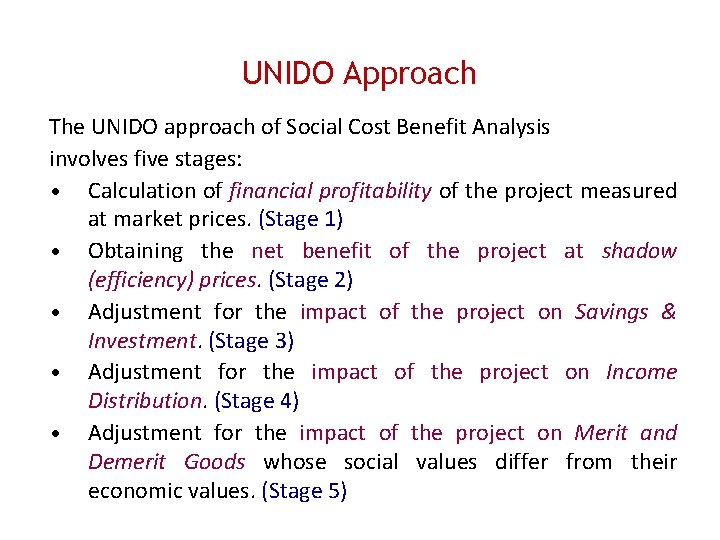
UNIDO Approach The UNIDO approach of Social Cost Benefit Analysis involves five stages: • Calculation of financial profitability of the project measured at market prices. (Stage 1) • Obtaining the net benefit of the project at shadow (efficiency) prices. (Stage 2) • Adjustment for the impact of the project on Savings & Investment. (Stage 3) • Adjustment for the impact of the project on Income Distribution. (Stage 4) • Adjustment for the impact of the project on Merit and Demerit Goods whose social values differ from their economic values. (Stage 5)
UNIDO Approach (Contd. ) Stage-1: Calculation of financial profitability of the project A good technical and financial analysis must be done before a meaningful economic (social) evaluation can be made so as to determine financial profitability. Financial profitability is indicated by the Net Present Value (NPV) of the project, which is measured by taking into account inputs (costs) and outputs (benefits) at market price.
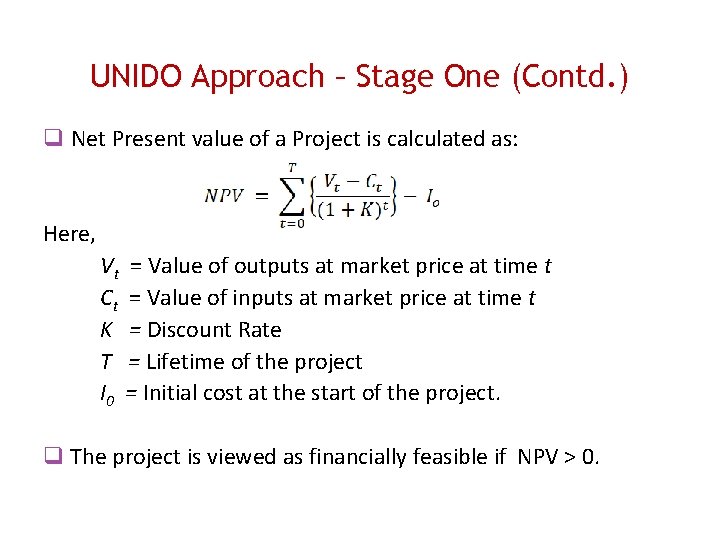
UNIDO Approach – Stage One (Contd. ) Net Present value of a Project is calculated as: Here, Vt = Value of outputs at market price at time t Ct = Value of inputs at market price at time t K = Discount Rate T = Lifetime of the project I 0 = Initial cost at the start of the project. The project is viewed as financially feasible if NPV > 0.
UNIDO Approach (Contd. ) Stage-2: Obtaining the net benefit of the project at economic (shadow) prices The Commercial Profitability analysis (calculated in stage - 1) would be sufficient only if the Project is operated in perfect market. Because, only in a perfect market, market prices can reflect the social value. If the market is imperfect (most of the cases in reality), net benefit of the Project is determined by assigning shadow prices to inputs and outputs. Therefore, developing shadow prices is very much vital.
UNIDO Approach – Stage Two (Contd. ) Shadow Prices reflect the real value of a resource (input or output) to society. Shadow Prices are also referred as economic prices, accounting prices, economic/accounting efficiency prices etc. Shadow Prices can be defined as the value of the contribution to the country’s basic socio-economic objectives made by any marginal change in the availability of commodities (0 utput) or factor of production (input). Example: A project of power station may increase the production of electricity which contributes to one of the socioeconomic objectives of the country.
UNIDO Approach – Stage Two (Contd. ) General Principles of Shadow Pricing Numeraire : A unit of account in which the values of inputs and outputs are to be expressed. Numeraire is determined at • Domestic currency rather than border price. • Present value rather than future value. • Constant price rather than current price.
UNIDO Approach – Stage Two (Contd. ) General Principles of Shadow Pricing (Contd. ) Tradability: Tradability refers to whether a good or service is tradable or nontradable; if tradable whether is fully traded or non-traded. A good/service is tradable in the absence of or within limited trade barriers. A tradable good/service is actually traded when • the import (export) supply is perfectly elastic over the relevant range of volume. • all additional demand (production) must be made (consumed) by import (export) due to the full capacity in the domestic industry (fulfillment of demand by domestic consumer).
UNIDO Approach – Stage Two (Contd. ) General Principles of Shadow Pricing (Contd. ) • the import price is less or the export price is more than the domestic cost of production. A good/service is non-tradable; if • its import price is greater than its domestic cost of production, and/or • its export price is less than its domestic cost of production. A tradable good/service that is not actually traded is called non-traded.
UNIDO Approach – Stage Two (Contd. ) General Principles of Shadow Pricing (Contd. ) Basis of Shadow Pricing: Depending on the impact of the project on national economy, there are three basis of shadow pricing: 1. Cost of production 2. Consumer willingness to pay 3. Foreign exchange value in domestic currency
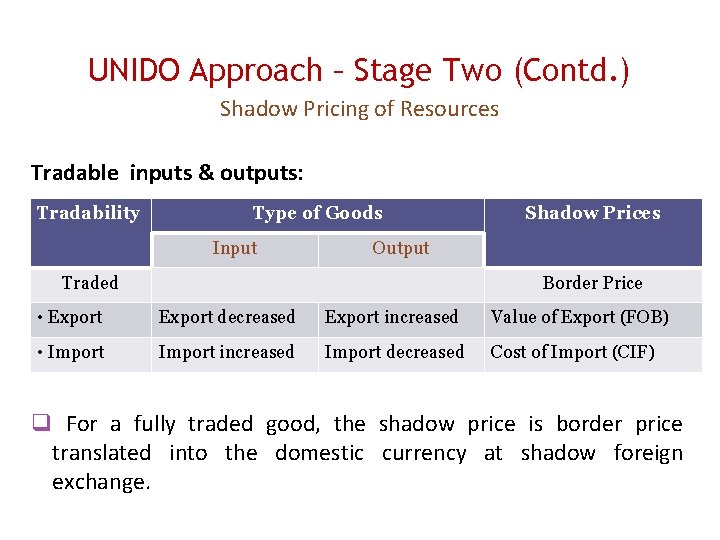
UNIDO Approach – Stage Two (Contd. ) Shadow Pricing of Resources Tradable inputs & outputs: Tradability Type of Goods Input Shadow Prices Output Traded Border Price • Export decreased Export increased Value of Export (FOB) • Import increased Import decreased Cost of Import (CIF) For a fully traded good, the shadow price is border price translated into the domestic currency at shadow foreign exchange.
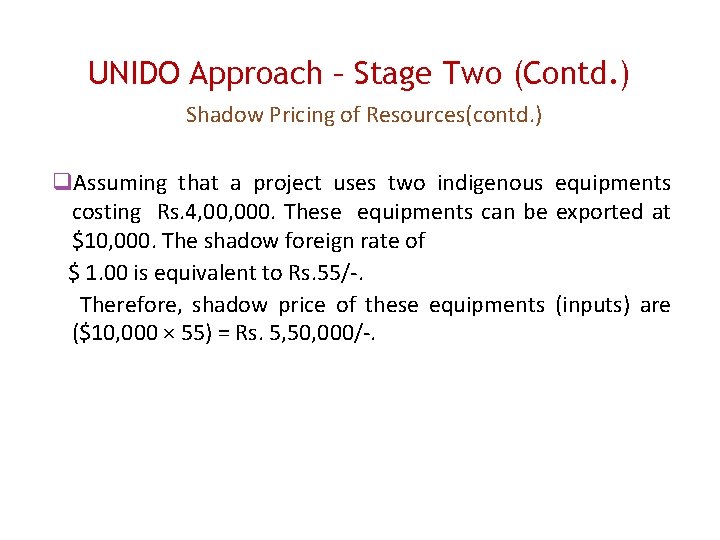
UNIDO Approach – Stage Two (Contd. ) Shadow Pricing of Resources(contd. ) Assuming that a project uses two indigenous equipments costing Rs. 4, 000. These equipments can be exported at $10, 000. The shadow foreign rate of $ 1. 00 is equivalent to Rs. 55/-. Therefore, shadow price of these equipments (inputs) are ($10, 000 × 55) = Rs. 5, 50, 000/-.
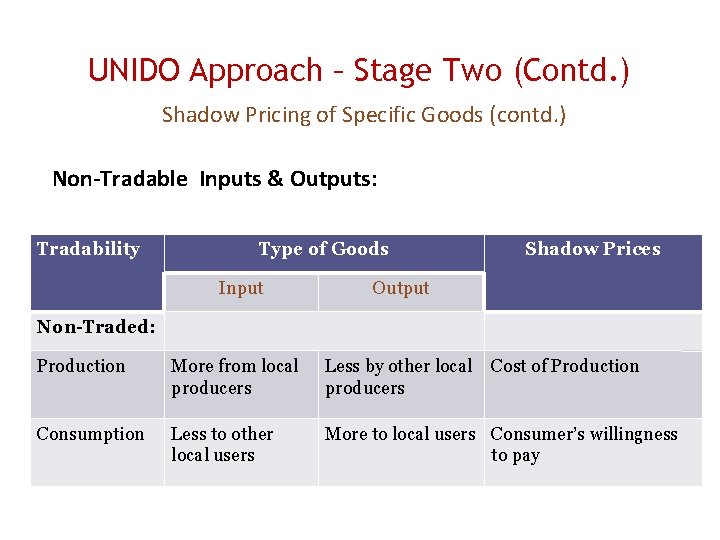
UNIDO Approach – Stage Two (Contd. ) Shadow Pricing of Specific Goods (contd. ) Non-Tradable Inputs & Outputs: Tradability Type of Goods Input Shadow Prices Output Non-Traded: Production More from local producers Less by other local producers Cost of Production Consumption Less to other local users More to local users Consumer’s willingness to pay
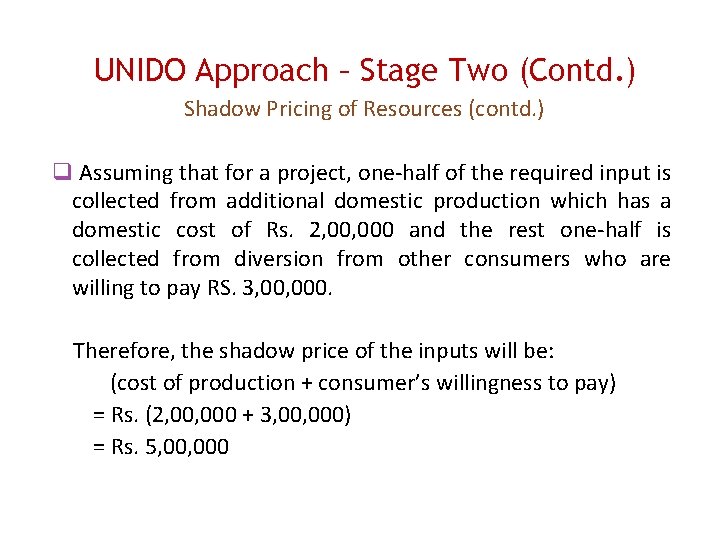
UNIDO Approach – Stage Two (Contd. ) Shadow Pricing of Resources (contd. ) Assuming that for a project, one-half of the required input is collected from additional domestic production which has a domestic cost of Rs. 2, 000 and the rest one-half is collected from diversion from other consumers who are willing to pay RS. 3, 000. Therefore, the shadow price of the inputs will be: (cost of production + consumer’s willingness to pay) = Rs. (2, 000 + 3, 000) = Rs. 5, 000
UNIDO Approach – Stage Two (Contd. ) Shadow Pricing of Resources (contd. ) Externalities: An externality is an external effect (either beneficial or harmful) causes from a project which is – • not deliberately created by the project sponsors but is an incidental outcome. • beyond the control of the persons who are benefited or affected by it. • not traded in the market place
UNIDO Approach – Stage Two (Contd. ) Shadow Pricing of Resources (contd. ) Example of External Effects: Near about 100, 000 people had lost lands 5, 680 acres due to the project of Jamuna Bridge. People may be affected by erosion and flood conditions brought about by changes to the river which result from the construction activities of a bridge. Environmental pollution created by brick field. A project of planting trees for commercial purpose may give protection to the environment against the increasing global warmth.
UNIDO Approach – Stage Two (Contd. ) Shadow Pricing of Resources (contd. ) Shadow Pricing of Externalities: Although valuation of external effects is difficult as they are often intangible in nature and there is no market price, shadow pricing of externalities may be made indirect means such as : The harmful effect of the bridge may be measured by the consumer willingness to pay for the output of the people which has been reduced due to the bridge. The cost of pollution may be estimated in terms of the loss of earnings as a result of damage to health caused by it.
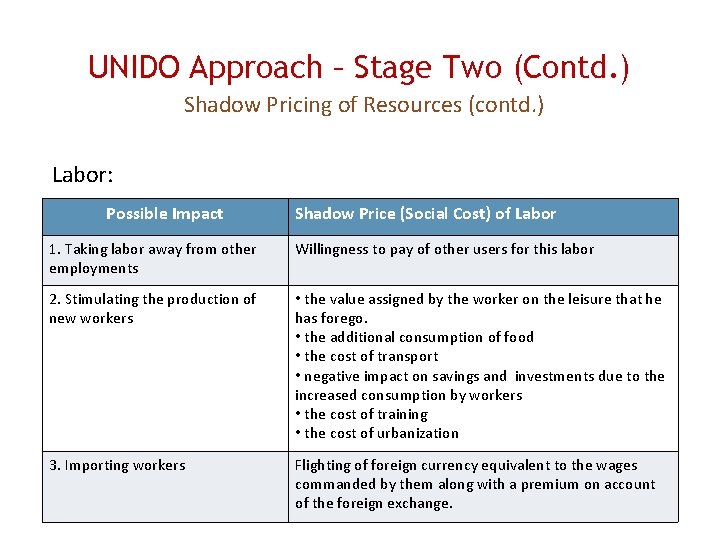
UNIDO Approach – Stage Two (Contd. ) Shadow Pricing of Resources (contd. ) Labor: Possible Impact Shadow Price (Social Cost) of Labor 1. Taking labor away from other employments Willingness to pay of other users for this labor 2. Stimulating the production of new workers • the value assigned by the worker on the leisure that he has forego. • the additional consumption of food • the cost of transport • negative impact on savings and investments due to the increased consumption by workers • the cost of training • the cost of urbanization 3. Importing workers Flighting of foreign currency equivalent to the wages commanded by them along with a premium on account of the foreign exchange.
UNIDO Approach – Stage Two (Contd. ) Shadow Pricing of Resources (contd. ) Capital: Investment of capital in a project causes to happen two things: i. Financial resources are converted into physical assets ii. Financial resources are withdrawn from national pool of savings. Thus alternative projects are foregone and there is an opportunity cost of it. The opportunity cost of capital (shadow price of capital) depends on the source from which the capital has generated.
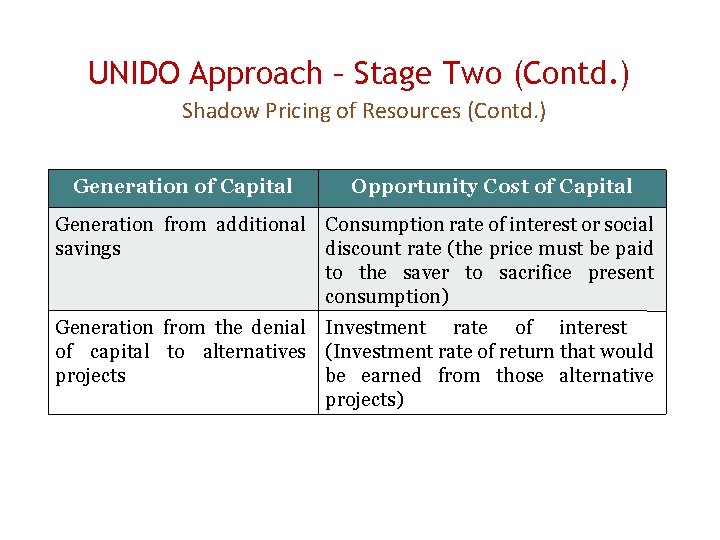
UNIDO Approach – Stage Two (Contd. ) Shadow Pricing of Resources (Contd. ) Generation of Capital Opportunity Cost of Capital Generation from additional Consumption rate of interest or social savings discount rate (the price must be paid to the saver to sacrifice present consumption) Generation from the denial Investment rate of interest of capital to alternatives (Investment rate of return that would projects be earned from those alternative projects)
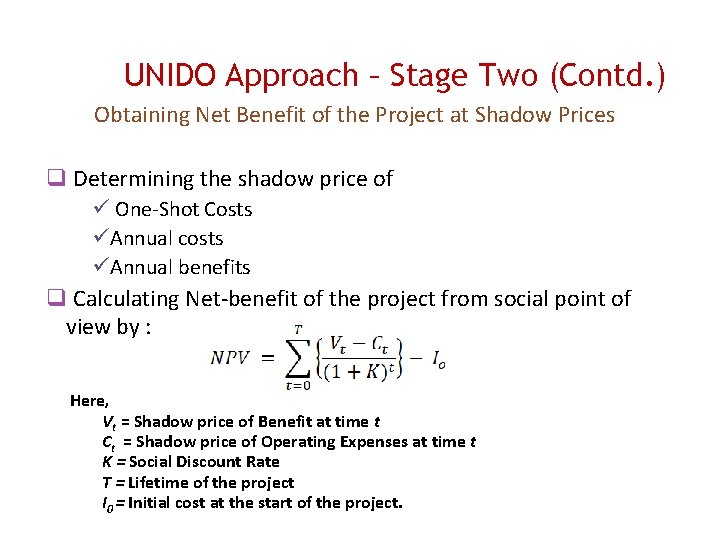
UNIDO Approach – Stage Two (Contd. ) Obtaining Net Benefit of the Project at Shadow Prices Determining the shadow price of One-Shot Costs Annual costs Annual benefits Calculating Net-benefit of the project from social point of view by : Here, Vt = Shadow price of Benefit at time t Ct = Shadow price of Operating Expenses at time t K = Social Discount Rate T = Lifetime of the project I 0 = Initial cost at the start of the project.
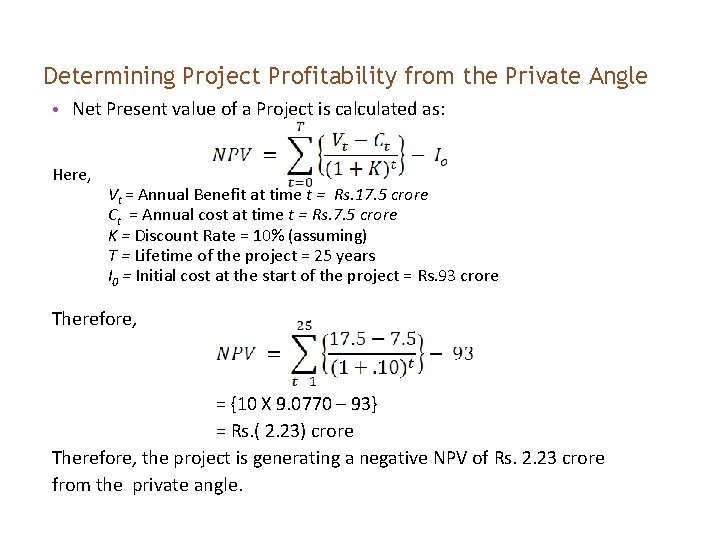
Determining Project Profitability from the Private Angle • Net Present value of a Project is calculated as: Here, Vt = Annual Benefit at time t = Rs. 17. 5 crore Ct = Annual cost at time t = Rs. 7. 5 crore K = Discount Rate = 10% (assuming) T = Lifetime of the project = 25 years I 0 = Initial cost at the start of the project = Rs. 93 crore Therefore, = {10 X 9. 0770 – 93} = Rs. ( 2. 23) crore Therefore, the project is generating a negative NPV of Rs. 2. 23 crore from the private angle.
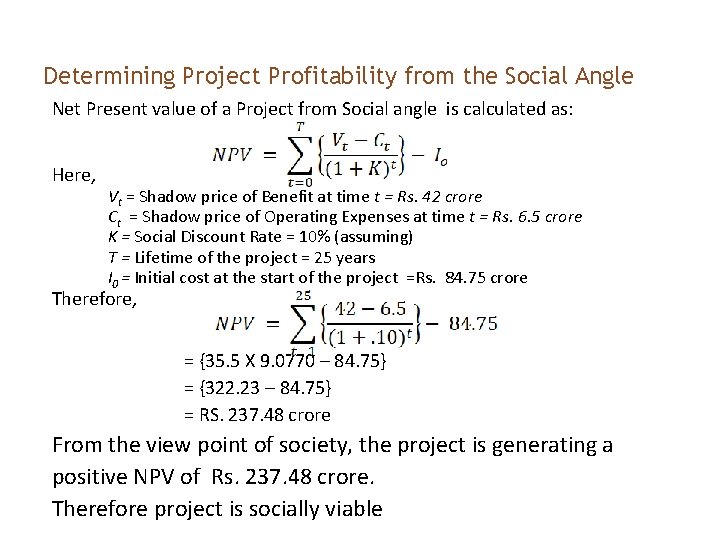
Determining Project Profitability from the Social Angle Net Present value of a Project from Social angle is calculated as: Here, Vt = Shadow price of Benefit at time t = Rs. 42 crore Ct = Shadow price of Operating Expenses at time t = Rs. 6. 5 crore K = Social Discount Rate = 10% (assuming) T = Lifetime of the project = 25 years I 0 = Initial cost at the start of the project =Rs. 84. 75 crore Therefore, = {35. 5 X 9. 0770 – 84. 75} = {322. 23 – 84. 75} = RS. 237. 48 crore From the view point of society, the project is generating a positive NPV of Rs. 237. 48 crore. Therefore project is socially viable
UNIDO Approach: Stage – 3 Adjustment for the impact of the project on Savings & Investment The purposes of this stage are to – determine the amount of income gained or lost because of the project by different income groups or stakeholders (such as business, government, workers, customers etc. ). evaluate the net impact of these gains and losses on savings measure the adjustment factor for savings and thus the adjusted values for savings impact. adjust the impact on savings to the net present value calculated in stage two.
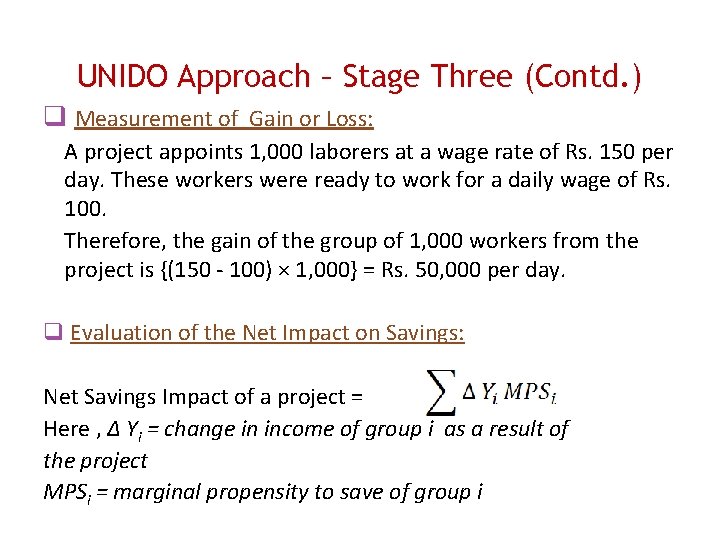
UNIDO Approach – Stage Three (Contd. ) Measurement of Gain or Loss: A project appoints 1, 000 laborers at a wage rate of Rs. 150 per day. These workers were ready to work for a daily wage of Rs. 100. Therefore, the gain of the group of 1, 000 workers from the project is {(150 - 100) × 1, 000} = Rs. 50, 000 per day. Evaluation of the Net Impact on Savings: Net Savings Impact of a project = Here , Δ Yi = change in income of group i as a result of the project MPSi = marginal propensity to save of group i
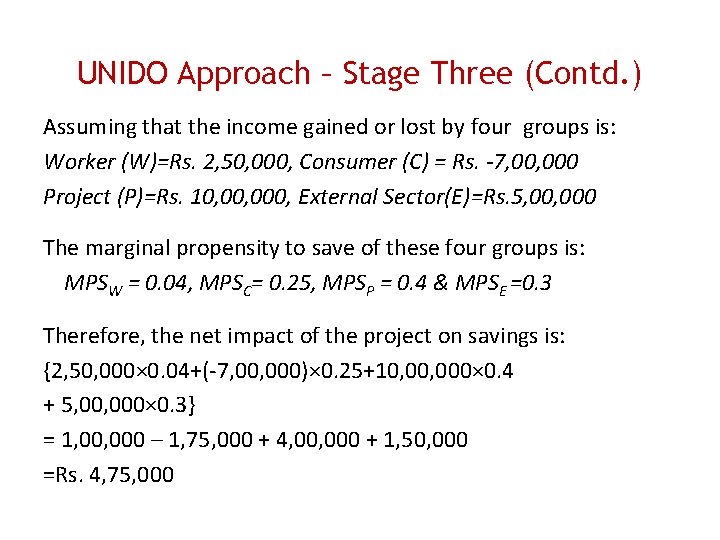
UNIDO Approach – Stage Three (Contd. ) Assuming that the income gained or lost by four groups is: Worker (W)=Rs. 2, 50, 000, Consumer (C) = Rs. -7, 000 Project (P)=Rs. 10, 000, External Sector(E)=Rs. 5, 000 The marginal propensity to save of these four groups is: MPSW = 0. 04, MPSC= 0. 25, MPSP = 0. 4 & MPSE =0. 3 Therefore, the net impact of the project on savings is: {2, 50, 000× 0. 04+(-7, 000)× 0. 25+10, 000× 0. 4 + 5, 000× 0. 3} = 1, 000 – 1, 75, 000 + 4, 000 + 1, 50, 000 =Rs. 4, 75, 000
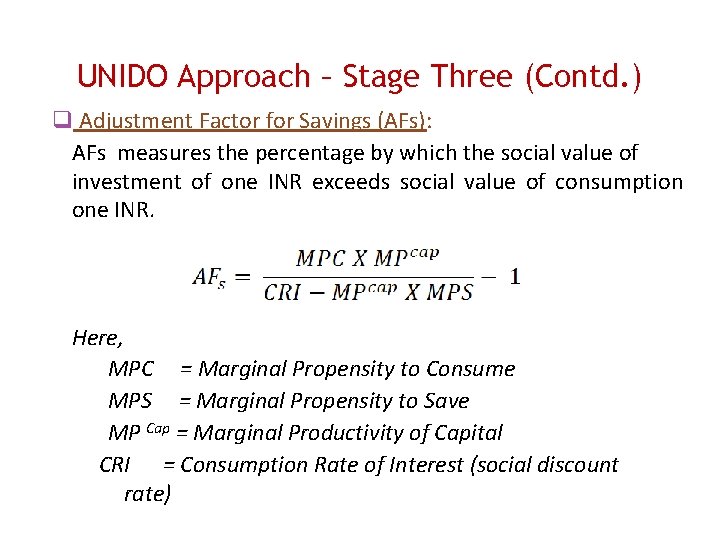
UNIDO Approach – Stage Three (Contd. ) Adjustment Factor for Savings (AFs): AFs measures the percentage by which the social value of investment of one INR exceeds social value of consumption one INR. Here, MPC = Marginal Propensity to Consume MPS = Marginal Propensity to Save MP Cap = Marginal Productivity of Capital CRI = Consumption Rate of Interest (social discount rate)
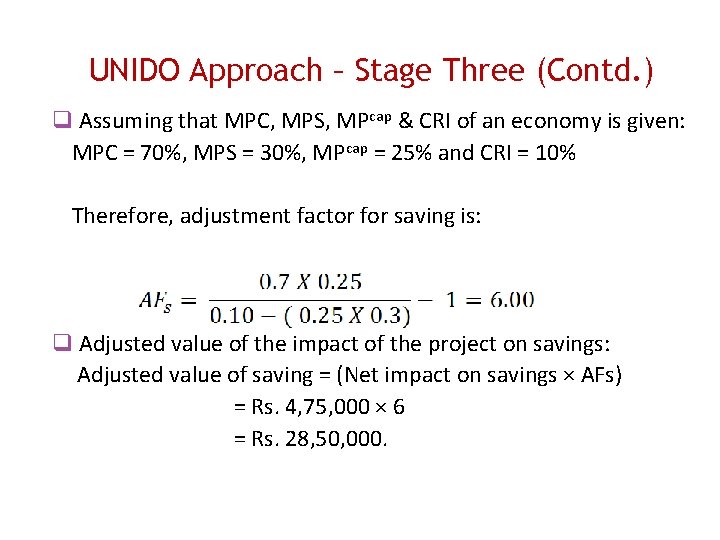
UNIDO Approach – Stage Three (Contd. ) Assuming that MPC, MPS, MPcap & CRI of an economy is given: MPC = 70%, MPS = 30%, MPcap = 25% and CRI = 10% Therefore, adjustment factor for saving is: Adjusted value of the impact of the project on savings: Adjusted value of saving = (Net impact on savings × AFs) = Rs. 4, 75, 000 × 6 = Rs. 28, 50, 000.
UNIDO Approach – Stage Three (Contd. ) • This RS. 28, 50, 000 is now added to the net present value of the project calculated in stage -2 ( Rs. 237. 48 crore) • Therefore, the adjusted net present value at this stage will be Rs. ( 237. 48 +. 285) = Rs. 237. 765 crore.
UNIDO Approach: Stage – 4 Adjustment for the impact of the project on Income Distribution Government considers a project as an investment for the redistribution of income in favor of economically weakens sections or economically backward regions. This stage provides a value on the effects of a project on income distribution between rich & poor and among regions. Distribution Adjustment Factor (Weight) is calculated and the impacts of the project on income distribution have been valued by multiplying the adjustment factor with the particular income of a group. This value will then be added to the net present value re-calculated in stage three to produce the social net present value of the project.
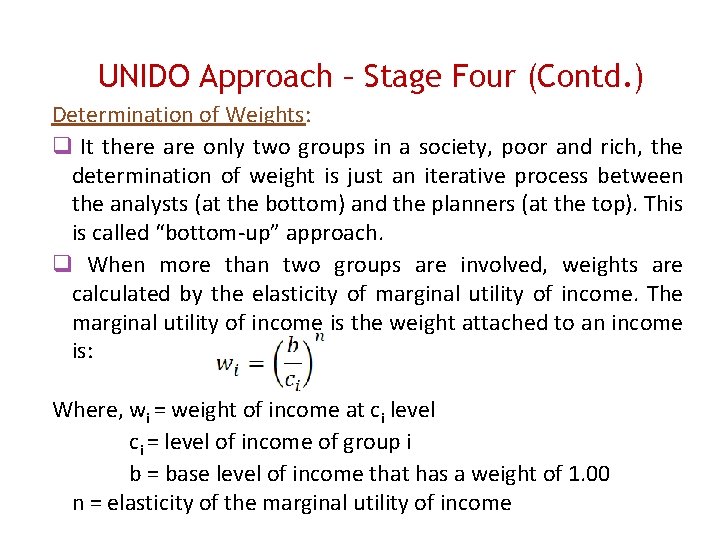
UNIDO Approach – Stage Four (Contd. ) Determination of Weights: It there are only two groups in a society, poor and rich, the determination of weight is just an iterative process between the analysts (at the bottom) and the planners (at the top). This is called “bottom-up” approach. When more than two groups are involved, weights are calculated by the elasticity of marginal utility of income. The marginal utility of income is the weight attached to an income is: Where, wi = weight of income at ci level ci = level of income of group i b = base level of income that has a weight of 1. 00 n = elasticity of the marginal utility of income
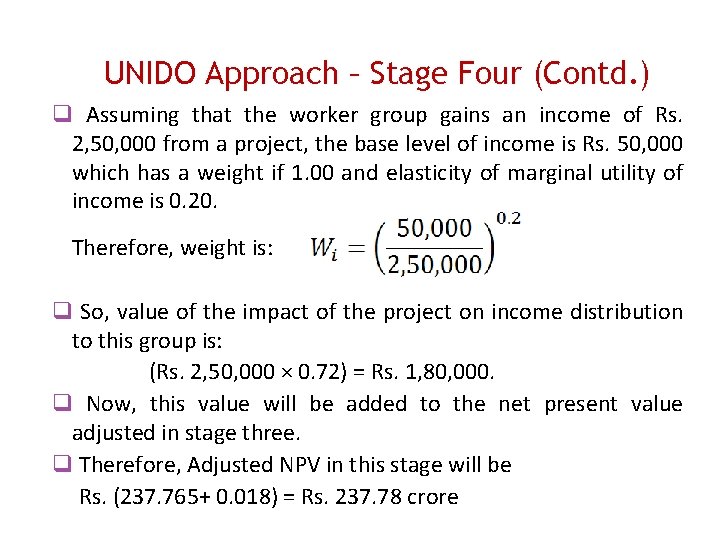
UNIDO Approach – Stage Four (Contd. ) Assuming that the worker group gains an income of Rs. 2, 50, 000 from a project, the base level of income is Rs. 50, 000 which has a weight if 1. 00 and elasticity of marginal utility of income is 0. 20. Therefore, weight is: So, value of the impact of the project on income distribution to this group is: (Rs. 2, 50, 000 × 0. 72) = Rs. 1, 80, 000. Now, this value will be added to the net present value adjusted in stage three. Therefore, Adjusted NPV in this stage will be Rs. (237. 765+ 0. 018) = Rs. 237. 78 crore
UNIDO Approach: Stage – 5 Adjustment for Merit and Demerit Goods If there is no difference between the economic value of inputs and outputs and the social value of those, the UNIDO approach for project evaluation ends at stage four. In practical, there are some goods (merit goods), social value of which exceed the economic value (e. g. oil, creation of employment etc. ) and also there are some goods (demerits goods), social value of which is less than their economic value (e. g. , cigarette, alcohol, high-grade cosmetics etc. ) Adjustment to the net present value of stage 4 is required if there is any difference between the social and economic value.
UNIDO Approach – Stage Five (Contd. ) The steps of adjustment procedure are: • Estimating the present economic value • Calculating the adjustment factor • Multiplying the economic value by the adjustment factor to obtain the adjusted value • Adding or subtracting the adjusted value to or from the net present value of the project as calculated in stage four.
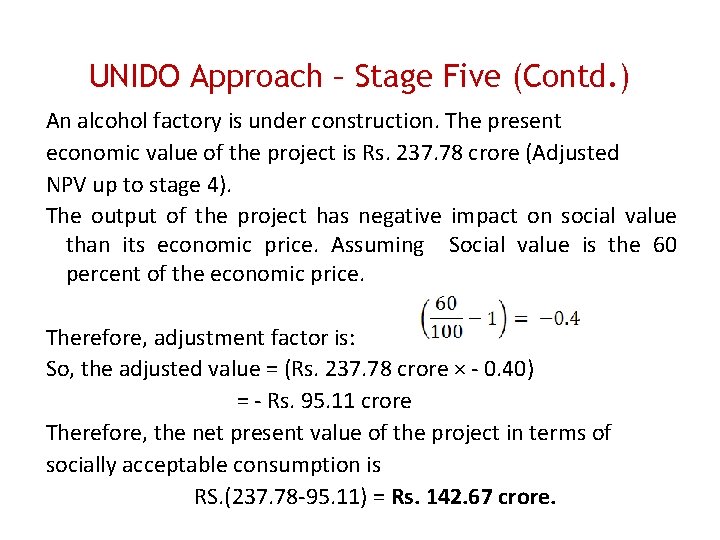
UNIDO Approach – Stage Five (Contd. ) An alcohol factory is under construction. The present economic value of the project is Rs. 237. 78 crore (Adjusted NPV up to stage 4). The output of the project has negative impact on social value than its economic price. Assuming Social value is the 60 percent of the economic price. Therefore, adjustment factor is: So, the adjusted value = (Rs. 237. 78 crore × - 0. 40) = - Rs. 95. 11 crore Therefore, the net present value of the project in terms of socially acceptable consumption is RS. (237. 78 -95. 11) = Rs. 142. 67 crore.
- Slides: 41