
Social Competencies and Peer Relationships Longitudinal Associations with
- Slides: 22
Social Competencies and Peer Relationships: Longitudinal Associations with Peer Group and Adolescent Aggression Jill Antonishak, Ph. D. F. Christy Mc. Farland Joseph P. Allen, Ph. D. University of Virginia Collaborators: Joanna Chango Amanda Hare Kathleen B. Mc. Elhaney, Ph. D. Jennifer Haynes Nell Manning Jessica Meyer Erin Miga Claire Stephenson
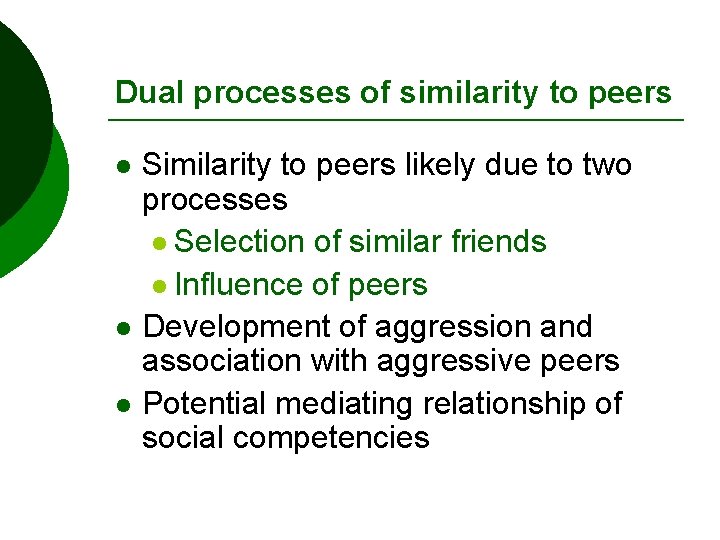
Dual processes of similarity to peers l l l Similarity to peers likely due to two processes l Selection of similar friends l Influence of peers Development of aggression and association with aggressive peers Potential mediating relationship of social competencies
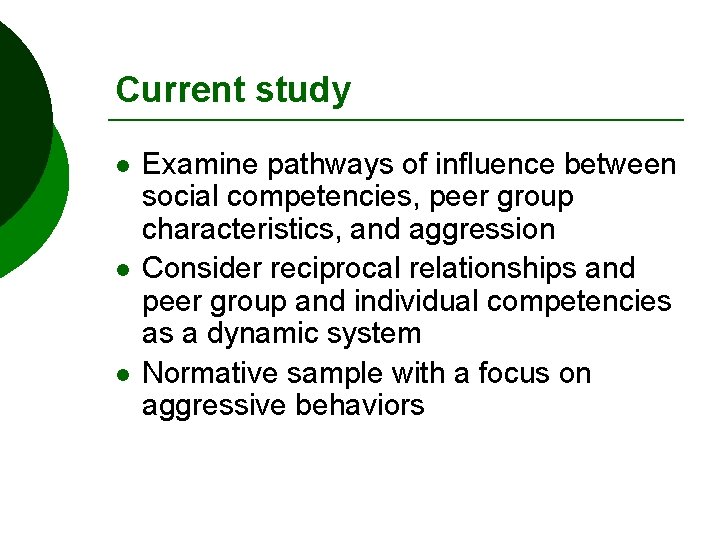
Current study l l l Examine pathways of influence between social competencies, peer group characteristics, and aggression Consider reciprocal relationships and peer group and individual competencies as a dynamic system Normative sample with a focus on aggressive behaviors
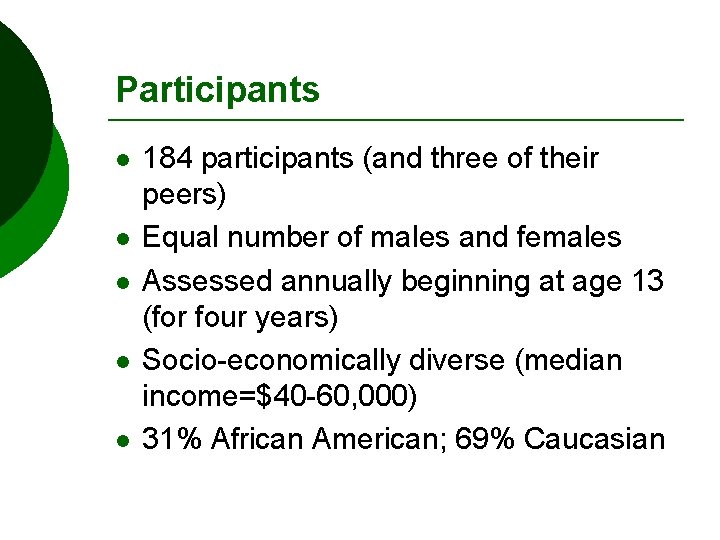
Participants l l l 184 participants (and three of their peers) Equal number of males and females Assessed annually beginning at age 13 (for four years) Socio-economically diverse (median income=$40 -60, 000) 31% African American; 69% Caucasian
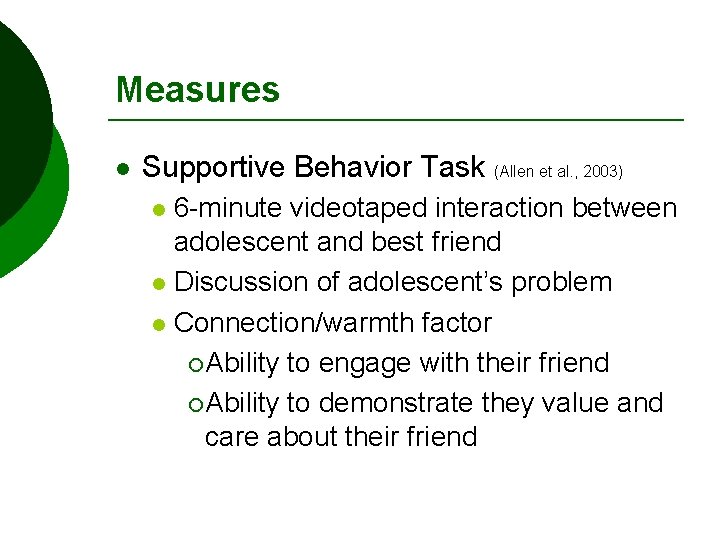
Measures l Supportive Behavior Task (Allen et al. , 2003) 6 -minute videotaped interaction between adolescent and best friend l Discussion of adolescent’s problem l Connection/warmth factor ¡ Ability to engage with their friend ¡ Ability to demonstrate they value and care about their friend l
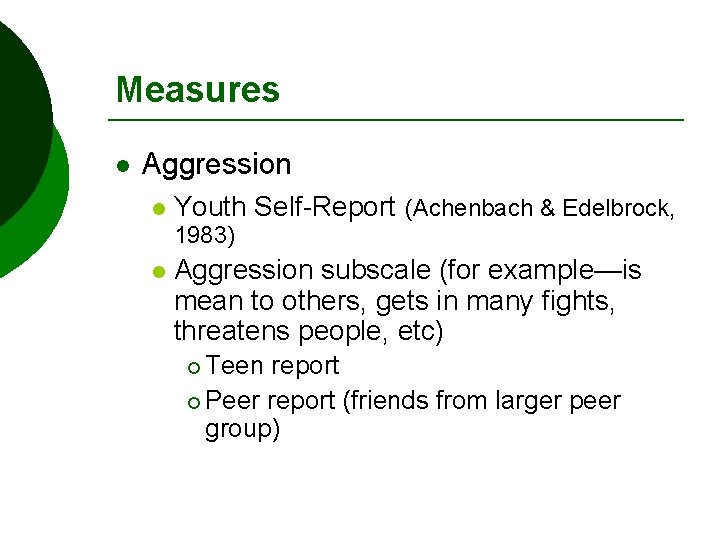
Measures l Aggression l Youth Self-Report (Achenbach & Edelbrock, 1983) l Aggression subscale (for example—is mean to others, gets in many fights, threatens people, etc) ¡ Teen report ¡ Peer report (friends from larger peer group)
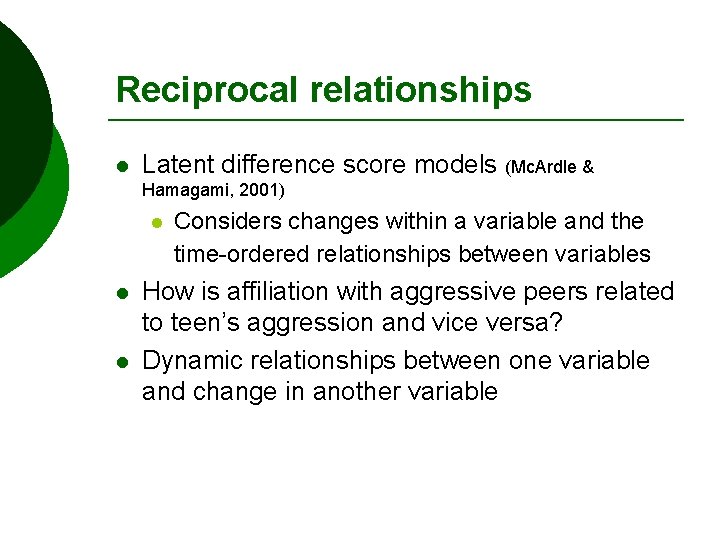
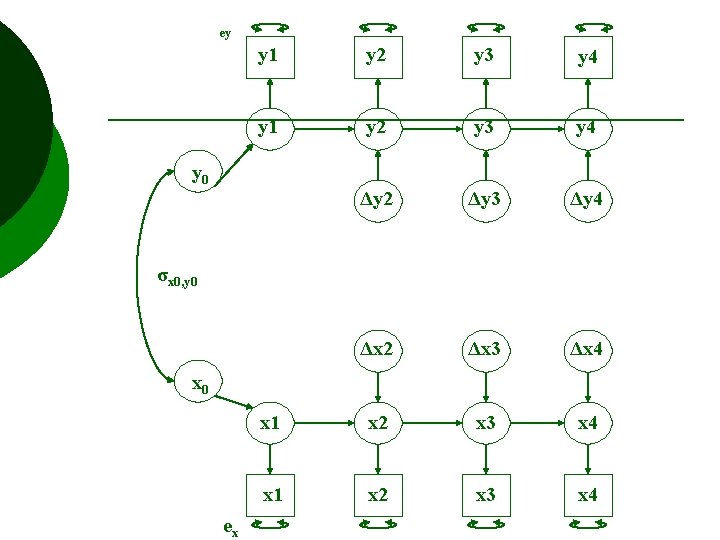
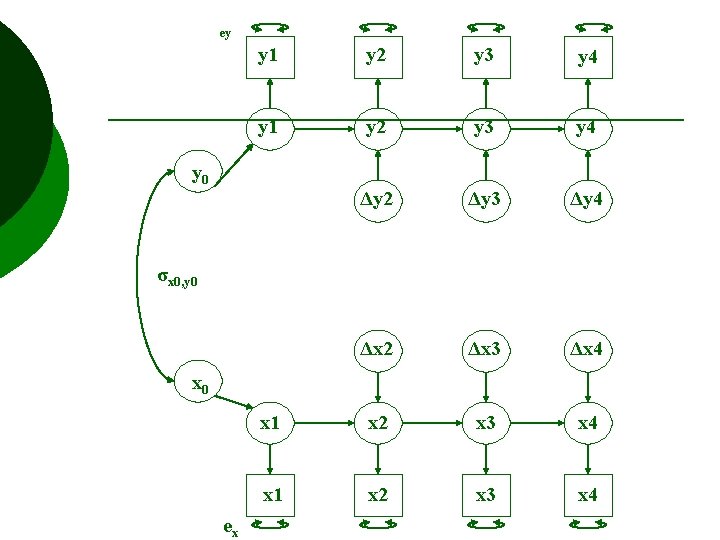
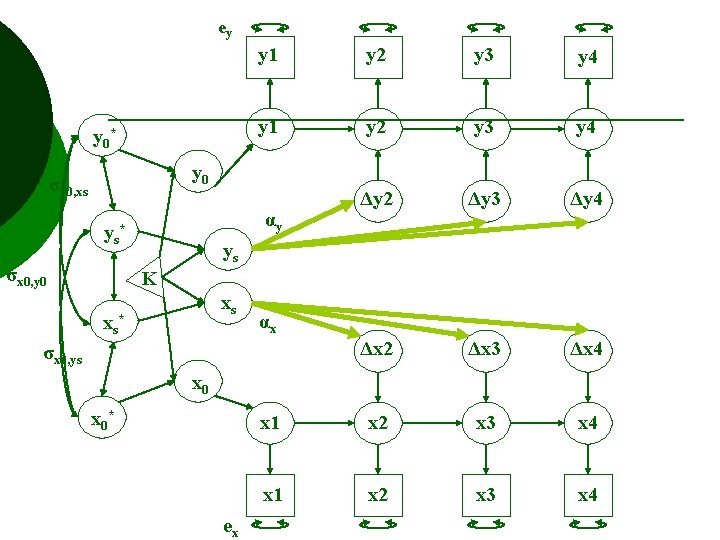
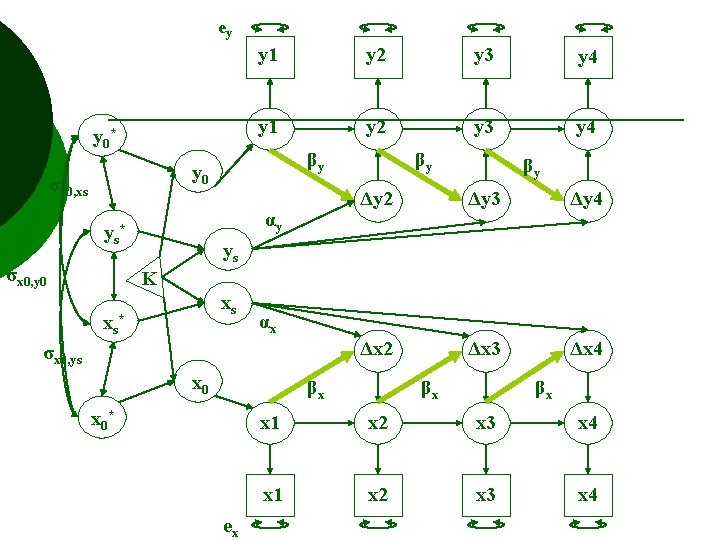
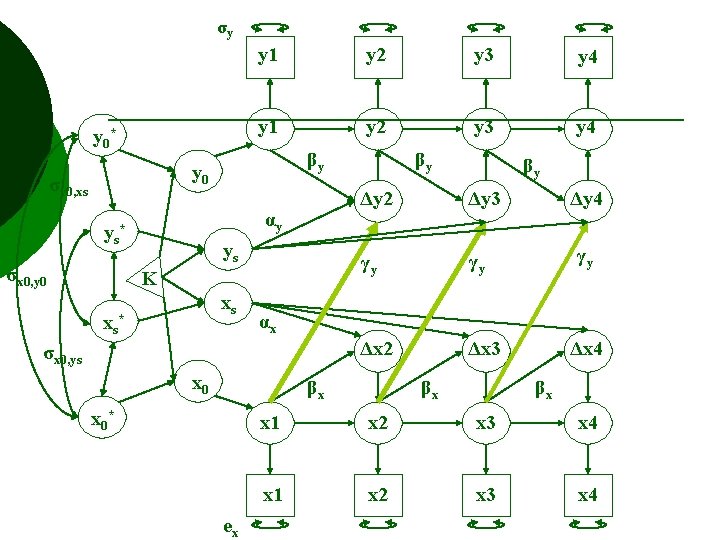
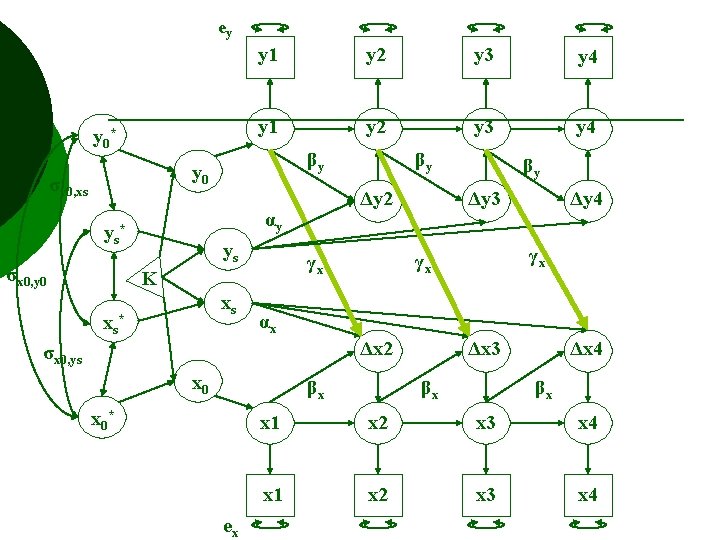
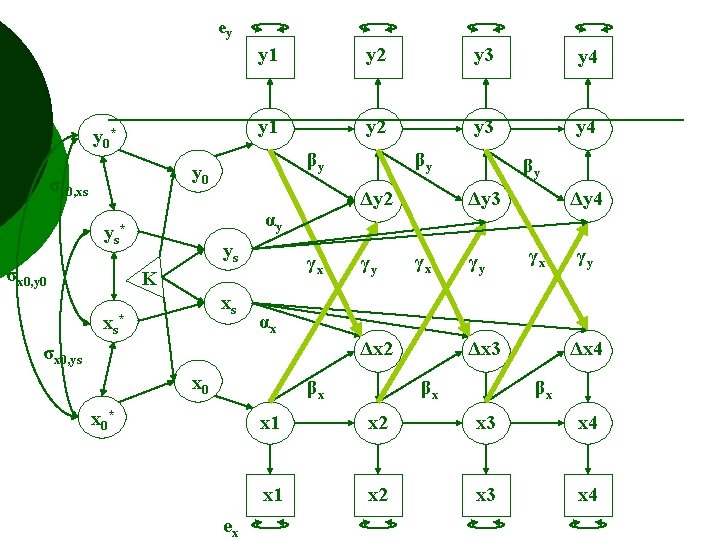
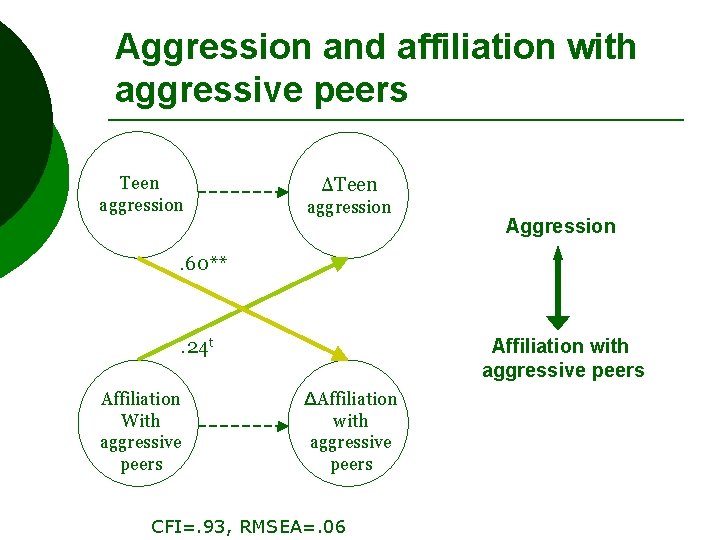
Reciprocal relationships l Latent difference score models (Mc. Ardle & Hamagami, 2001) l l l Considers changes within a variable and the time-ordered relationships between variables How is affiliation with aggressive peers related to teen’s aggression and vice versa? Dynamic relationships between one variable and change in another variable
ey y 1 y 2 y 3 y 4 Δy 2 Δy 3 Δy 4 Δx 2 Δx 3 Δx 4 x 1 x 2 x 3 x 4 y 0 σx 0, y 0 x 0 ex
ey y 1 y 2 y 3 y 4 Δy 2 Δy 3 Δy 4 Δx 2 Δx 3 Δx 4 x 1 x 2 x 3 x 4 y 0 σx 0, y 0 x 0 ex
ey y 0* y 1 y 2 y 3 y 4 Δy 2 Δy 3 Δy 4 Δx 2 Δx 3 Δx 4 x 1 x 2 x 3 x 4 y 0 σy 0, xs αy ys* σx 0, y 0 ys K xs xs* αx σx 0, ys x 0* ex
ey y 0* y 1 y 2 y 3 y 4 βy y 0 σy 0, xs αy ys* σx 0, y 0 βy βy Δy 2 Δy 3 Δy 4 Δx 2 Δx 3 Δx 4 ys K xs xs* αx σx 0, ys x 0 βx x 0* ex βx βx x 1 x 2 x 3 x 4
σy y 0* y 1 y 2 y 3 y 4 βy y 0 σy 0, xs αy ys* σx 0, y 0 ys K xs xs* βy Δy 2 Δy 3 γy γy Δx 2 Δx 3 x 0 βx ex Δy 4 γy αx σx 0, ys x 0* βy βx Δx 4 βx x 1 x 2 x 3 x 4
ey y 0* y 1 y 2 y 3 y 4 βy y 0 σy 0, xs σx 0, y 0 Δy 2 αy ys* ys xs Δy 3 Δx 2 x 0 βx ex Δy 4 γx αx σx 0, ys x 0* βy γx γx K xs* βy Δx 3 βx Δx 4 βx x 1 x 2 x 3 x 4
ey y 0* y 1 y 2 y 3 y 4 βy y 0 σy 0, xs σx 0, y 0 Δy 2 αy ys* ys γx K xs xs* βy γy Δy 3 γx Δx 2 x 0 βx ex γy Δy 4 γx γy αx σx 0, ys x 0* βy Δx 3 βx Δx 4 βx x 1 x 2 x 3 x 4
Aggression and affiliation with aggressive peers Teen aggression ΔTeen aggression Aggression . 60** . 24 t Affiliation With aggressive peers Affiliation with aggressive peers ΔAffiliation with aggressive peers CFI=. 93, RMSEA=. 06
How do friendship competencies relate to changes in aggression?
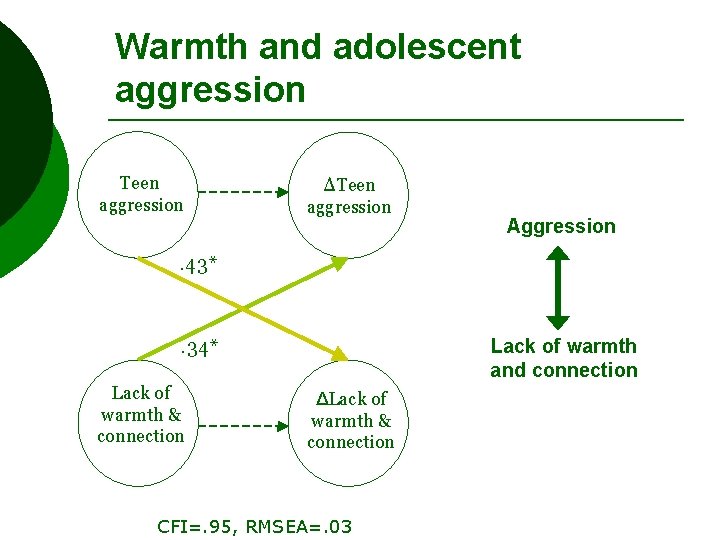
Warmth and adolescent aggression Teen aggression ΔTeen aggression Aggression . 43* . 34* Lack of warmth & connection Lack of warmth and connection ΔLack of warmth & connection CFI=. 95, RMSEA=. 03
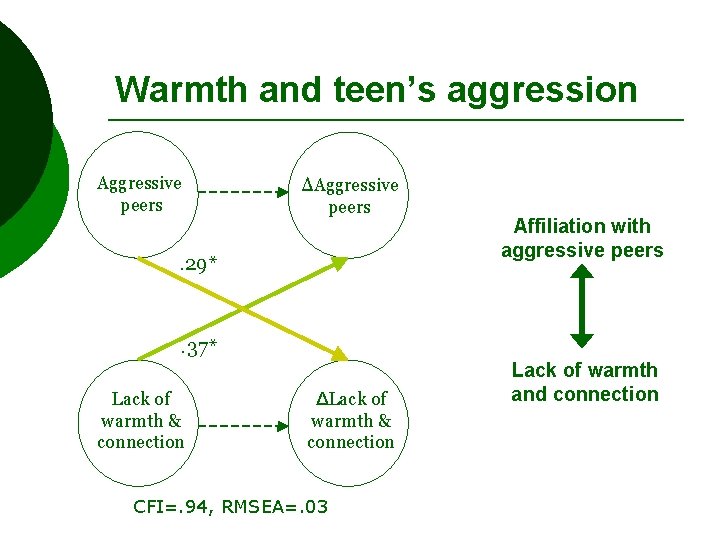
Warmth and teen’s aggression Aggressive peers ΔAggressive peers . 29* Affiliation with aggressive peers . 37* Lack of warmth & connection ΔLack of warmth & connection CFI=. 94, RMSEA=. 03 Lack of warmth and connection
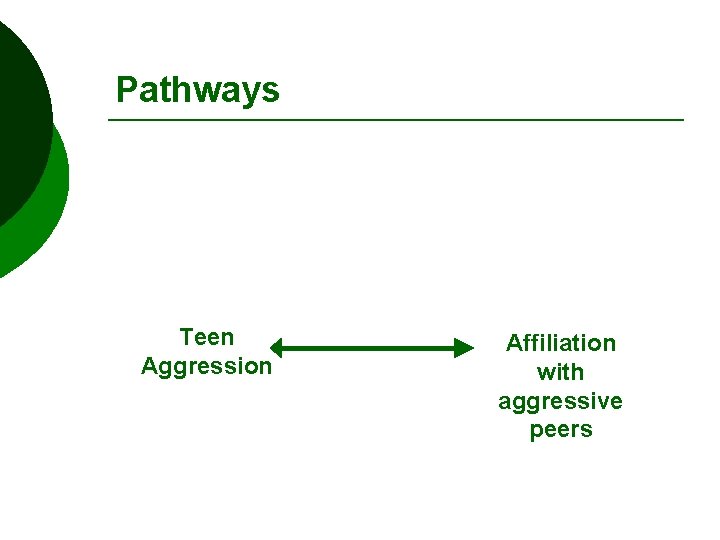
Pathways Teen Aggression Affiliation with aggressive peers
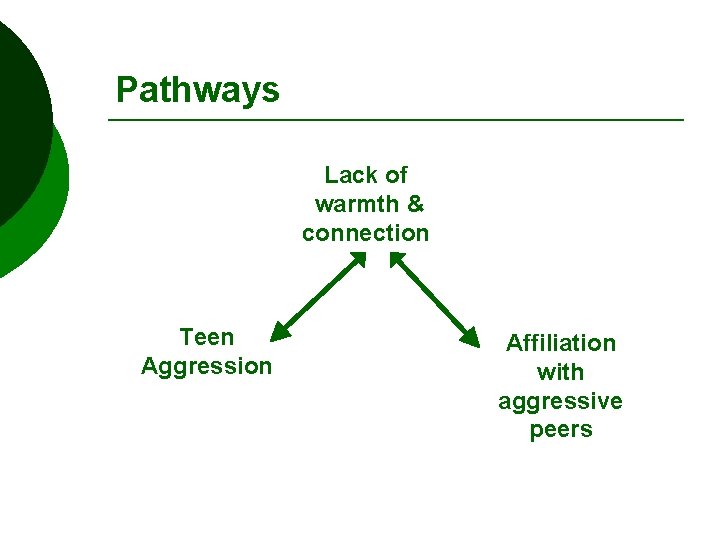
Pathways Lack of warmth & connection Teen Aggression Affiliation with aggressive peers
Conclusions l Social competencies play an important role in linking aggression and affiliation with aggressive peers. l l Social information processing (Dodge et al, 2003) “Deviancy training” Support for transactional framework and self-perpetuating cycle Point of intervention
For copies of related papers: www. teenresearch. org Acknowledgements: We would like to thank the National Institute of Mental Health for funding awarded to Joseph P. Allen, Principal Investigator, (Grants #R 01 -MH 44934, and R 01 -MH 58066)