
Social Communication and Learning Standards Making the Connection


- Slides: 28
Social Communication and Learning Standards Making the Connection ISHA 2/11/05 Jan Petru MS, CCC-SLP; Jennifer Millette MSW, LCSW; Sharron Santefort BS; Vanessa Granato-Wagner MS, CCC-SLP Contact: JPetru@d 230. org
Presentation Objectives n n n Participants will be able to identify 4 -5 Illinois State Standards that could be used to write student goals in the area of social communication. Participants will be able to name 5 key components of the Social Communication High School class developed by the SWCCCASE staff at Andrew High School in Tinley Park, IL Participants will be able to identify and explain perspective taking and gestalt processing social thinking strategies when analyzing teacher classroom management style and literacy curriculum. Presentation Acknowledgements: n The team would like to thank Michelle Garcia-Winner SLP for her inspirational books, presentations and videotapes explaining social thinking and how to teach it. n The team would also like to thank the SWCCCASE Cooperative administrative staff, Nancy Ranquist, Christi Flores and Gina Dio. Guardi for giving us total support in developing this curriculum. A special thanks to Cyndy Palmer for her technical support.
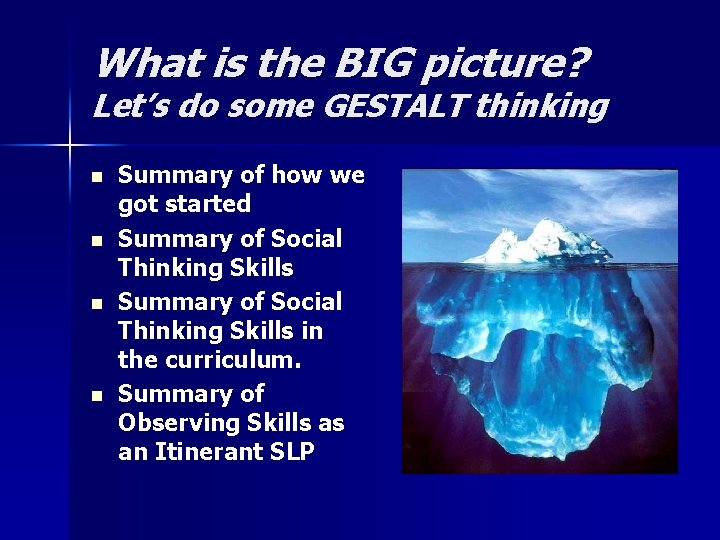
What is the BIG picture? Let’s do some GESTALT thinking n n Summary of how we got started Summary of Social Thinking Skills in the curriculum. Summary of Observing Skills as an Itinerant SLP
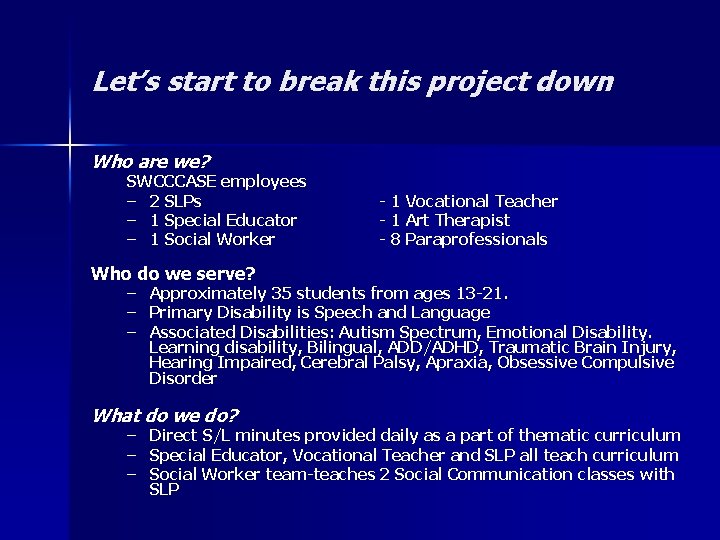
Let’s start to break this project down Who are we? SWCCCASE employees – 2 SLPs – 1 Special Educator – 1 Social Worker - 1 Vocational Teacher - 1 Art Therapist - 8 Paraprofessionals Who do we serve? – Approximately 35 students from ages 13 -21. – Primary Disability is Speech and Language – Associated Disabilities: Autism Spectrum, Emotional Disability. Learning disability, Bilingual, ADD/ADHD, Traumatic Brain Injury, Hearing Impaired, Cerebral Palsy, Apraxia, Obsessive Compulsive Disorder What do we do? – Direct S/L minutes provided daily as a part of thematic curriculum – Special Educator, Vocational Teacher and SLP all teach curriculum – Social Worker team-teaches 2 Social Communication classes with SLP
Basic Guidelines for CD Classes n n n n n Illinois Standards Driven IEP driven Language based Strategy based Multiple Intelligence Visually organized Assistive technology Social interaction Problem-solving strategies
Here’s our Perspective on Social Communication Basic Social Communication Needs Always Interfere with the Academic Learning (Taken from I LAUGH Model, Garcia-Winner) Initiating n n n following directions doing steps to a project, to starting and continuing conversations getting help when needed Listening Attentively n n n paying attention to others in 1 -1 conversations and small groups class discussions field trips and/or after school events Understanding the abstract or Inferential n n n comprehension of information inherent in teacher conversations teen-ager conversations verbal and written directions academic texts and literacy genre Perspective taking skills n n n n personal problem solving develop friendships develop good social relationships with family members be a member of a school club work successfully in cooperative groups for class projects analyzing characters in fiction or non-fiction literature employment Ability to understand or use humor n n n use humor throughout the day to ease anxiety and calm situations understand teacher, peer or character use of humor
What? ? ? Is. Isthis What? ? ? ? ? Is this some Speech thistype someoftype ofand Speech and Language typ Language e of. Utopia? Speech Utopia? and Language Utopia? WE know what you are thinking (because we are reading your non-verbal communication with our eye gaze, doing social thinking to try and take an immediate read of your perspective by using our past memory of traditional SLP type services and now we will analyze what we must do, do it quickly and answer. ) “Yes, it is Utopia. ” We would like to share what we did and show ways that you can do it too!
SOCIAL COMMUNICATION CLASS-ORIGINS Discovery of Michelle Garcia- Winner (MA, CCC, SLP) publications: Core group of students with similar characteristics n n Test well on traditional assessments (“normal” IQ or higher) Diagnoses may include HFA, AS, NVLD, PDD-NOS, or no official diagnosis (the “quirky kid”) These students have problems have social, interpersonal, organizational and personal problem solving difficulties that affect daily functioning Examines perspective-taking abilities as indicator of student’s functioning This particular group of characteristics termed “social cognitive deficits” Intervention crucial for this population n Connection to emotional and behavioral difficulties (anxiety, depression) Problems continue into adult life if not addressed (college, work, community) Little to no adult services currently available
Social Communication Class Origins continued…. Intervention rationale n n n Social skills training vs. social thinking (adds the “why” to the “how) Majority of people (“neurotypical” intuitively aware of the social curriculum Students with social cognitive deficits need the social curriculum/rules specifically taught to them This curriculum needs to be broken down into specific steps and applied in every setting the skills will be used in This approach addresses the underlying cause of deficits, not symptom relief Our perspective at Southwest CD… this makes sense! n n Identification of a subgroup of students fitting this description within the CD Program Checking in with students (the eye-gaze test) Consensus-best practice is intervention occurring daily across multiple settings Hmm… can we actually DO this? (Wheels are turning!)
SOUTHWEST COOPERATIVE CD PROGRAM ACTION Plan Goals n n Create daily, for-credit Social Communication class based upon Michelle Winner’s framework Create bi-monthly community based after-school activity program Objectives n n n Supervisor support and consent Research similar programs in area Prepare required documents – Course description, including specific state standards – Activity group proposal that connected with student IEP goals/objectives n Parent outreach
CURRICULUM Includes specific concepts and worksheet templates from Michelle Garcia-Winner‘s books/videos/workshops: – – – “Why Care? ” “Me” Binder First Impressions Eye Gaze (“Thinking With Your Eyes”) Non-verbal vs. Verbal Communication Expected vs. Unexpected Behaviors Social Mapping Social Relationships Interactive Perspective Taking Solving Problems Before They Become Problems Making A Social Plan
INSTRUCTIONAL METHODS n n n n n Team-taught by SLP and Social Worker Role plays Photos Video clips Peer assessment Self assessment Problem solving journal Weekend journal Social plan homework Parent homework
Social Communication Learning Standards Where’s The Connection? English/Language Arts Goal 1: Read with understanding and fluency n Learning Standard C: Understand a broad range of materials Goal 4: Listen and speak effectively in a variety of situations n Learning Standard A: Listen effectively in formal and informal situations n Learning Standard B: Speak effectively using the language appropriate to the situation and the audience
Learning Standards Continued… Social Emotional Learning Standards (new for 2005, may be linked for 2005 -06 school year) Goal 2: Use social-awareness and interpersonal skills to establish and maintain positive relationships Learning Standard A: Recognize the feelings and perspectives of others Learning Standard B: Recognize individual and group similarities and differences Learning Standard C: Use communication and social skills to interact effectively with others Learning Standard D: Demonstrate an ability to prevent, manage, and resolve interpersonal conflicts in constructive ways
Learning Standards Continued… Goal 3: Demonstrate decision-making skills and responsible behaviors in personal, school and community contexts n n n Learning Standard A: Consider ethical, safety, and societal factors in making decisions Learning Standard B: Apply decision making skills to deal responsibly with daily academic and social situations Learning Standard C: Contribute to the well-being of one’s school and community
Present Level of Performance-Example 1 Strengths n Student A received a C+ during the 1 st semester. Student A can verbalize the meaning of the concepts taught in the Social Communication class. He knows nonverbal communication, first impression, social mapping, perspective taking, personal needs and social relationships. Participation and class tests range from 70100%. Needs n Student A has a difficult time demonstrating these skills in his own conversations/social relationships with teachers and peers in the classroom. He has a difficult time using eye contact to think, understanding the intention of others, regulating his own behavior during interactions and understanding the different types of conversations. Strategies that have been tried and the result n Direct teaching, role-plays, watching TV clips, and practice increase Student A’s use of and carry-over to real situations throughout the day.
Goal as Referenced to Standards-Example 1 By April 2005, Student A will make progress toward demonstrating understanding of the relationship of verbal and nonverbal messages within a context, given direct instruction and role plays, (4. A. 4 d) as evidenced by increased social pragmatic skills in class by completing a conversation sheet about 4 -5 members of the class 1 -2 times by the end of the 3 rd quarter. Objectives: n Given instruction and practice, Student A will describe and monitor his own directed eye gaze during a 4 -5 minute role play n Given social scenes and discussion, Student A will report motive or intent of the person being observed n Given social scenes and discussions, Student A will tell changes in how other people feel or think and regulate own behavior to match that feeling
Social Communication and Content Area: How Do They Connect ? English/Literacy n Story Grammar n Character Analysis n Vocabulary n Inferential Meaning
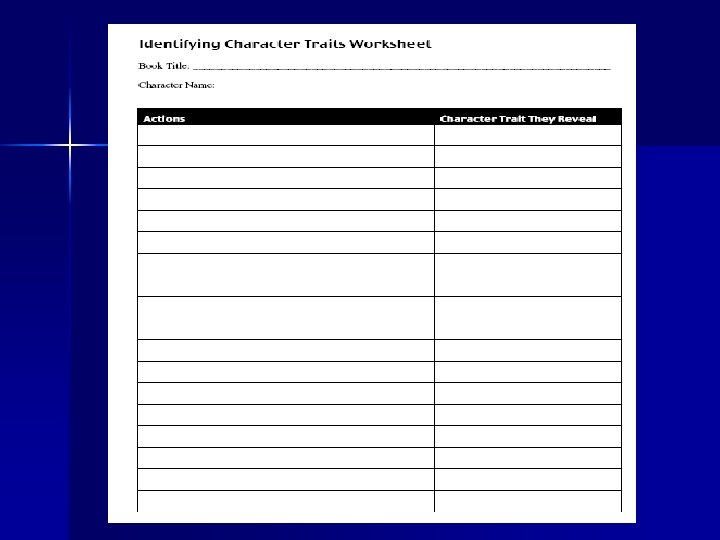
Vocabulary and Character Analysis n Word meanings (adjectives) n Infer from literal details n Apply character traits n Supporting reasons for chosen traits
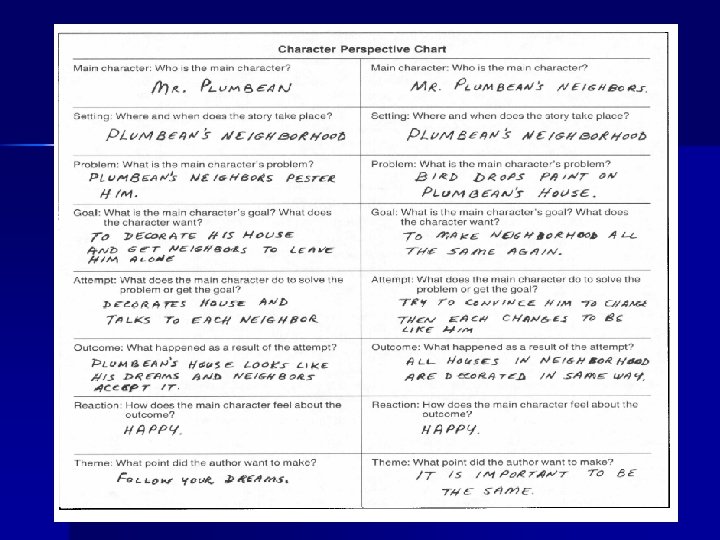
Story Grammar n Story maps n Character Perspective Chart
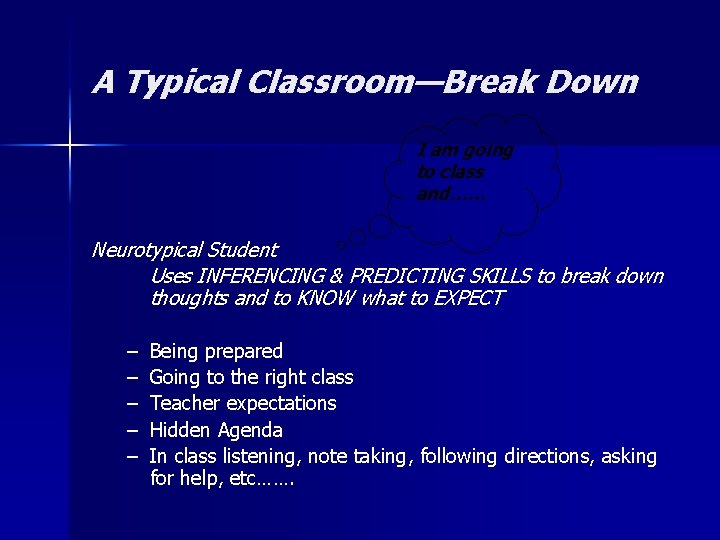
A Typical Classroom—Break Down I am going to class and…… Neurotypical Student Uses INFERENCING & PREDICTING SKILLS to break down thoughts and to KNOW what to EXPECT – – – Being prepared Going to the right class Teacher expectations Hidden Agenda In class listening, note taking, following directions, asking for help, etc…….
Our Student’s Perspective What is happening? ? ? n n Inferential language is very important Not seeing a “Big Picture” to break down Semantic Skills Hearing words and not listening with their eyes (eye gaze)
Strategies in the Classroom What can we do? n n n Teach listening with ears, eyes and thinking Teach the “Social Map” of a classroom Expected and Unexpected Teach Awareness of strengths and needs Teach Organization Teach Initiation Teach the meaning of non-verbal language
How? Strategies n Visual Aids on Desk with Cues When the teacher says, “Here is the direction”, I should pick up my head to look When the teacher writes on the board, I should look at what she is writing, I should take notes When I don’t understand what the teacher is saying I can say, “I’m not understanding that, I need some help, Can you say that again? ” n Color-Coding folders, book covers etc. n Need to call their attention to their own distractibility and their language disability
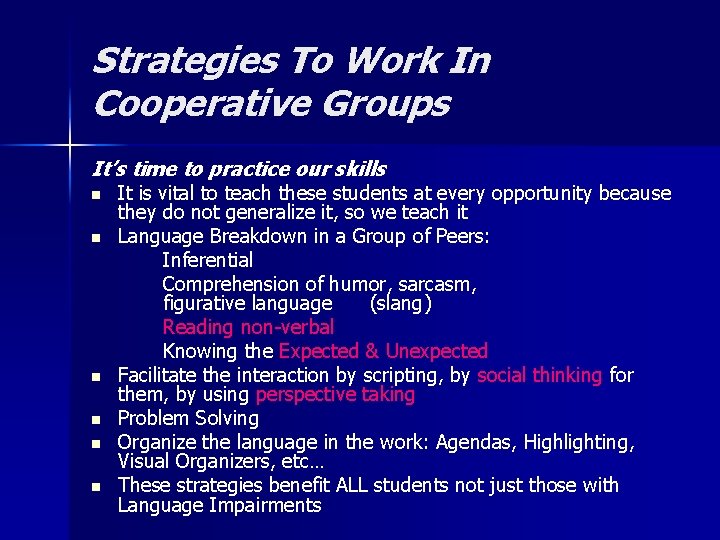
Strategies To Work In Cooperative Groups It’s time to practice our skills n n n It is vital to teach these students at every opportunity because they do not generalize it, so we teach it Language Breakdown in a Group of Peers: Inferential Comprehension of humor, sarcasm, figurative language (slang) Reading non-verbal Knowing the Expected & Unexpected Facilitate the interaction by scripting, by social thinking for them, by using perspective taking Problem Solving Organize the language in the work: Agendas, Highlighting, Visual Organizers, etc… These strategies benefit ALL students not just those with Language Impairments
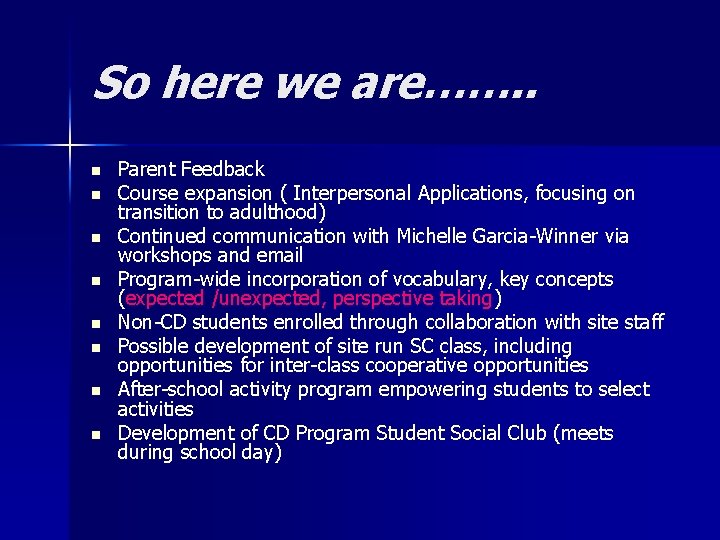
So here we are……. . n n n n Parent Feedback Course expansion ( Interpersonal Applications, focusing on transition to adulthood) Continued communication with Michelle Garcia-Winner via workshops and email Program-wide incorporation of vocabulary, key concepts (expected /unexpected, perspective taking) Non-CD students enrolled through collaboration with site staff Possible development of site run SC class, including opportunities for inter-class cooperative opportunities After-school activity program empowering students to select activities Development of CD Program Student Social Club (meets during school day)