
Social Cohesion Measurement Based on the Data from
Social Cohesion: Measurement Based on the Data from European Value Study Paul Dickes, Marie Valentova, Monique Borsenberger CEPS/Instead, Luxembourg
General outlines of the paper • Aims: – To test empirically validity of the Bernard’s definition of social cohesion. – To construct a measurement/s of social cohesion using micro-level data. • Data: – European Value Study (EVS) 1999, representative sample of the Luxembourgish population, N=1211 individuals aged 18 years and older. – EVS contains a great number of subjective and objective items that measure attitudes toward and behaviour regarding social relations, participation, and trust at many levels of social reality as well as in many spheres of everyday life, which more or less correspond to dimensions of social cohesion covered by the Bernard’s theory. • Methodology: – Multidimensional scaling, Confirmatory factor analysis.
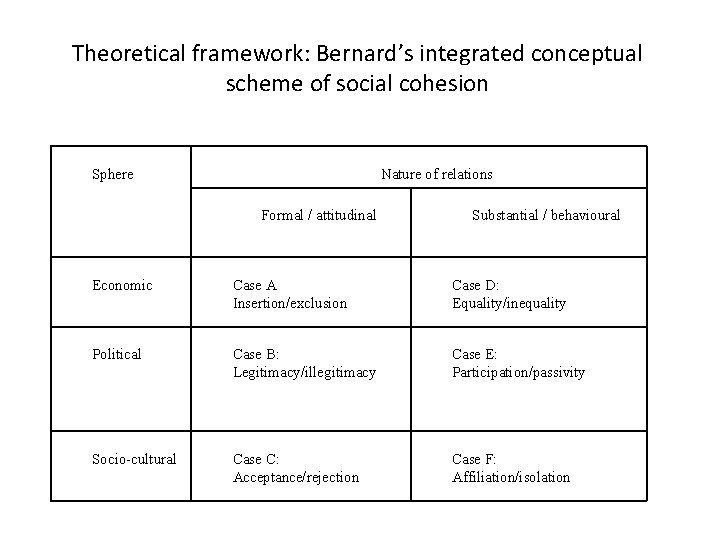
Theoretical framework: Bernard’s integrated conceptual scheme of social cohesion Sphere Nature of relations Formal / attitudinal Substantial / behavioural Economic Case A Insertion/exclusion Case D: Equality/inequality Political Case B: Legitimacy/illegitimacy Case E: Participation/passivity Socio-cultural Case C: Acceptance/rejection Case F: Affiliation/isolation
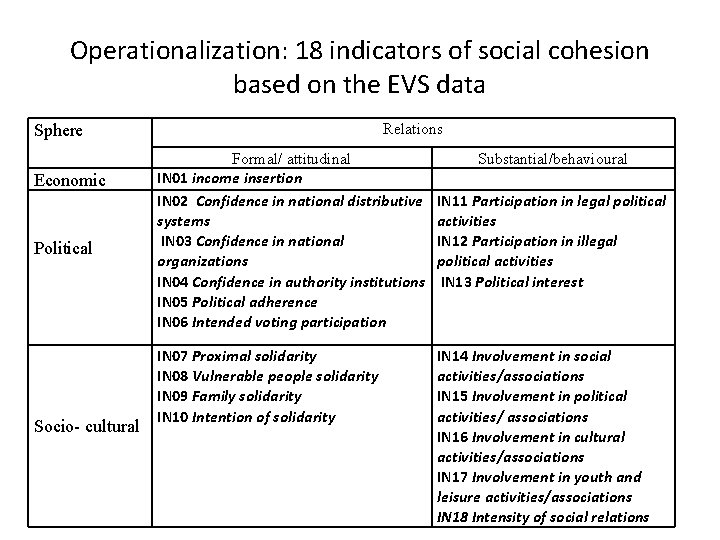
Operationalization: 18 indicators of social cohesion based on the EVS data Relations Sphere Economic Political Socio- cultural Formal/ attitudinal IN 01 income insertion IN 02 Confidence in national distributive systems IN 03 Confidence in national organizations IN 04 Confidence in authority institutions IN 05 Political adherence IN 06 Intended voting participation IN 07 Proximal solidarity IN 08 Vulnerable people solidarity IN 09 Family solidarity IN 10 Intention of solidarity Substantial/behavioural IN 11 Participation in legal political activities IN 12 Participation in illegal political activities IN 13 Political interest IN 14 Involvement in social activities/associations IN 15 Involvement in political activities/ associations IN 16 Involvement in cultural activities/associations IN 17 Involvement in youth and leisure activities/associations IN 18 Intensity of social relations
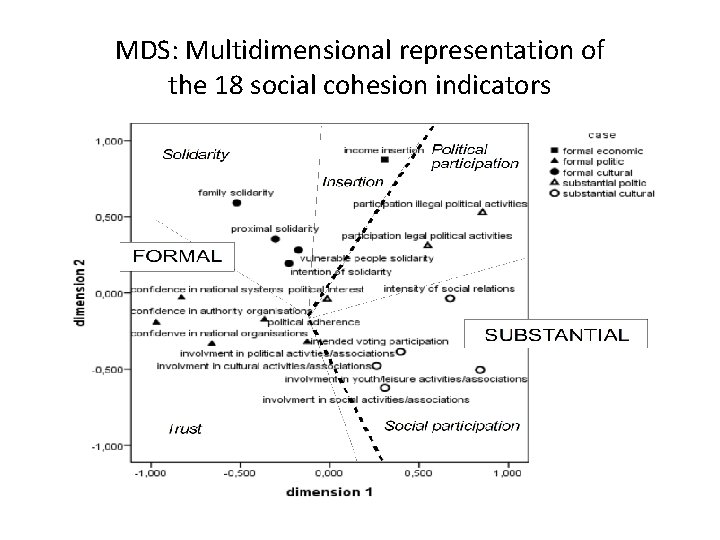
MDS: Multidimensional representation of the 18 social cohesion indicators
Model 1: six oblique latent factors
Model 2: Hierarchical representation with two correlated second-order factors
Model 3: Hierarchical representation with two orthogonal second-order factors
Model 4: Hierarchical representation with one second-order factor
Concluding remarks • Conclusions: – The results of multidimensional scaling reveal that Bernard’s conceptualisation of social cohesion can be confirmed. – Using confirmatory factor analysis, we estimated four distinctive adequate models: These four models allow us to calculate different factor scores of social cohesion, which can be used to answer different research questions and compare different population subgroups. • Comments: – The indicators do not cover perfectly all dimensions of Bernard’s integral theoretical scheme. Due to the data restrictions, we used only one indicator to cover formal economic sphere and none for the substantial dimension of economic sphere. – All these above proposed measurements of social cohesion are issued from the data of one country collected at one point in time. It is necessary that in the future the above described measurement sof social cohesion could be replicated on the 2008 EVS data set and thus cross-validated across time and across countries.
- Slides: 10