
Social Cohesion as a societal phenomenon differences in




- Slides: 19
Social Cohesion as a societal phenomenon: differences in degree or in kind? Germ Janmaat g. janmaat@ucl. ac. uk LLAKES, UCL Institute of Education Presentation for the CEPAL/COES workshop Regímenes y Políticas de Cohesión Social: Del análisis a la implementación Santiago, Chile, 27 -08 -2020 ’
Point of departure of my 2011 study on social cohesion* Limitations of existing approaches to social cohesion: • many definitions • theoretical and normative • elaborate and multidimensional • empirical grounding? • macro or micro phenomenon? * Janmaat, J. G. (2011). ‘Social Cohesion as a Real-Life Phenomenon: Assessing the Explanatory Power of the Universalist and Particularist Perspectives’, Social Indicators Research, Vol 100, No 1, 61 -83.
Key questions �Can a coherent empirical manifestation of social cohesion be identified? �If so, does this manifestation (or manifestations) conform to the modernist/universalist or the particularist/regimes perspective?
Two contrasting perspectives Modernist/universalist: “Social cohesion is a coherent unidimensional phenomenon and reflects the stage of socio-economic development of a country” Hypothesis: countries differ in degree of social cohesion and this variation is linked to economic development indicators Particularist/regimes: “Social cohesion is a regionally specific, path-dependent phenomenon rooted in distinct cultural and institutional traditions” Hypothesis: the social cohesion profiles of countries differ in kind are relatively enduring Policy relevance: If social cohesion is consistent with the particularist perspective, emulation of desirable forms of social cohesion by other countries will not be successful
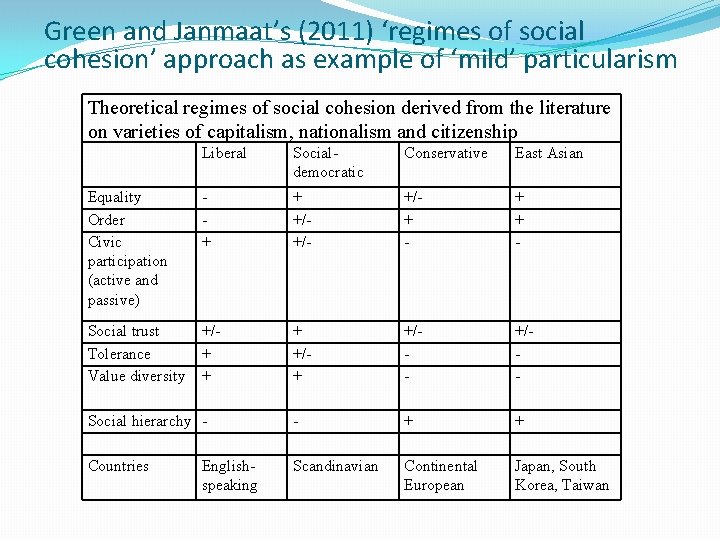
Green and Janmaat’s (2011) ‘regimes of social cohesion’ approach as example of ‘mild’ particularism Theoretical regimes of social cohesion derived from the literature on varieties of capitalism, nationalism and citizenship Liberal Socialdemocratic Conservative East Asian + + +/+/- +/+ - + + - Social trust +/Tolerance + Value diversity + + +/- +/- Social hierarchy - - + + Countries Scandinavian Continental European Japan, South Korea, Taiwan Equality Order Civic participation (active and passive) Englishspeaking
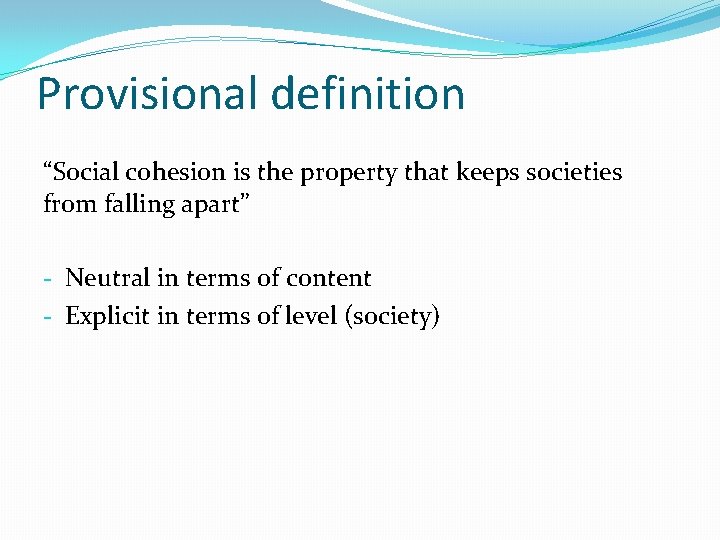
Provisional definition “Social cohesion is the property that keeps societies from falling apart” - Neutral in terms of content - Explicit in terms of level (society)
Which components of social cohesion to select? Relying on four macro-level approaches
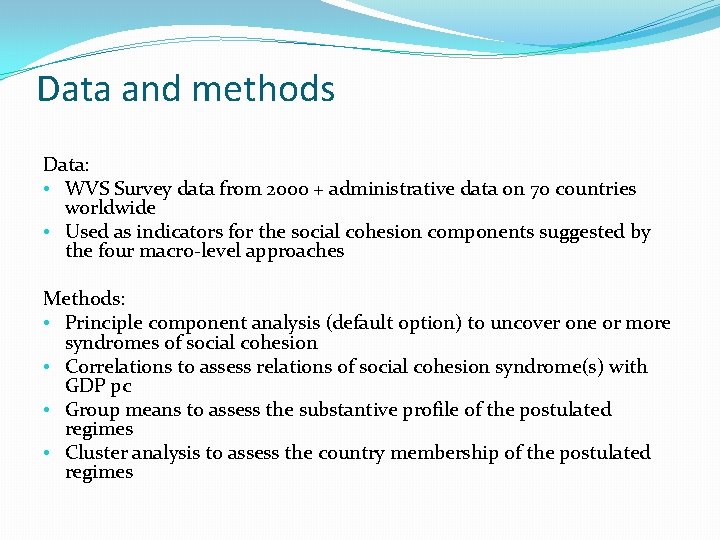
Data and methods Data: • WVS Survey data from 2000 + administrative data on 70 countries worldwide • Used as indicators for the social cohesion components suggested by the four macro-level approaches Methods: • Principle component analysis (default option) to uncover one or more syndromes of social cohesion • Correlations to assess relations of social cohesion syndrome(s) with GDP pc • Group means to assess the substantive profile of the postulated regimes • Cluster analysis to assess the country membership of the postulated regimes
Testing the universalist perspective �Can a coherent unidimensional syndrome of social cohesion be identified? �Is this syndrome related to GDP pc as indicator of socio-economic development?
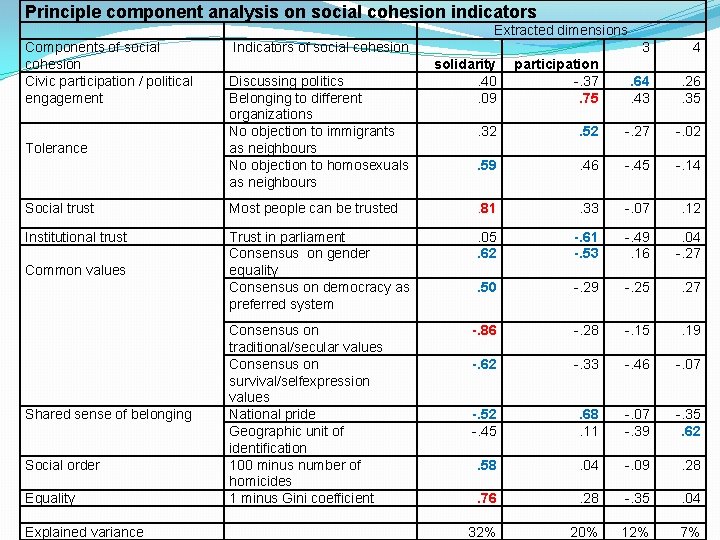
Principle component analysis on social cohesion indicators Extracted dimensions Components of social cohesion Civic participation / political engagement Tolerance Indicators of social cohesion Discussing politics Belonging to different organizations No objection to immigrants as neighbours No objection to homosexuals as neighbours 3 4 solidarity. 40. 09 participation -. 37. 75 . 64. 43 . 26. 35 . 32 . 52 -. 27 -. 02 . 59 . 46 -. 45 -. 14 Social trust Most people can be trusted . 81 . 33 -. 07 . 12 Institutional trust Trust in parliament Consensus on gender equality Consensus on democracy as preferred system . 05. 62 -. 61 -. 53 -. 49. 16 . 04 -. 27 . 50 -. 29 -. 25 . 27 -. 86 -. 28 -. 15 . 19 -. 62 -. 33 -. 46 -. 07 -. 52 -. 45 . 68. 11 -. 07 -. 39 -. 35. 62 . 58 . 04 -. 09 . 28 . 76 . 28 -. 35 . 04 32% 20% 12% 7% Common values Shared sense of belonging Social order Equality Explained variance Consensus on traditional/secular values Consensus on survival/selfexpression values National pride Geographic unit of identification 100 minus number of homicides 1 minus Gini coefficient
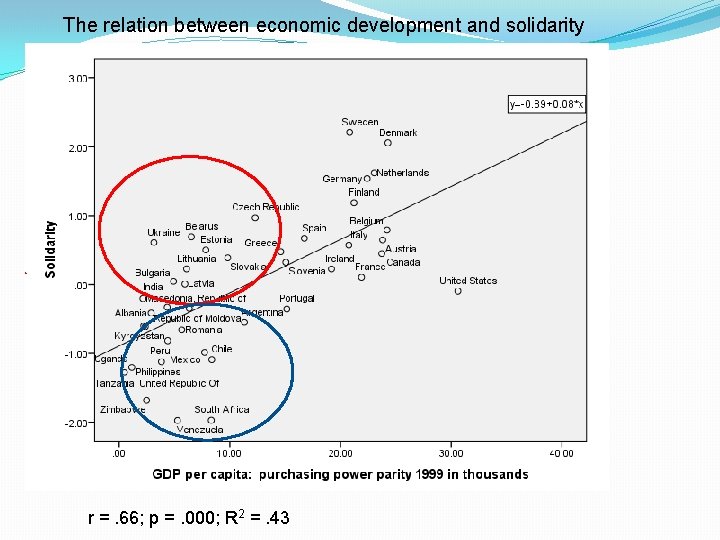
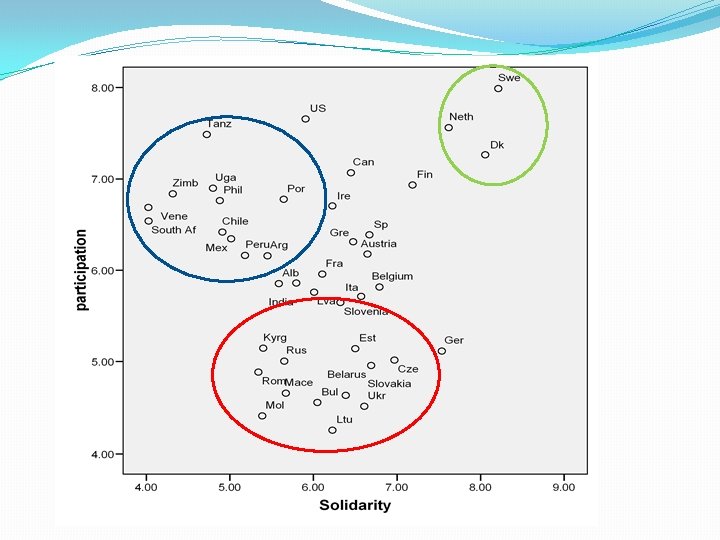
The relation between economic development and solidarity r =. 66; p =. 000; R 2 =. 43
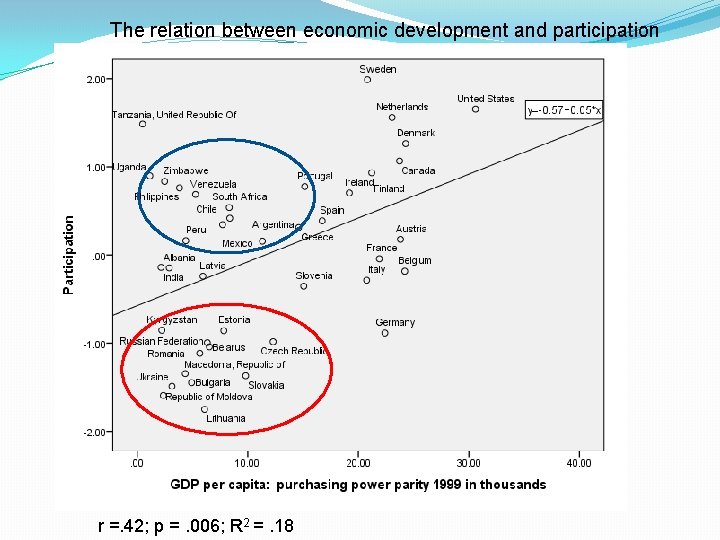
The relation between economic development and participation r =. 42; p =. 006; R 2 =. 18
How to assess the particularist perpective? Testing Green and Janmaat’s regimes of social cohesion �Do the data reflect the postulated regimes in substantive terms? �Do the data reflect the postulated regimes in terms of country membership? �How stable are the substantive profiles and country clusters? Data: WVS waves 1 (1981), 2 (1990) and 4 (2000) (sample restricted to OECD states)
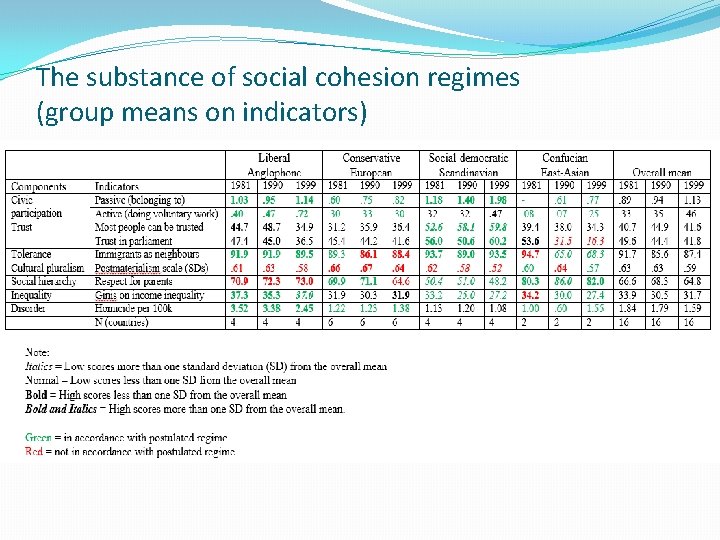
The substance of social cohesion regimes (group means on indicators)
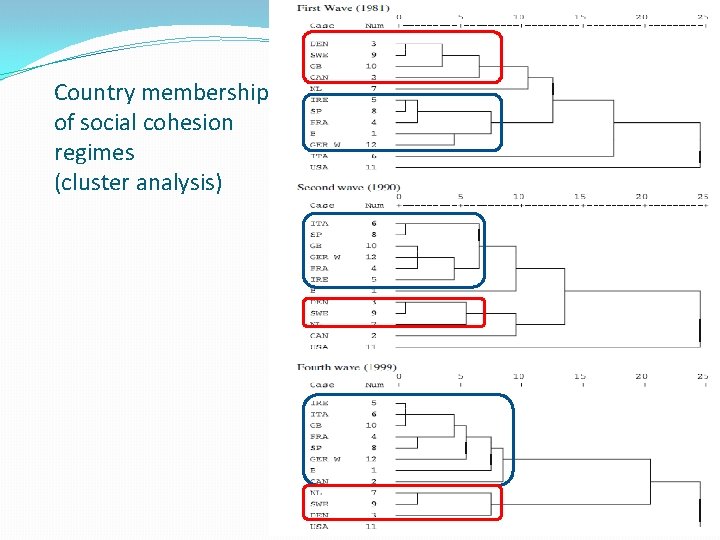
Country membership of social cohesion regimes (cluster analysis)
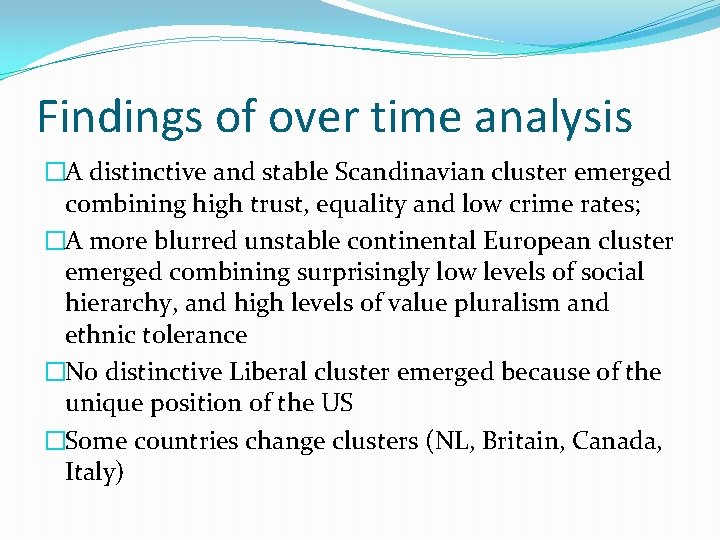
Findings of over time analysis �A distinctive and stable Scandinavian cluster emerged combining high trust, equality and low crime rates; �A more blurred unstable continental European cluster emerged combining surprisingly low levels of social hierarchy, and high levels of value pluralism and ethnic tolerance �No distinctive Liberal cluster emerged because of the unique position of the US �Some countries change clusters (NL, Britain, Canada, Italy)
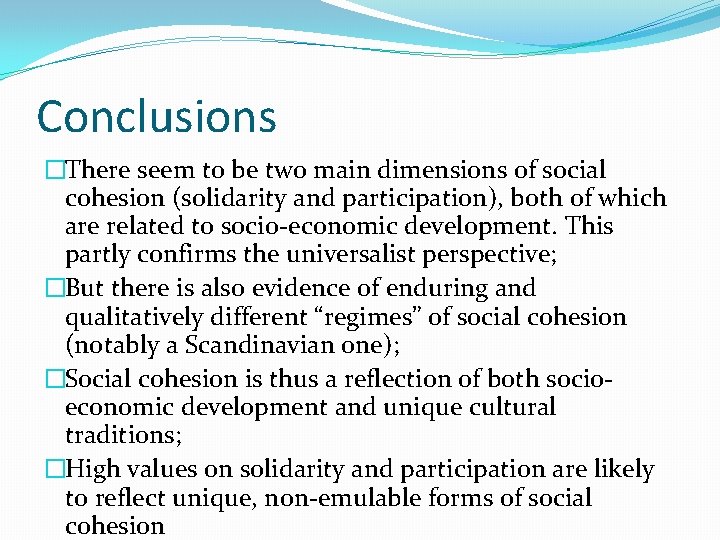
Conclusions �There seem to be two main dimensions of social cohesion (solidarity and participation), both of which are related to socio-economic development. This partly confirms the universalist perspective; �But there is also evidence of enduring and qualitatively different “regimes” of social cohesion (notably a Scandinavian one); �Social cohesion is thus a reflection of both socioeconomic development and unique cultural traditions; �High values on solidarity and participation are likely to reflect unique, non-emulable forms of social cohesion
Questions for discussion �Should we aim for an internally consistent model of social cohesion or a multidimensional one? (cf. Welzel and Inglehart 2016 in Comparative Political Studies) �Are multidimensional conceptions of social cohesion useful in policy terms? �How can we improve on the analysis of different regimes of social cohesion?