
Social Class Unit 3 Social Stratification Exists because

Social Class Unit 3
Social Stratification Exists because of unequal access to scarce resources and social rewards: creates social inequality Class system: based on both birth and individual achievement: 1. Vs. Caste system: closed system based on birth 2. Industrial societies move toward meritocracy: social mobility exists Social class: a grouping of people with similar levels of wealth, power and prestige
Role of Social Class Important: Gives individual power Identity 1. Others label us by class 2. We think of ourselves in terms of class 3. Through our actions we announce our status to others 1. Our friends, who we marry, activities, education, language, etc. Perspective/Behavior 1. Helps determine our perspective, beliefs and actions 2. Defines arrangements as fair
Karl Marx A. B. Emphasized importance of social class as driving force of history Developed view of classes based on production, way economy is organized 1. Bourgeoisie: capitalists, own means of production 2. Proletariat: workers, own and sell labor

Karl Marx continued… Based theory on class consciousness, meaning people have sense of belonging within their class 1. Predicted that stratification could only be replaced with equal society, because stratification is so important in determining how people behave 2. Prediction did not come true
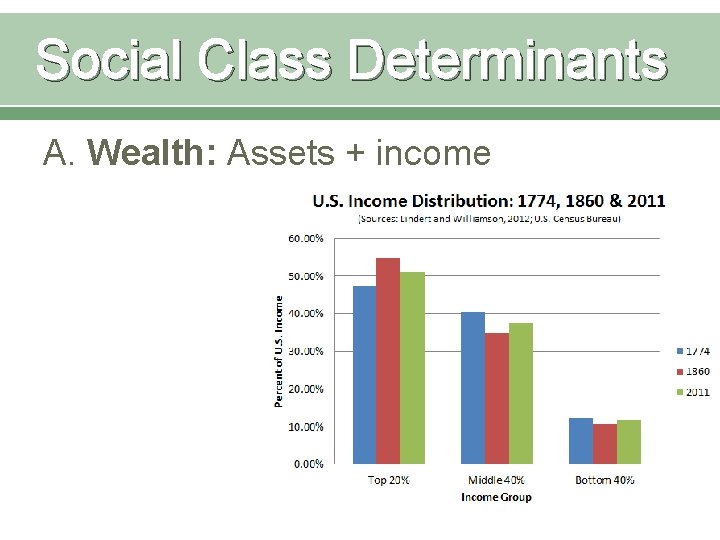
Social Class Determinants A. Wealth: Assets + income
Social Class Determinants B. Power: Ability to control behavior of others C. Prestige: Honor, recognition, respect 1. Occupation is greatest determinant
Social Class Determinants D. Socioeconomic Status (SES) 1. Educational level 2. Occupational prestige 3. Place of residence 4. Income
4 Social Class Categories A. Wealth B. Power C. Prestige D. Socioeconomic (SES) Status

The American Class System A. Upper Class B. Upper-Middle Class C. Lower-Middle Class D. Working Class E. Lower Class
The American Class System A. Upper-Class 1 -3% 1. Small group of well-to-do families 2. Owners of large businesses, top executives 3. Large investments, beautiful homes 4. Life-style and self-image that mark as V. I. P. s 5. Serve on boards of directors, written about on society page, children go to constly private schools 6. Strongest class consciousness 7. Powerful in economy and government
The American Class System B. Upper-middle class (10 -15%) 1. Living near and sometimes among upper class 2. Professionals and businesspeople, educated and successful 3. High incomes directly from their work career 4. Children brought up to go to college, usually remain in same class
The American Class System C. Lower Middle Class (30 -35%) 1. Modest but well-kept neighborhoods 2. Shop owners, office workers who do not have high 3. 4. 5. 6. managerial positions High school education, some college Little influence in community and government, but belong to church and social groups Respectable, stress moral values, religion, working hard to get ahead Women venture outside home but resists commitments that might keep them away from family
The American Class System D. Working Class (40 -45%) 1. Employees of shops, factory workers, unskilled jobs 2. Not much upward mobility, difficult to give up paycheck to prepare 3. Unions, not all active, put support with dues, depend on for advancement
The American Class System E. Lower class (20 -25%) 1. Public housing, run-down dwellings, low pay work or welfare, elderly, sick, single parents 2. Difficult to break out of vicious circle 3. Poor education, poor health, poor reputation, difficult to get good job 4. Ill luck, lack of motivation to move up
- Slides: 15