
Social Class in the United States Sociology 12

- Slides: 35
Social Class in the United States Sociology, 12 th Edition by John Macionis Copyright 2008 Prentice Hall, a division of Pearson Education. All rights reserved.
The U. S. Social Classes • U. S. created with never having a “noble class’. • America’s first attempt at legal caste system was slavery. • In America, the differences in wealth create a “stratified” class system. • Is America a middle class society like people would want to believe? Sociology, 12 th Edition by John Macionis Copyright 2008 Prentice Hall, a division of Pearson Education. All rights reserved.
A Middle-Class Society • Everyone stands equal under the law. • We celebrate individuality. • We interact mostly with people like ourselves. • The US is an affluent society. • Socioeconomic status (SES) reflects money (income, wealth & power), occupational prestige and schooling. Sociology, 12 th Edition by John Macionis Copyright 2008 Prentice Hall, a division of Pearson Education. All rights reserved.
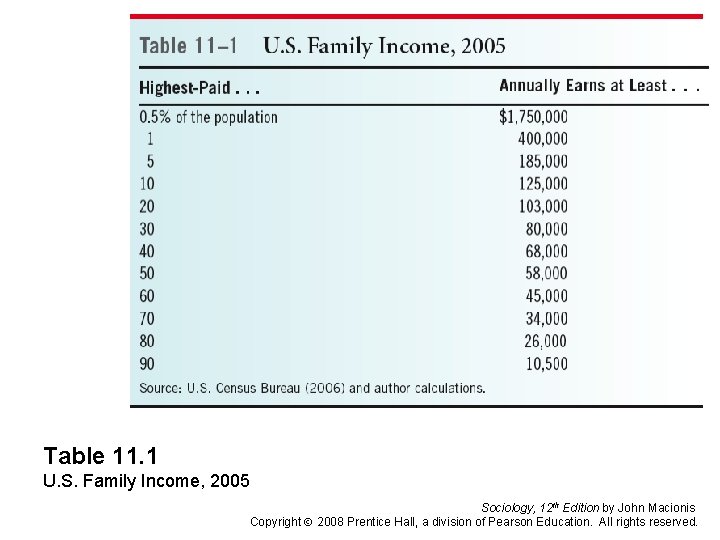
Table 11. 1 U. S. Family Income, 2005 Sociology, 12 th Edition by John Macionis Copyright 2008 Prentice Hall, a division of Pearson Education. All rights reserved.
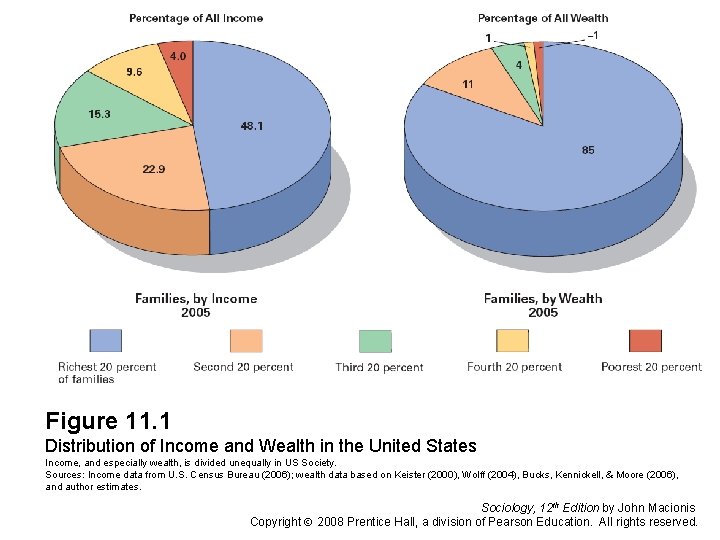
Figure 11. 1 Distribution of Income and Wealth in the United States Income, and especially wealth, is divided unequally in US Society. Sources: Income data from U. S. Census Bureau (2006); wealth data based on Keister (2000), Wolff (2004), Bucks, Kennickell, & Moore (2006), and author estimates. Sociology, 12 th Edition by John Macionis Copyright 2008 Prentice Hall, a division of Pearson Education. All rights reserved.
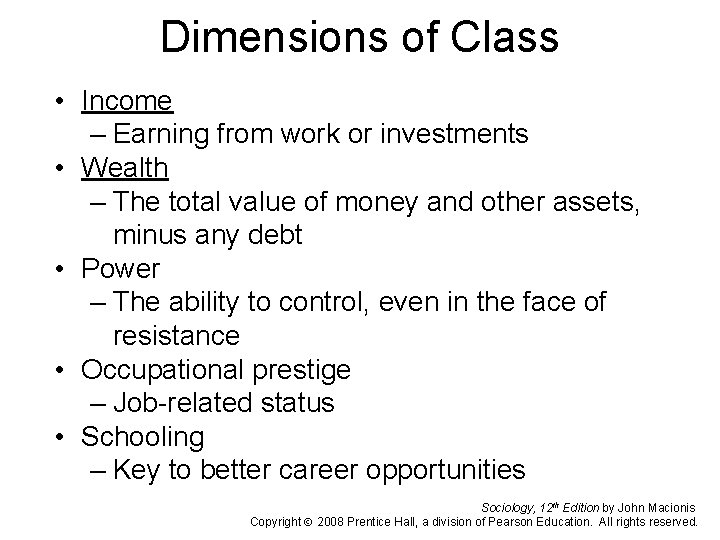
Dimensions of Class • Income – Earning from work or investments • Wealth – The total value of money and other assets, minus any debt • Power – The ability to control, even in the face of resistance • Occupational prestige – Job-related status • Schooling – Key to better career opportunities Sociology, 12 th Edition by John Macionis Copyright 2008 Prentice Hall, a division of Pearson Education. All rights reserved.
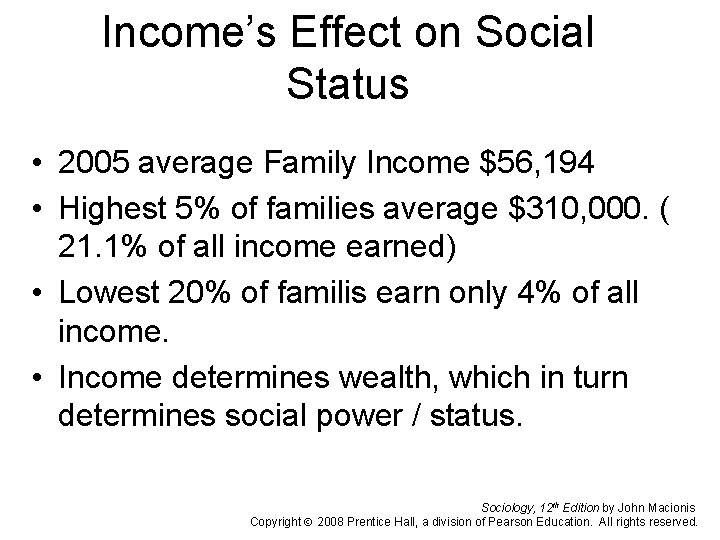
Income’s Effect on Social Status • 2005 average Family Income $56, 194 • Highest 5% of families average $310, 000. ( 21. 1% of all income earned) • Lowest 20% of familis earn only 4% of all income. • Income determines wealth, which in turn determines social power / status. Sociology, 12 th Edition by John Macionis Copyright 2008 Prentice Hall, a division of Pearson Education. All rights reserved.
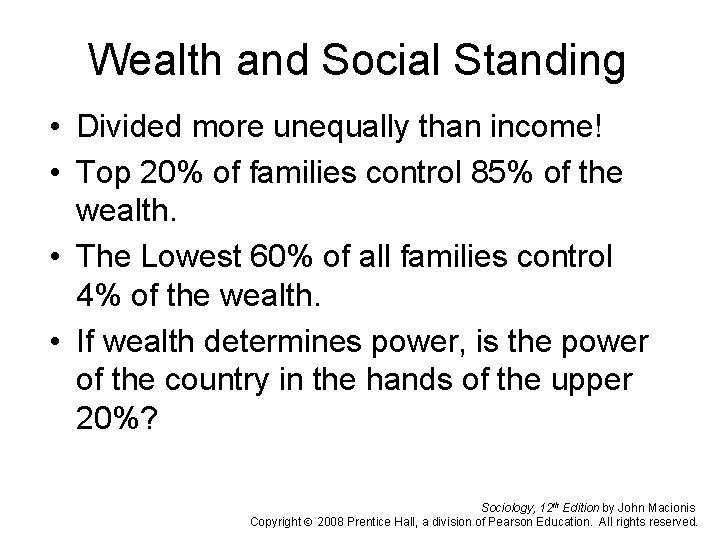
Wealth and Social Standing • Divided more unequally than income! • Top 20% of families control 85% of the wealth. • The Lowest 60% of all families control 4% of the wealth. • If wealth determines power, is the power of the country in the hands of the upper 20%? Sociology, 12 th Edition by John Macionis Copyright 2008 Prentice Hall, a division of Pearson Education. All rights reserved.
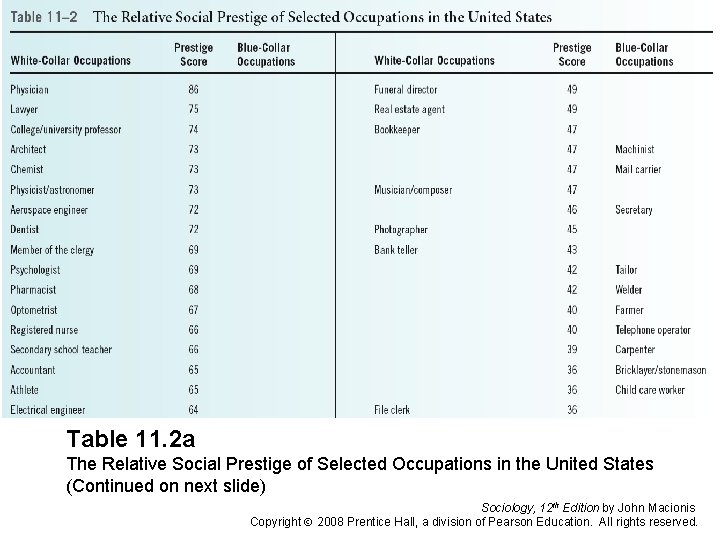
Table 11. 2 a The Relative Social Prestige of Selected Occupations in the United States (Continued on next slide) Sociology, 12 th Edition by John Macionis Copyright 2008 Prentice Hall, a division of Pearson Education. All rights reserved.
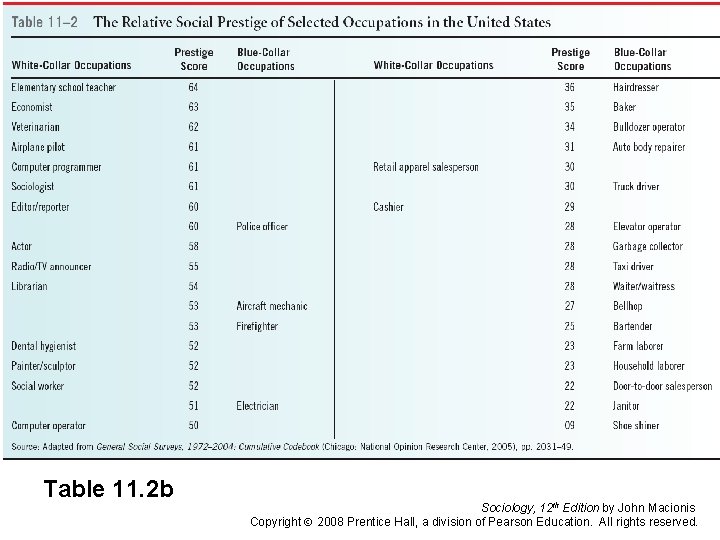
Table 11. 2 b Sociology, 12 th Edition by John Macionis Copyright 2008 Prentice Hall, a division of Pearson Education. All rights reserved.
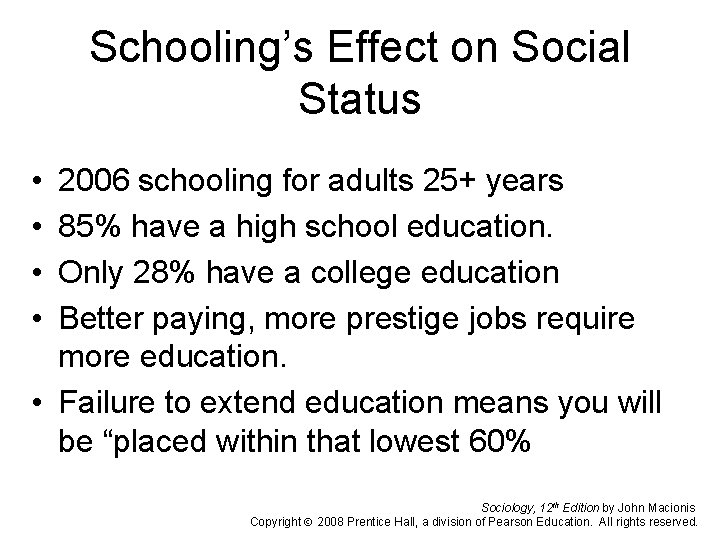
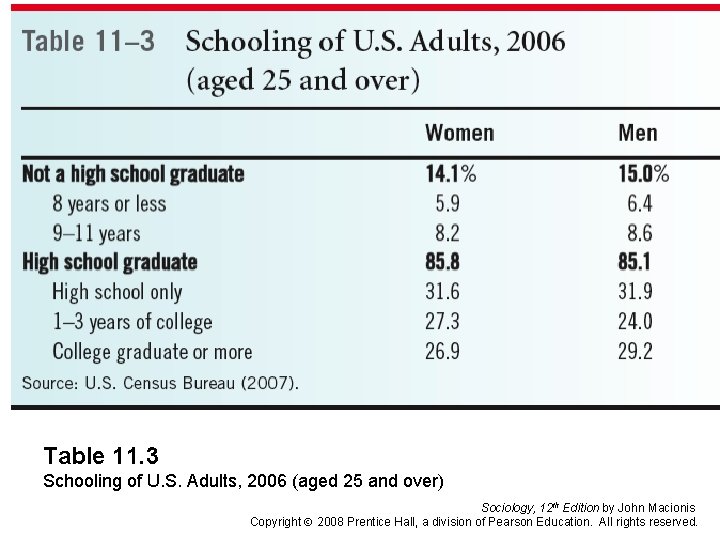
Schooling’s Effect on Social Status • • 2006 schooling for adults 25+ years 85% have a high school education. Only 28% have a college education Better paying, more prestige jobs require more education. • Failure to extend education means you will be “placed within that lowest 60% Sociology, 12 th Edition by John Macionis Copyright 2008 Prentice Hall, a division of Pearson Education. All rights reserved.
Table 11. 3 Schooling of U. S. Adults, 2006 (aged 25 and over) Sociology, 12 th Edition by John Macionis Copyright 2008 Prentice Hall, a division of Pearson Education. All rights reserved.
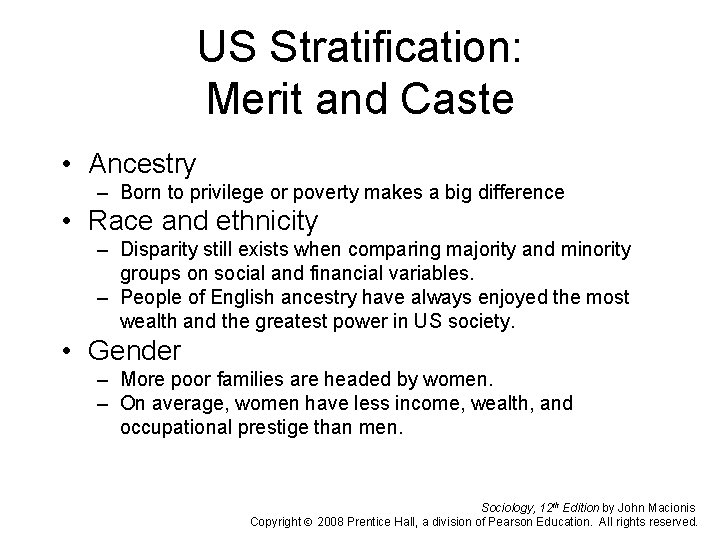
US Stratification: Merit and Caste • Ancestry – Born to privilege or poverty makes a big difference • Race and ethnicity – Disparity still exists when comparing majority and minority groups on social and financial variables. – People of English ancestry have always enjoyed the most wealth and the greatest power in US society. • Gender – More poor families are headed by women. – On average, women have less income, wealth, and occupational prestige than men. Sociology, 12 th Edition by John Macionis Copyright 2008 Prentice Hall, a division of Pearson Education. All rights reserved.
Sociology, 12 th Edition by John Macionis Copyright 2008 Prentice Hall, a division of Pearson Education. All rights reserved.
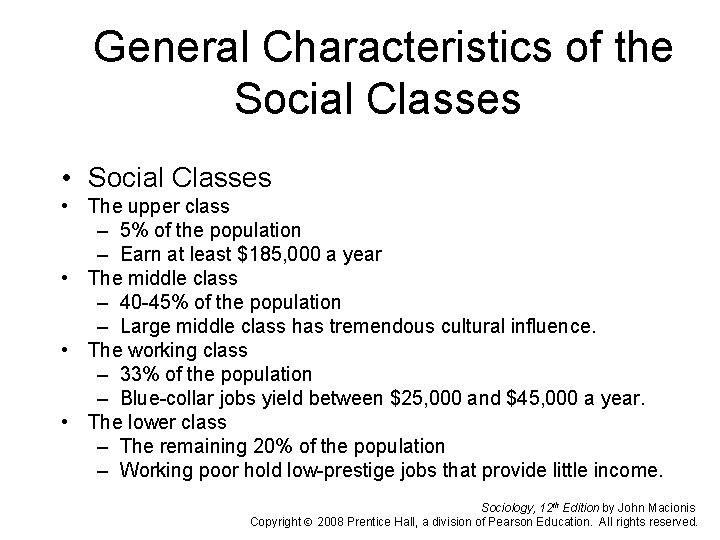
General Characteristics of the Social Classes • The upper class – 5% of the population – Earn at least $185, 000 a year • The middle class – 40 -45% of the population – Large middle class has tremendous cultural influence. • The working class – 33% of the population – Blue-collar jobs yield between $25, 000 and $45, 000 a year. • The lower class – The remaining 20% of the population – Working poor hold low-prestige jobs that provide little income. Sociology, 12 th Edition by John Macionis Copyright 2008 Prentice Hall, a division of Pearson Education. All rights reserved.
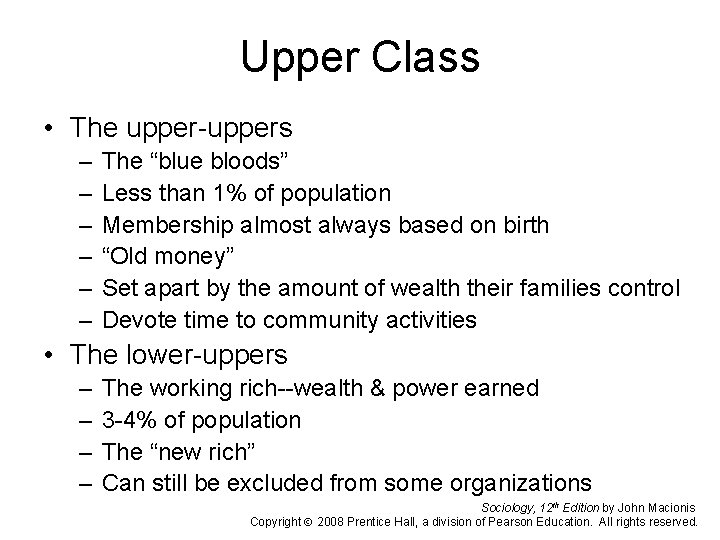
Upper Class • The upper-uppers – – – The “blue bloods” Less than 1% of population Membership almost always based on birth “Old money” Set apart by the amount of wealth their families control Devote time to community activities • The lower-uppers – – The working rich--wealth & power earned 3 -4% of population The “new rich” Can still be excluded from some organizations Sociology, 12 th Edition by John Macionis Copyright 2008 Prentice Hall, a division of Pearson Education. All rights reserved.
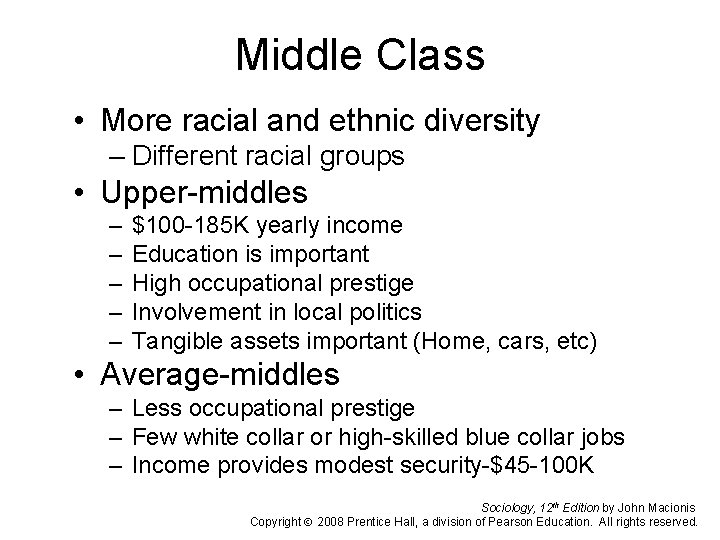
Middle Class • More racial and ethnic diversity – Different racial groups • Upper-middles – – – $100 -185 K yearly income Education is important High occupational prestige Involvement in local politics Tangible assets important (Home, cars, etc) • Average-middles – Less occupational prestige – Few white collar or high-skilled blue collar jobs – Income provides modest security-$45 -100 K Sociology, 12 th Edition by John Macionis Copyright 2008 Prentice Hall, a division of Pearson Education. All rights reserved.
Working Class • Lower-middle class • Marxist “industrial proletariat” – $25, 000 to $40, 000 annual income • • Routine jobs with less satisfaction Half own their own homes Fewer children go to college Vulnerable to financial problems caused by unemployment or illness Sociology, 12 th Edition by John Macionis Copyright 2008 Prentice Hall, a division of Pearson Education. All rights reserved.
Lower Class • 37 million Americans classified as poor in 2005 • Others are “working poor” with minimumwage jobs • Half complete high school, one in four attend college • Own homes in less desirable urban neighborhoods or rural south Sociology, 12 th Edition by John Macionis Copyright 2008 Prentice Hall, a division of Pearson Education. All rights reserved.
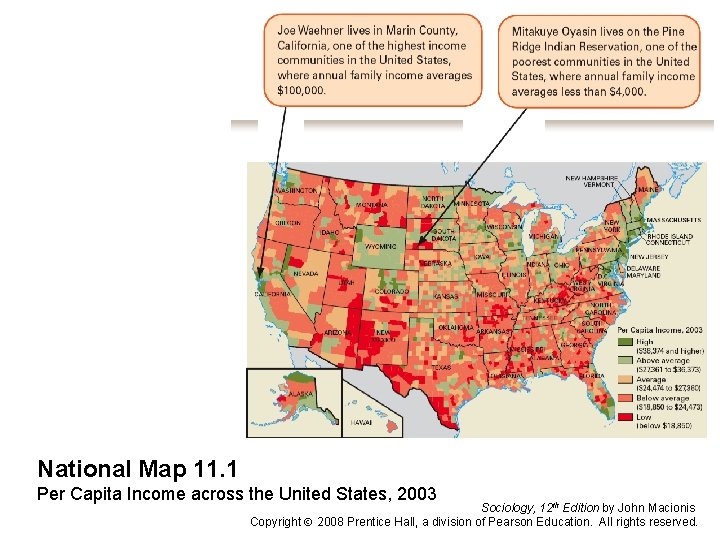
National Map 11. 1 Per Capita Income across the United States, 2003 Sociology, 12 th Edition by John Macionis Copyright 2008 Prentice Hall, a division of Pearson Education. All rights reserved.
The Difference Class Makes • Health – Amount and type of health care • Values and attitudes – Vary with position • Politics – Conservative or liberal • Family and gender – Type of parental involvement – Socialization practices – Relationships and responsibilities Sociology, 12 th Edition by John Macionis Copyright 2008 Prentice Hall, a division of Pearson Education. All rights reserved.
Social Mobility • Upward – College degree or higher-paying job • Downward – Drop out of school, losing a job or divorce • Structural social mobility – Changes in society or national economic trends • Intragenerational mobility – Change in social position during a person’s lifetime • Intergenerational mobility – Upward or downward movement that takes place across generations within a family Sociology, 12 th Edition by John Macionis Copyright 2008 Prentice Hall, a division of Pearson Education. All rights reserved.
SOCIAL MOBILITY • http: //www. youtube. com/watch? v=c 9 q 7 G 3 k 2 Kc. A Sociology, 12 th Edition by John Macionis Copyright 2008 Prentice Hall, a division of Pearson Education. All rights reserved.
Myth vs. Reality • Social mobility has been fairly high. • Long-term trend has been upward. • Intergenerational mobility is small, not dramatic. • Social mobility since the 1970 s has been uneven. Sociology, 12 th Edition by John Macionis Copyright 2008 Prentice Hall, a division of Pearson Education. All rights reserved.
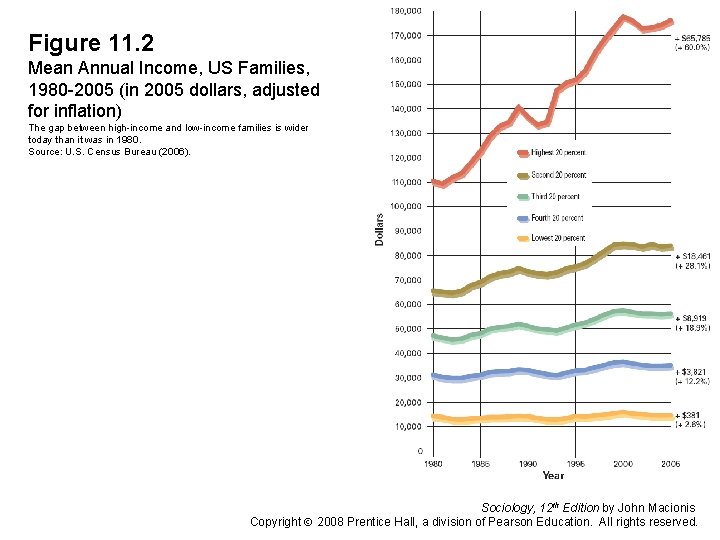
Figure 11. 2 Mean Annual Income, US Families, 1980 -2005 (in 2005 dollars, adjusted for inflation) The gap between high-income and low-income families is wider today than it was in 1980. Source: U. S. Census Bureau (2006). Sociology, 12 th Edition by John Macionis Copyright 2008 Prentice Hall, a division of Pearson Education. All rights reserved.
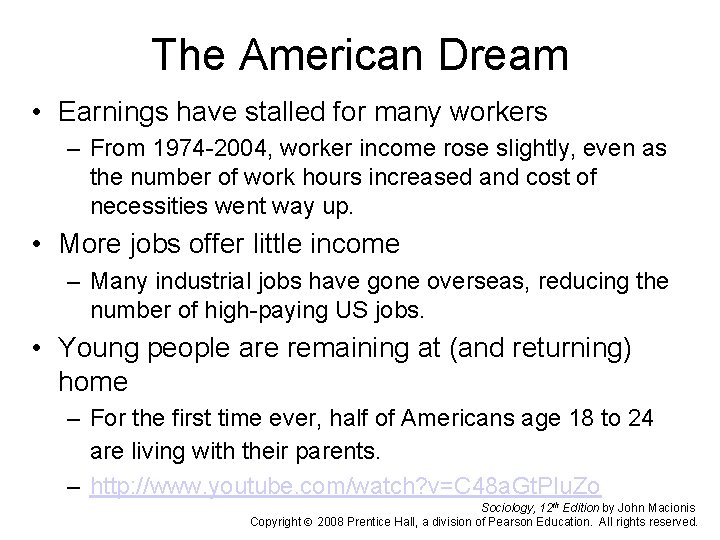
The American Dream • Earnings have stalled for many workers – From 1974 -2004, worker income rose slightly, even as the number of work hours increased and cost of necessities went way up. • More jobs offer little income – Many industrial jobs have gone overseas, reducing the number of high-paying US jobs. • Young people are remaining at (and returning) home – For the first time ever, half of Americans age 18 to 24 are living with their parents. – http: //www. youtube. com/watch? v=C 48 a. Gt. PIu. Zo Sociology, 12 th Edition by John Macionis Copyright 2008 Prentice Hall, a division of Pearson Education. All rights reserved.
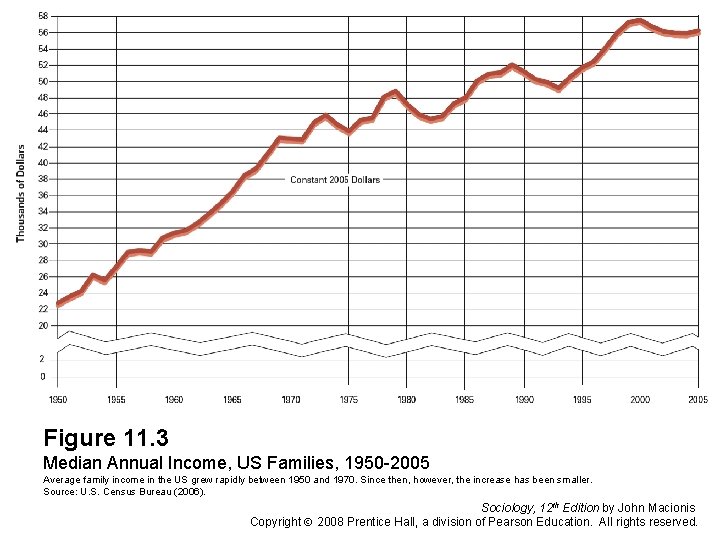
Figure 11. 3 Median Annual Income, US Families, 1950 -2005 Average family income in the US grew rapidly between 1950 and 1970. Since then, however, the increase has been smaller. Source: U. S. Census Bureau (2006). Sociology, 12 th Edition by John Macionis Copyright 2008 Prentice Hall, a division of Pearson Education. All rights reserved.
Global Economy and US Class Structure Global economic expansion • • • Jobs changed from manufacturing to service work. Creates upward mobility for educated people Investments for those with money Downsizing in companies affects average workers. Many US families working harder to stay afloat Sociology, 12 th Edition by John Macionis Copyright 2008 Prentice Hall, a division of Pearson Education. All rights reserved.
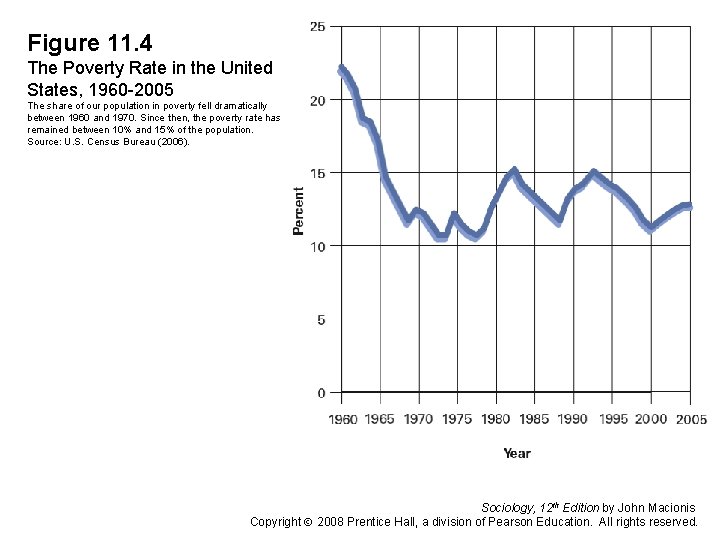
Extent of Poverty • Relative poverty–The deprivation of some people in relation to those who have more • Absolute poverty–A deprivation of resources that is life-threatening • Poverty line – About three times what the government estimates people must spend for food. – The income of the average poor family is 60% of this amount. • Extent of US poverty – 12. 6% (37 million) are impoverished. Sociology, 12 th Edition by John Macionis Copyright 2008 Prentice Hall, a division of Pearson Education. All rights reserved.
Figure 11. 4 The Poverty Rate in the United States, 1960 -2005 The share of our population in poverty fell dramatically between 1960 and 1970. Since then, the poverty rate has remained between 10% and 15% of the population. Source: U. S. Census Bureau (2006). Sociology, 12 th Edition by John Macionis Copyright 2008 Prentice Hall, a division of Pearson Education. All rights reserved.
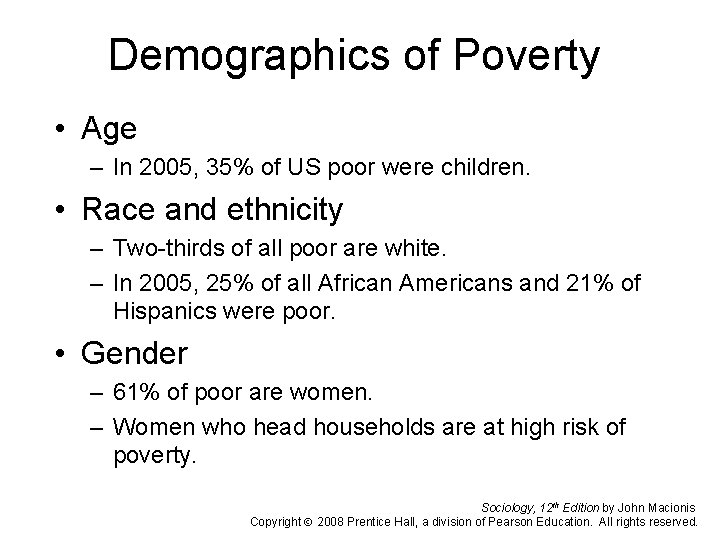
Demographics of Poverty • Age – In 2005, 35% of US poor were children. • Race and ethnicity – Two-thirds of all poor are white. – In 2005, 25% of all African Americans and 21% of Hispanics were poor. • Gender – 61% of poor are women. – Women who head households are at high risk of poverty. Sociology, 12 th Edition by John Macionis Copyright 2008 Prentice Hall, a division of Pearson Education. All rights reserved.
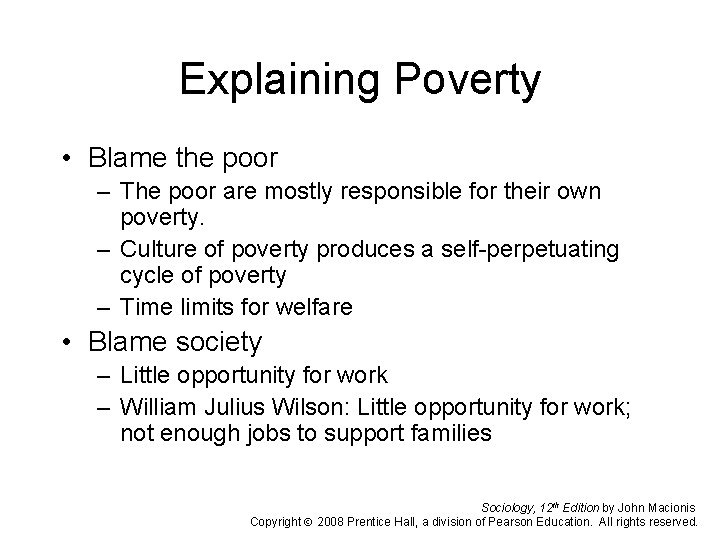
Explaining Poverty • Blame the poor – The poor are mostly responsible for their own poverty. – Culture of poverty produces a self-perpetuating cycle of poverty – Time limits for welfare • Blame society – Little opportunity for work – William Julius Wilson: Little opportunity for work; not enough jobs to support families Sociology, 12 th Edition by John Macionis Copyright 2008 Prentice Hall, a division of Pearson Education. All rights reserved.
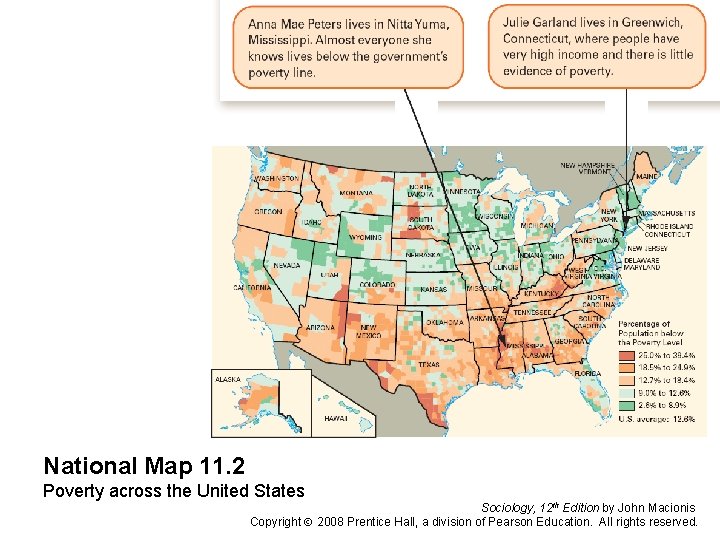
National Map 11. 2 Poverty across the United States Sociology, 12 th Edition by John Macionis Copyright 2008 Prentice Hall, a division of Pearson Education. All rights reserved.
The Working Poor • In 2005, 18% of heads of poor families worked at least 50 weeks a year. • Individual ability and personal effort play a part in shaping social position. • However, society is the primary cause of poverty. • A rising share of available jobs offers only low wages Sociology, 12 th Edition by John Macionis Copyright 2008 Prentice Hall, a division of Pearson Education. All rights reserved.
Homeless • No precise count – Experts estimate 754, 000 on any given night • Causes – Poverty – One-third are substance abusers – One-fourth are mentally ill • Many homeless are entire families due to structural changes in economy. Sociology, 12 th Edition by John Macionis Copyright 2008 Prentice Hall, a division of Pearson Education. All rights reserved.