
Social Class and OER Elizabeth Siler Associate Professor
Social Class and OER Elizabeth Siler, Associate Professor, Business Administration and Economics Department, Worcester State University Angela Quitadamo, Assistant Dean, Academic Student Success, Mount Wachusett Community College Vicki Gruzynski, Teaching and Learning Librarian, Worcester State University Presented at the Northeast OER Summit, May 22, 2019, Amherst MA This work is licensed under a Creative Commons Attribution 4. 0 International License.
Session Plan ● ● What is social class and how does it matter? How using OER has changed our teaching How OER can address problems at an institutional level Problems related to social class that OER does not address ● Questions and Discussion
What is Social Class? Complex Construct Consisting of: ● ● ● Education Level Total Income - Earned & Unearned for Household (Total Assets/Debt) Occupation & Industry (Level of Prestige) Subjective Perception of One’s Social Position (Working, Middle, Upper) Family Size & Composition Poverty/Hardship Assessments (Food Insecurity, Economic Pressure, Unmet Needs) Combination of Educational Attainment, Occupational Prestige, & Income
How Does Class Matter? “Individuals are not separate from their social contexts, people think and feel and act in culture-specific ways— ways that are shaped by particular patterns of historically derived meanings, practices, products, and institutions. ” (Di. Maggio & Markus, 2010: 348) 4
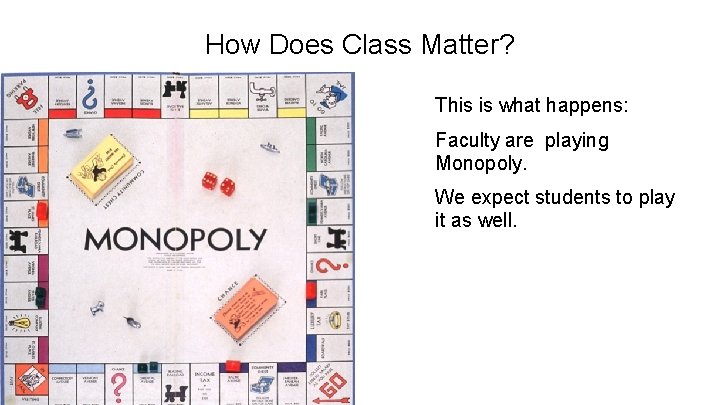
How Does Class Matter? This is what happens: Faculty are playing Monopoly. We expect students to play it as well. 5
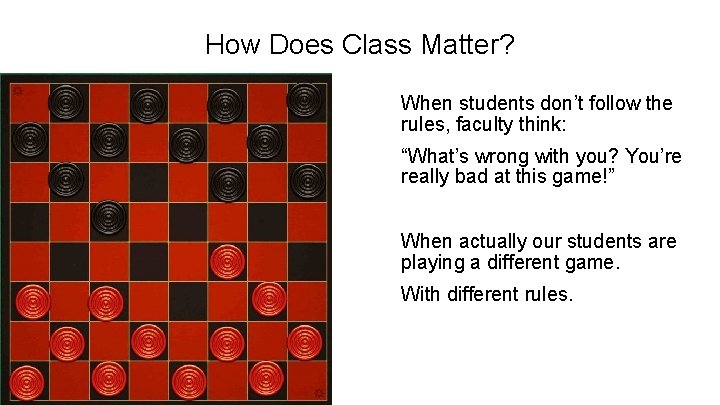
How Does Class Matter? When students don’t follow the rules, faculty think: “What’s wrong with you? You’re really bad at this game!” When actually our students are playing a different game. With different rules. 6
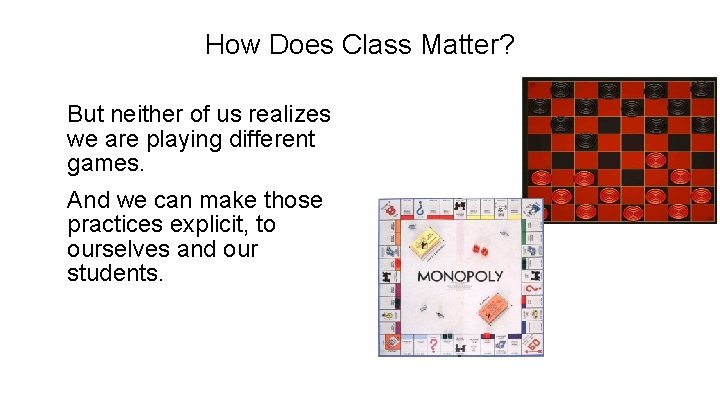
How Does Class Matter? But neither of us realizes we are playing different games. And we can make those practices explicit, to ourselves and our students. 7
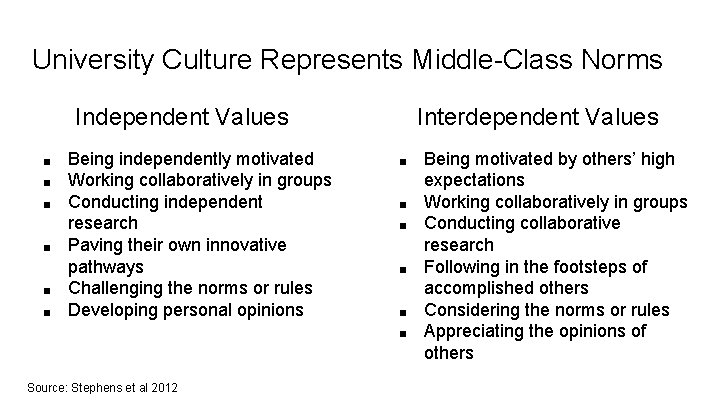
University Culture Represents Middle-Class Norms Independent Values ■ ■ ■ Being independently motivated Working collaboratively in groups Conducting independent research Paving their own innovative pathways Challenging the norms or rules Developing personal opinions Interdependent Values ■ ■ ■ Source: Stephens et al 2012 Being motivated by others’ high expectations Working collaboratively in groups Conducting collaborative research Following in the footsteps of accomplished others Considering the norms or rules Appreciating the opinions of others
How OER Changed Our Teaching ■ ■ ■ Books on reserve: which is very difficult for the ways many students schedule classes and campus time. Old editions: bookstore policies may prohibit the purchase; weeks’ delay in on-line ordering Using examples from companies like those our students might work at, not Microsoft or other large companies that are typical textbook examples. Using non-textbook sources and genres to promote the habit of reading Choosing topics because of their relevance, ex: how to handle conflict, types of social networks
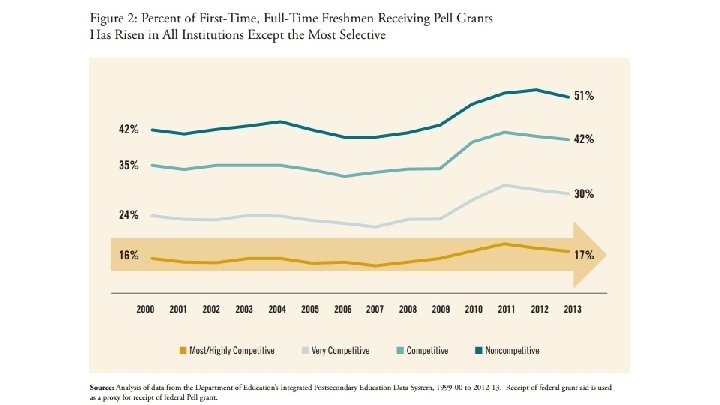
Administration Perspective ■ ■ ■ From an enrollment perspective, we know when there are multiple sections of the same course, OER sections typically fill first Students sometimes choose courses based solely on book prices Using OER can contribute to transparency in college costs Access to materials increases GPAs. More students with good academic standing and thus avoid SAP issues and the costs associated with noncompletion Classroom climate: OER promotes an inclusive and engaging classroom climate because all students have the materials. OER can build immediate instructor credibility with students. It’s an unspoken choice that acknowledges economic hardships being navigated by students.
Social Class Problems that OER Does Not Address ■ ■ ■ When students can’t afford the textbook, often they come to the library looking for help and alternatives Our students still have a million jobs and limited time to do their homework Students who live at home (or nearby) will still have expectations from their family that do not necessarily align with “school comes first” Having OER materials available electronically still requires Internet access and a working laptop If students don’t have internet access, they need to pay to print materials Doesn’t solve accessibility issues
Questions and Closing Thoughts If the first person in a family gets through college, it’s a demonstration that you can do it. One purpose of this presentation is to raise awareness about social class, especially as the traditional student population is shrinking. When you’re facing a problem, consider if there may be a social class component that you might not be seeing. What questions do you have? What would you like to discuss?
References (cited in presentation) Di. Maggio, P. , & Markus, H. R. (2010). Culture and Social Psychology: Converging Perspectives. Social Psychology Quarterly, 73(4), 347– 352. Stephens, N. M. , Fryberg, S. A. , Markus, H. R. , Johnson, C. S. , & Covarrubias, R. (2007). Unseen Disadvantage: How American Universities’ Focus on Independence Undermines the Academic Performance of First-Generation College Students. Interpersonal Relations and Group Processes, Journal of Personality and Social Psychology, 2012, Vol. 102, No. 6, 1178– 1197.
Additional References Collier, P. J. , and Morgan, D. L. (2008). “Is that paper really due today? ”: Differences in first- generation and traditional college students’ understandings of faculty expectations. Higher Education, 55, 425— 446 Goyette, K. A. and Mullen, A. (2006). Who studies the arts and sciences? Social background and the choice and consequences of undergraduate field of study. The Journal of Higher Education, 77(3), 497— 538. Harker, R. (1984). On reproduction, habitus and education. British Journal of Sociology of Education, 5(2), 117– 127 Hurst, A. L. (2010). The burden of academic success: Loyalists, renegades, and double agents. Lanham, MD: Lexington Books. Hurst, A. L. (2013). Student types as reflection of class habitus: An application of Bourdieu’s scholastic fallacy. Theory and Research in Education, 11(1), 43– 61. King, C. S. (2012). What’s a girl like you doing in a place like this? Journal of Public Affairs Education, 18(1), 51– 66. Stephens, N. , Hamedani, M. G. , & Destin, M. (2014). Closing the Social-Class Achievement Gap: A Difference-Education Intervention Improves First-Generation Students’ Academic Performance and All Students’ College Transition. Psychological Science, (February 2014), 1– 11. Stephens, N. , & Townsend, S. S. M. (2013). Rank Is Not Enough: Why We Need a Sociocultural Perspective to Understand Social Class. Psychological Inquiry, 24, 126– 130. Stephens, N. , Townsend, S. S. M. , Markus, H. R. , & Phillips, L. T. (2012). A cultural mismatch: Independent cultural norms produce greater increases in cortisol and more negative emotions among first -generation college students. Journal of Experimental Social Psychology, 48, 1389– 1393.
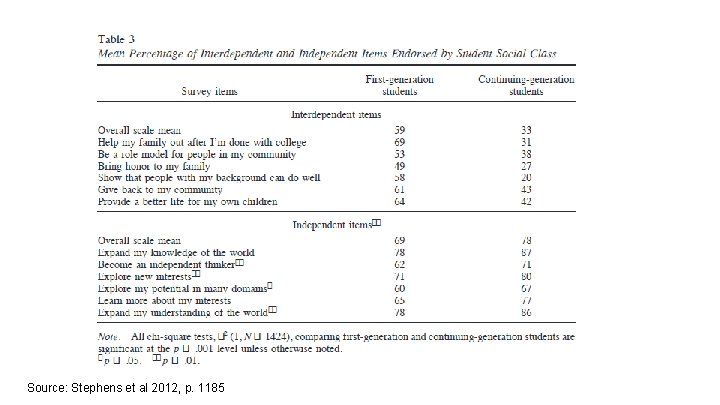
Source: Stephens et al 2012, p. 1185
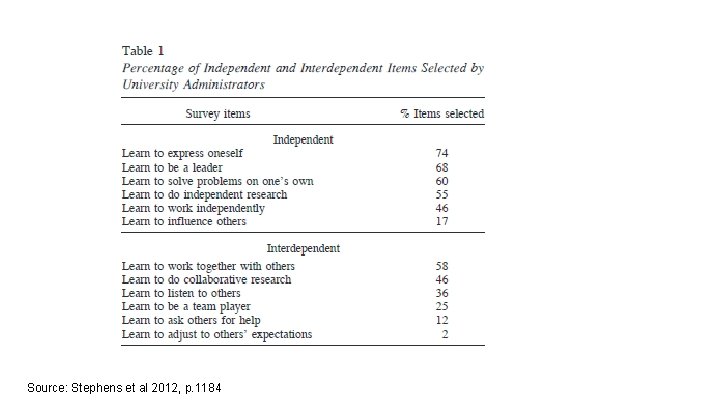
Source: Stephens et al 2012, p. 1184
Income Comparison Calculator https: //tippingpoint. org/povertylineprices/index. html#3
Contact us! Elizabeth Siler, Associate Professor, Business Administration and Economics Department, Worcester State University esiler [@] worcester. edu Angela Quitadamo, Assistant Dean, Academic Student Success, Mount Wachusett Community College aquitadamo [@] mwcc. mass. edu Vicki Gruzynski, Teaching and Learning Librarian, Worcester State University vgruzynski [@] worcester. edu Twitter: @boo_urns
- Slides: 19