
Social Change Model of Leadership Engaging Leaders Retreat
- Slides: 20
Social Change Model of Leadership Engaging Leaders Retreat Presenters: Diquan Edmonds Ashley Geiner Adapted from: NCSU CSLEPS
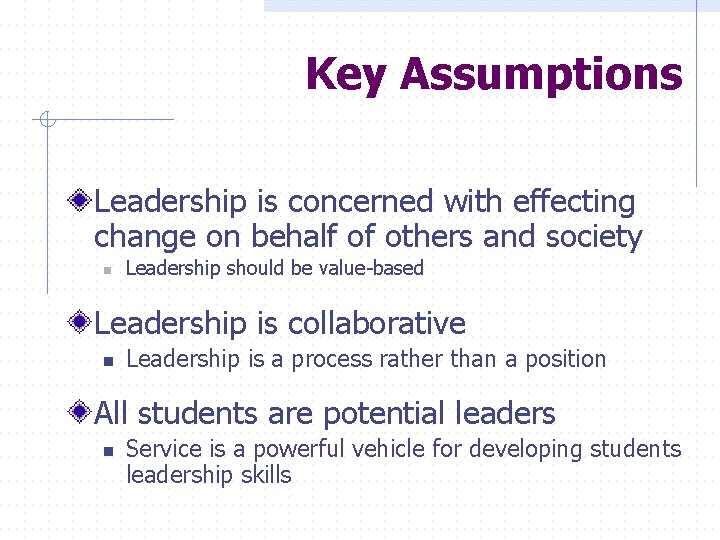
Key Assumptions Leadership is concerned with effecting change on behalf of others and society n Leadership should be value-based Leadership is collaborative n Leadership is a process rather than a position All students are potential leaders n Service is a powerful vehicle for developing students leadership skills
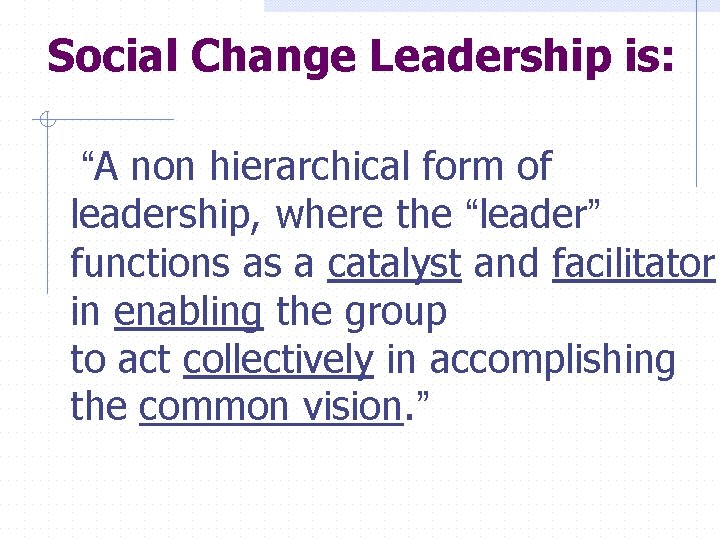
Social Change Leadership is: “A non hierarchical form of leadership, where the “leader” functions as a catalyst and facilitator in enabling the group to act collectively in accomplishing the common vision. ”
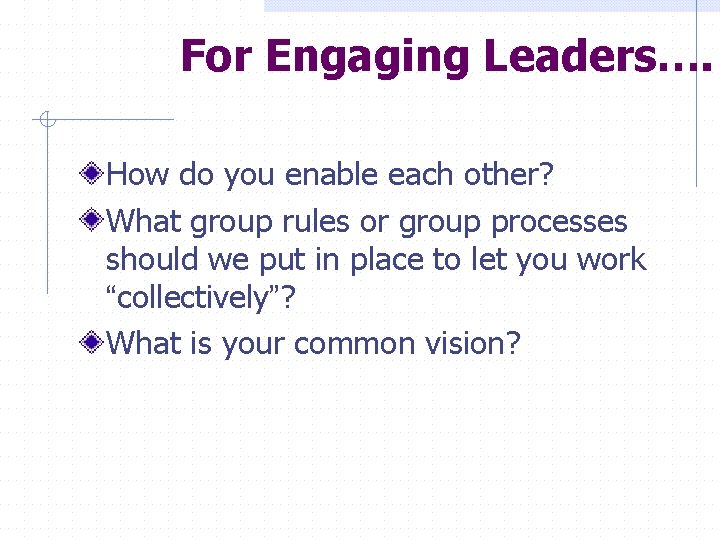
For Engaging Leaders…. How do you enable each other? What group rules or group processes should we put in place to let you work “collectively”? What is your common vision?
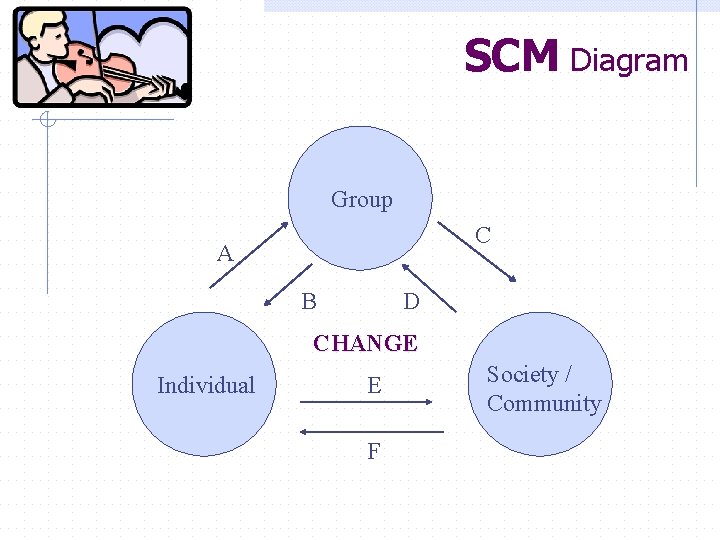
SCM Diagram Group C A B D CHANGE Individual E F Society / Community
3 Perspectives of Leadership Individual n n What personal qualities are we developing in our members? What personal qualities are most important for a group to function?
3 Perspectives of Leadership Group n How can the leadership development process be: w Collaborative? w Designed to develop the individual qualities of each member? w Designed to effect positive social change?
3 Perspectives of Leadership Community / Society n What common goal are we trying to accomplish? w What do you want to get out of the Engaging Leaders Program? n What kinds of activities could the Engaging Leaders Program do to positively effect the community?
Values are the core critical elements that lead to CHANGE within the individual, group, and community.
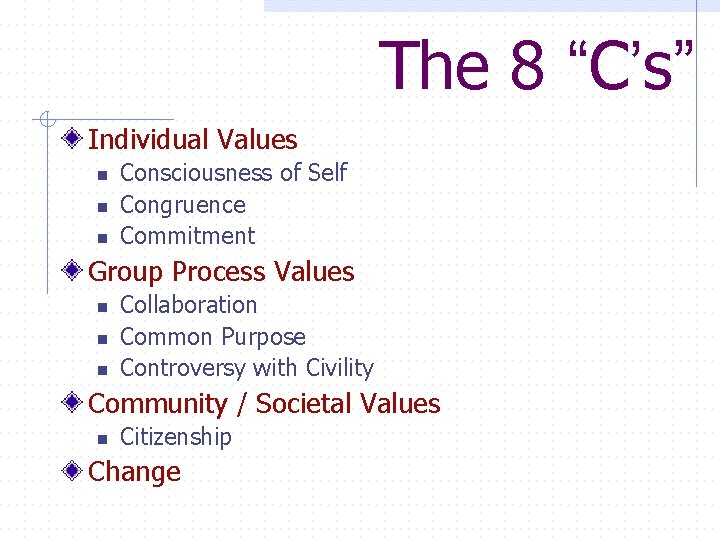
The 8 “C’s” Individual Values n n n Consciousness of Self Congruence Commitment Group Process Values n n n Collaboration Common Purpose Controversy with Civility Community / Societal Values n Citizenship Change
Consciousness of Self Being aware of the beliefs, values, attitudes and emotions that motivate one to take action. Individual
Congruence Thinking, feeling and behaving with consistency, genuineness, authenticity, and honesty toward others. Individual
Commitment The psychic energy that motivates the individual to serve and that drive the collective effort. Individual
Collaboration Work with others in a common effort. Group
Common Purpose To work with shared aims and values. Group
Controversy with Civility Differences of opinion point viewpoint are inevitable and need to be aired openly but with civility. Group
Citizenship The process whereby the individual and the collaborative group become responsibly connected to the community and society though the leadership development activity. Community
Change The ability to adapt to environments and situations that are constantly evolving, while maintaining the core functions of the group.
Let’s Start With You Why is it important to “know yourself”? How does self-knowledge play in to leadership effectiveness? What do you need to know more about to be confident? confident
Group Values LEADERSHIP Values: n n n What do you have in common as a group? What do you need to do to keep these in mind as you work together? Can you agree on 5 things that we will keep in mind while making decisions? CSLEPS Values