
SOCIAL CAPITAL IN THE CREATION OF HUMAN CAPITAL

- Slides: 19
SOCIAL CAPITAL IN THE CREATION OF HUMAN CAPITAL ADELINE LIN EWELINA KOBYLANSKA HANNAH WADMORE
CONTENTS A. Theory: James Coleman’s Social Capital in the Creation of Human Capital ■ Background: Coleman’s Theory ■ Social Capital-human capital and physical capital ■ Characteristics ■ Structure ■ Examples ■ Social capital in the creation of human capital ■ Social capital as a public good B. Criticism C. Alternative Approaches to Social Capital D. How businesses can use it: advantages and disadvantages E. Conclusion
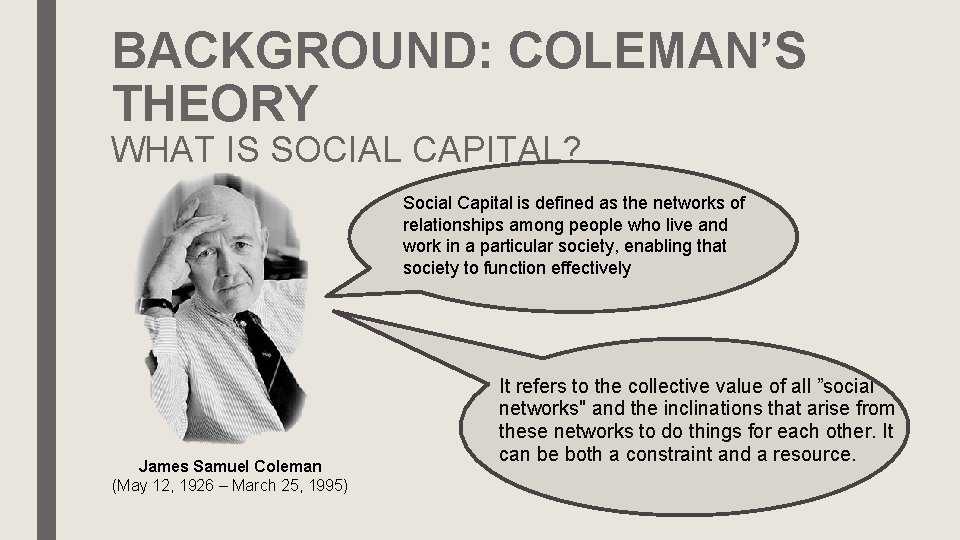
BACKGROUND: COLEMAN’S THEORY WHAT IS SOCIAL CAPITAL? Social Capital is defined as the networks of relationships among people who live and work in a particular society, enabling that society to function effectively James Samuel Coleman (May 12, 1926 – March 25, 1995) It refers to the collective value of all ”social networks" and the inclinations that arise from these networks to do things for each other. It can be both a constraint and a resource.
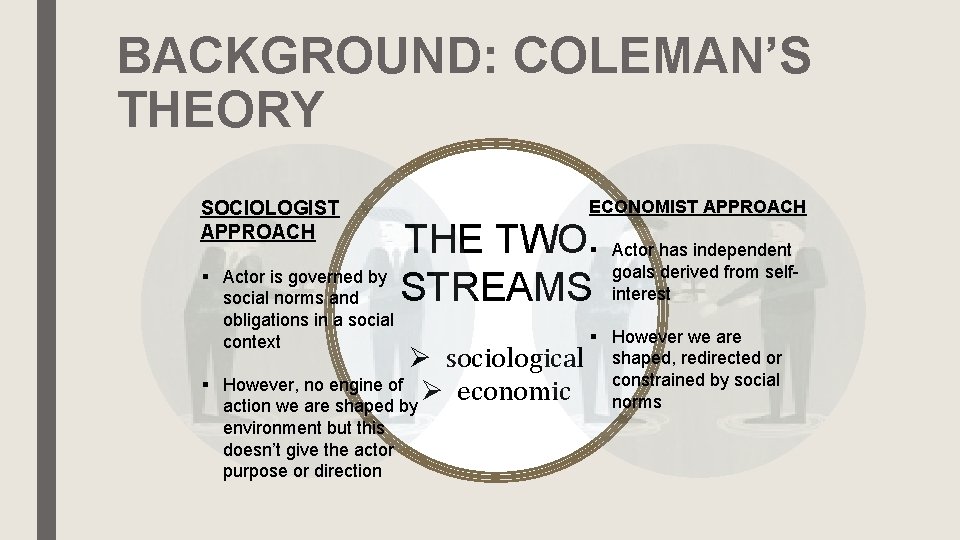
BACKGROUND: COLEMAN’S THEORY SOCIOLOGIST APPROACH § Actor is governed by social norms and obligations in a social context ECONOMIST APPROACH THE TWO§ STREAMS Actor has independent goals derived from selfinterest § However we are Ø sociological shaped, redirected or constrained by social § However, no engine of Ø economic norms action we are shaped by environment but this doesn’t give the actor purpose or direction
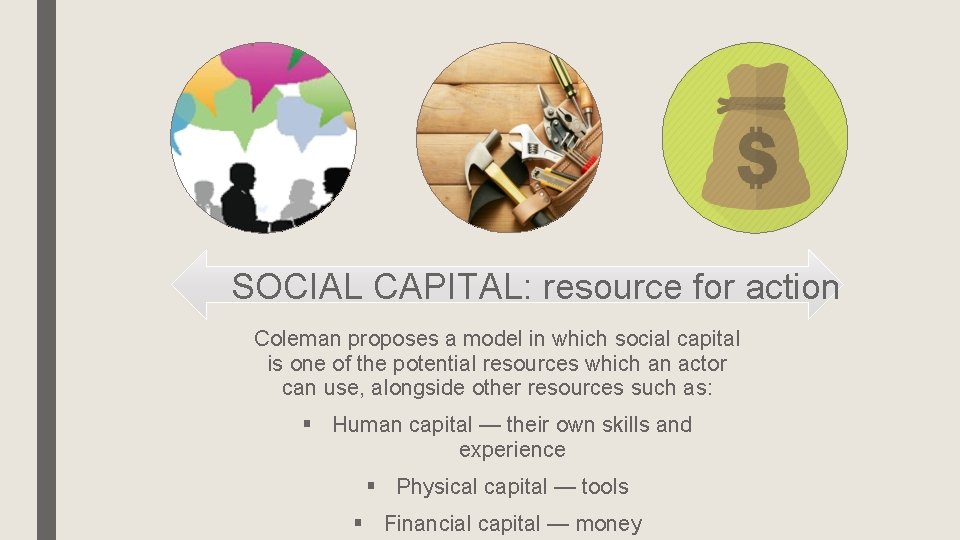
SOCIAL CAPITAL: resource for action Coleman proposes a model in which social capital is one of the potential resources which an actor can use, alongside other resources such as: § Human capital — their own skills and experience § Physical capital — tools § Financial capital — money
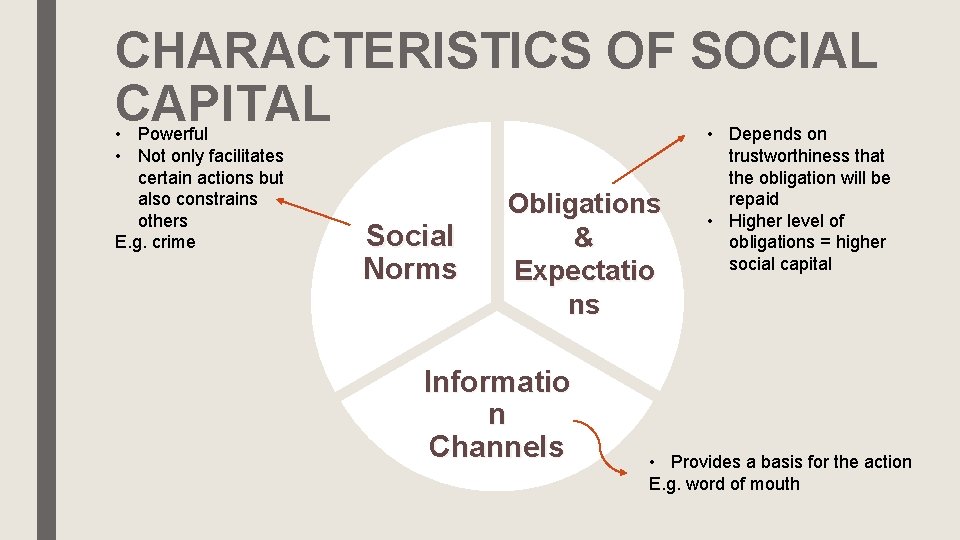
CHARACTERISTICS OF SOCIAL CAPITAL • Powerful • Not only facilitates certain actions but also constrains others E. g. crime Social Norms Obligations & Expectatio ns Informatio n Channels • Depends on trustworthiness that the obligation will be repaid • Higher level of obligations = higher social capital • Provides a basis for the action E. g. word of mouth
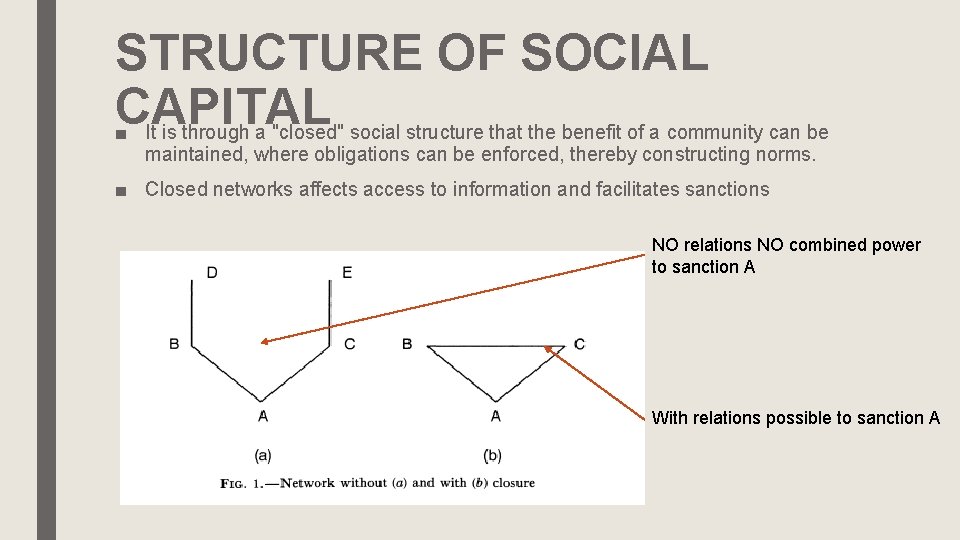
STRUCTURE OF SOCIAL CAPITAL ■ It is through a "closed" social structure that the benefit of a community can be maintained, where obligations can be enforced, thereby constructing norms. ■ Closed networks affects access to information and facilitates sanctions NO relations NO combined power to sanction A With relations possible to sanction A
EXAMPLES OF SOCIAL CAPITAL ■ Norms within Jerusalem and Detroit to Children can be left without supervision in Jerusalem, but not in Detroit due difference in social norms. ■ Diamond market in New York Closed structure of market maintains trustworthiness between actors and effectiveness of market operations.
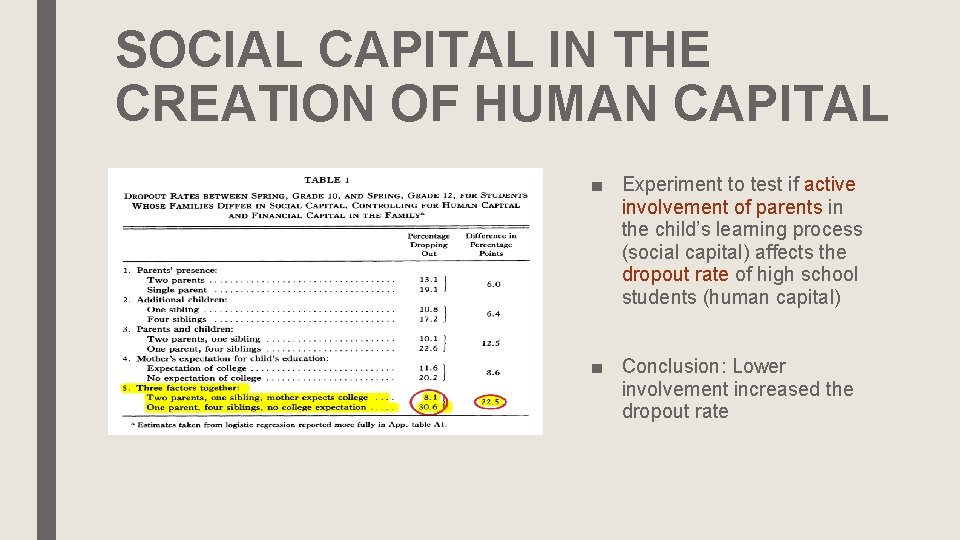
SOCIAL CAPITAL IN THE CREATION OF HUMAN CAPITAL ■ Experiment to test if active involvement of parents in the child’s learning process (social capital) affects the dropout rate of high school students (human capital) ■ Conclusion: Lower involvement increased the dropout rate
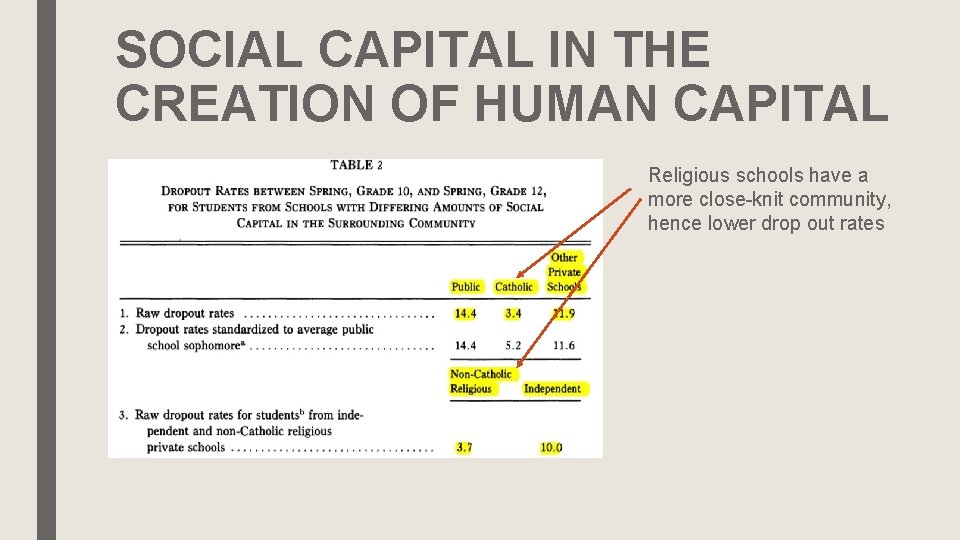
SOCIAL CAPITAL IN THE CREATION OF HUMAN CAPITAL Religious schools have a more close-knit community, hence lower drop out rates
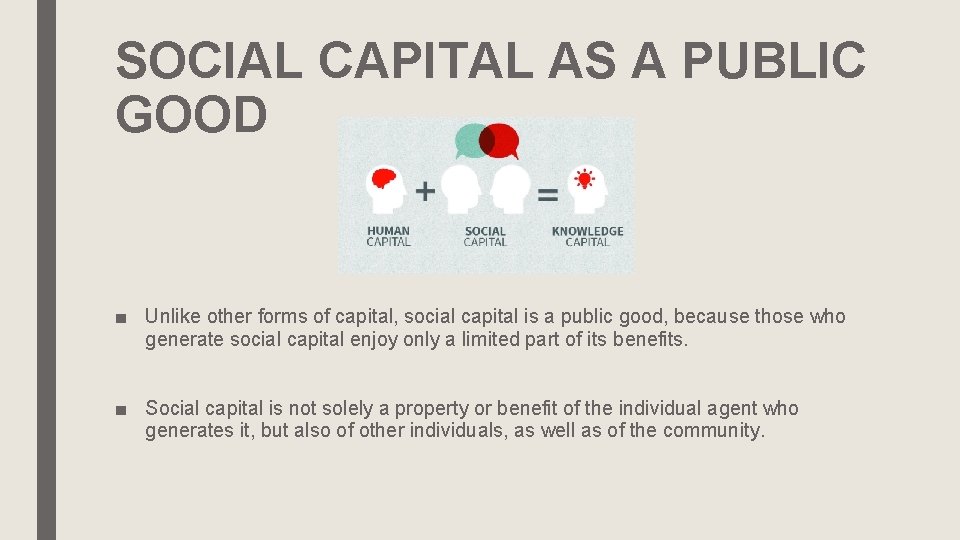
SOCIAL CAPITAL AS A PUBLIC GOOD ■ Unlike other forms of capital, social capital is a public good, because those who generate social capital enjoy only a limited part of its benefits. ■ Social capital is not solely a property or benefit of the individual agent who generates it, but also of other individuals, as well as of the community.
CRITICISMS ■ Haynes (2009) - A concept based on a misleading metaphor – it isn’t capital. - Not an original concept ■ Parcel and Menaghan (1993) - Coleman’s interpretation of social capital focuses on examining the quantity and not the quality of interpersonal relations ■ Morrow (2001); Molyneux (2002); Edwards, Franklin and Holland (2003) - Blind in how individuals of different genders, ethnicities and cultures experience and view social capital. ■ Coleman (1993) - Research has also primarily focused on poor communities, while the role of social capital in wealthy communities has been ignored. ■ Lin (1999) - Insistence on closed structure
ALTERNATIVE APPROACHES BOURDIEU, PUTNAM, BURT
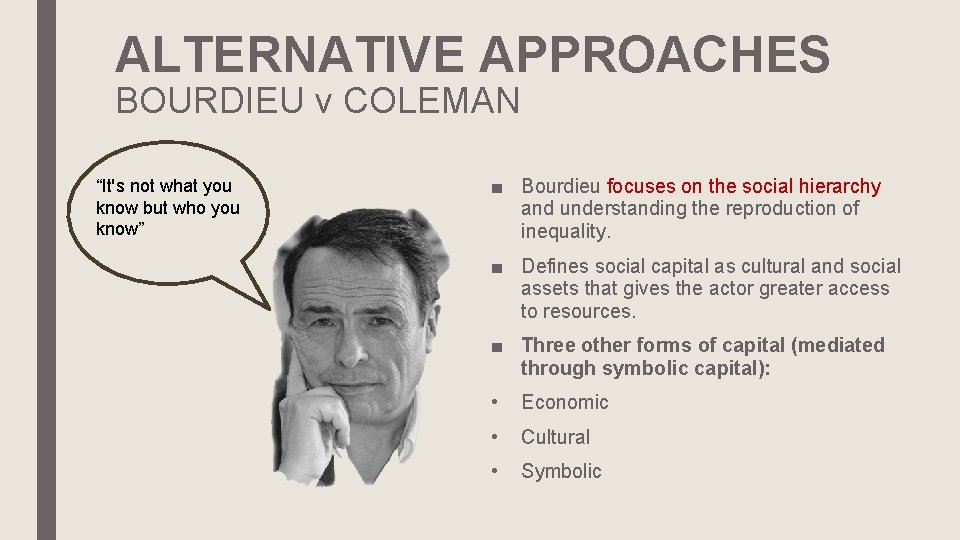
ALTERNATIVE APPROACHES BOURDIEU v COLEMAN “It's not what you know but who you know” ■ Bourdieu focuses on the social hierarchy and understanding the reproduction of inequality. ■ Defines social capital as cultural and social assets that gives the actor greater access to resources. ■ Three other forms of capital (mediated through symbolic capital): • Economic • Cultural • Symbolic
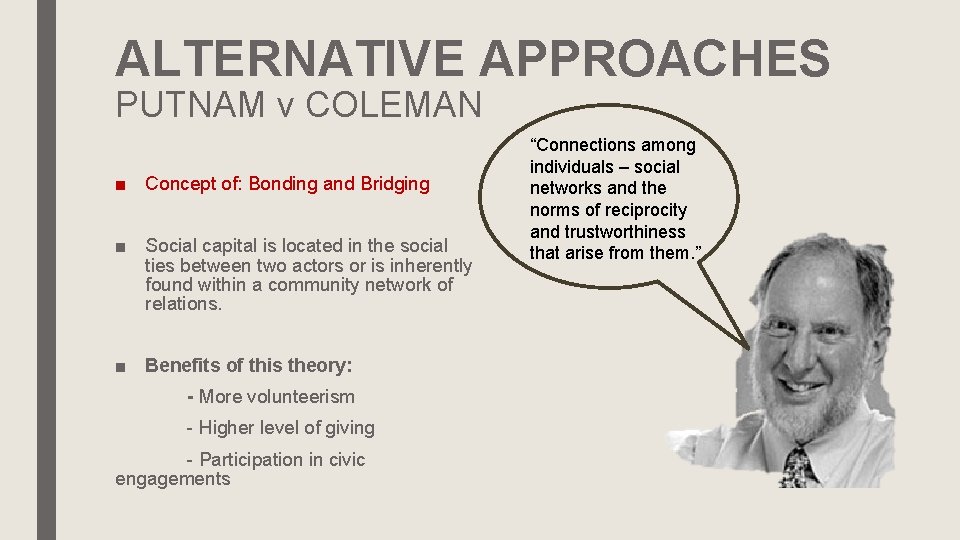
ALTERNATIVE APPROACHES PUTNAM v COLEMAN ■ Concept of: Bonding and Bridging ■ Social capital is located in the social ties between two actors or is inherently found within a community network of relations. ■ Benefits of this theory: - More volunteerism - Higher level of giving - Participation in civic engagements “Connections among individuals – social networks and the norms of reciprocity and trustworthiness that arise from them. ”
SOCIAL CAPITAL FOR BUSINESSES Lesser (2003) ■ Foster the development of communities of practices – Form informal groups to develop and share relevant knowledge – Serves as an intra-network clearinghouse by identifying those the knowledge ■ Create experiences that build trust among individuals – Adopting experiential learning classes (e. g Outward Bound) or training courses ■ Allow time for people to build common context and understanding ■ Use appropriate technologies to support network function and maintenance
SOCIAL CAPITAL FOR BUSINESSES § Within a Firm Greater coordination among individuals and departments improves morale and enhances productivity (Smith 2000). § When social capital is developed with the wrong actors or there is not enough autonomy, firms can suffer asymmetric information, ingenuity, reputation and ultimately revenue. § Among Firms Businesses banding together in a joint effort are able to establish deeper relationships with one another. § Family-firms may embody inefficient norms such as nepotism § Across Sectors Cross-sectoral partnerships for sustainable development of § Negative social capital can result in corruption
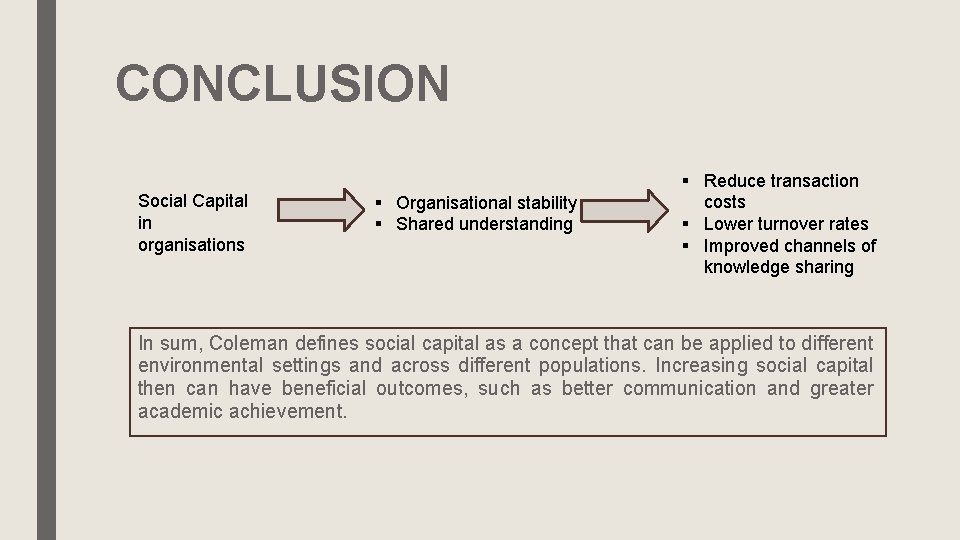
CONCLUSION Social Capital in organisations § Organisational stability § Shared understanding § Reduce transaction costs § Lower turnover rates § Improved channels of knowledge sharing In sum, Coleman defines social capital as a concept that can be applied to different environmental settings and across different populations. Increasing social capital then can have beneficial outcomes, such as better communication and greater academic achievement.
REFERENCES ■ Bourdieu, P. (1983). ‘Forms of capital’ in J. C. Richards (ed. ). Handbook of Theory and Research for the Sociology of Education, New York: Greenwood Press. [Online] Available at: https: //www. marxists. org/reference/subject/philosophy/works/fr/bourdieu-formscapital. htm [Accessed on 28 February]. ■ Coleman, J. (1988) Social Capital in the Creation of Human Capital American Journal of Sociology, 1 January 1988, Vol. 94, pp. S 95 S 120 Available at: http: //www. jstor. org. ezproxy. sussex. ac. uk/stable/2780243? seq=1#page_scan_tab_contents [Accessed on 28 February]. ■ Edwards, R. , Franklin, J. and Holland, J. (2003). Families and Social Capital: Exploring the Issues, . Families & Social Capital ESRC Research Group, South Bank University. [Accessed on 28 February]. ■ Haynes, P. 2009, Before Going Any Further With Social Capital: Eight Key Criticisms to Address, Federal Reserve Bank of St Louis, St. Louis. ■ Lin, N. (1999). Building a Network Theory of Social Capital. Dept. of Sociology, Duke University. [Accessed on 28 February]. ■ Molyneux, M. (2002). Gender and the Silences of Social Capital: Lessons from Latin America. Development and Change, 33(2), p. 178. [Accessed on 28 February]. ■ Morrow, V. (2001). “Young People’s Explanation and Experiences of Social Exclusion: Retrieving Bourdieu’s Concept of Social Capital. ” International Journal of Sociology and Social Policy 21(4/5/6): 37 -63. Online] Available at: http: //www. colorado. edu/journals/cye/14_1/articles/article 6 full. htm [Accessed on 28 February]. ■ Parcel, T. L. and E. G. Menaghan (1993). “Family Social Capital and Children’s Behavior Problems. ” Social Psychology Quarterly 56(2): 120 -135. [Online] Available at: http: //www. colorado. edu/journals/cye/14_1/articles/article 6 full. htm [Accessed on 28 February]. ■ Putnam, D. (1995). ‘Bowling Alone: America’s Declining Social Capital’, Journal of Democracy 6: 1, Jan, 65 -78. [Online] Available at: http: //muse. jhu. edu/demo/journal_of_democracy/v 006/putnam. html (Accessed on 23 February) Smith, M. K. (2000). ‘Social capital’, the encyclopedia of informal education. [Online] Available at: http: //infed. org/mobi/social-capital/ [Accessed on 28 February].